Musk's computing power business can achieve payback in one year, while Meta's Muse is still nowhere in sight.
This week, SpaceX, Tesla, and Meta successively released their Q3 financial reports.
On October 20, SpaceX disclosed during its Q3 earnings call that at current prices, the newly deployed computing power can pay back its cost in less than a year. A day later, Mark Zuckerberg told investors that Meta's personal agent Muse is not yet available for global launch, one of the reasons being that it consumes too much computing power to run.
When it comes to the same computing power, the two companies value it differently. SpaceX can sell it to external customers, while Meta has to bear the costs first and wait for free users to generate revenue. Tesla's financial report provides a third growth sample: vehicle deliveries fell year-on-year, but the number of paid FSD users is on the rise.
AI products are marketable, but why customers are willing to pay is the answer to how far this business can go.
Elon Musk's SpaceX has provided a more intuitive pricing anchor for major tech companies and the capital market. As long as computing power remains in short supply and can be allocated across different businesses, the revenue from external leasing will become a benchmark for internal projects. Free products need budgets, and proving that they can acquire users is not enough. It must also prove that these users are worth the company giving up the immediate rental income that could be earned right now.
The easier Musk's computing power business is to operate, the higher the threshold for launching free AI projects.
With a clear price tag for computing power, the outcome of model competition no longer determines who makes profits
SpaceX's superintelligence business SI generated 7.56 billion USD in revenue in Q3, accounting for about 52% of the total revenue. The company did not attribute all the growth to Grok, but explicitly mentioned that the commencement of new cloud service agreements is one of the main driving factors.
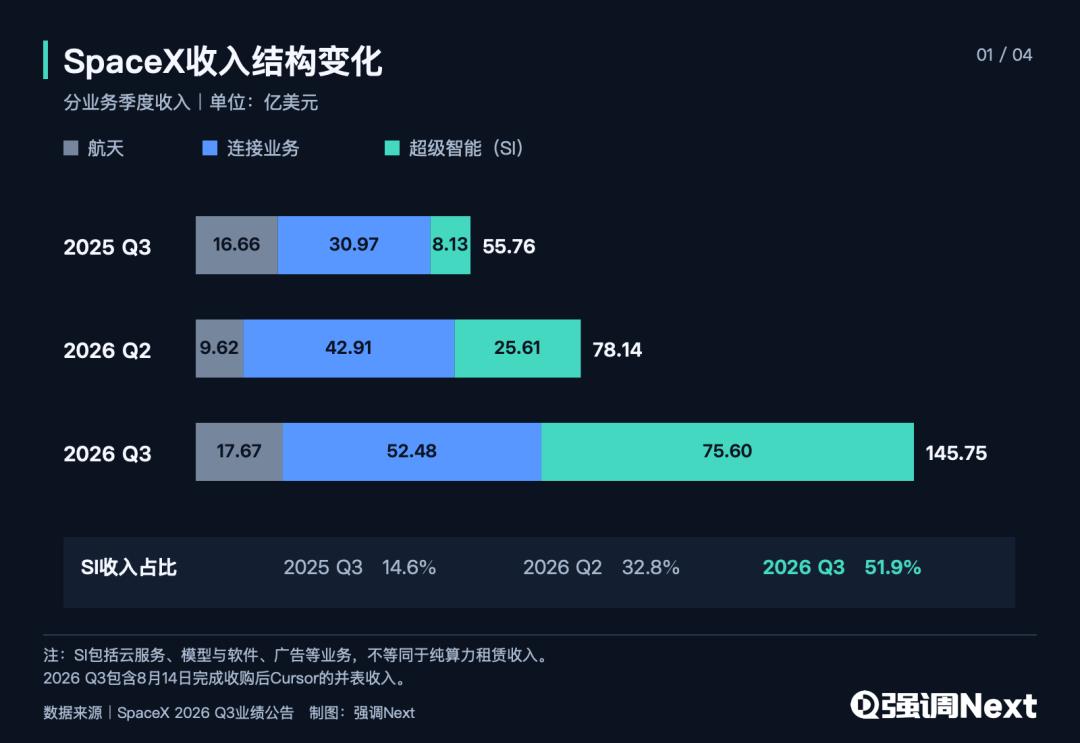
In May this year, Anthropic announced that it would lease all computing power of SpaceX's Colossus 1 data center, with an added capacity of over 300 megawatts, to increase the usage quota for Claude's paid users. Another agreement disclosed in June stipulates that Google will pay 920 million USD per month for computing power starting from October.
As a result, Musk's return on model investment has a path that does not need to wait for Grok to outperform its peers. The stronger the user demand for Claude, the more likely it is to bring computing power revenue to SpaceX. The competition between models can no longer directly determine which of the two companies makes profit and which suffers losses.
This also creates new pressure for cloud vendors. Google has its own cloud business, but it still purchases computing resources from SpaceX. At least during the period of supply shortage, whoever can deliver available computing power on time will have the opportunity to take the revenue. The advantages of long-term customer relationships and software services cannot solve the current capacity gap.
SpaceX's management also explicitly stated that it will compare the returns from in-house model training, in-house product inference and external cloud services to finally decide which party the computing power will be allocated to. This optionality is very important: SpaceX can continue to bet on its own models while gaining returns from the growth of other models.
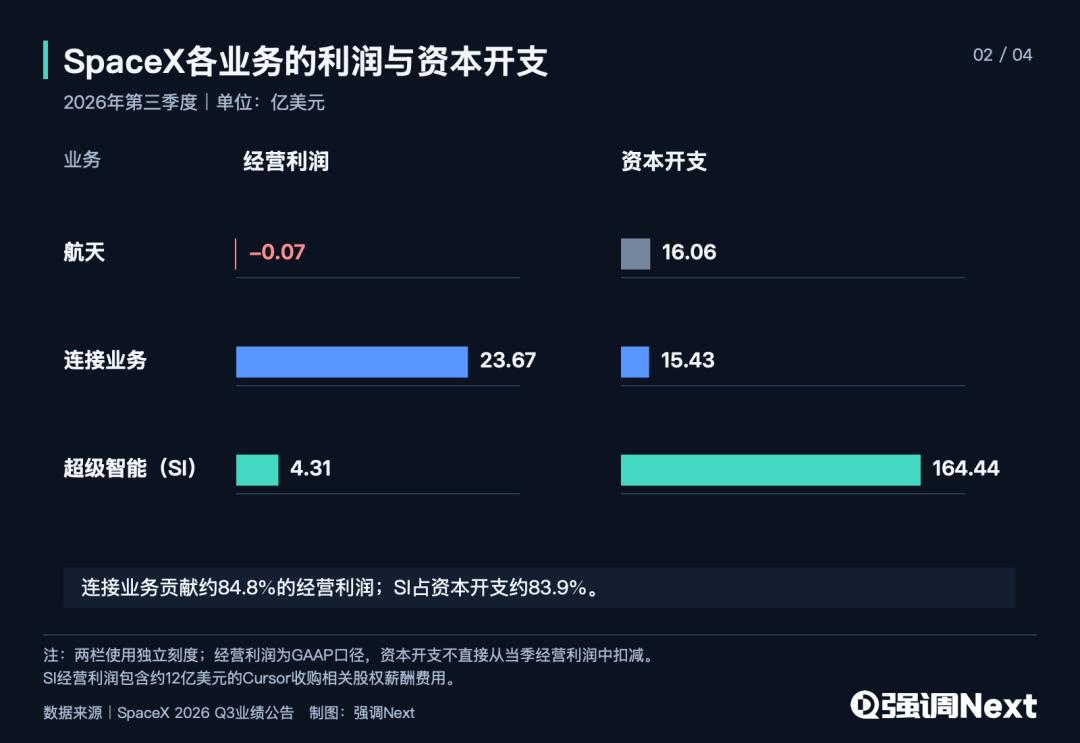
However, this price comes with an expiration date. The agreement between Google and SpaceX allows both parties to terminate the contract with a 90-day advance notice after December 31 this year, and the "payback in less than a year" is also clearly based on the current price. But as long as computing power remains tight, this price will always be on the internal meeting tables of every major tech company.
Free Agents must find revenue sources with higher profit margins than advertising
Roughly converting SpaceX's payback period, it is equivalent to recovering more than double the annual investment. This is the benchmark given by external customers, against which free products like Muse need to be measured.
Meta is therefore in a somewhat awkward position.
Muse was first launched in the US and Canada, and the management admitted that computing power has limited its expansion speed. The company hopes to increase the computing cost efficiency by more than ten times in the coming year, but the financial head also predicted that total service costs will still rise as users increase. While unit costs decline, total expenditures rise: cheaper inference will bring more and more complex tasks that eat up all the cost savings.
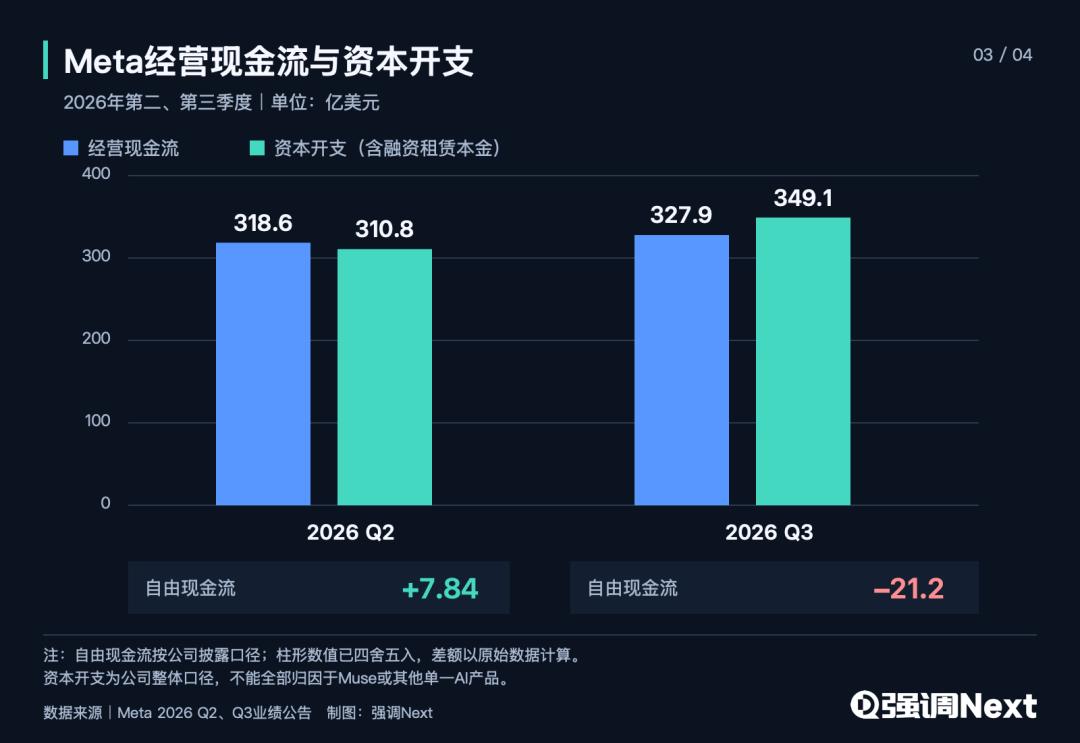
Meta's revenue structure is not easy either. Meta's Q3 revenue reached 64.6 billion USD, up 26% year-on-year, of which ad impressions increased by about 10%, and the average price rose by about 14%. The product of the two figures is basically consistent with the revenue growth rate. Growth still comes from advertising, and AI has not yet appeared significantly on the revenue line. At the same time, the company raised its full-year capital expenditure forecast to 135 billion to 145 billion USD.
Zuckerberg's proposed way out is to charge for transactions. Muse is free for most people, and merchants pay for the transactions facilitated by Muse. Advanced models, extra usage and enterprise functions are available via separate subscriptions. He revealed that shopping is the most common scenario for Muse, more than a quarter of users participate in it, and the average purchase amount exceeds 200 USD.
Whether merchants are willing to pay is the biggest variable of this model. Recommended ads help merchants grab attention, while Agents promise to compare prices for consumers and reduce unnecessary detours. The more effective it is, the harder it is to charge an extra layer of fees to merchants just for "bringing users".
If an order would have been closed through a Meta ad in the first place, and a service fee is added after it is completed by Muse, merchants will most likely deduct the fee from their ad budget. Meta needs to prove that Muse generates incremental transactions, not just renames the existing advertising revenue.
Agents that only have access volume but no payment and performance data cannot gain a foothold in this scenario.
Therefore, large tech companies with massive user bases cannot move users from old products directly to high-cost Agents. Which regions to cover first, which tasks to use more powerful models for, and how much usage to allocate to paid customers will directly affect its expansion speed. Traffic advantage is still useful, but the return on serving this traffic must be recalculated.
The same logic also applies to Agent products such as Qianwen GO and Doubao Shopping.
All monetizable AI products are tied to a specific task
Tesla's comparison is more direct. In Q3, its vehicle deliveries reached 486,500 units, down 2% year-on-year; the active FSD subscription indicator mentioned in the financial report reached 1.74 million, up 67% year-on-year. This indicator includes one-time purchases and monthly subscriptions, excluding free trials, and FSD still requires active driver supervision.
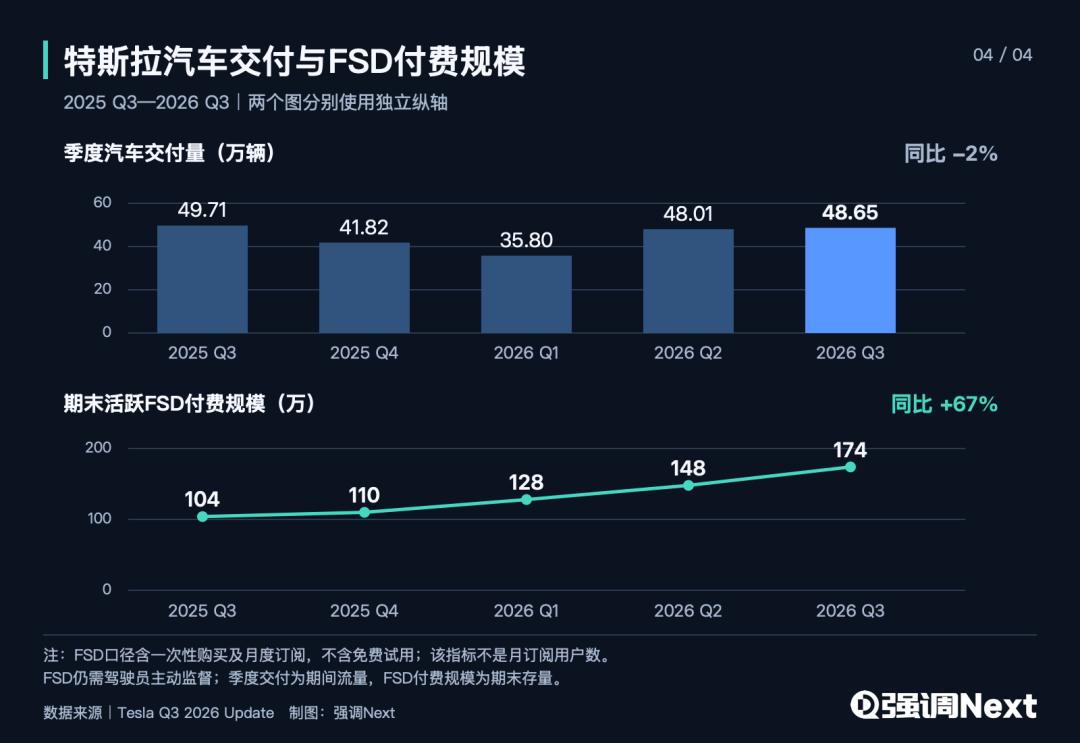
Fewer cars are sold, but more software subscriptions are sold, and the two growth curves have separated. The reason does not lie in grand slogans like "cars are AI portals", but in the fact that FSD corresponds to the clear task of driving, the effect of which users can feel after driving a few times, and users themselves decide whether to pay for it.
This also shows the real situation of Muse. Its most frequently used scenario is shopping, which happens to be a specific task with clear amount and results, and is closer to a monetizable form than general chat. But the fact that FSD users are willing to pay for assisted driving does not mean they are willing to pay for a general-purpose assistant in the car, nor does it infer the profit of Robotaxi. In Q3, Tesla's cumulative unsupervised driving mileage of Robotaxi was close to 2 million miles, about 8 times that at the end of Q2. The increase in mileage indicates that the service is expanding, but whether the fleet is profitable still depends on factors such as fleet operation efficiency, vehicle utilization rate, and cost per kilometer.
Another move Tesla made this quarter is equally critical. It lowered its full-year capital expenditure forecast from more than 25 billion USD to about 20 billion USD, and the free cash flow turned positive to 1.531 billion USD in the current quarter. The improved cash performance comes partly from new businesses, and partly from the changed pace of spending. Therefore, we cannot overestimate the maturity of the software business.
Only functions that are already monetizable are eligible to obtain long-term budgets. Projects further away from monetization require the company to be willing to wait longer. While releasing its financial report, Meta announced the establishment of non-voting Class C shares to add tools for future financing, employee compensation and potential acquisitions. This distribution itself does not bring new cash, but gives Muse a longer waiting period.
When reviewing financial reports, the AI revenue of major tech companies needs to be analyzed separately
Every part of the AI revenue of several major tech companies may be an expense for someone else.
The computing power sold by cloud vendors to model companies is the cost of model companies. The commission charged by Agents to merchants may come from the ad budget squeezed out of merchants. The simultaneous reported growth of multiple companies does not mean that end customers have paid the same amount of extra money.
The major tech companies' own accounting standards also affect the reading of financial data.
Microsoft announced on its July earnings call that starting from fiscal year 2027, the depreciation period for data centers and office buildings will be extended from 15 years to 25 years, and more data center leases will be converted from finance leases to operating leases. Finance leases are counted in capital expenditures, while operating leases are not. After the standard change, Microsoft's capital expenditure forecast for the 2026 calendar year was shown as about 175 billion USD from the original about 190 billion USD. The management emphasized that the investment plan itself has not changed. Roughly calculated based on its disclosed building cost, the depreciation recorded in the profit statement each year may be billions of US dollars less only due to the change of depreciation period.
No less money has been spent, it just looks less painful.
Cash flow is the other side of the picture. According to Google's Q2 financial report calculation, its operating cash flow minus capital expenditure is negative, which is the first time since its listing. Meta also faces the coexistence of rising capital expenditure and cash pressure in Q3. While increasing computing power investment, it is looking for returns for free products, and the cash flow of major tech companies is under pressure from both sides.
Meta is still choosing to increase its options. On September 28, it announced the establishment of Meta Enterprise Platform, which brings Muse, enterprise agents, model APIs and programming tools to enterprises, with CJ Desai, the head of the department, reporting directly to Zuckerberg. This makes paid demands outside consumers start to enter Meta's resource allocation.
This is also the consensus among major tech companies: reduce the dependence of revenue on the success of a single in-house application, and allocate resources to the B-end which is closer to monetization. For example, the competition in domestic AI office scenarios has become white-hot this quarter.
Therefore, for the financial reports of other tech giants to be released one after another later, we can also use these questions to squeeze out the moisture: How much of the AI revenue comes from external customers, and how much is internal transfer? Does the newly added AI revenue squeeze out the original business revenue? After the adjustment of the capital expenditure standard, how much has the real computing power investment increased?
SpaceX has demonstrated the return rate of selling computing power to external customers, Tesla has demonstrated the paid demand for specific tasks, and Meta is trying to turn shopping into the third type of revenue. AI products that are still acquiring free users still owe a key number in their financial reports: how much incremental profit these users leave for the company after using the product.
Note: The data in this article comes from public materials and does not constitute investment advice.
This article is from the WeChat Official Account "Emphasize Next" (ID: leo89203898), Author: Hua Wen, Editor: Xiao Bai, 36Kr is authorized to release this article.