The bosses of AI comic dramas are essentially working for computing power.
There are two types of AI comic drama creators:
One group invests their own money in producing dramas, betting on revenue sharing from platforms. The other takes orders for OEM production, charges production fees by the minute, and the finished works belong to the client party.
These are the only two channels for revenue inflow; for expenditure, the money is spent on labor, computing power, and paid traffic acquisition and promotion.
Strangely enough, even though production costs have dropped by 90%, drama producers do not feel more financially well-off. Where on earth has all the saved money gone?
……
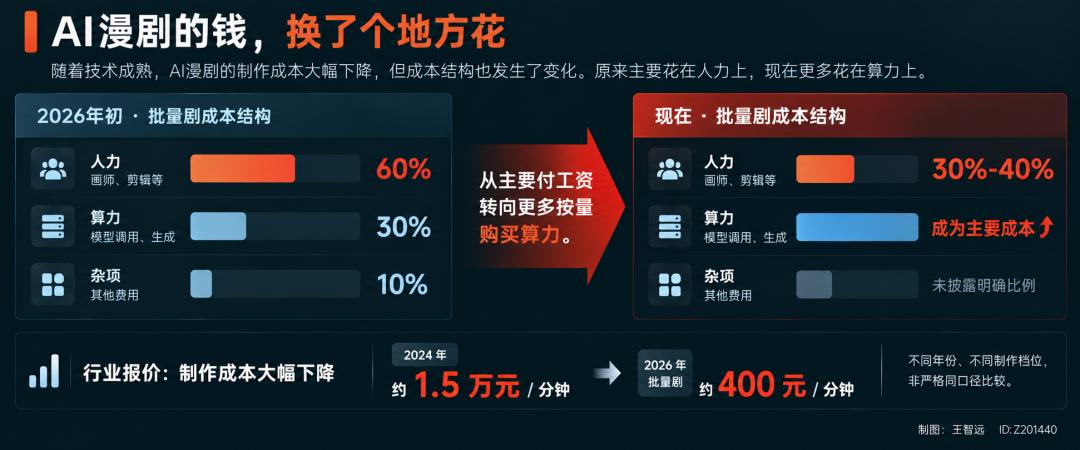
According to the industry quotation, producing an AI comic drama in 2024 cost 15,000 yuan per minute; in 2025, the total cost of a single work dropped to 100,000 yuan, equivalent to 1,000 yuan per minute.
The price reduction has not stopped. Huang Haonan, founder of Soyu Culture, said in October:
The unit price of mass-produced dramas is only 400 yuan per minute, and the total cost of a 100-minute work is less than 40,000 yuan. High-quality works are more expensive, with the unit price still around 1,000 yuan per minute.
Different tiers have different accounting standards. Using the quotation of mass-produced dramas to evaluate high-quality works, or vice versa, will easily lead to overstatement. However, the saved money does not all stay in the hands of drama producers, and part of it is paid in other links.
At the beginning of this year, the proportion of labor, computing power and miscellaneous expenses in mass-produced dramas was 6:3:1. Up to now, labor only accounts for 30% to 40%, while computing power has become the largest expenditure.
Theoretically, as technology matures, computing power should become cheaper and cheaper.
In April 2026, some cloud services raised their prices instead. Notices were issued in March and the price adjustment took effect in April; the price of computing power cards rose by up to 34%, storage by 30%, and the input price of some Tencent Hunyuan models rose by 463%.
These price increases are not calculated under the same caliber and cannot be summed up. However, no matter which of computing power cards, storage or model interfaces raises the price, drama producers have to recalculate their accounts.
Especially for small teams with little bargaining power, they can only accept the new price list modified by suppliers.
There is another sum of money that people outside this industry may not expect: AI generation is like a gacha draw.
I found a production review note, which mentioned that a final work used 95 storyboard pictures selected from 1700 generated pictures, with a screening ratio of nearly 18 to 1.
The characters and scenes must be consistent throughout the work. The same character face may look normal in one frame but completely different in the next. To avoid distortion, it is not unusual to generate dozens of iterations repeatedly.
In the end, only one picture is used in the finished work, and the computing power fee for the previous dozens of discarded pictures still needs to be paid. Those discarded pictures are not cheap at all, they are just not edited into the official content.
When these two facts are combined, the cost accounting becomes completely different.
In the past, when producing animations, most of the money was spent on personnel. The salaries of painters, colorists, frame interpolators and editors were all fixed expenditures. The salary cost is relatively stable, and the unit cost can be further reduced when the output increases.
Now that labor costs are saved, part of the money originally used to pay salaries has been turned into expenditure on computing power procurement. The computing power bill goes with the output, and you have to pay for each generation.
Although both are costs, their natures are different. Salaries are relatively fixed, while computing power is charged by usage. Large-scale teams can get lower unit prices, but small teams do not have such conditions.
Labor cost can be saved, but the purchase of computing power can only follow the price list. The production threshold has indeed been lowered, but the dependence on upstream computing power has deepened instead.
Let's look at the accounting of an individual creator.
One interviewed creator calculated that the cost of computing power plus discarded frames is 1 yuan per second, and the editing cost is 0.7 yuan per second, and the maximum output of finished content per day is 5 minutes.
To update 5 minutes of content per day, the cost of computing power and editing is about 510 yuan. However, a work with 60,000 views only generates a revenue of 45 yuan. No matter how low the production cost is, it cannot support such a cost structure.
Of course, this individual case cannot represent the whole industry, but this accounting at least shows that lower costs do not mean higher profits.
The cost side is roughly clear. The more rigid account is on the platform side.
……
What exactly are platforms buying? I break it down into three points.
First, what is the settlement standard of platforms.
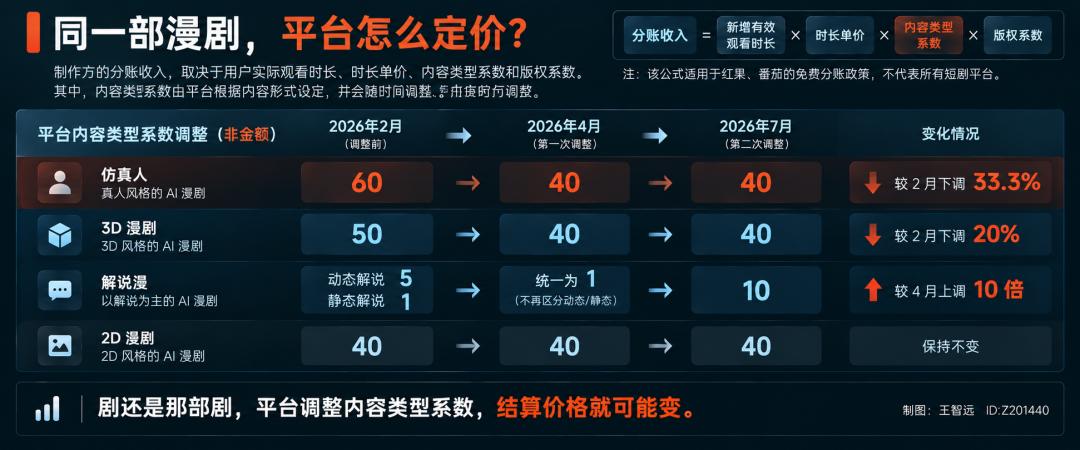
The Short Drama Copyright Center of Douyin Group stipulates that the free revenue sharing rules of Hongguo and Fanqie are based on the actual viewing duration of users. The algorithm is not complicated, which is the product of four values:
Newly added effective viewing duration in the current month, unit price of duration, content type coefficient, and copyright coefficient.
If users click in and leave after a few seconds, drama producers cannot get any revenue. This set of rules only applies to these two products, and the main Douyin app has another independent algorithm.
As you can see, what the production party submits is a complete drama, but what the platform actually buys is the time that users are willing to spend on this drama.
Second, who decides the value of this period of time? The platform holds three adjustment knobs: duration unit price, content type coefficient, and copyright coefficient.
Let's look at the content type first:
In February 2026, the coefficient of hyper-realistic human works was 60, 3D works was 50, 2D works was 40, emoji works was 10, dynamic commentary works was 5, and static commentary works was 1.
In April, the coefficient of hyper-realistic human works was reduced from 60 to 40, 3D works from 50 to 40, and the commentary comic works no longer distinguish between dynamic and static, and the coefficient was uniformly reduced to 1. The coefficients of other categories remained unchanged.
In just two months, the coefficient of hyper-realistic human works dropped by one third, 3D works by 20%, and commentary works even dropped by 80%.
In July, the platform made another adjustment. The coefficients of hyper-realistic human works, 3D works and 2D works remained at 40, the coefficient of commentary comic works was adjusted from 1 to 10, and cash rewards ranging from 10,000 yuan to 200,000 yuan were issued to dramas on Hongguo with a popularity of over 50 million.
The coefficient can be reduced or increased, and the platform has the final say on the direction of adjustment.
How much money drama producers can get depends not only on whether the audience likes the work, but also on which type of content the platform is willing to pay more for; the copyright coefficient is more straightforward, the full copyright coefficient is 2, and the non-full copyright coefficient is 1. For the same viewing duration, the revenue may differ by half.
As for the unit price of viewing duration, the platform does not make it public.
Drama producers cannot even calculate how much they can share for one hour of user viewing, let alone negotiate prices; as long as the platform adjusts the coefficient, the revenue will change accordingly. The drama remains the same, the audience has not changed, but the settlement price has changed.
Third, when the number of works keeps increasing, what will happen to the price?
According to statistics from DataEye Research Institute, in the first half of 2026, 221,900 new AI dramas and comic dramas were launched on the Douyin platform, of which only 1055 had more than 100 million views, accounting for 0.48%.
With more and more works, platforms no longer lack content, but lack users who are willing to spend time watching.
Practitioners reflect that the money that drama producers can get is getting less and less. Around 2024, 10,000 views could generate a revenue of about 100 yuan, then it dropped to 50 yuan and 30 yuan. In 2026, many projects only get 5 to 10 yuan for 10,000 views.
Some creators shared their backend data that a work with 180 million views settled for 180,000 yuan. On average, only 10 yuan can be earned for 10,000 views; this is only the revenue calculated backwards from the view count, and the platform does not settle accounts directly based on view count.
The more troublesome thing is that the completion of the work does not mean that someone will watch it.
To be seen by more people, you have to pay for traffic by yourself. There is a saying in the industry that for every 100 yuan of revenue, about 70 yuan is spent on promotion, and the production party gets less than 10 yuan in hand.
Placement monitoring data shows that the daily investment of AI short dramas on Douyin ranges from 150 million yuan to 170 million yuan. The more money is spent, the more intense the competition for users' attention becomes.
Taking OEM production orders is not easy either. According to the quotation of practitioners, the unit price was up to 1500 yuan per minute at the peak, but now it has been compressed to 600 to 800 yuan, and the final payment may not be settled on time.
Therefore, the interesting part of this business lies here.
The computing power price that the production party pays for is set by the upstream; the revenue from selling content is calculated according to the platform's rules; to get more people to see the work, they have to spend money to bid for traffic.
The platform does not need to pay for how much the production party has spent, it only focuses on how many audiences the content can retain. Everyone wants to compete for audiences, and the traffic cost remains high.
Revenue sharing means the platform pays money to the production party, while traffic investment means the production party pays money to the platform. After the money flows back and forth, the production party may not keep much profit.
……
Then who makes money in this whole industrial chain? I divide the accounts of this industry into four categories: content account, platform account, IP account, and computing power account.
For OEM orders, the unit price of ordinary comic dramas ranges from 500 to 800 yuan per minute, high-quality CG works can be quoted at 2000 yuan per minute, and S-level works can reach more than 10,000 yuan per minute. As long as you can get stable orders and deliver on time, the revenue is relatively easy to calculate.
If you invest your own money to produce dramas, you have to bet on the platform's revenue sharing.
Tencent disclosed in June 2026 that some comic dramas have a single-part revenue share of more than 20 million yuan, with a cost of about 400,000 yuan. However, the title of the drama and the detailed settlement data have not been released to the public.
It is a sample used by the platform for investment promotion, which proves that the upper limit of revenue exists, but does not indicate where the median revenue is; on the other hand, someone spent 13,000 yuan to produce 30 episodes, but only got 5 yuan for 10,000 views.
In the same industry, there are hits on one end and a large number of obscure works on the other; 0.48% is not the profit probability, but the proportion of works with more than 100 million views. But at least it can show how many works can really stand out.
The difficulty of the content account is that neither end is controlled by the producers themselves. Hits can make a lot of money, but most works do not have such luck.
Let's look at the platform account next.
The scale of Hongguo is very large. Third-party data shows that as of July 2026, its daily active users reached 168 million, more than doubling year on year; its revenue in 2025 exceeded 15 billion yuan, and this figure has not been officially confirmed.
But platforms are not making money effortlessly.
Kunlun Tech's 2026 semi-annual report shows that the revenue of its AI short drama sector in the first half of the year was 1.535 billion yuan, a year-on-year increase of 163%; the cost was 499 million yuan, an increase of 406%, and the gross profit margin of the sector dropped to 67.49%.
In the same period, the company's sales expenses were 3.34 billion yuan, and its operating cash flow was negative 467 million yuan. These two figures are the overall data of the company, and cannot be entirely attributed to the AI short drama business.
Platforms also need to spend money to compete for users, but compared with production parties, they have more say in deciding the settlement price of content.
In October, WeChat's Lv Paopao Short Drama launched an incentive plan that offers up to 100% revenue reward for high-quality new dramas. Producers got a second quotation outside Hongguo for the first time, although this quotation is supported by subsidies.
Having one more buyer is a good thing. Whether the quotation can be sustained depends on how long the subsidy can last and whether the producer has another high-quality drama in hand.
Not only WeChat is increasing investment, the premium AI drama incentive of Volcano Engine offers a maximum reward of 200,000 yuan per single work, requiring all works to use Seedance and the 2.5D proportion exceeds half; Hongguo also provided 3 million yuan as minimum guarantee subsidy, with the first prize of 1 million yuan.
The conditions are getting stricter, including model requirements, popularity thresholds, and duration standards. Any unqualified item will lead to a downgrade of the work. The subsidy is used to purchase high-quality works, not to cover losses for assembly-line low-quality productions.
The third account is the IP account.
A good story will not become worthless just because AI can generate images; China Literature's 2026 mid-term performance shows that its copyright operation revenue in the first half of the year was 1.614 billion yuan, a year-on-year increase of 41.9%; the revenue from short dramas and AI comic dramas exceeded 430 million yuan, a year-on-year increase of 2.3 times.
However, the net profit attributable to shareholders of the parent company was only 135 million yuan, a year-on-year decrease of 84.1%.
This decline needs to be explained clearly. There was a gain from the sale of invested companies in the same period of last year, which raised the comparison base; this year, it was affected by supplementary tax payment and late payment surcharge, so the decline