Amer Sports' 100 Billion Ambition
Recently, a board of directors personnel adjustment announcement from Amer Sports has drawn widespread industry attention — The board has appointed Ding Shaoxiang as the new director, and the appointment takes effect immediately.
Judging from personnel relations and resumes, Ding Shaoxiang is the son of Ding Shizhong, Chairman of the Board of Directors of ANTA Group, currently serves as the Chairman of Descente China, and has also taken charge of MAIA ACTIVE since January this year.
As one of the core members of ANTA's next-generation successors, from accumulating front-line experience in various core positions of the Descente brand, to being promoted to Chairman of Descente China to lead strategic development, to concurrently managing MAIA ACTIVE to adapt to multi-brand management, and then serving as a director at Amer Sports which owns numerous leading brands, ANTA Group's cultivation of Ding Shaoxiang can be described as methodical.
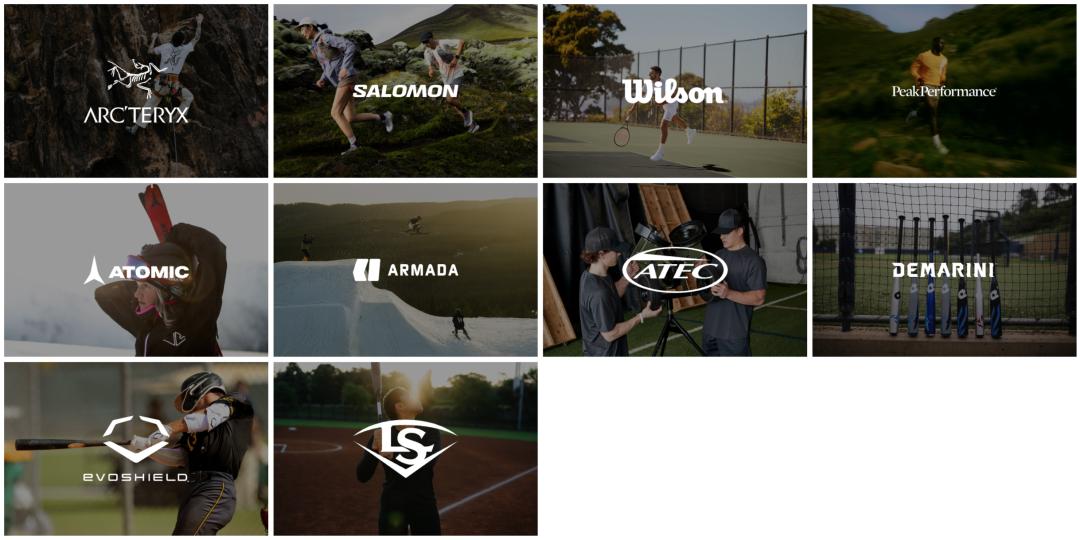
Brands under Amer Sports
Moreover, if we look through the development context of Amer Sports (hereinafter referred to as "Amer") after it was merged into the ANTA system, the time node when this personnel change occurs is also very deliberate: The current moment is an important node for Amer to move towards a new stage of high-quality growth in the future.
In 2019, when ANTA acquired Amer, it put forward the "Five 1 Billion Euros" plan to be completed by 2025, which was to build Arc'teryx, Salomon and Wilson into "1 billion euro" brands respectively; the Chinese market of Amer and the direct-to-consumer model also achieved 1 billion euros in revenue respectively.
In the end, this plan was completed ahead of schedule in the fifth year; in the same year, Amer also achieved two major achievements of turning losses into profits and going public.
Looking back at the previous journey, Amer's path can be described as smooth and promising. But after entering the secondary market, the brand is like being placed under a magnifying glass, and every move attracts much attention. The five-year plan can no longer be summarized in two simple sentences, but is split into more detailed parts.
We noticed that on the basis of financial reports, in the past two years, Amer has also shared the current situation and prospects of Arc'teryx and Salomon in depth through two investor events, coupled with the continuously revised long-term financial goals, its blueprint for the next five years is gradually emerging.
01
The $14 Billion Ambition
Let's look at a picture first:
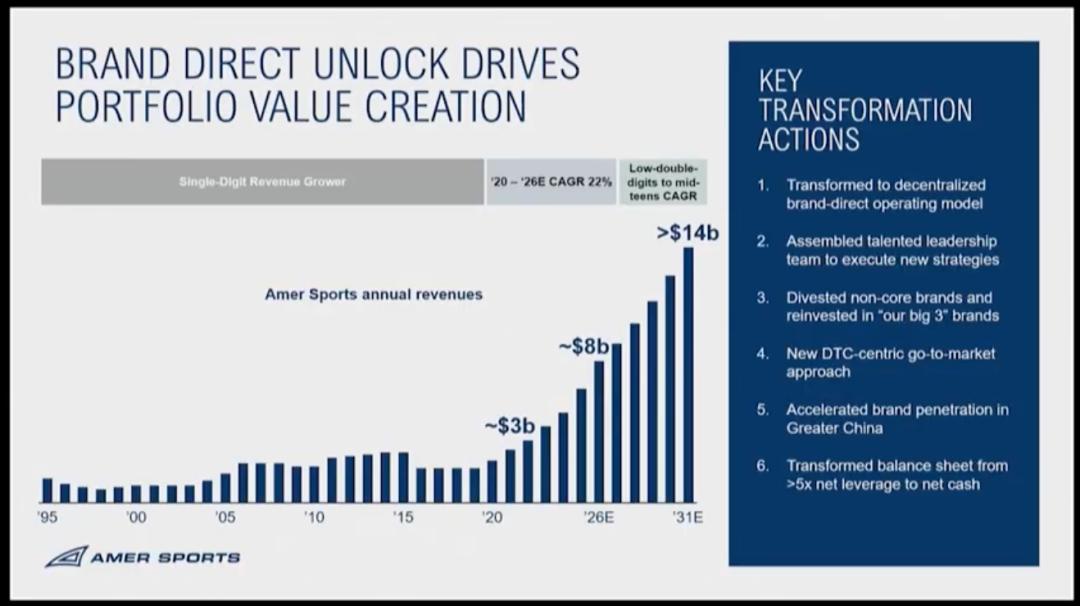
Picture sourced from Amer Sports Investor Day event
A very intuitive data can be seen in the figure: In 2026, Amer is expected to achieve revenue of 8 billion US dollars, and by 2031, five years later, the target revenue will exceed 14 billion US dollars.
What is the concept of 14 billion US dollars? If calculated based on 2020, one year after ANTA Group completed the acquisition, this figure is nearly 6 times the revenue of that year; even compared to 2025 after rapid development, the scale has more than doubled.
And if compared with other groups, it is approximately equal to the sum of the annual revenues of VF Corporation (which owns brands such as The North Face and Vans) and Deckers (which owns brands such as HOKA and UGG) — against the general backdrop of economic downturn, the establishment of this goal is quite courageous to go against the trend, and even makes many people feel exaggerated.
But if we split Amer into each of its brands, it does not seem impossible.
From 2022 to 2026, Amer's annual compound growth rate is as high as 22%, and it is expected to be only low-to-mid double digits in the next five years. That is to say, as the overall size of the market increases, the brand will gradually enter a mature period. Under such a general background, to truly achieve the 14 billion US dollar target, the full cooperation of all brands and all functions within the group is required.
Arc'teryx, Salomon and Wilson will continue to be Amer's core brands, and the first two of them will act as "cash cows" — it should be noted that Arc'teryx and Salomon only passed the 2 billion US dollar threshold respectively in the past two years, and their revenue this year is expected to reach 3 billion US dollars and 2.5 billion US dollars respectively.
Especially since the second half of last year, investors' attention has gradually shifted from Arc'teryx to Salomon, which has a faster growth rate, to help the latter further achieve a big leap in revenue. Zheng Jie, CEO of Amer Sports Group, introduced that in China alone, Salomon will soon reach a sales scale of 1 billion US dollars.
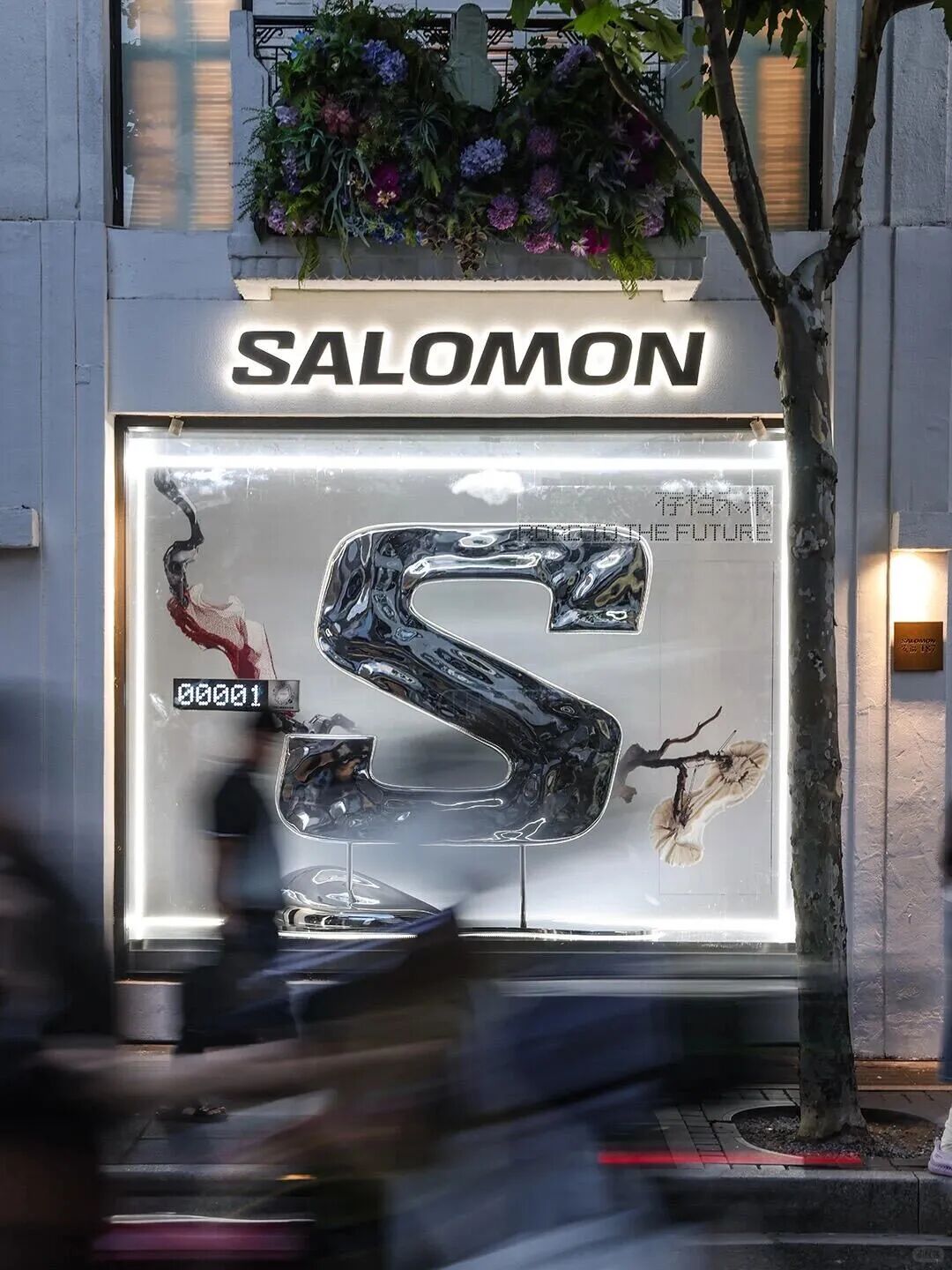
Source: SALOMON Salomon
In the future, both Arc'teryx and Salomon will have a mid-double-digit annual compound growth rate. Wilson does not disclose the brand growth rate separately, but data shows that its ball sports and equipment segment can also achieve a mid-to-high single-digit growth.
All these data can at least lead to two inferences:
First, in line with the overall pace of the group, the two most core brands of Amer are likely to drop from the year-on-year growth rate of 30% or 40% that they used to achieve frequently, and return to a more mature and stable growth;
Second, converting the growth rate into actual revenue, the next five years may "nurture" two brands with a scale of 5 billion US dollars.
Last year, Stuart Haselden, CEO of Arc'teryx, put forward the goal of "expanding the brand's revenue to 5 billion US dollars by 2030" at the Investor Day event, and according to Salomon's expected growth rate, it will also reach around 5 billion US dollars in five years.
In addition, Amer is confident to continue to improve the operating profit margin of its brands, and the profitability of Arc'teryx and Salomon is still in a rising period. 14 billion US dollars may really not be a random fantasy.
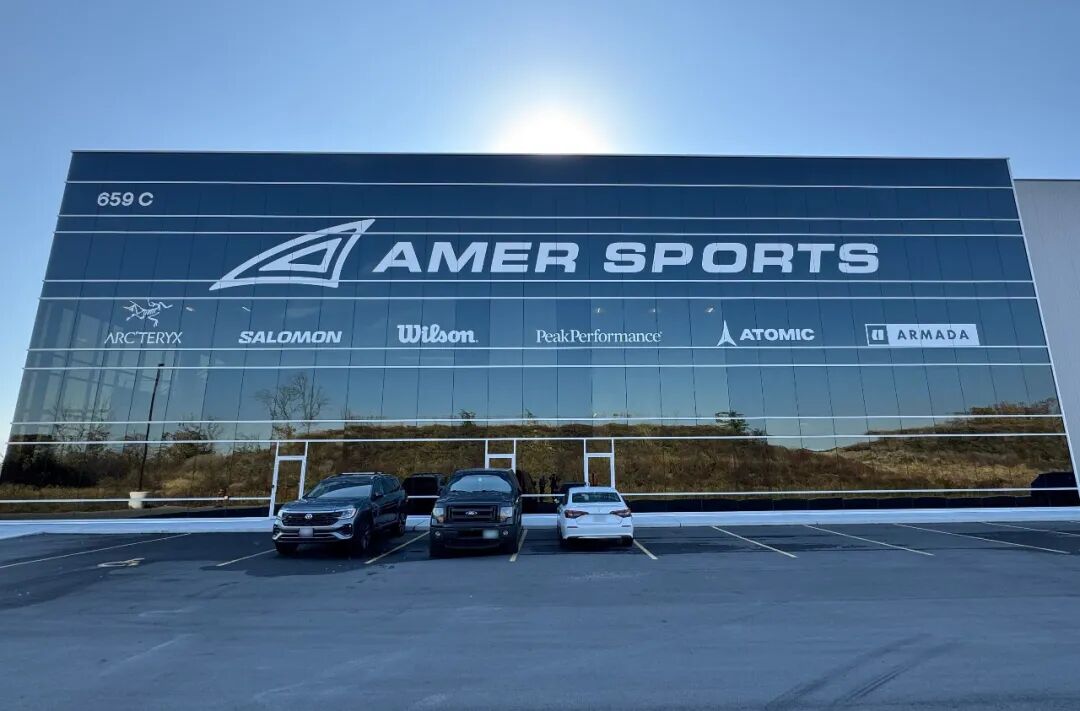
Source: Amer Sports
Back in 2021, on the 30th anniversary of ANTA, Ding Shizhong, Chairman of the Board of Directors of ANTA Group, put forward a rather aggressive "double 100 billion" goal, that is, both ANTA Group and Amer Sports Group should achieve a scale of 100 billion yuan.
After Amer was successfully listed, Lai Shixian, Co-CEO of ANTA Group, recalled to *China Entrepreneur* that many of ANTA's goals seemed "very large" to him, but the results often exceeded the expectations of this rationalist, "Unconsciously, the bragging we made has really come true."
In this light, the realization of Ding Shizhong's "double 100 billion" plan may only be a matter of time.
After all, up to now, no one will doubt the business ability of the ANTA system anymore. And this art of doing business will also be presented in the future operation of several core brands of Amer.
02
The Partial Subject Specialist Seeks Balance
The realization of financial goals ultimately falls on the operation of specific brands.
In the past 5 years, Arc'teryx and Salomon have proved their product strength and commercial operation capabilities, and have taken advantage of the outdoor trend to break through from niche circles to mass consumers. But entering the next stage, as a brand worth 3 billion or 5 billion US dollars, the original strategies have parts worth continuing, and there is also a need for re-calibration.
The parts worth continuing are naturally the unique charm that the brand is proud of, and also the most profitable "killer weapon". For example, Salomon, which exists as a professional outdoor brand, attaches increasing importance to sports fashion.
At the Investor Day, many executives repeatedly emphasized that the Sportstyle series is a sharp tool for the brand to release huge potential, especially to help the brand expand the group of young female consumers. Sportstyle footwear contributes 40% of the brand's revenue, and high-performance footwear accounts for 30%. In the future, the Sportstyle series will still be one of Salomon's business priorities and main sources of profit.
As for Arc'teryx, its advantage lies in its unique market positioning.
"We cover at least three different market segments: we are in a leading position in the outdoor products market; we have won market share in the high-end and luxury outerwear market; and we have occupied the vast sportswear and footwear market in a brand new way. At present, we have not found direct competitors for Arc'teryx," Stuart Haselden said.
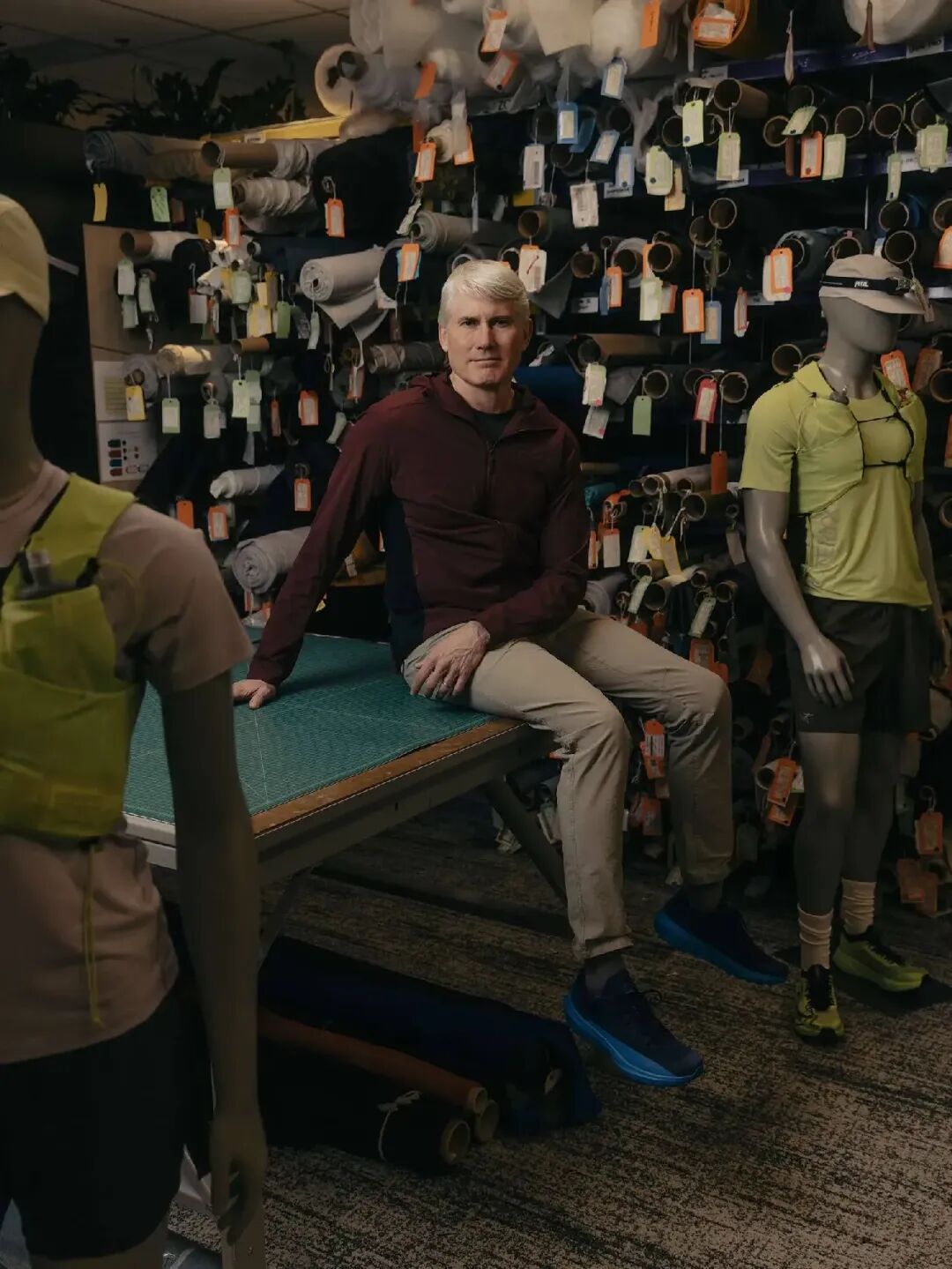
Stuart Haselden
Apart from continuation, some changes are taking place. The most obvious one is that the brand CEOs of Arc'teryx and Salomon have repeatedly emphasized "balance", and this pursuit of balance is especially reflected in products and market expansion.
The two partial subject specialists have been "making up lessons" in terms of products in the past two years.
As a brand dominated by male consumers and clothing, Arc'teryx began to increase investment in footwear products and women's series as early as 2024. Salomon is just the opposite: the player that focuses on footwear has launched more and more clothing series, and for footwear, it has expanded more running scenarios on the basis of trail running.
This change in product strategy is not so much a choice of the brand itself, but rather a path that sports brands naturally have to go through at different stages.
For example, when the Salomon brand was restarted in 2021, the revenue of footwear and clothing was almost 50/50, but the internal decision was made to "focus on footwear in the next three years". Facts have proved that this positioning and product precision and segmentation make it easier for the brand to find its position in the market and occupy the minds of consumers.
Now, under the situation that footwear products are generally facing stagnant growth, it is not difficult to understand that Salomon chooses to re-focus on the clothing category with higher profit margins. In the next five years, the annual compound growth rate of Salomon's clothing and luggage products will reach just over 20%, which is higher than the mid-to-high double-digit growth of footwear products. But due to the large base, the contribution of footwear will still be as high as 70%.

Source: SALOMON Salomon
In fact, as early as the previous ANTA financial report meeting, Zheng Jie had already stated that whether it is Arc'teryx or Salomon, they will eventually move towards becoming a comprehensive brand.
This year, the appointment of brand heads in the Greater China region also reflects the same logic — letting Yi Yi, the former head of Salomon Greater China, make up for Arc'teryx's shortcomings, and Du Wenjun, the former Vice President of Product for Nike Greater China who comes from a comprehensive brand, join Salomon.
The trend that partial subject specialists move towards balance through "making up lessons" and professional brands move towards comprehensive brands will become more and more obvious in the next five years.
03
Growth Slows Down in the Chinese Market,
North America Gains More Attention
In addition to products, the "balance" emphasized by Arc'teryx and Salomon is also reflected in market expansion. This brings us to the issue we are most concerned about: can the Chinese market maintain its current growth rate in the future?
The data has already told us the answer:
- For Salomon, previously EMEA (Europe, Middle East and Africa) and Greater China had the highest growth rates, reaching 40% and 30% respectively, while Asia Pacific and North America were around 15%.
But by 2031, the region with the strongest brand growth is expected to be North America, with an annual compound growth rate of just over 20%; the annual compound growth rate of Greater China and Asia Pacific is expected to be high double digits; while the annual compound growth rate of EMEA, the home base, is the lowest, expected to be only low double digits. That is to say, the high and low momentum is completely reversed.
- Greater China is even more important to Arc'teryx. The 2025 financial report data shows that Greater China contributes 44% of revenue, followed by the United States, accounting for 32%. In the past five years, the annual compound growth rate of Greater China was as high as 48%, far higher than the global 30%.
However, in the five years from 2025 to 2030, Greater China is expected to only maintain a low double-digit annual compound growth rate. "We expect the growth rate of the Chinese market to slow down in the next few years, the regional pattern between China and North America will be more balanced, and by 2030, the business scale of these two regions will be roughly equivalent," Stuart Haselden introduced.
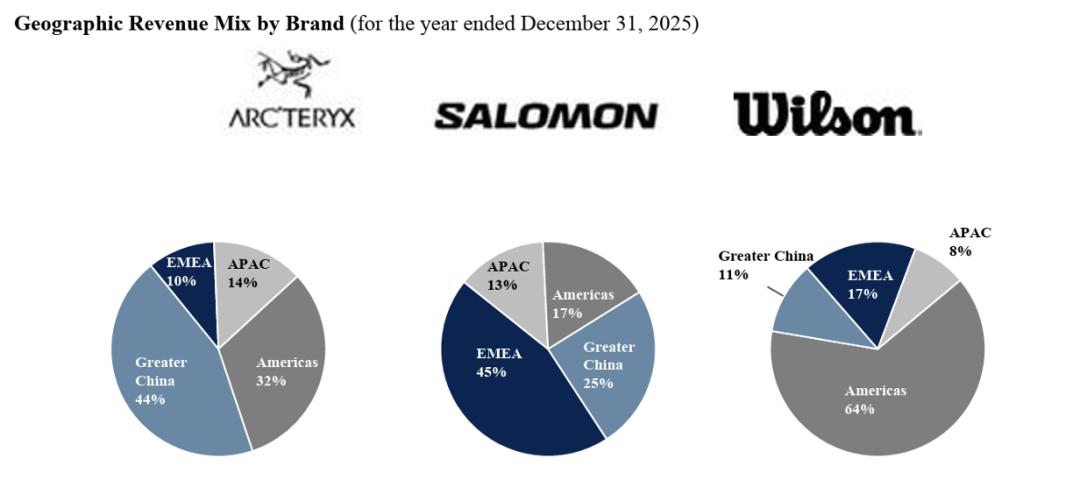
Source: Amer Sports financial report
From the perspective of the market environment, Arc'teryx and Salomon's emphasis