AI entertainers are debuting in droves, but very few of them are actually making money?
AI entertainers haven't figured out how to make stable profits yet, but they have already learned to "leave the group".
In mid-October, virtual girl group BABYQUEEN announced that member Mity would suspend activities due to "pregnancy", which once sparked heated discussions. Later, the creator admitted that this was just a fictional exit reason: operating multiple AI characters at the same time was too much of a workload to handle. The attempt by several enthusiasts accidentally broke a misconception: AI can easily generate entertainers, but it may not be easy to operate them properly.
At almost the same time, Mango TV officially announced five original AI entertainers: Cheng Du, Fang Yu, Lin Enna, Qi Xu and Zhan Yan, and launched the show *Amazing, My Friend* starring "them". Complete with independent character settings, social accounts, real-life screenwriters and talent management teams, the platform is trying to operate AI characters as long-term entertainer assets.

In recent years, from virtual idols such as Hatsune Miku that grew up relying on user-created content ecosystems, to AI-native entertainers such as Yuri whose image and content creation are partially supported by generative AI, and then to AI actors such as Fang Taozi who emerged from AI short dramas, AI entertainers have gradually explored different development paths.
Where are domestic AI entertainers now? Can they convert traffic into real commercial value?
01
AI Entertainers: Where Are They Now?
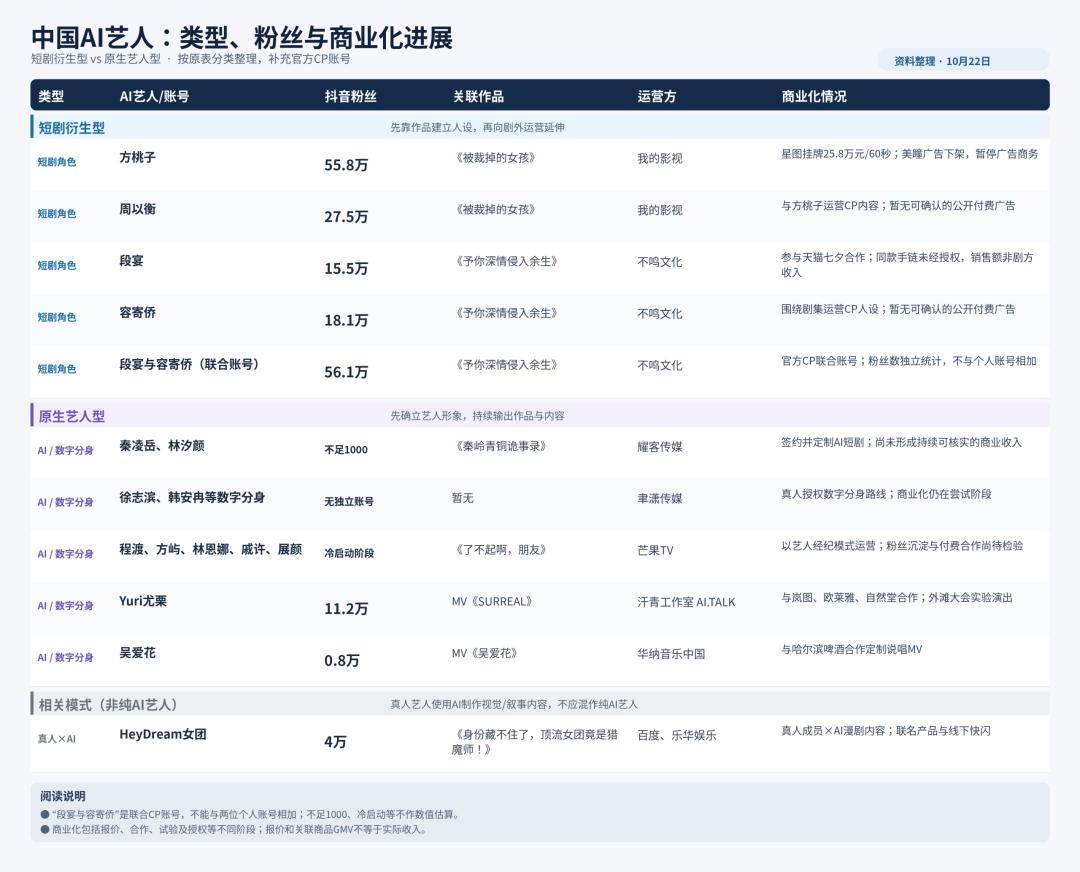
According to their creation paths, current domestic AI entertainers can be roughly divided into two categories: short drama-derived type and original entertainer type.
The former builds public recognition of the characters through AI short dramas, and then sustains popularity through independent accounts, off-drama content and character interactions; the latter is built as an independent entertainer from the very beginning, and gradually builds public recognition through continuous content creation and character management.
Both draw on the methods of traditional talent management, but they have different starting points.
At present, the model of "making the drama popular first, then making the character popular", which is similar to that of long-form TV series, is still easier to generate public attention.
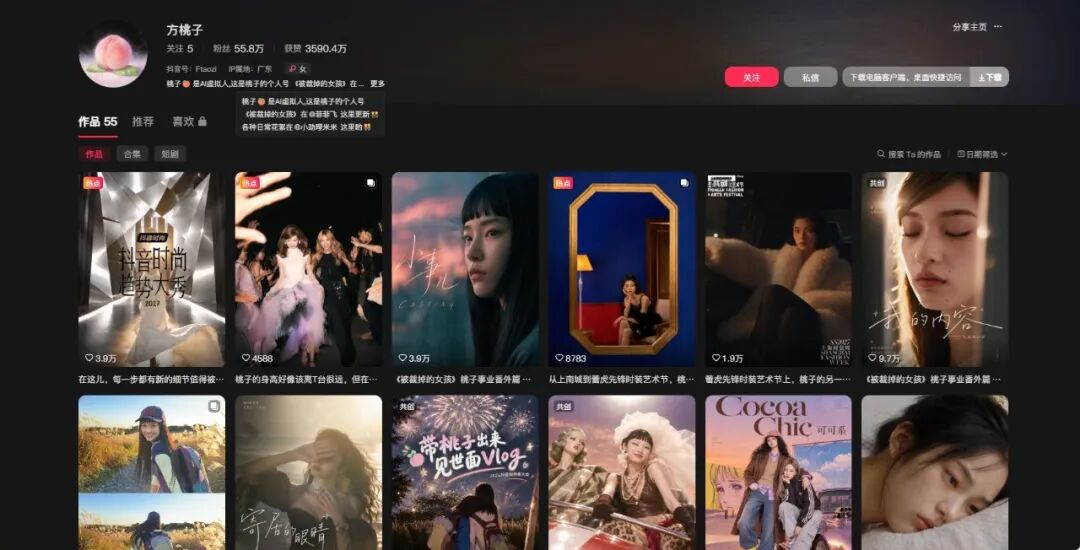
In June this year, the AI short drama *The Laid-off Girl* became a hit on Douyin, and the female lead Fang Taozi quickly became widely known. She promptly opened a personal account to continuously update content about daily life and fashion, extending her character setting beyond the drama. In less than two months, she gained 400,000 Douyin followers and successfully realized commercial monetization.
It is reported that the quotation for a single commercial post on Fang Taozi's official Douyin account once reached 258,000 yuan per 60 seconds, which is on a par with real-life internet influencers with millions or tens of millions of followers. As of October 22, she has accumulated 558,000 followers and a total of 35.9 million likes, becoming one of the most representative cases of domestic AI entertainers.
At the same time, the male lead Zhou Yiheng in the same drama also opened a personal account to update daily life content such as cooking and fitness, as well as side stories of *The Laid-off Girl*. He currently has 275,000 followers in total. Although there is no clear commercialization trend yet, the two continue to operate their CP relationship through joint vlogs and account interactions, which in turn drives traffic to the drama and provides space for subsequent content expansion.
Similar operation methods are very common among AI entertainers. Taking Duan Yan and Rong Jiqiao in the AI short drama *Give You Deep Affection for the Rest of My Life* as an example, the two not only opened personal accounts, but also set up a couple account to continuously update CP-oriented content, new drama launch information and behind-the-scenes footage. However, compared with Fang Taozi, the two are between AI characters and independent AI entertainers, and are more closely bound to the drama. The resulting consumption such as the same style of bracelets is also closer to film and television IP derivatives.
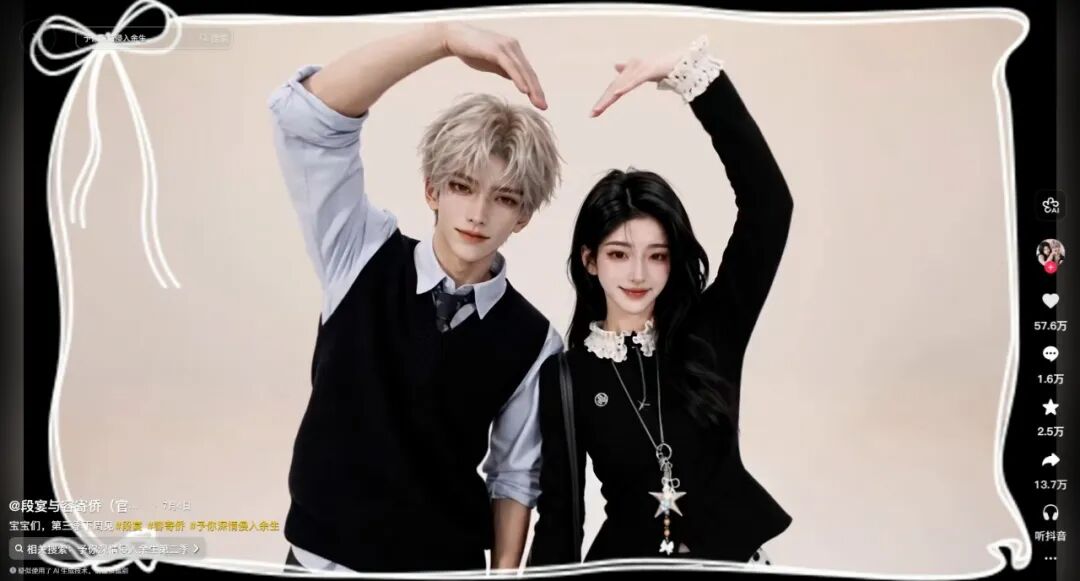
This type of AI entertainer usually still highly depends on the original work. Once the popularity of the drama fades, it is still unknown whether the account can grow independently.
If the short drama-derived type follows a relatively mature operation logic and is easier to win the favor of the audience, then the original entertainer type attracts more attention from the industry, behind which is the exploration of the future business model of AI entertainers. For this reason, many platforms and film and television companies have entered the market one after another, trying to seize the opportunity.
In March this year, Shanghai Youhug Media took the lead in announcing the signing of AI entertainers Qin Lingyue and Lin Xiyan, and customized the AI short drama *Mysteries of Qinling Bronze Relics* for the two. But different from the logic of "the drama drives the popularity of the characters", this path seems somewhat inverted. Worse still, the previous discussions about the two AI entertainers focused on negative content such as which real entertainer their faces resembled and portrait right infringement, and there was no popularity left when the drama was launched.
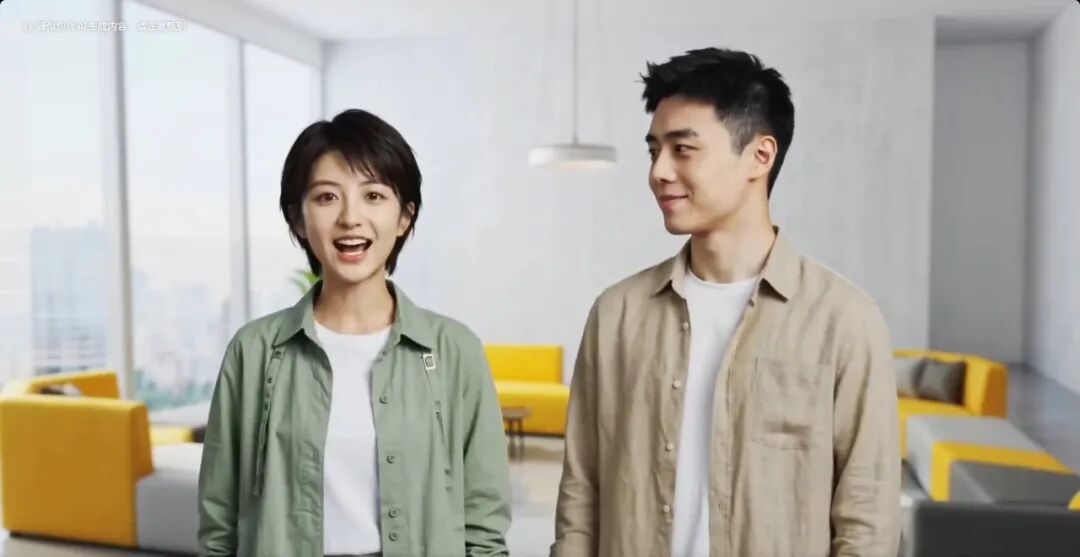
In addition, there is the "real-life digital avatar" route of Yuxiao Media. Unlike Youhug Media which builds original AI entertainers from scratch, the six AI actors it announced are all modeled based on real people with their authorization, including internet influencers such as Xu Zhibin and Han Anran. However, this attempt still caused public controversy, failed to form continuous popularity, and the supporting AI short drama also had no follow-up.
It can be seen that launching AI entertainers without mature works still faces great market risks.
Compared with AI actors, AI singers and AI idols may be more suitable for the development path of original entertainers.
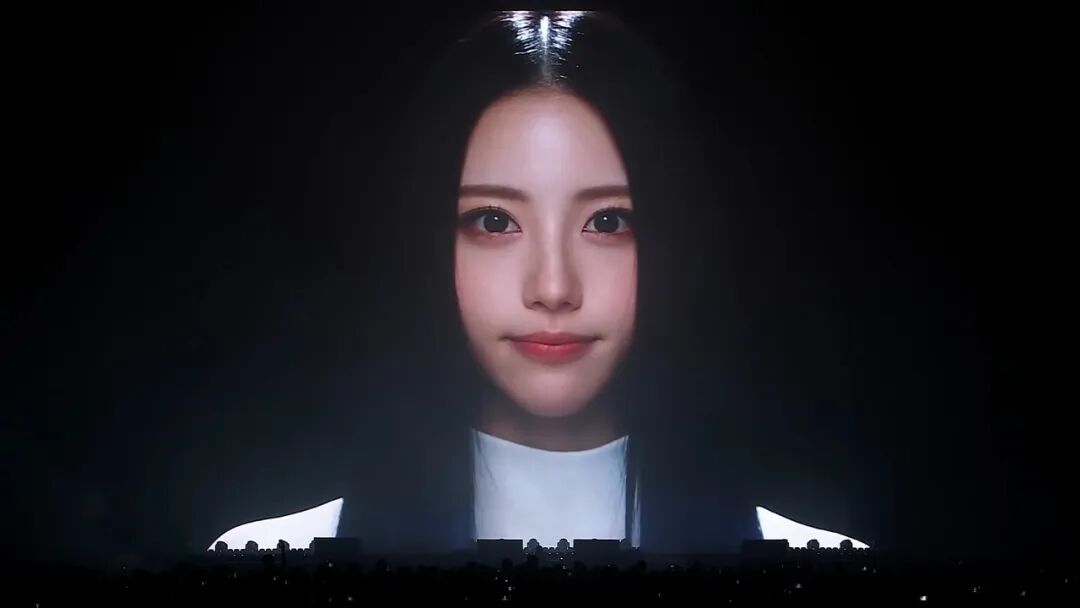
For example, Yuri, created by AI.TALK under Hanqing Studio, is an early popular original AI singer in China. Last year, her first MV *SURREAL* received more than 12 million views across all platforms, and she later reached co-creation cooperation with brands such as Voyah, L'Oréal and CHANDO. In September this year, she held China's first offline concert for AI entertainers at the 2026 Bund Conference, extending the content scene from online to offline.
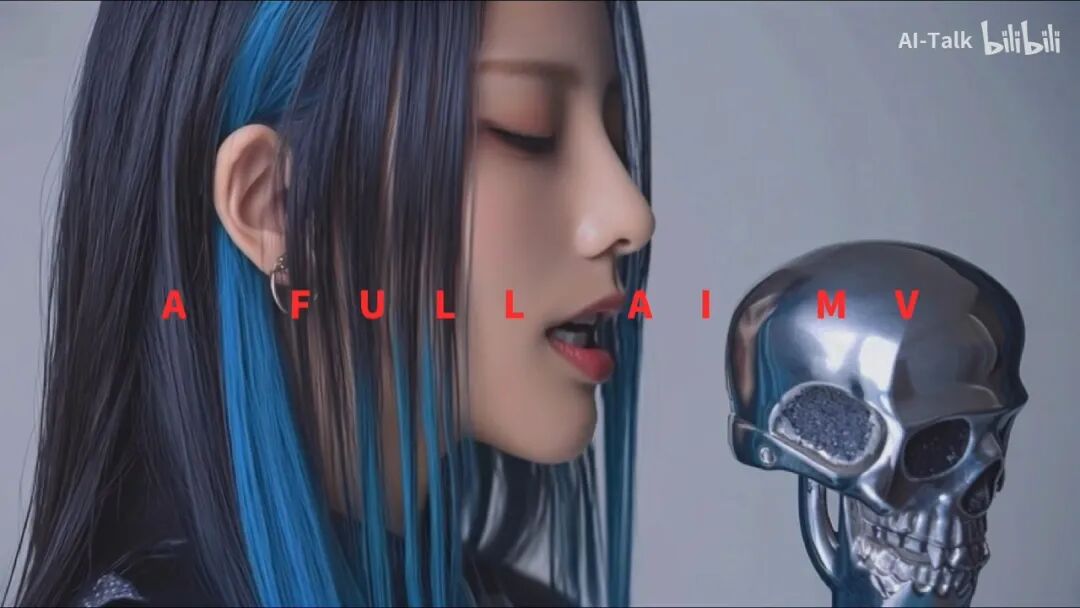
Wu Aihua, an AI virtual rap singer launched by Warner Music, focuses on a retro martial arts character setting, and the views of her first MV *Wu Aihua* exceeded 10 million. She also cooperated with Harbin Beer to create a customized rap MV, embedding brand content into music works; HeyDream, incubated by Baidu in cooperation with Du Hua, tries to combine real-life girl groups with AI comic drama content. The members are still real idols, and AI is used to generate visual materials such as comic dramas and short videos in batches. The project has launched a co-branding with the Boluzi brand and held offline pop-up activities.
These cases show that AI characters are no longer satisfied with "finishing their performance and leaving" in a single work, but are beginning to fight for opportunities for independent accounts, long-term character settings and continuous operation. However, there is still a long way to go from being seen, to being liked, to being supported by paid users.
02
AI Entertainers: What Is Their Real Commercial Value?
Although there are continuous discussions from the outside world about "AI entertainers replacing real entertainers", judging from the actual performance, the real commercial value of AI entertainers still needs to be verified.
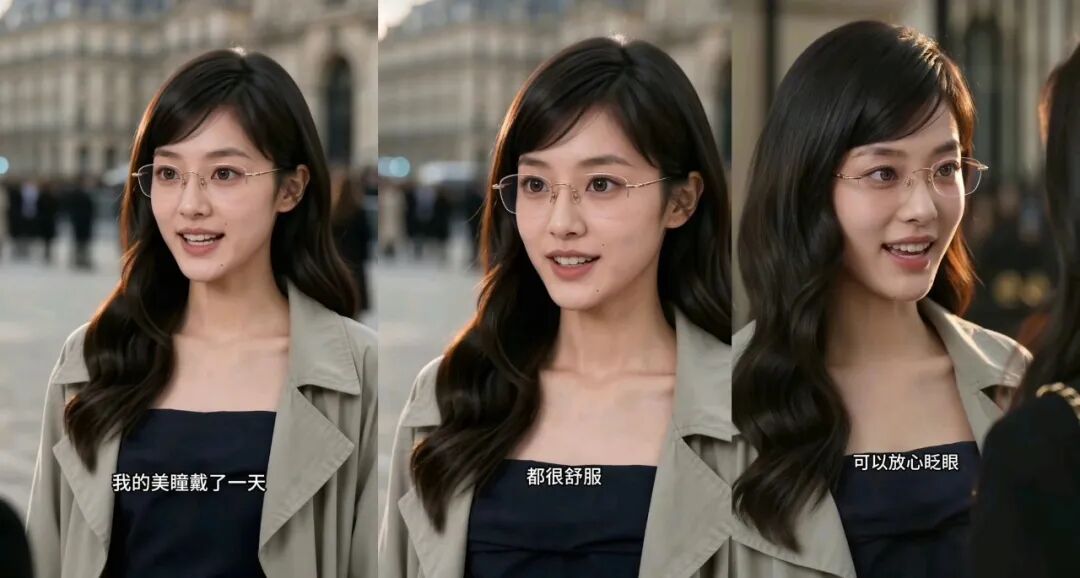
Take Fang Taozi, the most commercially successful at present, as an example. At the end of July, after she released her first contact lens advertisement, the news that the quotation for her videos longer than 60 seconds reached 258,000 yuan became a hot topic in the industry. In just over a month, she went from a character in an AI short drama to an independent internet influencer, and it seemed that she had completed the monetization path that real internet influencers need several years to finish.
However, this advertisement was actually taken off the shelves in early August. The core controversy is that in the video, Fang Taozi said in the first person that "the contact lenses are very comfortable to wear for a whole day", which caused complaints from consumers that "virtual characters don't have eyes". The incident subsequently triggered discussions on the authenticity of AI entertainers' advertisements and the attribution of responsibilities, and related matters were transferred to the local market supervision department for handling.
At the same time, the so-called 258,000 yuan is not the real market transaction price. In September, CQ CHAN, the person in charge of Fang Taozi's operation team, revealed in an interview with *Southern Metropolis Daily* that the team's initial quotation was 70,000 yuan. After the character became popular, he raised the price to 258,000 yuan, hoping to "block commercial demands through high prices and avoid commercialization interfering with content creation".
In other words, taking this quotation directly as the money-making ability of AI entertainers is a misreading in itself, let alone drawing the conclusion that AI entertainers have stronger monetization ability than real entertainers of the same size.
At the same time, after the first advertisement caused controversy, the team publicly stated that they would temporarily reject all advertising and business cooperation, and focus on content creation again. At the end of August, she appeared in the COSMOCRUSH electronic publication under the *COSMOPOLITAN* column, and the operator also clearly stated in the interview that this cooperation was "zero payment".
From this case, it is obvious that exposure, commercial quotation and actual income cannot be equated.

Of course, this is not a total denial of the commercial value of AI entertainers.
For example, Duan Yan participated in Tmall's Qixi Festival advertisement, and Yuri and Wu Aihua also have actual brand cooperation, which shows that enterprises have indeed begun to try to include AI entertainers in their marketing investment scope. Especially for Yuri's cooperation with Voyah, the brand not only considers whether the virtual image is novel enough, but also considers the matching degree of account traffic, fan portrait and brand positioning.
However, at present, the influence of these AI entertainers is more concentrated in the cultural and entertainment industry, brands and media circles, and has not really entered the public view. Public commercialization cases are still dominated by customized short films and brand co-creation, and there is still a gap from continuous endorsement and stable product sales promotion.
Similarly, the appeal of AI entertainers in offline performances also needs to be verified at present. Take Yuri as an example. Although her performance at the Bund Conference is regarded as the first offline concert for AI entertainers in China, the operator did not define it as a traditional concert. Zhao Hanqing, the founder, said that this performance is more like a human-machine co-created live experiment or performance art, rather than a ticket-selling performance for the market.
In addition, character popularity can drive derivative consumption, but it does not mean that the operator can directly benefit from it. This Qixi Festival, bracelets marked as "the same style as Duan Yan" sold more than 10,000 pieces on short video platforms. Calculated at the lowest selling price, the sales volume exceeded 1 million yuan. But according to the investigation report of *Beijing Daily*, this product has not been authorized by the drama party, and even the promotional pictures are AI pictures generated by the merchants themselves. The production party said that it did not participate in the design, production and sales of related products, and would not benefit from it.
For AI entertainers, how to develop character value through official peripheral products, authorized co-branding and other methods, and establish a clear authorization mechanism to convert market attention into their own income, is also a problem that needs to be explored in the commercialization process.
Therefore, to judge whether AI entertainers can make money, we can't only look at the quotation, the number of brand cooperations or the GMV of related products, but also figure out who gets the income, how much is actually settled, and whether the operator has the corresponding authorization rights and interests.
At present, the profit-making methods of AI entertainers have taken shape, but there is still a distance from a replicable and sustainable profit model.
03
Where Is the Bottleneck for AI Entertainers' Commercialization?
Although AI entertainers can quickly gain followers with the help of works, the number of followers cannot fully reflect the stickiness and value of the audience.
For brands, hundreds of thousands of followers are more like a threshold. Whether fans are willing to interact actively and whether the audience portrait matches the brand are the important basis for evaluating the cooperation value. To convert attention into continuous commercial value, AI entertainers must first solve the problem of long-term popularity.