The new plan released by the Ministry of Industry and Information Technology has propelled direct green power access to the top priority, yet less than 10% of the 400 related projects have broken ground, and what direct green power access lacks is definitely not policy support.
The integration of direct green power connection into the policy framework faces implementation obstacles such as cost tracing issues.
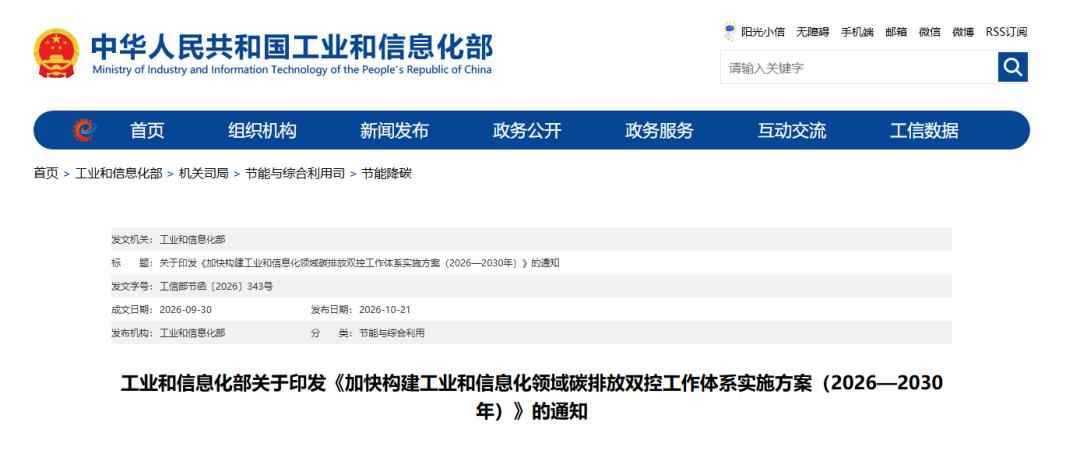
Energy Foresee learned that on October 21, the Ministry of Industry and Information Technology issued the *Implementation Plan for Accelerating the Construction of the Dual Control Work System for Carbon Emissions in the Industrial and Information Technology Fields (2026-2030)*, explicitly listing direct green power connection and source-grid-load-storage integration as the guiding models for national-level zero-carbon factories and zero-carbon computing power facilities, and proposing to build around 500 national-level zero-carbon factories and zero-carbon computing power facilities by 2030. This marks the first time that direct green power connection has been incorporated into the institutional framework for the dual control of industrial carbon emissions.
However, in the same month, Jiang Qingguo, Deputy Secretary-General of the Distribution and Power Special Committee under the China Energy Research Society, disclosed a set of figures: More than 400 direct green power connection projects have been approved across 24 provinces, but less than 10% have officially started construction. The 1.2 million-ton ethylene project of Dushanzi Petrochemical in Tarim consumes 1 billion kWh of green power annually, cutting carbon emissions by 1.37 million tons.
Leading cases are fully feasible. But while approval documents are issued smoothly, construction sites stay quiet. Direct green power connection is currently experiencing a contradiction between institutional upgrading and implementation barriers.
01
Approvals Are Easily Issued
Construction Sites Fail to Kick Off
The policy logic of direct green power connection has completed three major leaps in two years. Document No. 650 issued in May 2025 opened the "one-to-one" single-user access, Document No. 1192 released in September 2025 set the rule of paying transmission and distribution fees based on capacity (demand), with the capacity connected to the public power grid as one of the calculation factors, and Document No. 688 rolled out in May 2026 expanded the model to "one-to-many", granting industrial parks and zero-carbon parks formal access qualifications.
The dual carbon emission control scheme released by the Ministry of Industry and Information Technology in October further embedded this model into the evaluation system for national-level zero-carbon factories, setting gradient targets for the physically verified volume of non-fossil energy power consumption (no less than 35% for annual power consumption above 5 million kWh, and the basic requirement no less than 10%). It only counts physically traceable power consumption, excluding the simple purchase of green certificates from the scope of verification.
The density of institutional supply is beyond doubt. The problem is that every step forward of the regulation unfolds the cost ledger at the project side once more. A 100-kilometer 110kV dedicated direct green power connection line, with a total investment of about 250 million yuan including energy storage construction, while a conventional public transmission line of the same length only costs 120 million yuan. The extra 130 million yuan covers the independent construction cost of the dedicated line, step-up stations, energy storage facilities, and a fixed cost that cannot be shared by any other party.
Cheng Yongqiang, Chairman of the Source-Grid-Load-Storage Digital Intelligent Industry Alliance, judged that even if grid-connected projects adopt the direct connection model, they still need to pay transmission and distribution fees corresponding to capacity reserve to the public grid, which is a rigid cost stipulated by Document No. 1192 and cannot be bypassed.
The industrial logic of direct green power connection has never been "green power is cheap", but how much "physical traceability" is worth. When the core return of an investment is based on compliance qualification rather than electricity price arbitrage, its implementation rhythm is destined not to depend on policy popularity, but on who is willing to pay for that compliance "qualification".
The comprehensive electricity price for power consumption of the vast majority of direct green power connection projects is higher than that of conventional market-oriented power purchase. The gap between the smooth approval and the stagnant construction is not caused by poor implementation, but the cost ledger itself has not reached balance.
02
Computing Power Load Is Making Flexible Adjustments
Industrial Load Is Bearing Rigid Constraints
Facing the same cost bill for direct green power connection, the adjustment space of computing power facilities and process industry are not at the same level at all.
The first large-scale "computing-power and power coordination" direct green power supply project in Zhongwei, Ningxia has a total investment of 8.7 billion yuan. 500,000 kW of photovoltaic power from Datang is directly supplied to the data center cluster one kilometer away through four 110kV dedicated lines, cutting the transmission loss from the conventional 5% to less than 3%, and the supporting 1.5 million kW of wind power project is still under construction.
The advantage of computing power load lies in its flexibility: IT load can be adjusted with the output of wind and solar power, the declared capacity can be compressed, and the design of standby interface has flexible space. Rough calculations show that under the same power consumption scale (compared with electrolytic aluminum projects with stable load), the computing power project reduces the grid connection capacity from 600,000 kW to 420,000 kW. Estimated at the assumed capacity electricity price of 22 yuan/kW·month, the annual difference in capacity electricity fee is about 47.5 million yuan. This is not because green power itself is cheaper, but the flexible load curve gives the project room to re-settle accounts with the power grid.
The process industry has no such adjustment space. Once the ethylene unit of Dushanzi Petrochemical is ignited, the steam balance, cracking depth and compressor drive cannot allow fluctuations following wind speed changes.
The reason why its direct green power connection can operate smoothly does not depend on load flexibility, but on its high degree of integration: power supply, carbon capture, blue hydrogen and blue ammonia circulate within the same investment entity and operation system. The benefit of 1.37 million tons of carbon reduction is not recovered through electricity price, but digested through product carbon attributes and compliance access requirements.
Direct green power connection will not be evenly rolled out across all industries. It is easier to form a closed-loop operation in computing power facilities and export-oriented leading manufacturing enterprises, because adjustable load or product premium can absorb incremental costs; in the traditional process industry with rigid load, it is first a compliance tool, and secondly an energy solution. Promoting direct green power connection as a universal measure to reduce electricity prices will be rejected in the first round of investment calculation.
03
The Pass to EU CBAM
Stuck at "User-Level" Traceability
It is an undisputed fact that export enterprises are the most urgent buyers of direct green power connection services.
Although China's green certificates have been recognized by RE100 in 2025, they have not yet been accepted by the EU CBAM, and cannot be used alone as emission reduction vouchers for production electricity to verify product carbon footprints. CBAM clearly recognizes the carbon emission calculation model of direct connected power mode, while virtual PPA is excluded from the recognition scope. In the EU's recognition sequence for green power usage methods, physical direct connection ranks at the highest level.
However, "recognizing the model" and "accepting the data" are two completely different things. Multi-user direct green power connection allows the same power source to serve multiple legal entities at the same time. The project as a whole can prove that green power has entered the direct connection system with clear boundaries, but the green power consumption obtained by a single user depends on time-sharing metering and distribution rules.
Wang Yongli from North China Electric Power University made an accurate distinction: "The whole project is traceable" does not equal "single user can be accurately traced". When EU verifiers require an export enterprise to provide an hourly-level physical direct connection evidence chain corresponding to its export batches, the general statistical account at the park level cannot be automatically decomposed into sub-accounts at the enterprise level.
This constitutes the most realistic mismatch of direct green power connection in export scenarios: the policy side uses the multi-user model to lower the access threshold for small and medium-sized enterprises, but the compliance side may leave an interface that has not been fully tightened in user-level traceability.
Document No. 688 opened the access door, but the maturity of metering granularity and distribution rules has not fully kept up. It is not wrong for export enterprises to bet on the direction of direct green power connection, but equating "obtaining direct connection qualification" with "obtaining CBAM pass" is an underestimation of the institutional time difference.
This scheme from the Ministry of Industry and Information Technology has embedded direct green power connection into the access framework of zero-carbon factories, and there is no turning back for this development direction. The regulation has turned direct green power connection from an optional item to a mandatory requirement, and now it is the turn of cost accounting parties to deliver the final answer.
This article is from the WeChat official account "Energy Foresee", written by Zhao Jianan, published with authorization from 36Kr.