After surging 7 times, the valuation has slumped to zero within half a year, MiniMax falls below its IPO price, Yan Junjie's net worth evaporates by 90 billion yuan.
Hong Kong-listed tech stocks plunged collectively, MiniMax (0100.HK), one of the "two leading large model players" in the Hong Kong stock market, also fell below its issue price.
On October 22, MiniMax's stock price opened low and moved lower, closing down 6.52% at HK$160.7 per share, with a total market capitalization of HK$56.6 billion. This marks the first time since MiniMax's listing that its share price has fallen below the issue price of HK$165 per share.
As one of the two AI large model companies listed in Hong Kong, MiniMax once saw a rapid rise in its share price after listing. In March this year, the company's share price peaked at HK$1330 per share, rising more than 7 times compared with the issue price, and its total market capitalization also exceeded HK$410 billion.
Since then, MiniMax's share price has started to correct. Compared with the high point in March, the company's latest share price has dropped by nearly 90%, and its total market capitalization has also evaporated by more than HK$350 billion.
As MiniMax's share price moves lower, the net worth of YAN Junjie, the founder of the company, has shrunk accordingly.
At present, YAN Junjie holds 79.1025 million MiniMax shares, with a shareholding ratio of about 22.65%. At the peak of the company's share price in March this year, YAN Junjie's net worth once exceeded HK$100 billion. As MiniMax's share price has dropped by nearly 90%, YAN Junjie's net worth has continued to shrink, and the latest market value of his held shares is about HK$12.7 billion.
In just 7 months, YAN Junjie's net worth has dropped by about HK$92.5 billion.
Similar to MiniMax, in recent months, Zhipu (2513.HK), another AI large model listed company on the Hong Kong stock market, has also seen its share price drop significantly. On October 22, Zhipu's share price fell 7.10% to HK$460.8 per share, and its total market capitalization dropped to about HK$225 billion. Compared with the high point of HK$2980 per share in June, the cumulative decline of its share price during this period has reached about 85%.
Why are AI large model companies no longer favored by the market?
Model capability remains the core variable
Both MiniMax and Zhipu landed on the Hong Kong stock market in January this year, but after listing, the share price performance of the two sides showed different trends.
MiniMax was founded 5 years ago. Its founder YAN Junjie is 37 years old this year. He once worked at Baidu, then joined SenseTime and was promoted to positions including Vice President and Vice Dean of the Research Institute. In 2021, YAN Junjie left SenseTime to start his entrepreneurial journey, and MiniMax was born.
At the beginning of its listing, MiniMax was favored by the market for its higher overseas revenue, and its share price hit a high of HK$1330 per share in March. However, as the AI track ushered in revaluation, the market began to pay attention to Zhipu, which has stronger model capabilities.
After that, the share price performance of the two companies crossed. In July, Zhipu's market value once reached 7 times that of MiniMax. Today, Zhipu's market value is still 4 times that of MiniMax. At the time when MiniMax's share price fell below the issue price, Zhipu's share price is still nearly 3 times higher than its issue price.
The different market performance of the two companies lies in the difference in their model capabilities. From the market's perspective, as the large model track becomes increasingly crowded, only companies with stronger model strength and continuous iteration capabilities can gain competitive advantages.
In June this year, MiniMax released its flagship large model MiniMax M3. At that time, the company's official website showed that MiniMax M3 was at the forefront of the industry in professional tasks such as programming and agents. In the SWE-Bench Pro list that tests coding capabilities, M3's performance surpassed GPT-5.5 and Gemini 3.1 Pro, approaching Claude Opus 4.7.
However, in the following 4 months, MiniMax has not yet released a new flagship large model. It only updated a Flash model M3.1 Flash on October 19. In the Artificial Analysis list, the score of this model is slightly higher than GLM-5.3 Flash previously launched by Zhipu, but still lower than Zhipu's flagship large model GLM-5.3.
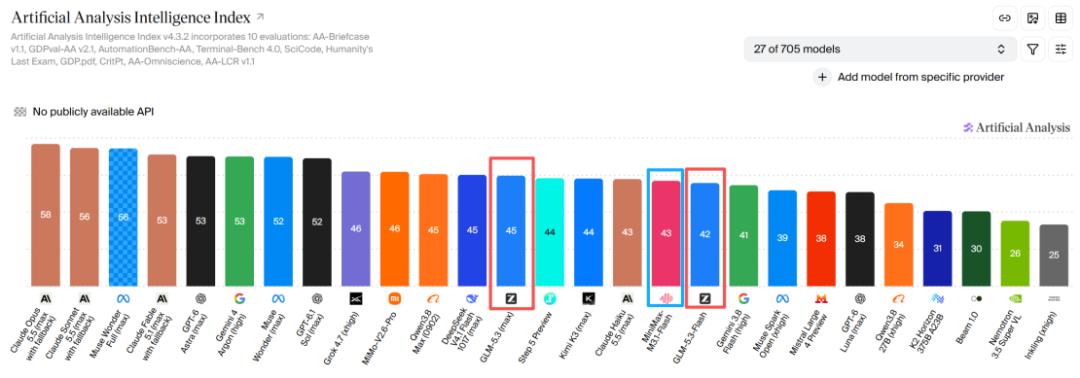
MiniMax previously stated that the company is developing two models, M3.1 and M3 Pro. The parameter scale of M3 Pro is expected to increase to about 3T, and reinforcement learning and long-horizon task training will be further expanded. But at present, it is still unknown when the above models will be launched.
In contrast, Zhipu's model iteration is faster, and it even once reached the domestic SOTA (state-of-the-art) position.
In June and August this year, Zhipu successively launched two models, GLM-5.2 and GLM-5.3. At the beginning of the launch of GLM-5.3, its score on the Artificial Analysis list was as high as 60 points, ranking first among open-source models together with Kimi K3. GLM-5.3 Flash (Nilai Large Model) launched by the company in August this year also once attracted market attention.
In a research report in July, JPMorgan Chase stated that open weights expand the distribution scope of models, but the monetization ability still highly depends on model quality, iteration speed and endpoint reliability. For models with leading capabilities, open weights can expand the usage scale with the help of external GPU computing power such as cloud service providers, inference platforms and private deployment. But for models with insufficient differentiation, broader access rights instead accelerate price comparison and traffic replacement.
Of course, relying on its long-term accumulation in the C-end market, MiniMax has certain competitive advantages in multimodal capabilities. In July this year, MiniMax launched the open-source video generation model MiniMax H3, which focuses on high cost performance. Three weeks after its launch, the number of downloads exceeded 24 million, making it one of the main competitors of ByteDance's Seedance 2.0.
Overall revaluation of the AI track
The recent overall revaluation of the AI track is also one of the important driving factors for MiniMax's downward share price.
Since ChatGPT launched the generative AI revolution, the AI track has ushered in an unprecedented period of rapid development. Many views believe that AI will not only create new industries but also reshape a large number of traditional industries, thus creating the biggest industrial opportunity in the next ten years.
In the following years, from upstream computing power infrastructure manufacturers to downstream large model base companies, the entire AI industry chain has received a large amount of capital support, and the valuation of enterprises has continued to rise.
However, in the first half of this year, the market's enthusiasm for AI has deviated from the fundamentals of the track. When MiniMax's share price peaked in March this year, the company's TTM price-to-sales ratio once exceeded 600 times, and Zhipu's TTM price-to-sales ratio at the high point in June even exceeded 1000 times.
Such high enthusiasm has aroused market vigilance. Since then, the market has begun to re-examine the AI track, paying more attention to the real capabilities of large model companies' models and their actual commercialization progress.
As one of the leading large model companies in China, MiniMax once relied on C-end-oriented AI products to support its revenue. With the improvement of large model capabilities, the B-end-oriented open platform and other AI-based enterprise service businesses have replaced C-end products and become the main source of revenue for MiniMax.
In the first half of this year, the revenue of MiniMax's open platform and enterprise service business reached 74 million US dollars (about 497 million RMB), a year-on-year increase of 703.1%, and the revenue proportion increased from 30.3% in the same period of the previous year to 63.4%.
Driven by this business, in the first half of this year, MiniMax's total revenue increased by 283.1% year-on-year to 117 million US dollars (about 778 million RMB), and the adjusted net loss expanded by 52.7% year-on-year to 293 million US dollars (about 1.96 billion RMB).
However, compared with Zhipu, there is still a certain gap in MiniMax's revenue scale. At the half-year performance meeting this year, Zhipu's management mentioned that the company's ARR had reached 1.6 billion US dollars by the end of August, while MiniMax's ARR was 800 million US dollars.
In order to motivate the team to deliver more results, YAN Junjie released an internal letter in July this year, announcing that he will no longer receive any salary from the company until the day the company achieves AGI. In the next four years, he will take out shares under his name equivalent to 4% of the company's total share capital to motivate team members who fight side by side with the company for a long time and create value together; at the same time, he will take out 1% of the shares to set up a special fund to continuously support the development of relevant open source communities.
This article is from the WeChat Official Account "Damofinance" (ID: damofinance), written by Damofinance, and authorized for release by 36Kr.