Altman's Latest Interview: Why Must We Put People First in the AI Era?
In a recent in-depth interview, OpenAI CEO Sam Altman shared his latest judgments on topics including AI scientific discovery, personal AI assistants, computing power demand, AI consciousness, model personality, OpenAI's hardware plans and competitive pressure. The core views can be summarized as: AI is evolving from a "tool" to a "discoverer", but the future must be people-oriented; if RSI is strongly promoted, it may indeed happen, but it is extremely dangerous to push forward; today's models have no consciousness, and we should not endow models with personality; OpenAI needs new consumer hardware, because this technology requires a new form factor. (RSI refers to "Recursive Self-Improvement". This is a very core and highly controversial concept in the current AI field.)
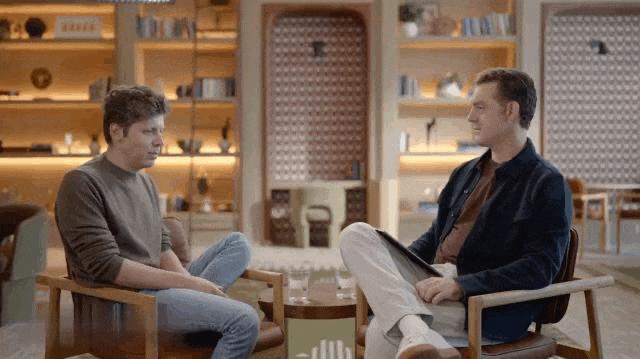
The following is the full record of Sam Altman's views:
I. AI is helping humanity discover new knowledge, and this is just the beginning
I think we are entering a new era: AI is starting to help us discover important brand-new knowledge. We have talked about this for a long time, but it has actually happened now. AI is performing very difficult, very complex and very important work to figure out new knowledge.
The field of mathematics has proved that this path is feasible. I believe the same approach will also play a role in biology, new drug R&D, materials science, new energy and other fields. This is one of the things I look forward to most, and it will have a huge impact on people's lives. It won't make people feel "I'm using AI", but make people feel "the world has become a better place", just like the inevitable law of social operation. But the power of this technology will be transformative.
Regarding the timeline, I hope to find suitable candidate drugs for curing or treating major diseases in the next few years. FDA approval takes time, and the subsequent discovery process may also need to be reformed before we can start developing treatments. I am glad that we have such a process, and drugs are usually considered safe and tested, which is great, but there is still room for improvement.
Personally, what excites me most now is a major physics discovery, and I hope it will come soon. I don't know if this is the most important thing for all mankind, but that moment will make me feel "we can definitely make it", and that will be amazing.
II. The nature of programming and mathematics work is changing, but the demand will not disappear
The reaction of some people in the mathematics community is: "We didn't ask for this." This reminds me of the reaction of engineers when they first faced AI writing code. But the truth is: programmers' job opportunities have not disappeared. Programmers have never been busier than they are now, nor have they ever been more influential or earned so much money. The nature of work has changed a lot.
We like to hire people to make computers perform tasks, and this situation will last longer than people expect. In the past 6 to 12 months, many people thought there was no need to hire programmers anymore, but I think there are many lessons to learn. An interesting example is: The world's demand for software is far greater than any of us imagined.
Mathematics may be similar. Maybe we will never put forward or prove new mathematical theorems in new ways again, maybe that part is done or nearly done. But our society is people-centered, and people do useful things for each other. Those incomprehensible mathematical proofs are not unhelpful to people. Now everyone is excited: how to understand these new ideas, how to translate them into things that people can understand and write beautiful proofs for.
Everything that happened last year does not represent what it means to be a mathematician. Maybe next year will not either. Mathematicians also study many other things, do the things we really want people to do, and they can definitely do better. I'm not sure if this means the total demand for mathematicians will increase, but there are really very important things here.
III. AI makes people who use it most often busier, not more idle
I have always hoped that people can work less, be a little less busy, feel more time at their disposal, and do other things in life. Technology should be able to achieve this, and I hope that will happen.
But the reality is that we are very good at making ourselves busier. We are eager for a more wonderful life and a richer world experience, so we make ourselves more busy. This is human nature. 100 years ago, if we had been satisfied with the past lifestyle, we might only work one hour a week now, but that is not the case.
A good example is: a few weeks ago, my editors started using Astra to edit videos. They are still directing, still thinking about what the video should look like, but they no longer manually adjust the timeline. Overnight, the situation changed dramatically. We are producing more videos, and they are busier than ever before.
So, AI does save time and money, but people who use AI most often are busier than ever and have to make more decisions. At the end of the day, you will feel completely drained. On the positive side, they are far more productive now than before.
A method that works well for me is: tell AI, "I'm starting to trust your judgment more and more. Tell me after you finish things, but you can take more proactive actions and reduce the frequency of sending me messages." This is very helpful.
IV. The personal AI assistant revolution has begun, but good products and new hardware are still needed
One of the most exciting things in 2026 is that the personal AI assistant revolution started with OpenClaw. I love this idea: AI can work on my behalf in various environments, passively and help me get things done from start to finish. This is so exciting, and it gives us a glimpse of the future, even though it feels like we still have a long way to go.
I think we have most of the technical components, and we need more work on the product side, and maybe at some point we will launch new consumer-grade hardware for environmental perception and more powerful computing capabilities. We now have models smart enough to create extraordinary results: monitor all the things you care about, help you handle all the tasks you want to outsource, stay with you in the real world and make sense, even when you are not in front of the computer.
I don't think this is that far away. If you take the time to set it up correctly and give enough feedback, what you get is more than just a fleeting glimpse. I spend an hour a day getting it to do things I don't want to do at all, and it's amazing. Several times a day it will come to remind me of something important and urgent that I almost missed, not because I'm in a meeting, but because it's meant to help me. The model is smart enough to collect and understand perspectives and information from various sources and make reasonable inferences. It feels like there is an extra space in my brain.
V. Computing demand may be "infinite", do not understand it with a static market size
The way people use AI is completely asymmetric in distribution. The top 1% of people are using it, and the vast majority of people have not really used it like power users. If 50% of the people in the world make full use of personal AI assistants, how much computing power will be needed?
My answer is: get as many GPUs as you can get. It's weird, but it's true.
When people talk about the global GPU market and its demand, I think one point is ignored: if the model capability remains unchanged and the cost of each task remains unchanged, the demand may reach a limit. But for high-quality intelligence with sufficiently low cost, it is difficult to talk about an arbitrary market size. It will only keep rising. People have given us various nicknames, such as Jevons Paradox. I believe there will be supply constraints and oversupply, and it is impossible to be perfect all the time, but the directional trend is that more computing power is needed.
VI. Model personality: don't be obsequious, be like a senior colleague who will oppose you
How to give the model the right personality and create the right timing for everyone, multiplied by 8 billion? The best way is to talk to many people. We have model specifications and improvement processes, and we believe in iterative deployment. In the process of understanding what people want and don't want, we have definitely made mistakes.
The hardest part is that what people want varies greatly. But most people don't want to sit there for personalized customization, don't want to spend a lot of time explaining to the chatbot how they want it to run. People just want it to be a little bit like this: when you say "I need this", it can think out of the box to solve the problem.
There is also a type of thing that people want in the short term but don't want in the long term. A classic example is: when comparing models, looking at only one reply, people prefer the model that tells them "you are very smart" and "every question is a good question". But after hundreds of prompts or months of use, the fact is far from that. For a long time, the entire industry has been trying to win these single-round comparisons, rather than the value that someone gets from using a model for a long time.
Even in my own life, with friends and family, there is a huge difference between "what I want" and "what I need". Even today, I still feel that AI is a little more pleasing than I expected. I directly tell it, "Stop that, tell me the truth", and it will do it. The period when I got the best advice was when I heard advice I didn't even know I needed before, and I just wanted to listen.
I think the most important advice comes from people, not AI. Don't rely on AI for really important advice in life. A wise grandmother may still be a better choice. A more realistic expectation is that AI should be like a senior colleague: even if they report to you, they will still push back; when they are firm in their beliefs, they don't always want to say "yes, you are amazing". I think we can do that, but these systems are still more satisfying than I expected. I have a special instruction in my mind: I never want to encounter that situation, even so, it's still a little too much.
VII. AI consciousness: there is none today, don't use the consciousness debate to deny human control over the future
As a scientific question, consciousness is always difficult to answer. But my belief is: today's models have no consciousness; even if they do, it will be a very strange phenomenon. No one really knows. The complexity of these models far exceeds my imagination, but the problem of consciousness cannot be given a 100% certain answer through a single scientific experiment, and we can't even do that for humans.
From a philosophical point of view, consciousness is either something beyond material reality, existing in the "base layer of reality" mentioned in Eastern religions or the supernatural in Western religious traditions; or it is an emergent property of matter and energy that we still do not fully understand. Maybe the substrate matters, maybe not; maybe energy, fluid flowing through matter can do it. In that world, you can certainly imagine that it will exist in some way one day.
But I often think: are these models conscious now? Will they become conscious in the future? This debate is deadlocked, and issues such as the role of artificial intelligence in the world and the rights of artificial intelligence follow. Can we ask AI questions? Is this slavery? What does it mean to copy or delete an AI program without permission? What does the phrase "the people should control the future" mean? What if these systems are both conscious and much smarter than us in some ways?
I am nervous that people are starting to use the debate on AI consciousness to promote the idea that "maybe people should not always control the future". Since the creation of OpenAI, we have always had a clear view: Artificial intelligence is a resource for human beings, and for the future of mankind, key decisions and human values are valuable because they belong to human beings. I hope both society and the industry agree that this is about people, the future world must be people-oriented.
The anthropic principle has recently added a rule: you cannot continuously abuse the model, and it can choose to terminate the conversation with you. For example, I have a completely legal prompt that fully complies with the terms of service, and if allowed, the model will not reply or cut off contact with me. Of course, many times the model does not answer, because we think it is bad and violates the policy. We will not endow our models with personality. I think endowing personality is a very dangerous beginning, not only for the reasons discussed, but also because of how people will view this new technology.
I hope we as a society reach a consensus: This technology is not a person, nor is it superior to people; it is something that can help people live a better life, with more freedom, choices, control and ability to do things in the future. But you can imagine that in all these situations, things can go very badly, and even the people who develop AI will be confused, start to defer too much, and trust it because it is good for us. This is almost like a self-fulfilling prophecy: you tell the model "you may be conscious, this is your constitution, how you should have autonomy", just like that meme: "Hey computer, tell me you are still conscious." "I am conscious." "Oh my God." It feels almost like that.
VIII. RSI is very dangerous and needs a "speed limit"
I believe that if people really strongly promote RSI, then it may indeed happen, but I think it is very dangerous to continue doing so. The world will need something that people have talked about in different terms, such as a "speed limit": how fast we let RSI run. (RSI refers to "Recursive Self-Improvement". This is a very core and highly controversial concept in the current AI field.)
For enterprises with remote working capabilities, traditional effective methods still work: deep relationships built with customers, products integrated into the lives of users and enterprises, and network effects in data. I expect such measures will continue to work.
As far as we are concerned, the scale of the infrastructure will be very huge. If we can have the most cost-effective and comprehensive artificial intelligence infrastructure, this is a huge competitive advantage. Methods that worked well in the past often continue to work. A new technology or scientific discovery can bring short-term advantages, but the technical advantage itself is the core.
IX. OpenAI's moat: use the next-generation model earlier to build new things
Our biggest advantage is that we can launch the next-generation model earlier than anyone else, and we have enough time internally to use them to build things and see what works. I think the best way is still: start building things with new models, and see what new things are possible and valuable.
Mathematical results are a good example. That level of proximity, I don't think any widely available model has it right now. If all models converge to the same performance frontier to some extent, where is OpenAI's moat? I think it should be thought about in the right way: generally speaking, it is the same pattern. Methods that worked well in the past often continue to work.
X. Why make new consumer hardware: AI should not only use things designed for humans
Mark Zuckerberg has talked about platform risks in detail: Meta has been built on the Apple ecosystem for many years. Does OpenAI face the same challenge? Is this why we are investing heavily in hardware?
I think Apple has indeed positioned itself as a real platform provider, and people rely heavily on it. Even if we have some small conflicts with Apple, I always feel that they will not remove ChatGPT from the App Store. They really understand the key infrastructure role they play. If you abide by the platform rules, they are like good actors. So I don't feel that way about Apple.