Big tech giants are flocking to the AI short drama sector.
Recently, Lv Paopao, the short drama mini-program under Tencent, officially launched an offensive against Hongguo Short Drama. In this AI era where ARR is checked on odd days and RSI on even days, seeing the hand-crafted fierce competition full of artisan spirit from the traditional industry again is extremely familiar and comforting.
On the surface, this is the reignition of the war between Tencent and ByteDance, the old rivals, but in fact, the AI short drama track has long been bustling with activities and gathered numerous outstanding players.
Earlier, Kuaishou, Baidu, iQiyi and Youku have seized their positions in this field, and later e-commerce platforms including Taobao and JD joined in for fun, with the principle of participation first. When you order a Meituan takeaway and accidentally open Alipay, you can also drop by the 80s supply and marketing cooperative themed short drama section casually.
It seems like the eight major sects are besieging Bright Summit, but in fact, the situation is as chaotic as the mess in Northwest Shanxi.
Tencent has the highest-profile stance and the most sufficient preparation. While laying out Lv Paopao, it also launched products such as National Short Drama and Mars Short Drama Community. It splits its forces into three routes to encircle Hongguo without forgetting internal horse racing competition.
The mobile internet industry that has been silent for a long time finally welcomes a major hotspot, temporarily surpassing the high-profile AI in public opinion, and can have a small-scale vigorous development.
The Dispute Has Begun
The reason for large manufacturers to roll up their sleeves and enter the market is very simple. In the segmented formats of the mobile internet, the patterns of e-commerce, short videos and social platforms have long been solidified, and the total user base has hit the ceiling one after another. AI short drama is the only incremental market in the current internet traffic business.
For internet companies, users are not only users of products, but also the source of commercial value. No matter through advertising display, e-commerce transactions or other value-added services, platforms can convert users' attention and consumption demands into revenue.
Therefore, internet companies have a mysterious yearning for traffic entrances. Everyone has hundreds of millions of monthly active users, but they keep saying they have no traffic. Especially e-commerce, a big traffic consumer, is morbidly hungry for traffic.
One of the reasons why the takeaway war was extremely fierce last year is that there are few scenarios left that can generate traffic, so they can only reach out to the hard bone of the takeaway industry.
At this time, AI short drama appeared just in time.
The emergence of AI short drama has created a new content form. Under the circumstance that the general situation of the mobile internet seems to be settled, it has successfully created a brand new traffic entrance.
However, the production threshold of live-action short drama itself is not low. As the market scale expands, shooting scenes are becoming more and more exquisite, actors' pay is rising, and costume, fantasy and other themes have higher and higher requirements for costumes, props and special effects, leading to rapid growth in costs.
Last year, the production cost of ordinary micro short dramas was about 200,000 to 300,000 yuan, and the average cost of high-configured high-quality dramas has exceeded 3 million yuan [1]. Compared with short videos, the production cost is too high, and even large manufacturers dare not enter the market easily.
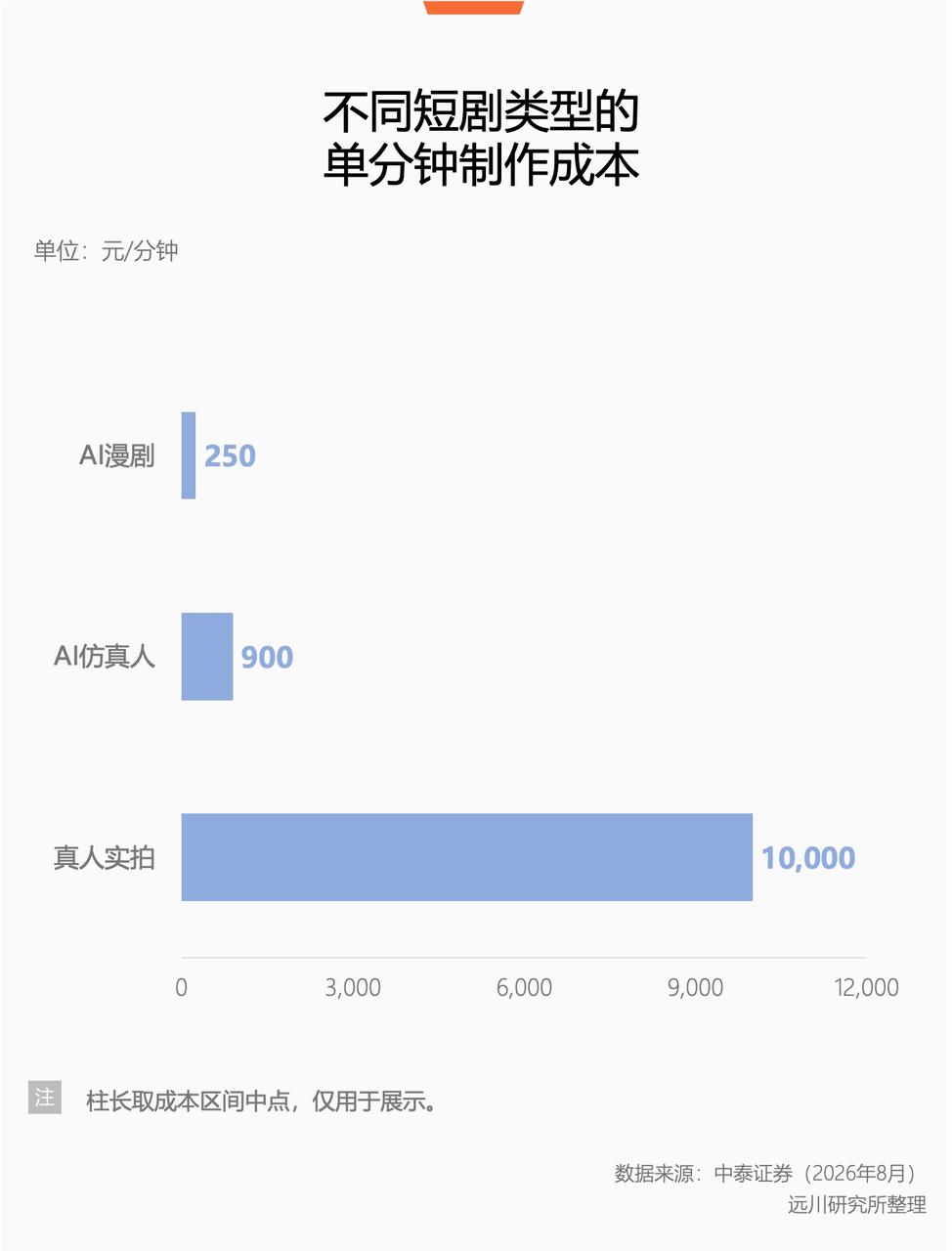
After the emergence of AI short drama, the production cost has dropped significantly, which means the trial and error cost has also decreased accordingly. The supply of AI short drama market will increase, which is an almost predictable trend.
For internet companies that are hungry for traffic, the newly added traffic is meaningless if it is too expensive. Low-cost AI short drama is not only a new content business, but also a traffic pool worthy of competition.
External conditions also provide corresponding favorable factors.
The market has verified the user demand for short dramas, and AI has further reduced the cost and threshold of content production. For large companies with capital, technology and traffic channels, a market that has been verified but whose competition pattern has not been completely solidified is naturally worth entering and competing for.
The new market does not mean starting from scratch. Large manufacturers come back to the table with the user, traffic and channel resources accumulated over the past ten years, so the competition pattern of short dramas can hardly break away from the original internet power map.
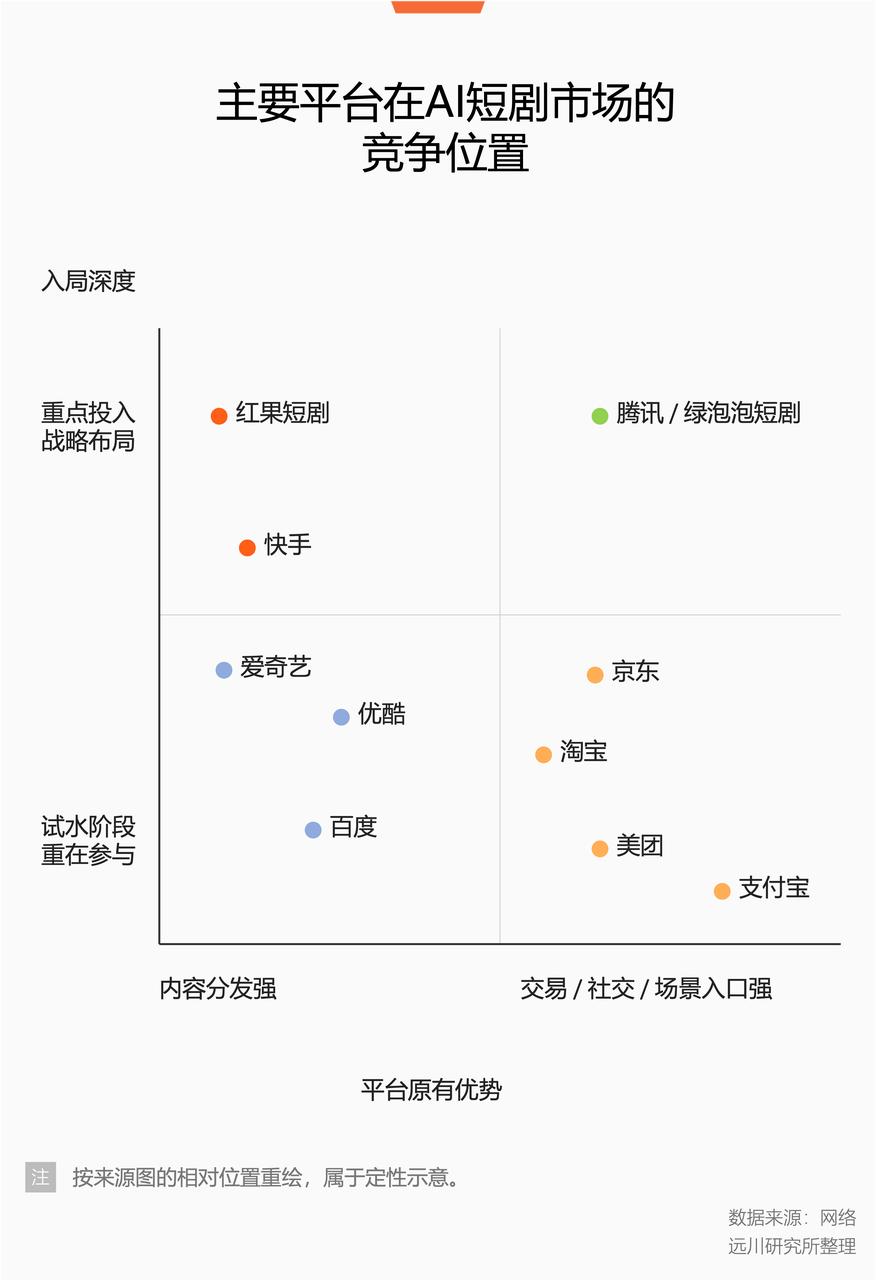
In other words, the current AI short drama market is a bit like the short video market around 2016.
In 2016, Kuaishou had a first-mover advantage, but players including Douyin, Huoshan Video, Xigua Video and Tencent Weishi entered the market one after another. In just two years, Douyin overtook all others. Short videos have evolved from an emerging track to the main battlefield for large internet manufacturers to compete for user duration.
One's own failure is certainly terrible, but the success of peers is even more distressing. The fact that predecessors reached the top does not mean the pattern is settled, it only proves that the road is passable.
The AI short drama is probably entering such a stage.
Exclusive Memory
As the short drama market develops to today, Hongguo has begun to receive the classic treatment of internet giants: making enemies on all sides.
On the one hand, the user scale of Hongguo is indeed large, but if AI short drama still has broad room for growth, as more and more players enter the market, even if the original market advantage remains unchanged, it may be gradually diluted in front of the expanding denominator.
On the other hand, the commercial competition between content platforms is largely the competition for high-quality content. For audiences, if they want to watch a certain drama, it is difficult to replace it with another drama; for platforms, obtaining content that no other platform has is the key to building the attractiveness of the content library to consumers.
In this case, exclusive copyright has become an important bargaining chip. Whether Tencent Video or Netflix, they are willing to pay high copyright fees for popular dramas, or simply invest in self-made content to keep attractive works on their own platforms.
The same logic applies to the game industry. Nintendo relies on Mario and The Legend of Zelda to support the sales of Switch. If The Legend of Zelda is really ported to PS5, consumers may not be happy.
In some segmented fields, precisely because of the existence of exclusive content, the first-mover advantage and user scale advantage of large platforms are diluted.
For example, Netflix created the form of video streaming, but it did not swallow the market in a snowball way. Instead, it coexisted with streaming services such as HBO Max and Disney+ for a long time, and it has to continuously rely on exclusive content such as House of Cards and Stranger Things to maintain its competitiveness.
In recent years, Apple has also continued to increase its investment in the video streaming business, making it difficult for a stable market pattern to appear, and a single dominant player is far from in sight.
In other words, the competition in most content industries is that everyone spends money to compete for things that others do not have. It is exploitation for e-commerce platforms to force merchants to choose between two options, but it is a generous treatment to treat producers as valued partners when content distributors sign exclusive agreements with producers.
Another view is that AI short drama producers lack bargaining power. The more direct reason may not be the exclusive cooperation itself, but after AI matures, there is a pulse-like growth in content supply.
After the production cost of AI short drama is reduced and a large number of dramas are produced, the content available for platforms to choose increases rapidly, and supply exceeds demand. It is inevitable that drama teams line up to seek distribution. This does not mean that all content has no bargaining power.
The top 1% of content is always irreplaceable, and the cash cow will never lack bargaining power.
Upstream and Downstream
Compared with other mobile internet formats, although AI short drama is an internet business, it corresponds to a relatively complete content production chain.
Generally speaking, the upstream and downstream of the internet/software industry are relatively thin. There is no nested supplier structure, nor heavy investment such as equipment and factories. Therefore, the protagonists of garage startup stories are all internet companies, and no one has ever heard of an industrial giant born from garage entrepreneurship.
Although AI short drama is not comparable to the manufacturing industry, its upstream and downstream links have been very complex:
IP and copyright are important content sources for short dramas, with multiple platforms such as China Literature, Jinjiang, ChineseAll and Fanqie Novel standing in this field.
Below IP are screenwriters and production companies. A large number of entities are lightweight production companies and project-based teams. Screenwriters are mainly individual creators or small studios, with highly scattered entities, which are as difficult to observe and count as hardware stores on the street.
Among them, there are also models and tools such as Seedance and Keling as technical support, and finally the short drama platform is responsible for distribution, dissemination and commercialization.
According to the caliber of QuestMobile, by May this year, the de-duplicated users of the short drama industry reached 851 million, of which 500 million are in WeChat mini-programs, accounting for the largest proportion — it turns out that Hongguo's influence is even greater than previously estimated [2].
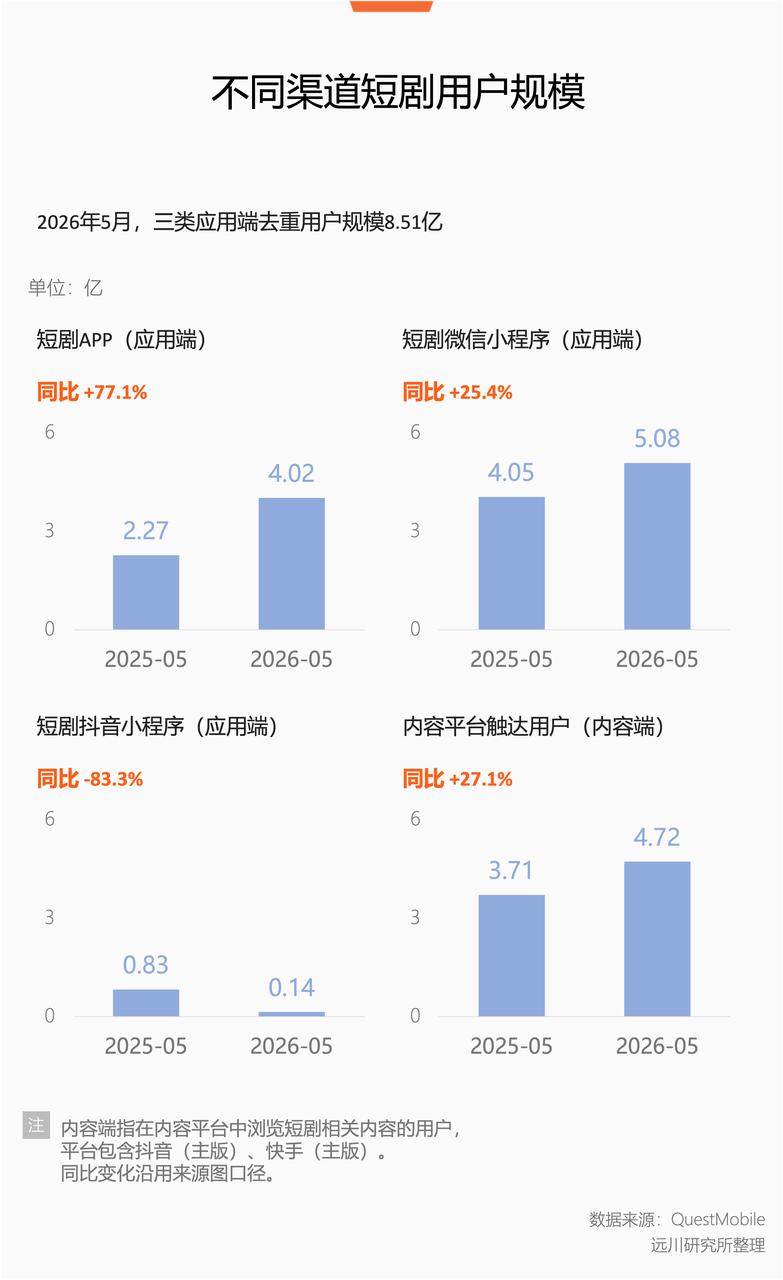
The more complex the upstream and downstream of an industry, the greater the game space in it.
The upstream and downstream links of the industry are closely connected, and each link has a natural motivation to expand its own discourse power. The "de-Ningde era" trend of auto companies that has been widely discussed before is the embodiment of the upstream and downstream competing for discourse power.
Although this kind of game is often interpreted as "exploitation" by one party to the other, it is essentially an objective phenomenon existing in the industrial chain: discourse power will naturally tilt to the side with a more concentrated market pattern. For example, memory manufacturers are concentrated while mobile phone manufacturers are scattered, so Apple and Xiaomi can only accept the reality of rising memory prices.
The same is true for short dramas. Content platforms master traffic, but may not master the best IP, models and production capabilities; model companies have technology, but may not have users; production companies have content production capabilities, so they can gain advantages across different channels and increase their value.
Companies that master traffic today may want to control content tomorrow; companies that sell models today may directly provide production services tomorrow; production teams that rely on platforms today may also gain stronger bargaining power because they master hit IP.
Even if a certain platform takes the lead in occupying user advantages, it cannot logically control the entire industrial chain.
Who will have the final say in AI short drama depends on how players in different links compete for the right to distribute technology, content, channels and profits.
Epilogue
Looking back on the development path of new content categories, from comics and games to online novels and short videos, almost all of them have been severely criticized.
The tradition of emerging mass entertainment causing moral anxiety has a long history, and many netizens still have a stereotype of AI short drama that it only targets the sinking market. But if you open your imagination, the theme of "I made the supply and marketing cooperative bigger and stronger after being reborn" is no different from The Count of Monte Cristo in the new century.
Content entertainment is always a real consumer demand, which is no different in the era of artificial intelligence. The boss's empty promise and cold computing power may be beautiful bubbles, but the joy of countless wonderful content blooming is real, and it is a rigid demand.
References
[1] "How to Mass Produce the 500 Billion Yuan Track, 'Overseas Short Dramas Made in Shanghai'", Jiefang Daily.
[2] "QuestMobile 2026 Short Drama Marketing Industry Report: Three Major Factors Promote Brand Short Drama Marketing to Move towards 'Precise Cultivation'", DoNews.
This article is from WeChat official account "YuanChuan Research Institute" (ID: YuanChuanInstitution), written by Director Huang, authorized for release by 36Kr.