Zeng Ming's latest 10,000-word speech: The present moment is strikingly similar to 1993
Over the past two years, everyone has been stuck in anxiety: How exactly will AI change things? What remains unchanged? Where is the inflection point?
This morning, at the Hupan Innovation and Research Center in Hangzhou, Zeng Ming held the third "Looking Ten Years Ahead" open class. Right at the opening, he said: I have been less and less anxious in the past two months, because more and more things are becoming clearer as I observe them.
He broke this transformation down into six progressively layered propositions: intelligent business, what AI-native means, the industrialization phase of AI, value creation and competition, intelligence-creating organizations, and intelligent strategy.
The core judgment is one: AI has just entered the opening of its second stage, the massive explosion of applications has not truly begun, the "browser" has not appeared yet, and everyone is on the same starting line.
The following is a refined and organized version, hoping it will be helpful to you.
I. Intelligent Business: The essence of future business is to fulfill human intentions
1. AI unlocks supply first, then unlocks demand
On the supply side, AI is becoming increasingly powerful, while its cost has been dropping sharply, and a hundredfold or even higher drop is still visible in the foreseeable future. Its most important role is to increase the quantity and richness of high-quality supply, completely breaking the historical bottleneck of scarce supply in more and more fields.
But because AI is not yet smart enough and still too expensive, all the current AI applications we see are trying to replace simple, repetitive, relatively low-value manual labor. That is why in the past two years people always feel that the huge investment in AI does not bring good results. The fundamental reason is that from day one, the ceiling of value it can create is extremely limited.
What truly creates huge value is unlocking new supply. Good private doctors, good teachers, good financial advisors, credible information experts who can give you practical advice when you travel — in every aspect, we feel that good supply is far too scarce. If more high-quality supply is brought to the general public, the social value it creates will be enormous.
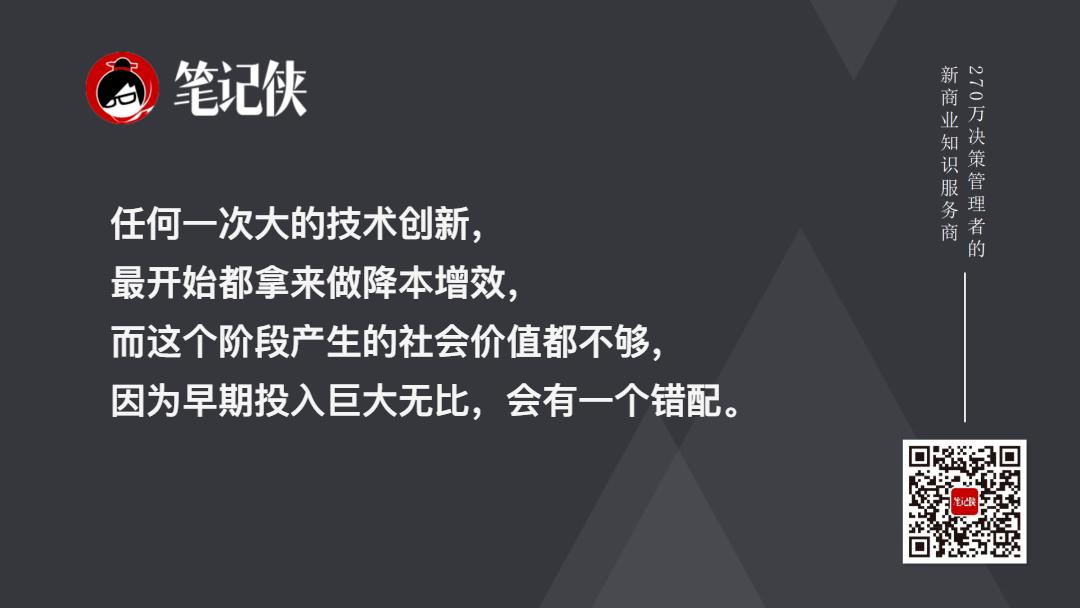
Every major technological innovation is initially used to reduce costs and improve efficiency, but the social value generated at this stage is insufficient, because the early investment is extremely huge, leading to a mismatch.
But this stage is necessary, because technology can only develop better in real scenarios. The inflection point we are about to usher in is when technology matures enough to enable real large-value innovation. At that time, the changes brought by AI will be more fundamental and extensive, and people will find the work more and more smooth, because they will enter a positive cycle. Right now, the whole industry is still in the stage of arduous exploration.
We now think that supply has been extremely involuted, and all demands that can be met have been satisfied, but the actual situation is completely different. From the demand side, simple homogeneous supply is indeed severely overcapacity, but human desires are endless, and aspirations are inexhaustible.
The biggest breakthrough brought by AI is that it can accompany us all the time at low cost, high efficiency and in real time. Whether it is a personal assistant, a house manager or emotional companion, the essence of future products is to interact with us deeply, so they will understand us better than we understand ourselves in the future. Personalized demands will be truly unlocked for the first time.
The commercial progress in the past 30 years has been driven by two technological breakthroughs: search and recommendation, and AI will bring the third technological breakthrough.
The essence of business models will also change accordingly: from the competition for attention through information brought by recommendation algorithms, to real personalization. Because recommendation essentially guesses your possible demands based on human behaviors, especially the behaviors of people similar to you, but AI does not need to guess — AI just knows.
This is the real beginning of personalized services, and the origin of extreme personalization. Therefore, from this perspective, the changes in future business will be fundamental and far-reaching.
2. From "thousand faces for a thousand people" to "a thousand faces for one person"
Every technological revolution will bring extremely huge commercial paradigm changes.
In the industrial age 150 years ago, the problem solved was insufficient supply, and the solutions were standardization, assembly lines and hierarchical systems;
In the internet age, the problem solved was overproduction. In the mid-to-late 1980s, the United States basically had excess production capacity, so it realized large-scale matching to help products find suitable users better;
The AI era aims to solve personalized demands.
The corresponding evolution path is from "one face for all" to "thousand faces for a thousand people", then to "a thousand faces for one person". Back in 2010 when we were working on Taobao, we proposed to use the platform to solve information asymmetry, improve the matching between products and users, and finally achieve "thousand faces for a thousand people". After more than ten years of efforts, this goal has been basically realized.
The next step is "a thousand faces for one person". Everyone is full of endless changes and richness. Understanding the real intention of a person in different time and different scenarios, and dynamically generating the most suitable solution for the current moment, is the future of business, whose essence is increasing personalization.
3. The starting point of business shifts from products to intentions
Up to now, the starting point of all businesses is products. The R&D and design of products are based on our assumptions and inferences about user demands. Tools may become more and more advanced, but their essence is still pre-guessing the possible demands of a group of users: first make the product, then figure out how to promote and distribute it. Commodities are the starting point of modern business.
The future will take consumers' intentions as the starting point. Because AI gives us the tool to finally get close to consumers and understand their real intentions, and only by taking intentions as the starting point can we truly achieve consumer-centric operation.
The "customer first" principle we have been talking about used to be a reflection of value propositions and corporate values. In the future, being customer-centric will be the starting point of all business models, because you have to center on it. AI revolves around it every day, understands it, and then generates solutions according to its demands.
The first step is like this: after AI understands the intention, it searches the entire network for suitable solutions or products. If there is none, you can launch a tender to see who is willing to provide the products and services you want. After the consumer confirms, AI can also execute it on their behalf.
Therefore, the core competition of future business is actually to seize the first entry point where people express their real intentions. The AI you are willing to talk to will master your real information, and it may become the starting point of your commercial activities.

But the first step is still intention matching, where commodities are selected from the existing commodity library. In the longer-term second stage, demand and supply are generated at the same time. Because "a thousand faces for one person" does not mean generating products infinitely, but finding the combination of solutions, services and products that is most suitable for this specific person at this moment, under the constraints of complex supply and the premise of cost-effectiveness requirements.
4. Once the supply side changes, the old business model will be subverted
But to achieve this, it is actually necessary to transform from the traditional supply chain to a collaborative network. The traditional supply chain is a linear information flow channel, whose essence is fixed products, fixed processes, large-scale delivery, and participating enterprises are also fixed.
The future supply network is a collaborative network, which calls different capability nodes in real time according to specific tasks to temporarily form solutions. This is a bit like the state that current personal assistants are starting to show.
After using personal assistants such as Manus (general intelligent agent product), people will find that the user experience has not changed that much. The essence is that the supply side has not changed yet, and they only use existing stock products and services to improve efficiency. Only changes on the supply side can bring substantial leaps in experience. Therefore, to achieve business breakthroughs and reach Intelligent Business 2.0, the supply side also needs to complete AI-enabled expression and combination.
To sum up, intelligent business realizes the change of business essence from selling products to fulfilling human intentions. And it will definitely form its own unique competitive advantage, because the scenario-based learning closed loop will become a new competitive advantage.

To add a little more, why is this matter so important to us? Because this is a new business model, and the new business model is bound to be subversive to the past. The commercial changes in the past 20 years are basically the continuous upgrading and optimization of recommendation algorithms. Attention economy, user duration, exposure, and DAU (Daily Active Users) are the cornerstones of current business.
The essence of AI business is to take responsibility for results and deliver results directly. When you can deliver results directly, many intermediate processes will no longer exist. This may evolve into Agent-to-Agent collaboration, and the way of collaboration needs to be explored in practice. But many past practices will face substantial challenges in the future, and new businesses will adopt a completely new model.
II. What is AI-native: If you remove AI, does the product still work?
1. Using AI does not equal being AI-native
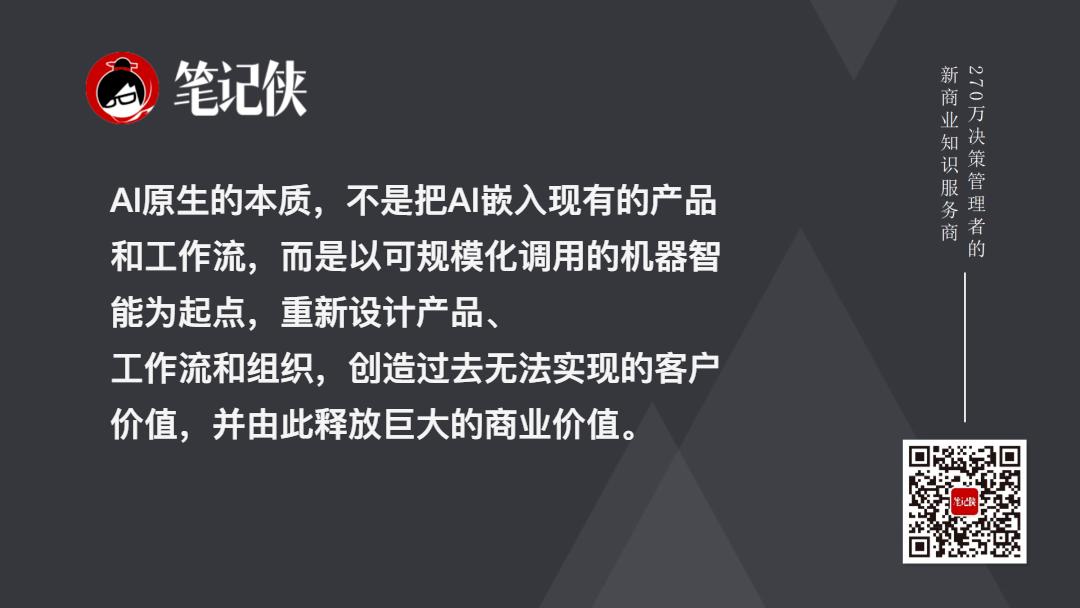
The essence of AI-native is not embedding AI into existing products and workflows, but taking the scalable machine intelligence as the starting point to redesign products, workflows and organizations, create customer value that cannot be realized in the past, and release huge commercial value accordingly.
"Scalable machine intelligence" emphasizes that general intelligence has become a new basic production factor of society. In history, the production factors were land, labor and capital. Now there is a new factor called intelligence, or labor has become human plus AI, and the whole society will change on this basis.
These layers evolve together: products change, workflows change accordingly, organizations also change, and even business models will be reshaped. The key is to give full play to the fundamental advantages of new technologies.
A direct test is: If you remove AI, can the product and business still operate normally? If it can still operate, only with lower efficiency, it is most likely AI-enhanced; if the product value, workflow or organizational mode can no longer function, it is closer to AI-native.
2. General-purpose technologies need to go through three stages
From an academic perspective, AI is an innovation of general-purpose technology.
General-purpose technologies have three characteristics:
They can be widely used at all levels;
They are major innovations that require a very long development period;
They will spawn a large number of complementary innovations, because they are fundamental innovations that require a lot of engineering innovations and application innovations to finally form large-scale innovations at the top level.
This is why Jensen Huang talks about the "five-layer cake", saying that AI ranges from the most basic power, energy and land, to chips, then to the cloud, and finally to application services. The entire technology stack requires complementary collaborative innovation, so it is a long ecological evolution process.
When AI first came out, people naturally compared it to the internet, but soon realized that it is such an important productivity breakthrough that they compared it to the Industrial Revolution. Going further, since it is based on language, abstracts and extends all human knowledge, it can be linked back to the three major original technological breakthroughs of human civilization: the use of fire, the invention of language, and the spread of writing.
Major transformations of general-purpose technologies basically go through three stages:
First, the technology is sufficiently reliable, cheap and easy to use, and becomes social infrastructure;
Second, native product and service innovations emerge on this basis, starting to truly create huge new value. Instead of making optimizations under the original technical framework, they reconstruct business and society from the bottom up according to the logic of new technologies;
Third, the new technology penetrates into all aspects of society.
Take the electrification in the United States as an example.
In 1882, Thomas Edison lit up an entire block of one square kilometer in Manhattan, which was equivalent to a productization pilot, because it required electric lamps, wires, generators and power transmission networks, demonstrating the complete prototype of electricity.
Edison founded General Electric on this basis to produce hardware such as power generation equipment and light bulbs. But his executive assistant believed that electricity should become a public utility and infrastructure, so he left to build centralized power plants and long-distance transmission networks.
In 1896, Niagara Falls used the kinetic energy of water to generate electricity, and transmitted power remotely to Buffalo more than 20 kilometers away. There were many technological breakthroughs in the middle, such as alternating current, transformers, and the formation of the modern power grid architecture, including the AC technology created by the real inventor Nikola Tesla.
Before the infrastructure business model was invented, every factory had to hire a chief power generation officer, buy GE's equipment, build a power plant, buy coal, and generate electricity on its own.
After the emergence of infrastructure service providers, the proportion of U.S. manufacturing using electricity rose sharply: about 10% in 1900, 25% in 1909, over 50% in 1920, and about 78% to 80% in 1929.
The period from 1910 to 1920 was when the infrastructure matured and applications began to explode, so the landmark event of modern industry appeared: in 1913, Henry Ford launched the assembly line at the Highland Park Ford Plant.
3. Applications will surely flourish in full bloom
After the infrastructure crosses a certain usability critical point, native applications begin to emerge intensively, and the emergence of applications in turn drives the popularization of infrastructure.
With electric lights, families are willing to connect to electricity; with electric irons, vacuum cleaners and washing machines, the value of home electricity access is further increased; but after the emergence of radios and refrigerators, no electricity means you cannot access modern family life.
This is a positive feedback loop: electricity crosses the critical point, native applications appear, the value of electricity consumption increases, more families access electricity, the market expands, more native applications emerge, technology further matures, and then penetrates into all walks of life.
Therefore, the second stage of applications will surely flourish, because it is a large-scale social exploration process. The infrastructure stage is relatively concentrated: once the direction is clear, people will invest a lot of capital and manpower to let the top talents overcome the most difficult technical problems.
But when it comes to the application stage, all kinds of possibilities emerge, because people do not know exactly what the new technology is used for, what can bring real customer value, and what users are willing to pay for.
At this time, a typical entrepreneurial wave will appear: a large number of entrepreneurs pour in to conduct various experiments on products, business models and production methods; then the market selects the winners to see who represents the future products and models; finally the industry enters the consolidation stage. This process cannot be planned linearly, and requires long-term social collaboration.
4. From Web to mobile internet, native also has version 1.0 and 2.0
The second general-purpose technology innovation is more relevant to us. Some older people have experienced some products