The "8-yuan braised pork knuckle rice" dilemma of gyms
Recently, a friend of mine called me out of the blue, saying he wanted to open a gym and asking for my opinion.
This took me by surprise. As far as I knew, he would barely consider starting a business in the fitness industry. But this time, he had a clear direction in mind: a 24-hour chain gym, and he had even inspected several franchise brands.
I advised him to wait and observe for a longer period, and reminded him that running a store requires full dedication, which is far less easy than described in the franchise introduction. I actually spent the whole call trying to talk him out of the plan. But what concerned me more than whether he would open the store was that even he had begun to seriously research 24-hour gyms.
This is somewhat similar to the scenario when the stock market heats up: people who never used to invest in stocks start discussing which share to buy. Latecomers do not necessarily lose money, but the change in participants often means that this business has evolved from a niche experiment for a few people to a well-known entrepreneurial choice.
My friend said when he attended investment promotion conferences, he found that many people preparing to enter the industry had no prior connection to the fitness sector. Some used to run tobacco and alcohol stores, some owned mahjong parlors, and others had operated small chain businesses like facial wash bars and hair wash shops.
Some of these people reaped returns in the early stage of development of new business formats, and are now looking for their next project: an investment of 300,000 to 500,000 yuan that can be replicated, with operational support provided by the brand headquarters.
24-hour gyms meet their expectations for this type of project. (Extended reading: 24-hour gyms are full of unemployed young people | Quite Interesting)
Small footprint, monthly payment system, smart access control, fewer sales staff, plus headquarters support for site selection, equipment procurement and opening promotion. The required investment and manpower for a gym are thus greatly streamlined, and even entrepreneurs with no prior industry experience can arrange their preparation work accordingly.
However, the lowered entry threshold also means competitors can enter the market more easily. Whether the profitability conditions of early stores can still hold after the continuous increase in supply is the problem that latecomers need to face.
01
Low price used to be a good answer
In the past two years, low-cost gyms have indeed brought new business opportunities. They tapped into part of the incremental demand: people who had the willingness to work out before but were blocked by the high cost of membership cards finally had an affordable option.
One of the main barriers of traditional commercial gyms is the large prepaid fee before you start training. Even if the average monthly cost converted from the annual card is not high, paying two to three thousand yuan at one time is still an expense that requires careful consideration for college students, young people who have just started working, or people with no stable income for the time being.
This expense also comes with multiple uncertainties: whether you can stick to your workout plan, whether your living and working location will change, and whether the gym will remain in operation. Consumers need to take the full year's payment risk before they have fully experienced the service.
The monthly payment system shortens the prepayment cycle to one month. Pay just over 100 yuan, experience the service for a month first, and then decide whether to continue. The cost of trying fitness is reduced, and the loss from quitting halfway is also more acceptable.
Site selection near schools, communities and along commuter routes further cuts down travel time; all-day operation provides convenience for people with irregular schedules.
With the restrictions on cost, time and distance reduced at the same time, people who never considered going to the gym before now have a reason to give it a try.
Compared with relying on sales staff to repeatedly persuade customers to buy annual cards, monthly payment or even pay-per-use is easier to drive the first purchase of consumers.
Self-service fitness brands such as Metal Dog, Iron Beast Sports and Clock Duck have opened more and more stores in recent years. According to a report from *Xinjiang Daily* in August 2026, in Xinjiang alone, Metal Dog has 68 stores, Iron Beast Sports has 27 operating stores, and 14 more are under renovation. The number of stores announced on Clock Duck's official website has also exceeded 80.
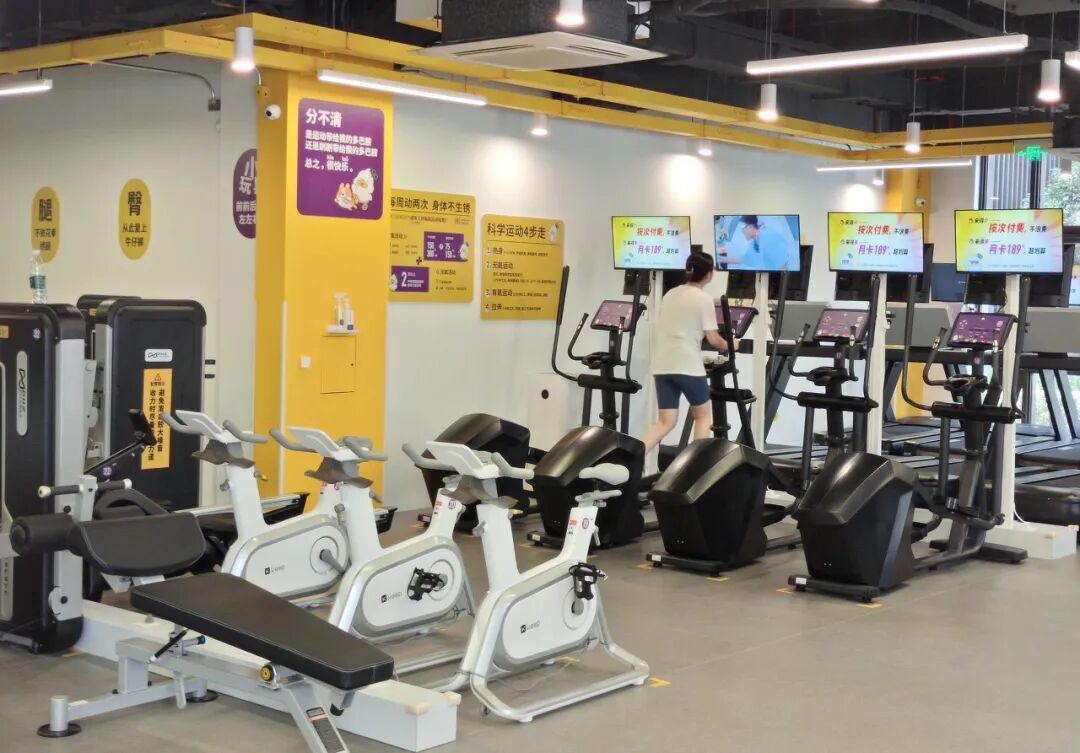
The growth of this type of store comes both from the transfer of members from traditional gyms and the addition of first-time paying trainees. Affordable price, close distance and no frequent sales pitches meet the most direct needs of this group of users. Corresponding changes have also taken place on the operation side. Focusing on the independent training needs around schools or communities, stores can reduce their footprint, do not need to equip swimming pools, some stores even save shower facilities, and cut down on sales and in-store coaches. The initial investment and daily expenses are subsequently reduced, leaving room for profitability under the monthly fee of just over 100 yuan.
The advantage of early stores lies in the unmet training demand in the surrounding area. When similar stores gradually increase, later operators need to compete for existing members, and the customer acquisition difficulty and revenue expectations will change accordingly.
02
Good locations are limited, while replication is accelerating
Areas around schools, communities and where young people gather are the site selection directions repeatedly emphasized in franchise materials. But these labels only indicate potential customer groups, and cannot replace the judgment of specific locations.
The walking distance that students can accept, whether there is a main traffic road between the community and the store, and whether the store is on the commuting path of residents will all affect the actual passenger flow. Once a store proves that the location is profitable, other operators will follow up quickly.
Take the area around universities as an example: a gym with a monthly fee of 159 yuan may obtain stable passenger flow by virtue of convenience and low price. When a second store is added, the market may still be able to accommodate it. But when the third and fourth stores open one after another, if the number of paying trainees does not grow at the same pace, these stores will start to compete for the same group of students.
When the area, equipment, decoration and operation mode are very similar, the differences perceived by consumers are quite limited. Therefore, price has become the most direct means of competition.
Dropping the price from 159 yuan to 99 yuan, then to 89 yuan, and even using a 69 yuan opening promotion to attract passenger flow is a very common choice under homogeneous competition.
The monthly payment system further reduces the cost for members to switch to other stores.
Under the annual card model, the thousands of yuan in membership fees already paid will make consumers tend to use up their remaining membership. Under the monthly payment model, as long as you do not renew your membership when it expires, you can switch to another store without losing the large amount of unused prepayment. Distance, workout partners and equipment experience can still retain members. But when these differences are not obvious, a price difference of dozens of yuan may affect renewal. If the original store charges 139 yuan per month, and the new nearby store only charges 99 yuan, consumers can completely switch to the new store for a month of experience after their membership expires.
The 1,000 members brought by the opening promotion do not equal 1,000 people who will still renew their membership half a year later. The brand headquarters can assist with store preparation and promotion, but the continuous revenue ultimately depends on the store's operational performance. The success cases in franchise materials may be formed in a stage with less competition. Entering the market when there are already many similar stores around, the single-store revenue and payback period cannot directly follow the experience of early stores.
03
How low prices affect user choices
I used to work out at a low-price chain gym and met a young man there, who came almost every day.
One day, he enthusiastically did the math for me: how much it would cost to buy two buckets of purified water at the gym every day outside; how much it would cost to take a shower there; and how much a workout would be worth. Adding all these up at the market price, he thought he "consumed" at least 20 to 30 yuan here every day, while his monthly card only cost 139 yuan.
In the end, he said to me very happily: "Bro, I earn more than 700 yuan a month from this gym."
In his calculation, working out, taking a shower and drinking water can all be converted into the benefits brought by this card. The more fully you use it, the more cost-effective the purchase is. The frequency of visits the operator expects him to maintain, or whether he will buy other services, does not affect his judgment. This is also in line with the promise of the product itself. When the store takes low price and unlimited access as its selling points, daily workout and shower are services that members have already paid for. Making full use of these rights and interests is a normal consumption choice.
If a store keeps compressing space, decoration and personnel expenses and takes low price as its main selling point, it will more easily attract price-sensitive users. The difference between 89 yuan and 79 yuan, and whether new and old members can enjoy the same discounts, will all become the basis for their comparison and selection. Since operators compete for customers with a price difference of only ten yuan, it is difficult to expect customers to ignore the same price difference when renewing their membership.
Additional consumption cannot be regarded as inevitable revenue either. Some members buy low-price monthly cards precisely to get a space for independent workout anytime. Buying a monthly card does not mean that members will also buy personal training, nutrition products or other services. Whether these products can be sold depends on actual demand.
Price preference is not equivalent to income level. People with higher income may only need basic training facilities, and people with limited budget also care about hygiene and maintenance. What stores need to understand is what users have bought, rather than presuming how much more they will spend.
Low-price monthly cards may also attract a group of high-frequency users. A friend who runs this type of gym told me that the highest daily attendance rate of his store reached 70%. According to his description, at the peak, out of 1000 members, about 700 people visit the store every day.
04
High attendance does not necessarily mean good business
In gym operation, high attendance is usually regarded as a positive signal. Continuous workout helps to form a habit, and members are more likely to renew their membership after getting training results. But under the conditions of low monthly fee, unlimited access and small footprint, high-frequency use will also increase the service pressure of the store, especially when the visiting time is highly concentrated.
For the young man I know, going to the gym frequently is exactly why the monthly card is worth buying. But for the store, once such usage habits appear in large numbers, popular equipment may be in short supply. Discussions on social platforms about queuing for treadmills, bench press benches and Smith machines also show that overcrowding has affected the workout experience of some members.
If we put the visiting situation described by my friend into a hypothetical 500-square-meter store: 1000 valid members in the current month, 700 different members visit the store every day, how much reception pressure does the store need to bear?
The key to judgment lies in the visiting time period and length of stay of members.
Assuming that half of the workouts take place within four hours in the evening, and each person stays for one and a half hours, there are an average of about 131 people present during this period. The 500 square meters also needs to exclude non-training areas such as passages and changing rooms, so equipment rotation and personnel movement will face great pressure, and comfort can hardly be guaranteed.
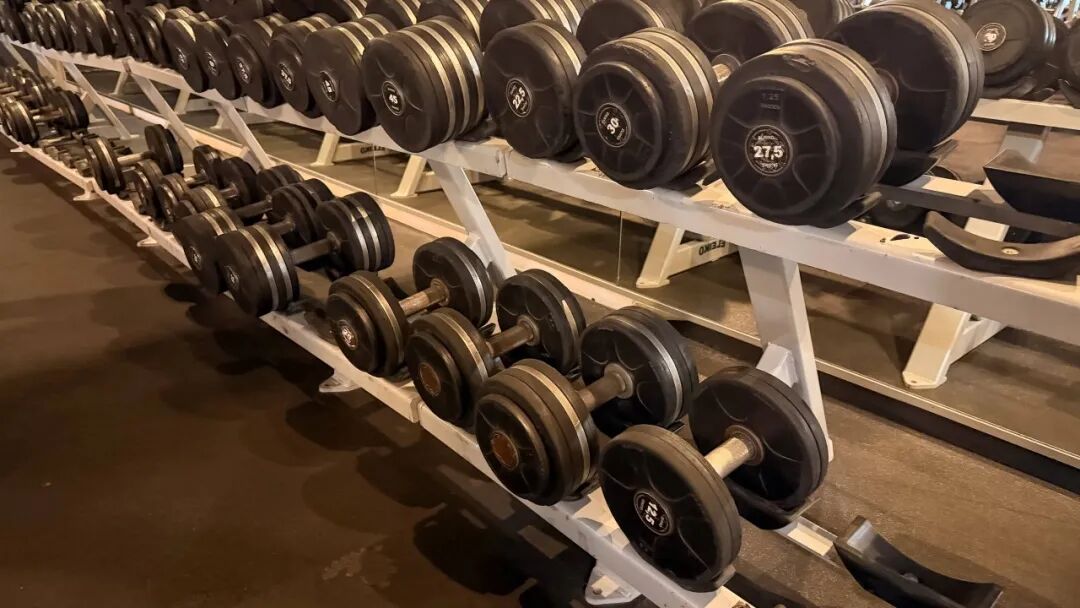
All-day operation does not mean that passenger flow can be evenly distributed. The schedules of students and office workers are relatively concentrated. Extending business hours can only disperse part of the demand, but cannot eliminate the evening peak.
No matter you use the monthly card 5 times or 25 times, the basic membership fee remains the same. Increased usage will bring more demand for cleaning, consumables and maintenance; after exceeding the existing reception capacity, it may also be necessary to add equipment or adjust the space. If the operator is unwilling to add more investment, queuing, declining hygiene and delayed maintenance will affect the experience, and then affect membership renewal.
Strong passenger flow can prove that the product has certain appeal, but it is not enough to prove that the profit model is feasible.
05
The similar dilemma of 8-yuan pork knuckle rice
Recently in Guangzhou, I saw another similar business: semi-self-service pork knuckle rice priced at around 8 yuan. A portion of rice comes with pork knuckle, pickled Chinese cabbage, green vegetables, and some are even served with half an egg or fish balls. You cannot add unlimited meat, but rice, soup and some vegetarian dishes can be refilled for free.
From the perspective of product design, this business model is not difficult to understand: attract passenger flow at a very low price, control costs by supplying meat by portion, allow free refills of rice and vegetarian dishes, and increase revenue through paid items such as extra meat and extra eggs.
The store I visited was crowded at the rice serving area, rice was scattered on the floor, and the supply of green vegetables could not keep up. Customers kept adding more rice, more dishes and more soup, trying to get a full meal within the 8-yuan price range.
"Get full for 8 yuan" is the most attractive promise of this product.
Operators may expect that most people are full with one portion, and a small amount of refills will not significantly affect profits. But what the product actually attracts may be precisely the group of people who need to add more rice many times and are unwilling to pay extra.
Both businesses need to answer the same question: if customers make full use of the promised services but rarely pay extra, can the current price still cover the costs?
06
When cost becomes the starting point of operation
I used to know a street snack vendor in Wuhan. His food tasted great, his business was good, and he was quite well-known locally. After chatting with him, I learned that he used to be a chef at a top luxury hotel in Macau.
He said that in the past, when he worked in high-end catering, he would first put forward requirements for raw materials, craftsmanship, taste and presentation, and then discuss how to control costs. After returning to Wuhan to run low-price snacks, the order was reversed: first determine how much cost a product can afford, and then try to make the best product within this range.
After the selling price and profit margin are compressed, quality improvement often has to give way to cost control. Even if you know that a certain process or a certain raw material helps to improve the product, you may not be able to keep it. This trade-off also happens in gyms.
Equipment with more comfortable movement trajectories may require higher procurement investment; increasing the frequency of cleaning can improve bathroom hygiene, but will also increase daily expenses. Compared with the intuitive 30-yuan price difference of monthly cards, these improvements can only be perceived through actual use. In the opening competition, price reduction is therefore more likely to become the priority choice of operators. But if dealing with peers' price cuts becomes the long-term focus of operation, the budget for equipment upgrading, cleaning and maintenance may be continuously compressed. The investment originally planned to be supplemented after the operation stabilizes will also continue to be postponed due to a new round of price competition. The daily discussions in the store will then focus on reducing configurations, delaying maintenance and controlling expenses.
Cost control is of course necessary, but when it continuously squeezes the space for product improvement, low price may come at the cost of declining experience. Operators need to retain members, but lack the profit to maintain service quality, so the store falls into a recurring vicious price competition.
07
There is no shortage of stores nearby, but there is a lack of suitable options
The Chinese market still has high-quality traditional clubs, high-end stores, boutique studios and professional iron gyms. The problem is