Betting on AI: The Breakout Battle of the "King of African Mobile Phones"
Recently, Transsion was listed on the Hong Kong Stock Exchange at an opening price of HK$35.2 per share. After deducting issuance expenses, the net proceeds raised by Transsion on the Hong Kong stock market are approximately HK$2.968 billion, and the primary use of this fund is R&D of AI and terminal technologies.
The development of AI is an inevitable trend, domestic mobile phone manufacturers including Xiaomi, Huawei, OPPO and VIVO have all taken AI as their core strategy. However, in this IPO financing of Transsion for AI development, we have found a problem:
On the first day of its IPO, Transsion's issue price of HK$35.30 was the lower limit of its offering range, and at the opening of the first trading day, its opening price even fell below the issue price.
This shows that the capital market lacks confidence in Transsion's AI transformation. Why is the capital market unwilling to pay for Transsion's AI dream when the entire mobile phone industry is stepping into the AI track and taking AI as the core of future growth?
01 Transsion's AI Awareness Begins to Awaken
Speaking of Transsion, what comes to your mind? Most people will immediately think of the title "King of African Mobile Phones".
While other domestic mobile phone manufacturers were engaged in fierce competition in the domestic, Southeast Asian and other markets, Transsion avoided the fierce competition and directly expanded its business in Africa: For every two mobile phones sold in the African market, one is a Transsion product.
It is no exaggeration to say that in this overseas segmented market of Africa, Transsion is the only domestic mobile phone manufacturer that can compete head-to-head with Apple and Samsung.
But behind the title of "King of Africa", Transsion has another feature — it is the domestic mobile phone manufacturer that faces the least pressure to develop AI.
Against the backdrop of the AI wave, domestic mobile phone manufacturers have followed up on AI in recent years and taken it as the core strategy for future growth:
Huawei and Xiaomi took AI as their core strategy back in 2018. OPPO and VIVO also officially shifted their focus to AI in 2024, and Honor announced at the beginning of 2025 that it would become an AI terminal ecosystem company.
When did Transsion start to take AI as its core strategy? The answer is mid-2026. In its semi-annual report, Transsion officially made it clear for the first time:
Shift its strategic focus from market expansion and product upgrading to AI-driven high-quality development and value leapfrogging.
It can be said that judging from the timing of official announcements, Transsion is the latest among all domestic mobile phone manufacturers to awaken to AI and faces the least AI-related pressure, no exceptions.
Many people may ask, why did Transsion, which has been "unresponsive" for a long time, suddenly wake up and bet heavily on AI this year? It is entirely forced by the market.
This pressure comes on the one hand from the capital market. As an A-share listed company, the capital market requires performance growth. In 2025, Transsion's performance plummeted: its revenue reached 65.591 billion yuan, a year-on-year decrease of 4.55%; its net profit attributable to shareholders was 2.581 billion yuan, a year-on-year plunge of 53.49%.
On the other hand, it comes from peer mobile phone manufacturers. Transsion's good sales performance in Africa is largely due to the fact that domestic mobile phone manufacturers did not pay enough attention to the African market, allowing Transsion to seize the opportunity first. However, with the completion of global layout, peers such as Xiaomi have begun to increase their deployment in Africa.
For example, Xiaomi has set up a dedicated strategic team specially targeting Transsion (dubbed the "Anti-Transsion Office") and entered 16 African countries; Honor has cooperated with mainstream African operators MTN and Vodacom; OPPO and vivo have invested in building factories in regions such as Egypt...
Under the siege of domestic mobile phone manufacturers, Transsion began to retreat in the African market, and its mobile phone sales volume dropped from 105.66 million units in 2023 to 91.12 million units in 2025.
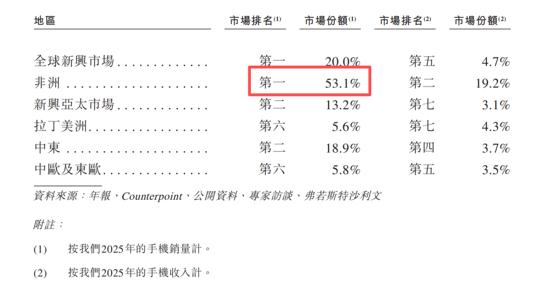
(Source: Transsion Prospectus)
Therefore, no matter for the responsibility to shareholders or the protection of the African market, Transsion must transform and take AI as its core strategy.
02 Transsion's AI Story Receives Cold Response
AI transformation sounds easy, but how does Transsion plan to achieve AI transformation?
"Concentrate resources for investment in the AI track, and deeply integrate AI technology into the whole chain of product R&D, user service and ecosystem construction". Transsion has directly written its grand blueprint for AI in this year's semi-annual report, which means that it will use AI technology to connect all its hardware products together.
This idea is more or less the same as that of domestic mobile phone manufacturers such as Xiaomi and Honor.
In fact, for domestic manufacturers such as Xiaomi, Huawei and Honor, they are no longer just mobile phone manufacturers, but have become hardware manufacturers based on mobile phones.
For example, in addition to mobile phones, Xiaomi also has smart home products, smart hardware and even SU 7 new energy vehicles. In addition to mobile phones, Honor also has other categories such as laptops, smart TVs, watches and electric scooters.
In addition to mobile phones, Transsion also has many product lines under its name:
For example, oraimo, its consumer electronics sub-brand, has TWS Bluetooth headsets, smart watches, Bluetooth speakers, power banks and other products. Syinix, its mid-to-high-end home appliance brand, has smart TVs, air conditioners, refrigerators, freezers, washing machines and other products. In addition, Transsion also has products such as laptops, earphones and two-wheeled electric vehicles.
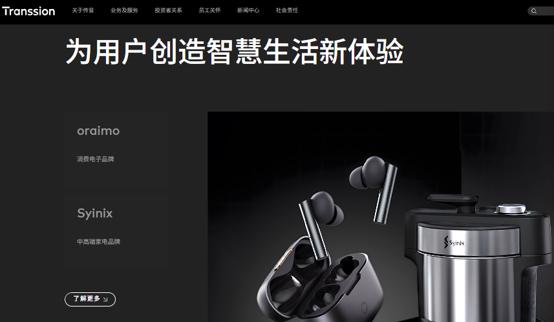
(Source: Transsion Official Website)
These mobile phone manufacturers hope to use the carrier of mobile APPs to connect these hardware devices to form a smart ecosystem. But with the emergence of AI, the role of mobile APPs has been replaced by AI.
Transsion also intends to follow a similar AIoT idea to build its own smart hardware ecosystem. Once it connects smart hardware such as mobile phones, computers, home appliances and speakers through AI, it will build an ecological barrier in the African market.
This will create a phenomenon: for an African family, once most of their 3C products are Transsion's products and they enjoy Transsion's AI intelligent services, consumers will subconsciously choose Transsion's system products when buying 3C products, which will make it very difficult for other brands to enter the market.
It can be said that Transsion's strategic transformation of AI is to take advantage of its high market share in the African market, and use the concept of AI ecosystem to build a barrier to prevent other players from intervening, so as to transform itself from the King of African Mobile Phones to the King of African Smart Hardware.
The vision of the AI concept is very attractive, but the capital market is obviously not confident enough in this grand blueprint of Transsion's AI transformation.
This can be seen from the financing of its listing in Hong Kong: the issue price is set at the lower limit of the offering range at HK$35.30, and the subscription multiple of international placement is only 2.55 times.
It is worth noting that in the first 8 months of this year, among 103 new stocks, nearly half of the new stocks have an international placement subscription multiple of more than 10 times.
It is not difficult to see the capital market's cold attitude towards Transsion's AI transformation.
03 Transsion Faces AI Competition From Peer Manufacturers
Obtaining external financing through listing to develop AI is the main purpose of Transsion's listing in Hong Kong this time, and Transsion has also highlighted this point on its official website:
"After landing on the Science and Technology Innovation Board of the Shanghai Stock Exchange in 2019, Transsion has completed the A+H dual-platform layout. With the listing of H shares, the capital market channels at home and abroad will be further unblocked, which will open up new capital space for Transsion's global development."
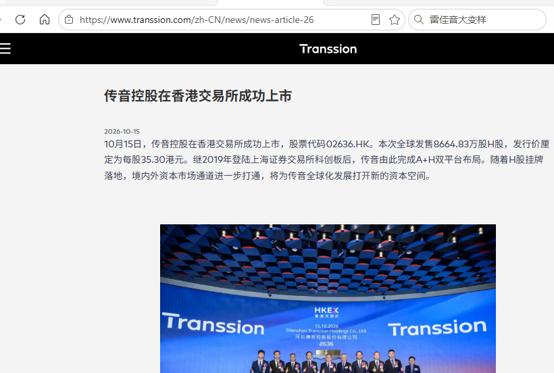
(Source: Transsion Official Website)
But can this round of financing really open up new space for Transsion? The answer is not necessarily, because the investment required for AI is extremely huge, and the funds Transsion has raised and its own capital reserves may not be able to reach the investment scale of mainstream mobile phone manufacturers in AI strategic transformation.
In the past few years, domestic mobile phone manufacturers' investment in AI transformation can be described as "burning money":
Xiaomi stated in its financial report for the first quarter of this year that in 2026, Xiaomi's investment in AI will be at least 16 billion yuan. Lei Jun even publicly stated on Weibo that from 2026 to 2028, Xiaomi plans to invest 60 billion yuan in the AI field in three years.
Although vivo has not disclosed its latest AI investment amount, as of October 2024, vivo has invested more than 23 billion yuan in R&D in the AI field.
Honor's "Alpha Strategy" for AI transformation plans to invest more than 10 billion US dollars in the next five years, with implementation carriers including Robot Phone, Agentic OS and cross-end AI ecological layout.
Judging from the above peers, the threshold for mobile phone manufacturers' AI transformation starts at least at the level of 10 billion yuan, so that AI technology can run through mobile phones, smart hardware and other businesses, and realize the transformation from a single mobile phone manufacturer to an AI ecological hardware manufacturer.
Facing the high-intensity investment of domestic peers, how much capital reserve does Transsion have?
One is the financing amount of this Hong Kong listing. According to data, the total amount of funds raised by Transsion is approximately HK$3.059 billion. After deducting HK$90.7 million of issuance expenses such as fees for hiring investment banks, its net proceeds are HK$2.968 billion (25.3 billion yuan).
The other is Transsion's cash stock. According to the semi-annual report, as of the end of the first half of 2026, Transsion's cash and cash equivalents balance is 116.41 billion yuan.
Adding up the stock cash and the financing amount, the total available cash of Transsion is about 142 billion yuan, and this cash also needs to cover the inventory of the supply chain such as memory chips.
That is to say, facing the annual AI investment of over 10 billion yuan from peers such as Xiaomi and Honor, Transsion has very limited capital available for AI transformation.
Compared with peers such as Xiaomi, Huawei and Honor:
From the perspective of timing, Transsion's AI strategic transformation is late, lagging behind its peers by 1 to 7 years;
From the perspective of resource investment, other manufacturers have an annual investment of over 10 billion yuan, while Transsion's total cash stock is only just over 100 billion yuan, and this part of the cash needs to be used for large dividends to shareholders and inventory preparation. The funds that can be used for AI are far less than that of its peers.
The capital market's cold attitude towards Transsion's AI dream is essentially not a vote against AI itself, but a reserved attitude towards the success rate of Transsion using limited resources to catch up in this 100-billion-yuan level competition.
When peers such as Xiaomi and Honor, who have invested tens of billions in the AI field and have a mature smart hardware system, pour into Africa, what can Transsion, the former King of African Mobile Phones, use to resist? At present, Transsion has no advantages either in the amount of funds available for AI investment or in the time spent on AI R&D.
This article is from the WeChat official account "Treasury Finance", the author is Vincent, the editor is Jiajia, and it is published with authorization from 36Kr.