Guoke Brain-Computer has completed tens of millions of yuan in seed round financing, solving the "four noes" dilemma in the brain-computer field.
Recently, Beijing Guoke Brain-Computer Intelligence Technology Co., Ltd. has completed a seed round financing of tens of millions of RMB. This round of financing is led by Sinovation Ventures, with Houtian Capital and Wanfang Capital participating in the follow-on investment.
Guoke Brain-Computer was founded in June 2026. It was established based on the transformation of scientific and technological achievements from the Institute of Automation of the Chinese Academy of Sciences, and focuses on the R&D and industrialization of non-invasive wearable two-way brain-computer interface technology. The company's products cover three hardware pipelines: forehead-stick type, headband type and high-density wearable brain-computer interface platform, targeting scenarios such as rapid screening of brain diseases, detection and regulation of mental and sleep disorders, and brain-computer interaction.
The company is deeply engaged in the "full-stack technology of wearable non-invasive two-way closed-loop brain-computer interface", takes "wearable hardware + AI algorithm" as the main technical line, and has formed independent technical capabilities in three directions: signal detection (reading), neural regulation (writing), and EEG decoding.
The technology and product positioning of Guoke Brain-Computer is to solve the "four noes" dilemma behind the current awkward situation where the industry is booming but real implementation is difficult, namely "inconvenient, unstable, unintelligent, and non-rigid demand".
To solve the "inconvenience" problem, the company's products adopt micro-miniaturized wearable design, integrate the closed-loop functions of "detection, decoding and regulation", and adopt unique designs such as multiple shielding, low power consumption and multi-dimensional degree of freedom structure as a whole, so as to meet the rigid preconditions for miniaturized, easy-to-wear practical application.
To solve the "instability" problem, the company's products adopt the integrated design of "hardware + AI" to realize the end-side integrated function of "sensing and computing integration", which fundamentally solves the difference of brain function signal drift caused by different models of equipment, and also eliminates the cross-dataset obstacle for building large EEG models from the source.
To solve the "unintelligent" problem, the company's products realize the complete function of "sensing and computing integration" on the end side based on the hybrid design of "MCU + FPGA", allowing users to wear and use it immediately and get real-time results, which completely solves the clumsy design of current medical products that "export data first and then manually read films or call algorithms for interpretation". Real-time interpretation results are presented in scenarios including psychiatric diagnosis and sleep monitoring.
To solve the "non-rigid demand" problem, the company's products are first pragmatically positioned for medical and health scenarios to address the diagnosis, regulation and treatment of mental health and sleep disorders. This scenario has rigid demand, and the above characteristics of the product such as "convenience, stability and intelligence" well meet the usage requirements of the demand group. Furthermore, mass implementation and application can generate highly consistent structured data, which is the foundation for building large EEG models, and also makes it feasible to expand applications in non-medical scenarios from the source.
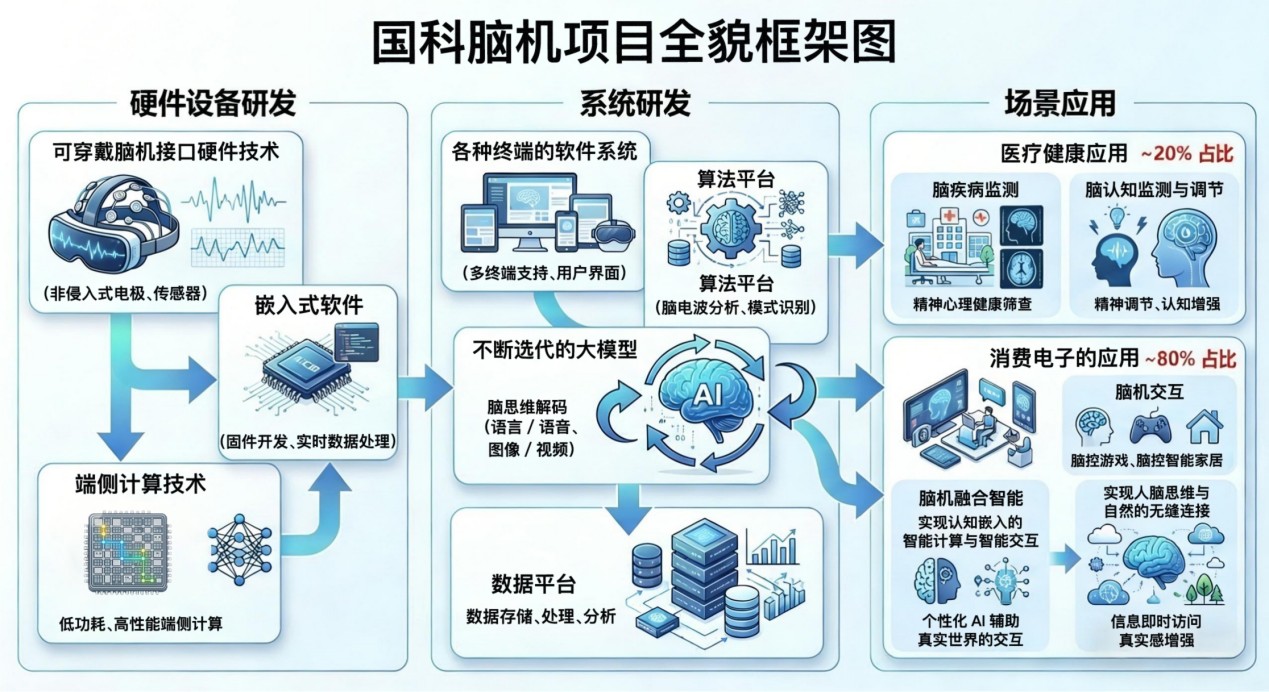
The fundamental development of brain-computer interface originates from the analysis of functional activity signals of the brain. Different brain activity patterns vary greatly, and signals detected by different devices from the same brain also differ significantly. This is why the AI large models that are popular in the field of computer vision (pictures of the same object taken by different cameras have little impact on the recognition effect of the algorithm) have not been widely applied in the field of neuroscience. This is because the large model trained by combining datasets collected by different hardware may have little guiding effect on downstream tasks. Guoke Brain-Computer's technical strategy solves this scheme defect from the very beginning, adopting the wearable "hardware + AI" mode to realize the integration of signal detection, decoding and regulation, and finally form an end-side intelligent agent for brain-computer interface.
"Integration" is the basis for the intellectualization of brain-computer interface devices, and wearable "miniaturization" is an inevitable prerequisite for devices to move towards wide-range scenario applications. This requires joint innovation of equipment products in many aspects such as "small size, high precision, strong computing power, low power consumption, and easy to wear", which is also the core idea of Guoke Brain-Computer's development. In the future, Guoke Brain-Computer will fully focus on three core dimensions of the development of the brain-computer interface field: medical health, natural interaction, and brain-computer intelligent agents, so that brain-computer interface technology can truly realize practical applications to meet demands, and even enter thousands of households.
After the completion of this round of financing, the company will expand its hardware and algorithm teams according to the established plan, promote the registration of medical devices, deepen clinical cooperative research, continuously improve the technical capabilities of "wearable hardware + AI algorithm", and promote the industrialized implementation of non-invasive wearable two-way brain-computer interface products.