220,000 ㎡! Up-and-coming AI Firm Targets Shanghai Office Buildings
Is Shanghai's office market welcoming its largest-ever single leasing deal?
Recently, market sources said that Agibot and its related companies have signed office space under the Lujiazui Group, covering three projects: Qiantan Yuan, Qiantan Shang and Yuqiao Smart Valley, with a total area of more than 220,000 square meters.
According to media reports, insiders confirmed that the relevant leasing information is true. Calculated based on market conditions, the annual rent is about 350 million yuan, excluding property management fees.
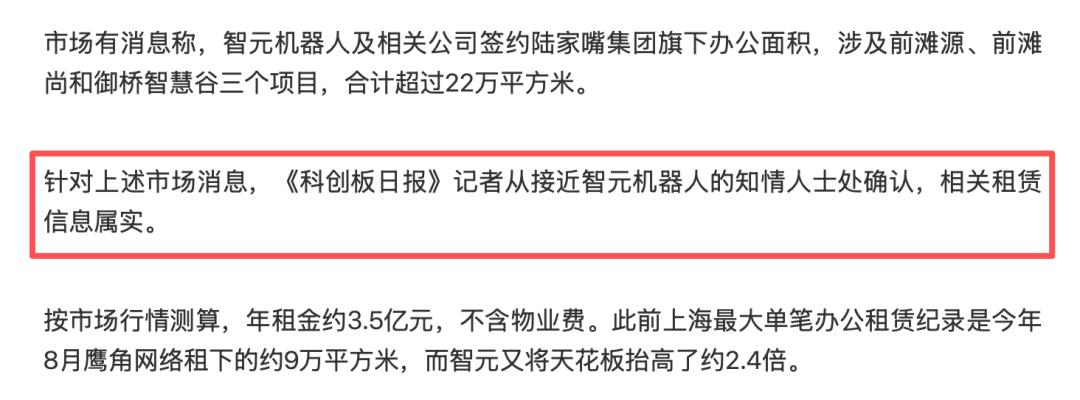
In this case, Agibot will set a new record for the single largest office leasing transaction in Shanghai, which was previously held by Hypergryph.
In August this year, Hypergryph signed for about 90,000 square meters of property in Tower T1 of the Xuhui Vanke Center Phase III. The leasing volume of Agibot is 2.4 times that of Hypergryph.
The report also pointed out that Agibot split its 220,000 square meters of space demand into three projects with completely different positioning. Among them, the leased area of Qiantan Yuan is about 63,000 square meters, which is a Grade A office complex in the core area of Qiantan Riverside, adjacent to the Waldorf Astoria Hotel, suitable for headquarters office, customer reception, brand display, etc.; the leased area of Qiantan Shang is about 73,000 square meters, which is a block-style low-density headquarters office product, more suitable for collaborative R&D of small teams.
The other leased site, Yuqiao Smart Valley, covers an area of about 88,000 square meters, namely Lujiazui Digital Smart Land · Smart Valley. The total construction area of the project is 213,400 square meters, and the part leased by Agibot accounts for more than 40% of the total construction area of the park, which is positioned for R&D, testing and pilot production.
According to industry insiders, humanoid robot R&D requires test sites, commissioning workshops and display spaces. The layout of taking the buildings in Qiantan as the headquarters reception site and the park in Yuqiao as the R&D and test site is essentially preparing for a team of 10,000 people.
Public information shows that Agibot was founded in February 2023, and quickly became one of the most high-profile leading enterprises in the humanoid robot track in a short period of time.
Among them, Deng Taihua is the founder, chairman and CEO of the company, and Peng Zhihui (known as "Zhihui Jun") is the co-founder, president and CTO. Deng Taihua is the former vice president of Huawei and the main leader of Ascend AI, while Peng Zhihui is a post-90s "Genius Youth" of Huawei.
Since its establishment, Agibot has completed multiple rounds of financing, with well-known industrial and venture capital institutions behind it including JD, Tencent, BYD, BlueRun Ventures and HSG.
In April this year, Deng Taihua revealed at the Agibot Partner Conference that Agibot's operating revenue has achieved 20-fold annual growth, rising from 300,000 yuan in the first year of the company's establishment to more than 60 million yuan in the second year, and exceeding 1 billion yuan last year. It is the robot company in China that has achieved 1 billion yuan in revenue the fastest from its establishment, and also the AI company in China that has achieved 1 billion yuan in revenue the fastest from its establishment.
According to him, this year's target can further achieve several times of growth, and the company's performance in the first quarter was very good.
On the other hand, some analysts believe that rising AI players are reshaping the pattern of Shanghai's office market.
Statistics from Cushman & Wakefield show that in the third quarter of this year, the vacancy rate of Shanghai's offices fell 2.7 percentage points month-on-month to 20.92%. Under the statistical caliber of CBRE, the vacancy rate of Shanghai's offices in the third quarter was 24.4%, marking the first month-on-month decline since last year.
Shaun Brodie, Head of Research Content, Greater China at Cushman & Wakefield, said that the current round of recovery in Shanghai's commercial office market is a structural market, and there is no sign of a full-market demand boom. Local enterprises are the main force of leasing demand, and the relocation and expansion of AI and Internet enterprises continue to underpin the market.
Earlier, international real estate consultant Knight Frank released a report stating that in 2025, Shanghai's office market completed the conversion of old and new growth drivers in a counter-cyclical environment, and the demand structure continued to optimize. Finance, professional services, and TMT enterprises have become the main leasing forces, accounting for nearly 57% in total, of which more than 35% of the leasing demand in the TMT industry comes from AI-related enterprises. While traditional major tenants are still shrinking, AI and humanoid robot enterprises have become the new major payers in the core business districts.
This article is from the WeChat Official Account "Leju Finance", written by Wu Wenting, and published with authorization by 36Kr.