Meta reduced its workforce by 12,000 in a year

Reported by Zhidx on October 22, in the early hours of today, Meta released its financial report for the third quarter of 2026. Its AI business has gradually entered the stage of product and commercialization verification: the daily active users of Meta's applications have reached 3.64 billion, with advertising revenue increasing by 26% year on year; about one and a half months after the launch of the personal intelligent agent Muse, more than 10 million users in the United States and Canada have configured their own intelligent agents, with a daily active usage ratio of about 25%.
In this fiscal quarter, Meta's revenue reached 64.601 billion USD (about RMB 431.3 billion), up 26% year on year; its net profit was 9.86 billion USD (about RMB 65.8 billion), up 264% year on year; the diluted earnings per share was 3.83 USD (about RMB 25.57).
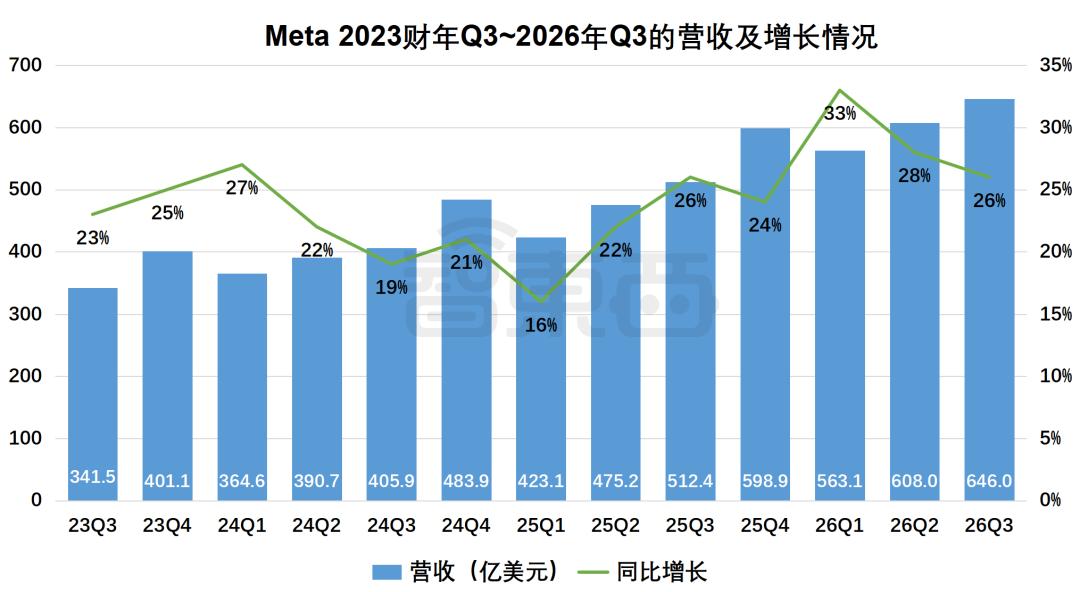
▲ Meta's revenue and growth in the past 3 years (Chart made by Zhidx)
Due to the recognition of a 9.89 billion USD (about RMB 66 billion) expense related to the US youth mental health lawsuit, Meta's operating profit decreased by 37% year on year to 12.988 billion USD, and the operating profit margin dropped to 20% from 40% in the same period last year. Excluding this expense, the earnings per share in this quarter is 7.40 USD (about RMB 49.40).
Meta's investment in AI infrastructure is also increasing rapidly. The capital expenditure in this quarter reached 34.91 billion USD (about RMB 233.1 billion), the free cash flow turned negative, standing at -2.12 billion USD (about RMB -14.15 billion).
As of September 30, 2026, the number of global employees of Meta was 66,775, a 15% decrease compared with the same period last year, a reduction of about 12,000 people. Meta is concentrating more resources on AI models, data centers, smart glasses and new product development. In addition, the Meta board of directors has also approved the establishment of new publicly traded non-voting Class C common stock, which is expected to take effect in January 2027.
As of the close of trading on October 21 Eastern Time, Meta closed at 697.52 USD per share (about RMB 4657 per share), up 0.47%, with a total market value of about 1.78 trillion USD (about RMB 11.88 trillion). After hours, Meta's stock price once rose 7% to 746.50 USD per share (about RMB 4984 per share). As of 20:00 Eastern Time after hours, Meta's stock price rose by 2.14% to 712.48 USD per share (about RMB 4757 per share).
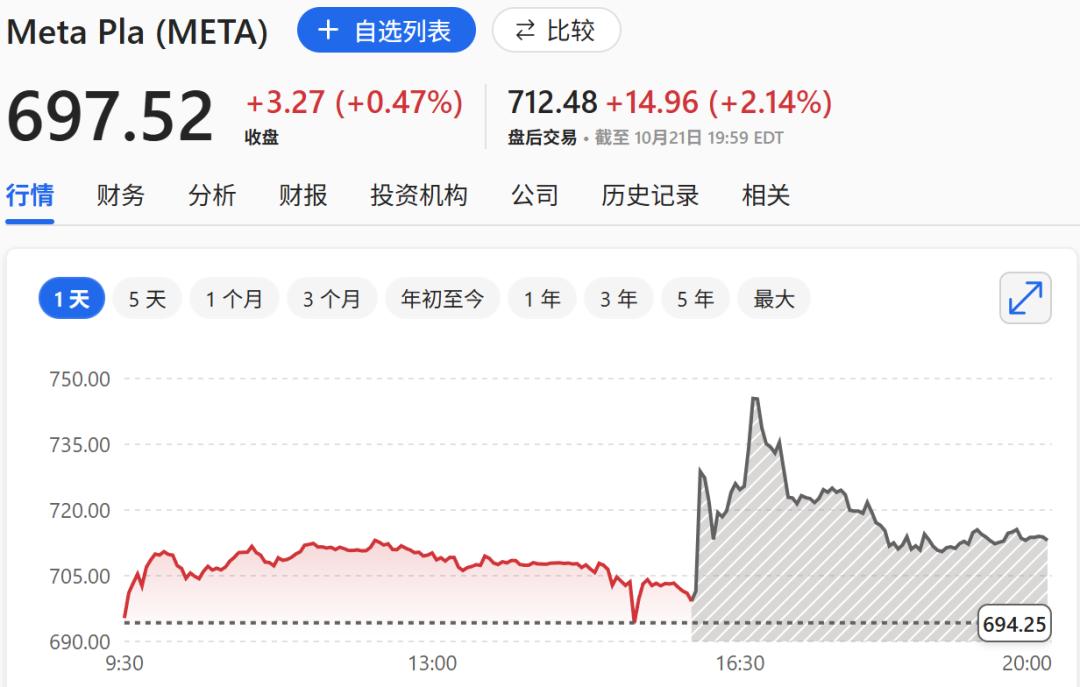
▲ Meta's stock price (Source: msn)
01. Advertising revenue hits 421 billion RMB, AI improves monetization of core business
Advertising is still Meta's most important source of revenue. The advertising revenue in this quarter reached 63.061 billion USD (about RMB 421 billion), up 26% year on year, accounting for about 97.6% of the total revenue.
By business segment, Meta's Family of Apps revenue in this quarter was 64.158 billion USD (about RMB 428.3 billion), up 26% year on year; Reality Labs revenue was 443 million USD (about RMB 2.957 billion), down 6% year on year.
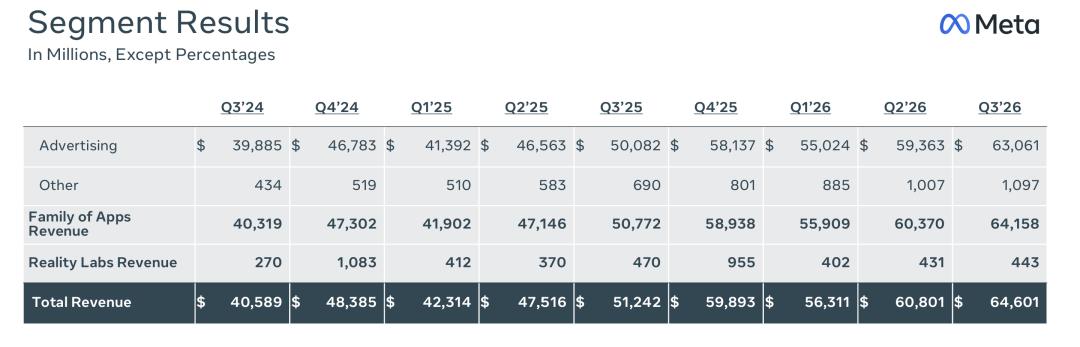
▲ Meta's business revenue in the past two years (Source: Meta)
From the perspective of advertising operation indicators, the number of ad impressions on Meta's applications increased by 10% year on year, and the average ad price rose by 14% year on year. As of September, the average daily active users of Meta's applications reached 3.64 billion, up 3% year on year. Under the circumstance that the growth rate of user scale slows down, the rise of advertising price and the increase of per-user value have become the main factors driving revenue growth.
Susan Li, Chief Financial Officer of Meta, said on the earnings call that the AI recommendation system is directly improving user engagement and ad conversion effect. In the third quarter, the average usage time per capita of Instagram worldwide achieved double-digit growth; after Meta deployed the generative retrieval architecture to Facebook Feed and Reels, the related viewing duration continued to increase.
Meta's R&D expenditure in this quarter reached 20.054 billion USD (about RMB 133.9 billion), up 32% year on year; the cost of revenue was 13.369 billion USD (about RMB 89.3 billion). Meta also migrated some content understanding models to its self-developed Muse model family. In internal tests, the related models reduced the unit content processing cost of Instagram, Threads, Facebook and advertising systems by more than 80%.
Muse has also begun to evolve from a model to a product. Mark Zuckerberg, founder and CEO of Meta, said on the conference call that about one and a half months after the launch of Muse, more than 10 million users in the United States and Canada have configured their personal intelligent agents, with a daily active usage ratio of about 25%. Shopping is one of the most common usage scenarios, with more than a quarter of users participating, and the average customer unit price exceeds 200 USD.
Zuckerberg said that Muse has shown clear product-market fit, and it is hoped that Muse will be developed into a product serving billions of people in the future.
Reality Labs' revenue in this quarter was 443 million USD (about RMB 2.96 billion), down 6% year on year; its operating loss was 4.129 billion USD (about RMB 27.57 billion). Susan Li said that the decline in Reality Labs' revenue was mainly due to the drop in sales of Quest headsets, but the revenue of AI glasses is still growing rapidly. Zuckerberg said that Muse will be connected to Meta smart glasses starting next month, becoming the core of the next-stage experience and subscription business of smart glasses.
02. Capital expenditure increases by 80%, free cash flow turns from positive to negative
Meta's capital expenditure in this quarter reached 34.91 billion USD (about RMB 233.1 billion), up about 80% year on year. Among them, the cash expenditure for purchasing property and equipment was 33.942 billion USD, and the principal payment of financial leases was 964 million USD, which is mainly used for the construction of data centers, servers and network infrastructure.
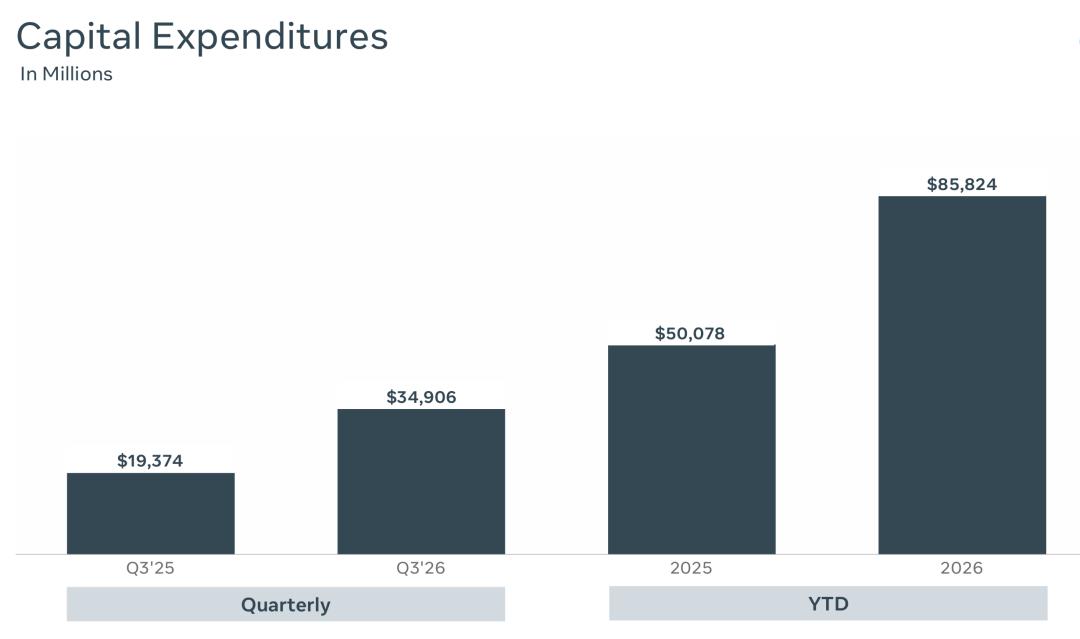
In the same period, Meta's cash flow from operating activities was 32.786 billion USD (about RMB 218.9 billion), which was lower than the capital expenditure, and the free cash flow was negative 2.12 billion USD (about RMB -14.15 billion). In the same period last year, Meta's free cash flow was 10.625 billion USD (about RMB 70.94 billion).
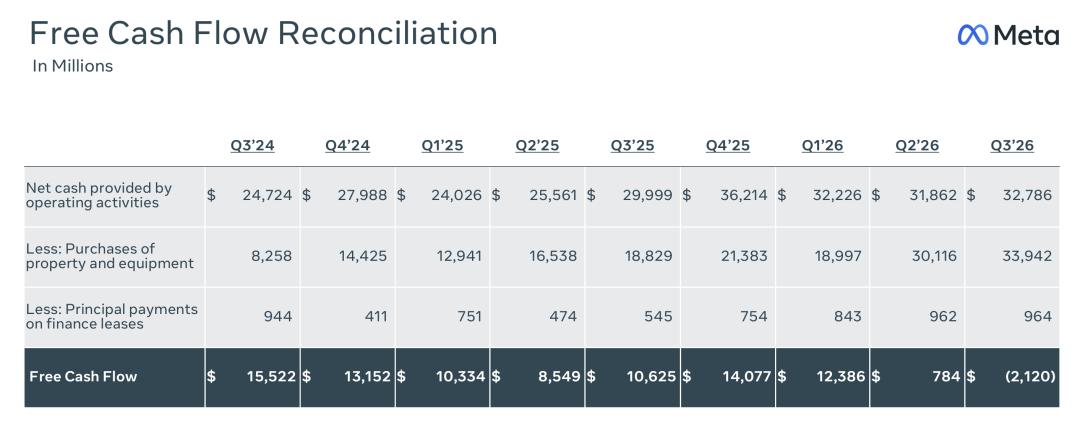
▲ Changes in Meta's free cash flow in the past two years (Source: Meta)
During the conference call, Zuckerberg said that the current operating cost of Muse is relatively high, and the company plans to increase its cost-effectiveness by more than 10 times in the next year. Meta will reduce costs by using smaller models, utilizing off-peak computing power, improving GPU utilization and reducing inference tokens. The management believes that with the improvement of model capabilities, smaller and more efficient models can be used in the future to reach the intelligence level of the current cutting-edge models.
Meta is also expanding the application scenarios of AI computing power. In addition to supporting Muse, it is also used in advertising recommendation, content understanding, enterprise API, Muse Code and other businesses to improve computing power utilization and diversify the commercialization risk of a single product.
Meta expects that the capital expenditure in 2026 will be between 135 billion USD and 145 billion USD (about RMB 901.3 billion to 968 billion); the annual operating loss of Reality Labs is expected to be 18 billion to 19 billion USD (about RMB 120.1 billion to 126.8 billion), which is expected to narrow to about 15 billion USD (about RMB 100.1 billion) in 2027.
As of September 30, 2026, the number of global employees of Meta was 66,775, down 15% year on year. The Meta board of directors has also approved the establishment of new publicly traded non-voting Class C common stock, which is expected to take effect in January 2027. Meta plans to distribute Class C shares to existing Class A and Class B common shareholders on a one-for-one basis, to expand future financing, employee incentive and M&A tools, while maintaining the founder-led governance structure.
03. Conclusion: AI brings revenue growth, cash flow continues to face pressure
Meta's third-quarter financial report shows that ad impressions, ad prices and user scale are still growing, and AI is continuously improving the efficiency of recommendation, interaction and ad conversion. The Muse application also shows potential in user growth, shopping transactions and enterprise services.
But at the same time, investments in model reasoning, data centers and smart glasses are continuously pushing up costs, and the free cash flow of a single quarter has turned negative. Meta expects that the revenue in the fourth quarter will continue to grow, reaching 73 billion to 76 billion USD (about RMB 487.5 billion to 507.5 billion). The market will focus on observing whether the new revenue from AI can cover the continuously rising infrastructure investment.
This article is from the WeChat Official Account "Zhidongxi" (ID: zhidxc om), written by Yang Jingli, published with authorization from 36Kr.