Tesla: "Over-promising Syndrome" of making unrealistic promises, "Procrastination Syndrome" in implementation, and will its bottom-line support eventually return to automobiles?
Tesla (TSLA.O) released its 2026 Q3 earnings report after U.S. stock market hours in the early morning of October 22 Beijing time, with overall performance being acceptable. The details are as follows:
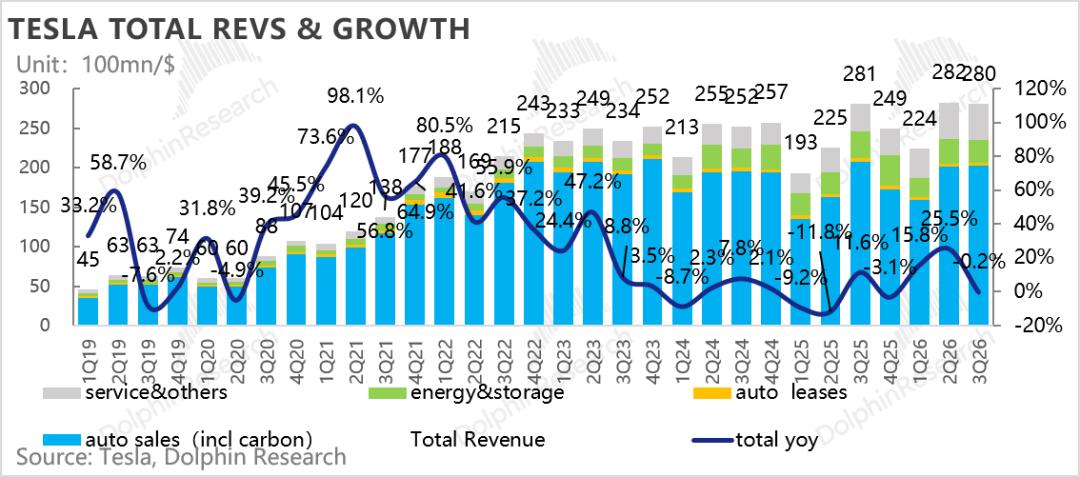
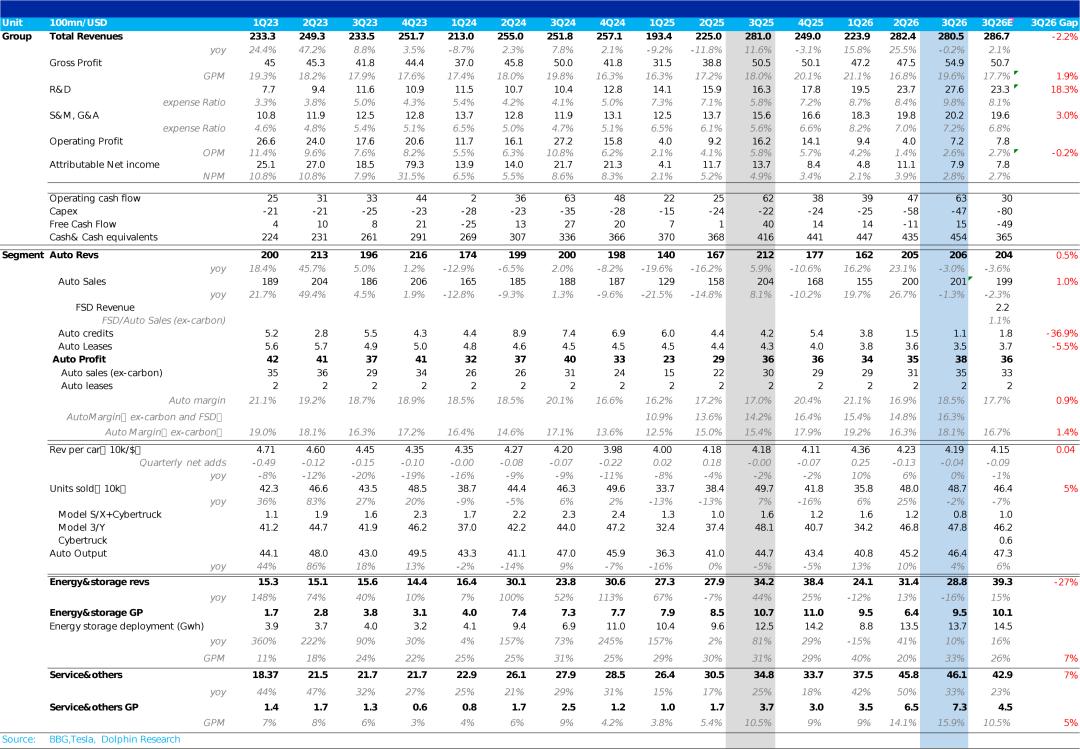
① Total revenue slightly lower than expectations: Total revenue in the third quarter was USD 28.05 billion, down 0.2% year-on-year, slightly lower than the expected USD 28.7 billion. The core vehicle sales revenue performed well, but energy storage revenue was only USD 2.88 billion, with both deployment volume and unit price lower than expectations.
② Automotive revenue exceeded expectations, average selling price per vehicle dropped slightly: Core vehicle sales revenue hit USD 20.1 billion (vs. expectation of USD 19.9 billion); the average selling price per vehicle decreased by about USD 370 quarter-on-quarter to USD 41,300, mainly affected by price cuts in China, end-of-quarter promotions, continued interest subsidies, rising proportion of deliveries in low-price markets, and declining deliveries of high-priced models such as Cybertruck.
③ Gross margin from vehicle sales improved significantly and beat expectations: The real gross margin of vehicle sales (excluding carbon credits) increased by 1.8 percentage points quarter-on-quarter to 18.1%, higher than the expected 16.7%.
The core reason is that the decline in cost per vehicle is significantly greater than the decline in selling price, coupled with the contribution of high-margin FSD revenue brought by the FSD penetration rate in North America rising to over 75%.
④ Heavy R&D investment in AI, full-year capital expenditure guidance lowered: R&D expenses increased to USD 2.76 billion (up 69% year-on-year), mainly invested in FSD training, AI chips and new product lines.
Capital expenditure for the quarter dropped to USD 4.73 billion, driving free cash flow back to positive at USD 1.53 billion; the full-year Capex guidance was lowered from "over USD 25 billion" to about USD 20 billion.
⑤ Operating profit slightly lower than expectations: The excess gross profit was basically offset by AI R&D expenses and SG&A expenses (including CEO performance bonus), resulting in operating profit of USD 720 million, slightly lower than the expected USD 750 million.
Overall view of Dolphin Research:
Overall, Tesla's performance this quarter is acceptable: revenue is slightly lower than expected, gross margin and cash flow greatly exceed expectations, and operating profit is slightly lower than expected due to AI investment constraints.
In the vehicle sales business, the unit price declined slightly quarter-on-quarter, but the real gross margin of vehicle sales rose to 18.1%. Dolphin Research believes that the recovery mainly comes from the rise of high-margin FSD revenue (penetration rate in North America exceeds 75%, and FSD has been approved for expansion to 9 countries in Europe), the dissipation of the one-off impact of Model S/X production line disassembly after production halt, the rising proportion of low-cost Shanghai-produced vehicles, and the decline in variable cost brought by the falling lithium price, which offset the rise of memory price and interest subsidy cost.
The energy storage business "dragged down" the revenue side: revenue was about 27% lower than expected, and both deployment volume and unit price were below expectations; the jump in gross margin mainly came from two one-off factors: tariff refunds and the write-back of accrued battery warranty expenses.
However, demand remains strong: Megapack for 2027 has been almost sold out, demand from data centers is booming, and the management expects ASP and gross margin to continue to rise.
But compared with the earnings report itself, the market is more concerned about the progress of the AI business, which accounts for most of the valuation:
The AI guidance in the earnings call is neutral to weak: execution data such as FSD subscriptions and Robotaxi mileage are better than expected, but unsupervised consumer FSD is delayed to 2Q27, large-scale deployment of Optimus will take at least one more year, and the "more than a dozen states by the end of the year" Robotaxi target has not been reaffirmed. The substantial monetization of AI will still be concentrated after 2027:
① Optimus: Early mass production has started, external deliveries will not begin until the end of 2027
Mass production rhythm: Elon Musk is obviously "cooling down" expectations. The Fremont production line has started "early production", and most of the equipment required for the annual production capacity of 1 million units has been in place; but the ramp-up follows the S-curve, about 10,000 links need to be done correctly, hand durability and tactile sensors are still being adjusted, and it will take at least one more year to reach about 20,000 units per week (annualized 1 million units), that is, around the end of 2027.
Current production volume: The company did not disclose it. According to research, the weekly production volume in Fremont rose from dozens of units in the second quarter to about 500 units in mid-September, and is expected to exceed 2,000 units per week by the end of the year, but the annualized volume is only about 100,000 units, which is still an order of magnitude away from the designed production capacity.
AI and delivery: The management said that it is necessary to produce 10,000 to 20,000 robots for self-practice in the Optimus Academy to form a data flywheel; the AI5 chip will be integrated around April 2027. External deliveries will start around the end of 2027, initially focusing on industrial scenarios that are dangerous, repetitive, and require 24/7 operation, and household products will be launched later.
Therefore, the external delivery time is basically consistent with market expectations, but the large-scale mass production is extended to around the end of 2027; there are limited recent catalysts: V3 has not been unveiled, only a "non-pre-programmed" demo video is promised to be released within 1-2 months.
② Robotaxi: Cybercab rhythm is better than expected, expansion target is diluted
Last quarter, the management's target was to achieve unsupervised operation in more than a dozen states before the end of the year, and the market expected the fleet expansion inflection point to be from the end of 2026 to the beginning of 2027:
Expansion progress: Unsupervised operation without safety officers covers a total of 6 cities: Austin, Dallas, Houston, Miami, Orlando, and Tampa, all in Texas and Florida; safety officers are still required in the Bay Area, and Phoenix and Las Vegas are under preparation.
Fleet size: The number of Tesla autonomous driving vehicles registered with the Texas DMV increased from about 420 at the beginning of September to about 589 at the beginning of October, of which Cybercab increased from 45 units to 169 units; compared with about 3,800 units of Waymo.
Mileage: The cumulative unsupervised mileage increased from about 380,000 miles in the second quarter to nearly 2 million miles at the end of the quarter, a quarter-on-quarter increase of about 5 times, and the weekly growth rate maintains double digits, which is in line with the guidance.
Expansion target: The target of "more than a dozen states" has not been reaffirmed; the plan is to unlock 24/7 operation and open to highways within the year. The management admitted that the current bottleneck is still technology, and it is expected to turn to regulatory constraints from 1Q27 to 2Q27.
Cybercab is the biggest highlight of this quarter: After being launched in Austin for about a month, its operation scale expanded by about 10 times, it will enter Dallas next month, and be extended to more cities before the end of the year. The nominal production capacity of the production line exceeds 125,000 units per year, which is actually higher. At present, production is scheduled according to service demand, and the constraint is regulation rather than manufacturing. A small number of units will be delivered to customers before the end of the year, but most of them will be self-owned by Tesla and operated as "Transportation as a Service".
Commercialization: At present, the cost target of USD 0.30 per mile has not been achieved, but a clear path has been seen; Musk expects it to start making significant contributions to the financial statements in 2Q27, and it will become "a major event" in 3Q27 or 4Q27.
Therefore, Dolphin Research believes that the mileage growth rate and Cybercab deployment are better than expected, but the urban expansion is significantly slower than the guidance, and the large-scale fleet expansion is more likely to fall in mid-2027, later than market expectations; the financial contribution will not be significantly visible until the second half of 2027.
③ FSD: Paid users greatly exceed expectations, unsupervised timetable is delayed
The number of global paid users exceeds 1.7 million, higher than the expected 1.57 million, and the proportion of subscription system reaches 50% for the first time; more than 75% of new cars in North America sign up for paid subscriptions upon delivery (about 55% in the second quarter), and each new car comes with a 1-month free trial by default.
But the unsupervised timetable is delayed: In addition to the software pushed with V15, vehicles also need to be included in Tesla's geofencing and fleet management system. The first batch of customer vehicles is expected to join the Robotaxi fleet around 2Q27, about two quarters later than the earlier "as early as 4Q26". Regarding the full approval of the EU, Musk said "I would be surprised if it is later than the first quarter".
Therefore, subscriptions and penetration rates are significantly better than expected, but the unsupervised core valuation node is delayed by two quarters, and no specific date is given for V15.
Finally, look at capital expenditure: The 2026 Capex guidance was lowered from over USD 25 billion to about USD 20 billion, coupled with a maximum borrowing limit of USD 30 billion (no withdrawal within the year), the short-term capital pressure is significantly eased. However, the management clearly stated that Capex will rise significantly next year, reaching tens of billions of dollars in 2028, invested in Robotaxi fleet, Optimus, computing power and wafer fabs. AI investment has not shrunk, but is more like a rhythm shift backward.
Therefore, the positive free cash flow benefits more from the backward shift of Capex and working capital, and its sustainability is questionable; the profit volume of existing business is difficult to independently support the tens of billions of dollars of investment, and the AI business must realize self-sustainability as soon as possible.
In terms of stock price, Tesla once fell to about USD 310 after the second quarter earnings report, and then recovered to about USD 386 driven by Cybercab operation, rapid growth of unsupervised mileage, Optimus mass production expectations and better-than-expected deliveries, which has priced in a considerable part of AI progress in advance.
However, at this earnings call, the key nodes supporting the stock price have all shifted backward: unsupervised FSD is delayed to 2Q27, large-scale deployment of Optimus will take at least one more year, and the financial contribution of Robotaxi will not come until the second half of 2027. The Optimus video, 24/7 operation, Cybercab city expansion and other events within the year are more verification of the existing route, which is difficult to form a significant catalyst.
Overall, Dolphin Research maintains a relatively cautious stance. The earnings report and cash flow provide fundamental support for the stock price, but the valuation is almost entirely based on AI realization after 2027. The backward shift of nodes makes it lack reasons for upward breakthrough in the short term, and it is likely to enter a shock range.
The following is the detailed analysis of the earnings report
I. Tesla: Gross margin finally got out of the trough
Total revenue in the third quarter was USD 28.05 billion, down 0.2% year-on-year, slightly lower than the expected USD 28.7 billion, mainly dragged down by energy storage, and the core vehicle sales revenue slightly exceeded expectations.
The overall gross margin was 19.6%, up 2.8 percentage points quarter-on-quarter, higher than the expected 17.7%. Both vehicle sales and energy storage gross margins got out of the trough. By business segment:
① Automotive business: Revenue exceeded expectations, profit margin improved significantly
The total revenue of the automotive business was USD 20.56 billion, down 3.0% year-on-year, higher than the expected USD 20.4 billion, of which:
Carbon credit revenue was USD 110 million, down another USD 40 million quarter-on-quarter, continuing the downward trend after regulatory adjustments (fine cancellation).
The core automotive sales revenue (excluding carbon credits and lease revenue) was USD 20.1 billion, higher than the expected USD 19.9 billion, mainly because the vehicle selling price was higher than expected, but the vehicle selling price still decreased by about USD 370 quarter-on-quarter to USD 41,300.
The real gross margin of vehicle sales (excluding carbon credits) was 18.1%, up 1.8 percentage points quarter-on-quarter, higher than the expected 16.7%.
Dolphin Research believes that it mainly comes from the rise of high-margin FSD revenue, the dissipation of the impact of Model S/X production line disassembly after production halt, and the decline in variable cost brought by falling lithium price, which offset the rise of memory price and interest subsidy cost.
② Energy business: Revenue is significantly below expectations, the jump in gross margin mainly relies on one-off factors
Energy business revenue was USD 2.88 billion, down 15.6% year-on-year, significantly lower than the expected USD 3.93 billion, mainly due to lower-than-expected deployment volume and quarter-on-quarter decline in unit price.
The deployment volume was 13.7 GWh, lower than the expected 14.5 GWh; the unit price decreased by about 10% quarter-on-quarter to USD 0.21/Wh.
Gross margin jumped from 20.4% to 33.1%, far higher than the expected 25.7%, mainly due to two one-off factors: tariff refunds and write-back of accrued battery warranty expenses.
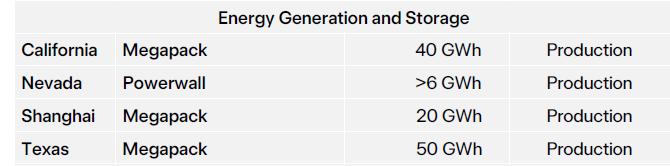
However, demand remains strong: Megapack for 2027 has been almost sold out, the management expects ASP and gross margin to continue to rise; Megafactory Texas (planned 50GWh) has been put into production, and the first batch of Megapack equipped with self-produced LFP batteries has started delivery.
③ Service business: Both revenue and gross margin exceeded expectations
Service and other revenue was USD 4.61 billion, up 32.5% year-on-year, higher than the expected USD 4.29 billion; gross margin rose from 14.1% to 15.9%, higher than the expected 10.5%, mainly from charging, insurance and spare parts.