One Year Into the AI Video Boom: The Productivity Dividend and the Loneliness and Confusion of a Generation
After taking graduation photos with his classmates, Yiye did not leave the campus. He voluntarily applied for a delayed graduation. "I'm now in my fourth year of postgraduate study, and I want to use this year to dive deep into AI."
Yiye is an AI video creator, and also a current student at the Directing Department of a Film Academy. At the end of April this year, he finished his first original AI video *The Last Shift*, which centers on the choice a bus driver makes in the era of autonomous driving. After the video was released, its performance metrics skyrocketed rapidly, earning nearly 100,000 likes on Xiaohongshu alone.
Because of this work, he received his first commercial order for AI video: as the executive director, he participated in the MV production of the new song *Wandering Immortal* by Chopstick Brothers. After that, advertising demands from well-known brands kept pouring in, with project quotations reaching as high as 1,000 yuan per second.
Yiye thought for a moment, "I did earn a little money, that's for sure."
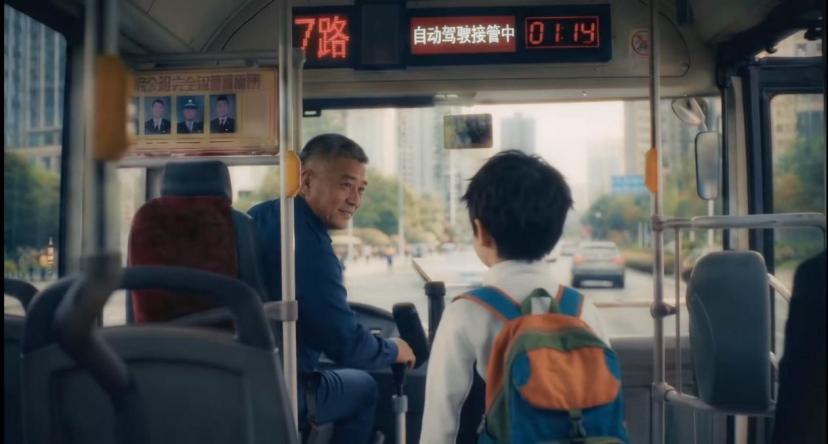
*The Last Shift* @Yiye
At a gathering of peers, "Yige Menglao" (hereinafter referred to as Menglao), the director of the AI short film *Unyielding*, met many young people similar to Yiye. They are all independent creators who have gained income through self-produced AI videos, and some of them have already set up their own "one-person companies". These creators, together with their works, gained widespread popularity on content platforms at an astonishing speed. "Some people can accumulate 200,000 fans in just one to two months," Menglao added, "but in other content tracks, it would take an average of seven to eight months to reach that level of fan growth."
Industry insiders generally agree that the boom of the AI video track started at the beginning of this year, after the release of Seedance 2.0. As the capabilities of video models keep improving, professional and amateur creators are pouring into this field continuously, driving up market demand in areas such as advertising and short drama production.
AI video is known as the new industry trend. Menglao and Yiye are super individuals in this wave, who are adventurers, trendsetters, and also beneficiaries of the boom.
"This is the wild west era of AI video," Menglao said.
This group of creators is a unique product of AI. There has never been an era before where technological progress could be so accessible to ordinary people. They can complete production and creation independently without relying on large organizations. Internet platforms are responsible for content distribution and dissemination, and the mature industrial chain helps them realize monetization quickly.
They have stepped into a brand new world, facing unprecedented traffic, revenue and technology resources.
At the same time, their confusion also follows one after another.
01
"I can barely take on all the orders coming in"
A cruise ship is floating on the sea, the camera pans upward, and the wreckage of interstellar war spacecraft is falling down.
This is the first AI video clip Yiye made this year. In order to test the quality of Seedance 2.0, he only provided a reference image of the cruising cruise ship and two lines of prompts. "The effect was a bit shocking to me," he still remembers the sound effect of the wreckage crashing into the sea, "the splash sound was very realistic."
Since 2025, Yiye has been testing AI video models over and over again. "I've been waiting, but the quality was far from meeting expectations, and those models felt like toys." After the spaceship clip was generated, he felt he had finally waited for the breakthrough. "Making blockbuster films with AI is never a dream anymore."
He showed me the opening of a commercial order, which is 8 seconds long in total, with colorful light beams shuttling between the skyscrapers in the city CBD and then penetrating into an apartment. If these 8 seconds were produced without AI, first of all, a 100% accurate CBD modeling would be required, and then all details such as the material of each building and the movement of the camera framing would need to be handled properly. The last step is rendering, which is the most time-consuming part. "High-precision rendering may take two hours to complete a single frame, but there are 24 frames in one second."
But now, even with only a 2D reference image, the AI video model can handle special effects work very well. "If you are lucky, you can finish the workload that used to take three to five days in just three to five minutes."
That advertisement was completed by him and his friends. For a 90-second finished video, the production took 6 days, and they earned 90,000 yuan in total.
Creators seem to be very fond of the scene where objects shuttle between buildings. The promotional video made by Director Chen for his personal studio "Simple AI" also has similar clips, where the flyer is a high-spirited superhero.
Director Chen has done many different jobs. After working in e-commerce for 20 years, the pandemic hit unexpectedly. After that, he started shooting product videos and promotional videos for e-commerce business owners, so he delved into AI text-to-image and video generation models. For a period of time, he even did AI account top-up services. At the end of April, OpenAI released ChatGPT-Image-2, whose upgraded image generation capability improved the quality of reference pictures for video production. "The evolution speed of AI is like a high-speed train," he soon made the decision to work on AI video full-time.
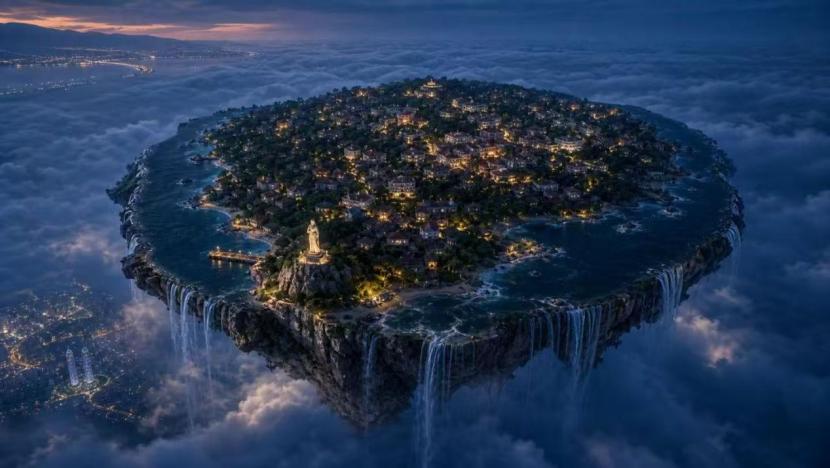
Promotional video of Director Chen's studio
"I can barely take on all the orders coming in," Director Chen said, "while I'm talking to you right now, I'm still drawing storyboards for the video." E-commerce product videos are the most in-demand orders he takes, but there are also relatively "special" tasks.
For example, a client who holds a patent for telescopic electrical wires asked him to produce videos of products such as hair curling irons, to show them to different factories and achieve cooperation through patent transfer and licensing. "I made five or six videos for him in a month, and he didn't need any modeling or actual shooting at all. It's a very smart business model."
Usually, the basic quotation for product modeling ranges from 300 yuan to 1000 yuan, and the cost of proofing and video shooting is charged separately, while the basic quotation for AI videos produced by Director Chen is 300 yuan per 15 seconds.
For clients, cost saving is the most obvious benefit of AI video models. It is not only "cheaper", but also "faster". Some short, fast-turnaround product videos can be delivered within a few hours, and time is money.
Previously, Yiye also took commercial orders for traditional advertisement shooting. He observed that after the rise of AI video models, the volume of traditional commercial orders has decreased by 40%. The capabilities of the models are still continuously improving, "In another half a year, this figure may rise to 60%."
In the industry, the business model where Yiye and Director Chen take AI commercial orders is called "contract production", which means making money by delivering AI videos to clients, and the content can be in various forms such as advertisements and short dramas. This is the most common monetization channel for creators at present, and also the source of the benefits they get from technological innovation.
But this sweetness comes with a hint of bitterness, as well as certain difficulties.
02
Rising computing power costs, and non-negotiable points consumption
AI video relies on technological innovation, and every major progress of large models can bring new possibilities. But every call to the model means a cost expenditure.
Among the creators that Xinmei has contacted, the mainstream production method is to first use tools such as ChatGPT-Image for text-to-image generation, and then use Seedance2.5 to generate videos. To ensure the output effect, memberships of GPT Plus/Pro, Jimeng, or aggregated platforms are almost standard equipment for them. Therefore, model cost is the core expenditure for creators who do contract production.
Director Chen has purchased the highest-level memberships of GPT Pro and Jimeng, but when it comes to cost, he is a little hesitant. "It's hard to calculate, this number may change at any time."
The reason behind this is that Jimeng has been raising prices continuously. The original quarterly membership fee Director Chen is paying is 11,699 yuan, and the latest discount for first-time recharge is 43% off, which is 4,999 yuan. But back in June, the first recharge only cost 3,999 yuan. At the beginning of this year, Yiye bought the annual premium membership card of Jimeng for 2,599 yuan, which came with 15,000 bonus points per month. Now, the same annual membership only gives 6,160 points per month, a reduction of nearly 60%.
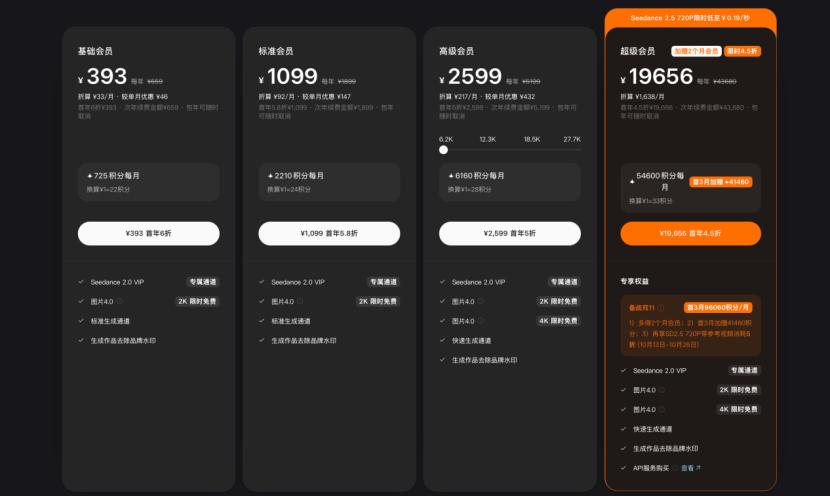
Membership price system on Jimeng's official website
Other aggregated platforms that have accessed Seedance2.0/2.5 are also raising prices together. LibTV has issued multiple official price adjustment notices, the latest one at the end of August, announcing that it plans to raise the annual card price by at least 1,000 yuan.
Director Chen said, "Seedance has already dominated the market, so naturally it has the pricing power."
It is worth mentioning that Seedance, as the absolute leading video generation model in the industry, is also the first model that actually makes real money for ByteDance. 36Kr once reported that Seedance has contributed more than half of the MaaS service revenue of its affiliated company Volcano Engine.
Director Chen estimates, "I can control the production cost within 100 yuan per 15 seconds." At present, the total membership fee he pays is four to five thousand yuan per month. Under the non-stop working mode, "I can earn 20,000 to 30,000 yuan a month at most, no matter how hard I work."
Cost control has become a required course for creators. ThxFish (hereinafter referred to as Fish), a creator in the AI video field, told Xinmei that he has been in the industry for half a year, released nearly 30 original AI videos, and taken dozens of commercial orders, but the total cost he paid for AI video models is only 659 yuan, less than 1% of his total income.
He alternates between multiple models during creation, "Kling has a relatively low trial and error cost." When generating a 15-second video in 1080P quality on LibTV, the point consumption of Kling3.0 is almost 30% of that of Seedance2.5. "Besides, Kling performs well in narrative scenes, especially when generating empty shots and fixed shots," Fish said.
Even though both Kling and Jimeng now support one-time generation of 30-second long videos, he rarely tries that. "I won't do a lot of repeated attempts to get a satisfactory result. I basically still use 10-second to 15-second generation length. If the 30-second output is not good, I have to re-generate it, and the cost will be higher."
Of course, points are never saved by scrimping. In order to attract outstanding creators, aggregated platforms such as LibTV and Tapnow have launched various incentive plans and activities with points as rewards. After Fish released his second video, he was invited to join LibTV's incentive plan, which gives him 20,000 bonus points per month. The redemption condition is that he uploads two original videos longer than 1 minute on the platform every month.
Even so, Fish still found that "after Seedance2.5 was released, the points are not enough for me". When taking commercial orders, he will negotiate with the client to let the other party bear the model cost. "If I have to do the production and pay for the computing power at the same time, I will feel a little aggrieved."
After Menglao finished the second episode of *Unyielding*, he reached a cooperation with SenseTime AI. "I barely need to worry about the points issue, and I don't have to be overly cautious when creating." But after carefully studying the market, he found that although aggregated platforms will cooperate with "super creators", this is more like marketing work to build popularity, which cannot bring direct revenue to the platform. It is a fact that the computing power cost of large models continues to rise, and the platforms will also calculate their accounts. In the future, the overall support intensity will gradually decrease and become stratified, "Points incentives will be concentrated on top creators, while middle and bottom creators will not get much share."
This means creators need to be more careful with their budget. Measuring costs like a company and trying to get as much revenue as possible has become their daily routine.
03
"Tiring, uninteresting, boring"
Theoretically, AI can already cover all links of film and television production: from the early stage of script writing, storyboard drawing, character styling, to mid-term shooting, and post-production editing, special effects and sound effects. But like all jobs that can use AI, AI is only responsible for the execution part, and it is people who truly determine the quality of the work.
Director Chen said many platforms promote "AI storyboarding", "you just need to enter a few prompts, and you can get dozens of pictures immediately", but he thinks those pictures "lack aesthetic sense and artistic effect", and it is difficult to charge a high price for them. "All my clients are repeat customers, because all the storyboards are drawn by me manually." Usually he will conceive the composition and shooting method of each picture, use PS or hand-painting for assistance when necessary, and work with AI to polish every shot. But this also brings higher labor costs.
His production speed is not fast, and a one-minute video is usually delivered within two days. He has carefully studied the market quotation, and such videos can be mass-produced at a price of 100 to 200 yuan in the market, but considering the working hours, his pricing is several times higher. "If a client keeps bargaining, I will introduce cheap labor to them. But I won't take the order myself, and I don't want to engage in price wars."
Content revision is unavoidable. For the advertisement that starts with "colorful light beams", Yiye and his friends spent six days from generation, revision to finalization. To be more precise, it was "six all-nighters". "I can't remember how many times we revised it," Yiye said. He once posted a photo of coffee on his WeChat Moments, with the workflow of multiple screens still running in the background. "I dreamed that the King of Hell praised me for having a good body," he joked self-deprecatingly.
After taking several months of commercial orders, Yiye spent about 10,000 yuan on model costs, and his income was about ten times that. But he feels that when he made the first few advertisements, "it was quite fun", but after a long time, all that is left is "tiring, uninteresting, boring". "Money can't buy the happiness of creation," he said.
Work takes up too much of Yiye's time: he has to carry his laptop with him even when traveling, he still uses the computer to do color grading when taking a taxi, and he can't focus on the dinner with important guests, "when the leader is sitting there, I'm still working overtime on the computer at the table".
"The money I earned is still hard-earned money," Yiye concluded.