Is milk tea falling out of favor? In 2026, young people are scrambling to drink "large-bottle plain water"
"From now on, we are officially stepping into the era of drinking large-volume water seriously!"
Recently, people no longer feel tired easily, and have started to enthusiastically study the "Large-Volume Water Theory".
The so-called "Large-Volume Water Theory", refers to giving up sugary drinks or beverages with excessive premium such as milk tea, and choosing large bottles of plain water of around 1.5L instead, focusing on simple hydration and returning to the essence of life.
Since the beginning of October, the trend of "drinking large-volume water" has surged in popularity on social media platforms, with a large number of netizens sharing their own "giant water bottles" and their experiences of drinking water.
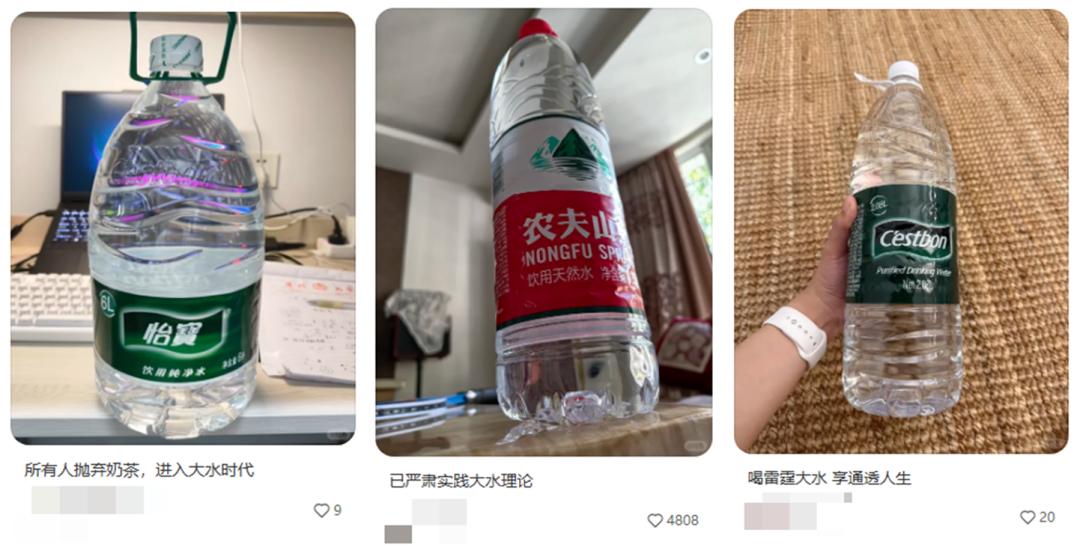
Image source: Xiaohongshu
As of October 21, the total number of views of the #LargeVolumeWaterTheory related topic on Douyin has reached 240 million.
Many people said that they have been drinking large-volume water for a long time, witnessing this niche habit gradually becoming a fashion trend. Now that this trend has finally gone mainstream, they even want to award themselves a "Pioneer of the Era" award, and compete for the title of "Academic Leader" in the field of large-volume water drinking.

Image source: Douyin comments
This trend has also spread from online to offline. On the shelves of supermarkets, large-packaged water has occupied prominent positions, and more people carrying large bottles of water are queuing up at checkout counters.
Interestingly, the conceptual boundary of large-volume water is still expanding. Within just a few days, people who follow this trend are no longer satisfied with drinking plain water only.
Some people have included large-bottle sugar-free tea, traditional Chinese health drinks, and even vitamin drinks and electrolyte water into the "large-volume water" category.
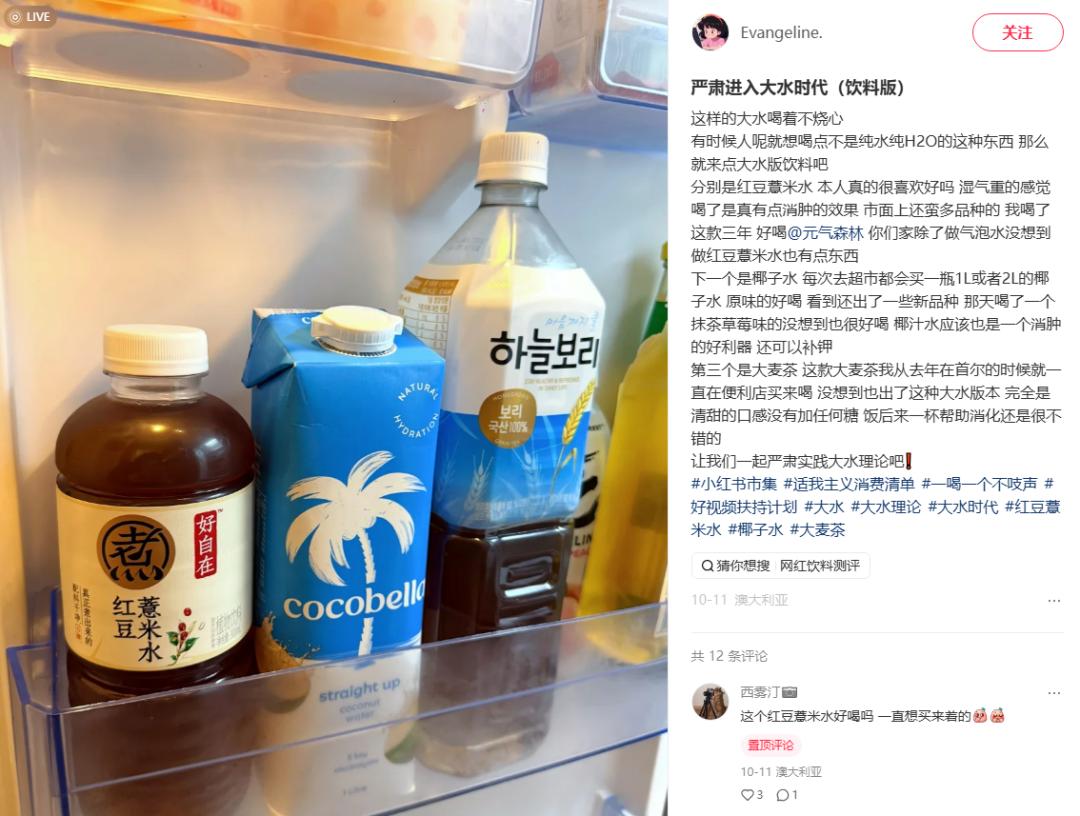
Image source: Xiaohongshu@Evangeline.
Some people have equipped their large water bottles with straw caps and cold brew tea bags, making drinking a bottle of water a ritual for gear enthusiasts.
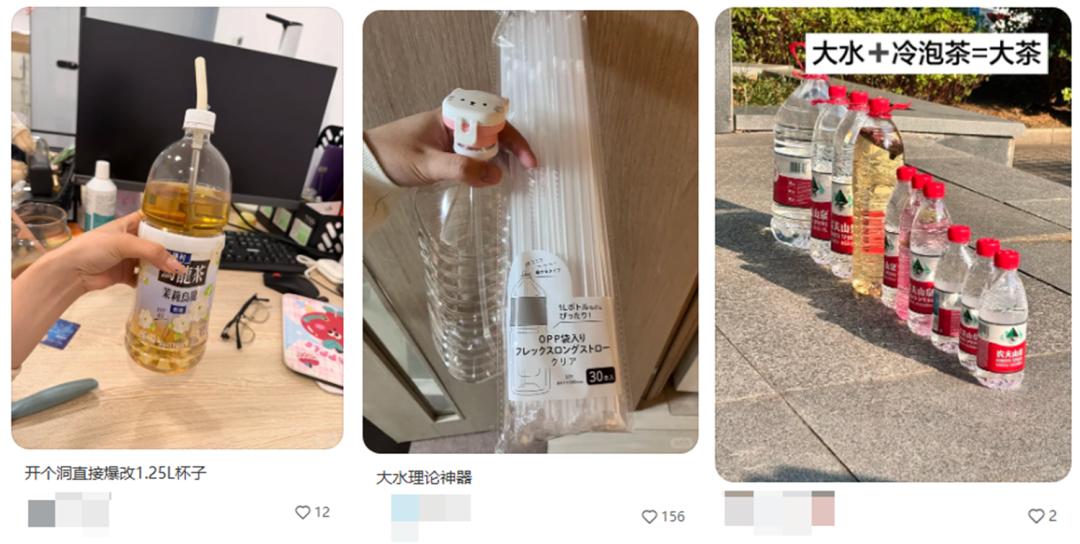
Image source: Xiaohongshu
From what to drink, how to drink, to what to drink with, large-volume water has gradually evolved from a product specification to a whole set of lifestyle.
Some people say this is the most practical and successful theory in 2026.
Of course, the Large-Volume Water Theory is not necessarily a serious new academic theory of consumerism. But its rapid resonance with the public proves at least one thing: Consumers are re-evaluating the value of beverages.
1
Tired of milk tea, do you see the value of large-volume water?
People are starting to take drinking water seriously.
The Dietary Guidelines for Chinese Residents (2022) recommends that adult men drink about 1700ml of water per day, and adult women about 1500ml. A large bottle of water of around 1.5L just provides an intuitive reference for the abstract daily water intake recommendation: One bottle of water is roughly the daily water intake target.
When the concept of large-volume water is further extended to beverages such as sugar-free tea and health drinks, consumers are not just buying more liquid, but also a drinking pattern that better fits their daily rhythm.
In the past, large packages mostly meant stockpiling for family use or sharing among multiple people; now, a bottle of large-volume water has become a daily personal supply. From occasionally buying a drink to reward yourself, to keeping a bottle at hand that accompanies you throughout work and daily life, the popularity of large-volume water reflects the extension of beverage consumption from "one-time enjoyment" to "all-day companionship".
Behind this "all-day companionship" also hides a sense of emotional control. In the fast-paced modern life full of uncertainties, it may be difficult to keep track of how much work you have finished in a day, but "finishing this 1.5L bottle of water in front of you" is an extremely definite and quantifiable goal.
When health awareness is combined with daily water intake needs, slogans like "The weak drink milk tea, the strong drink large-volume water" have the soil to spread. It endows the most trivial thing of drinking water with the meaning of self-discipline, health and even leading efficiency, making daily hydration an expression of life attitude.
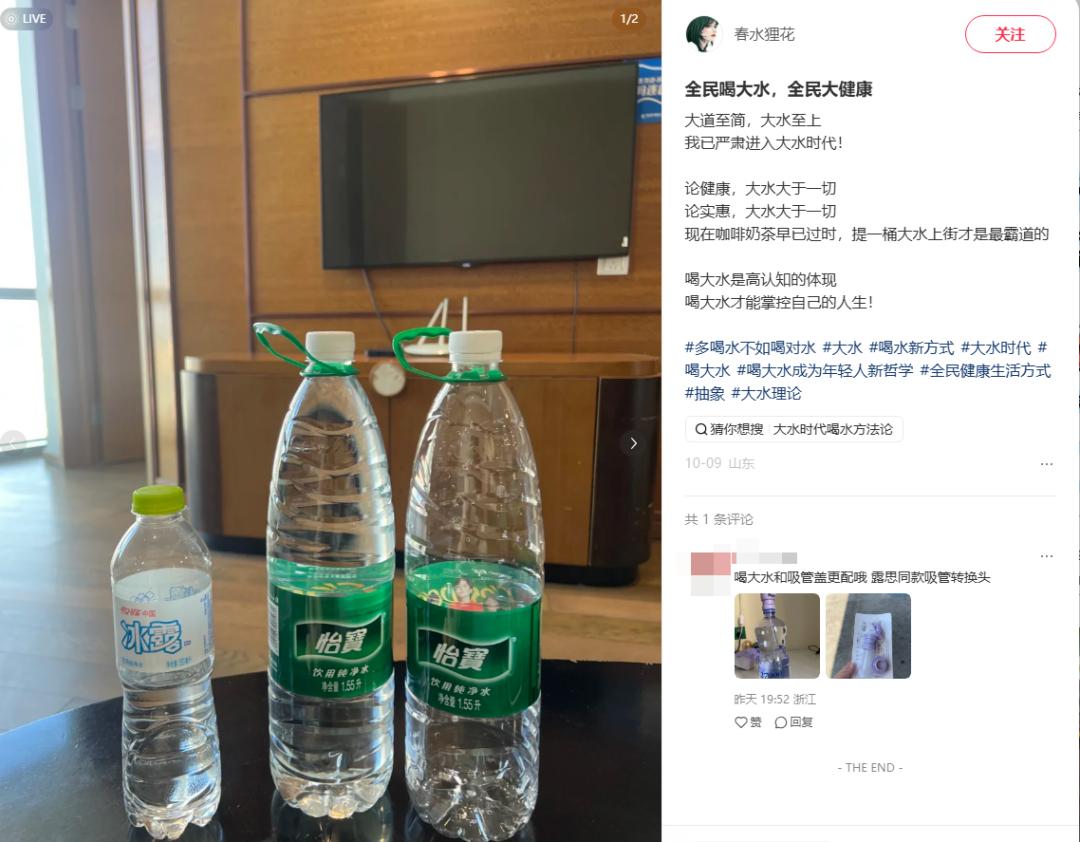
Image source: Xiaohongshu@Chun Shui Li Hua
Of course, health concepts explain why large-volume water becomes popular, while cost-effectiveness makes consumers more willing to pay for it.
It only costs one yuan more than a small bottle, but contains three times the volume. In today's era that advocates "pragmatic life", the cost-effectiveness of large bottles of water is self-evident.
Besides, the consumption scenarios of large-volume water are extensive. No matter when you are studying, working, exercising, or going out daily, a bottle of water can be a handy supply.
More importantly, large-volume water quietly reduces the decision-making cost of daily drinking.
What to drink today? Which one to buy? Do I need to buy another bottle in the afternoon? It can be said that the Large-Volume Water Theory is the perfect cure for choice anxiety. With a bottle of water on your desk, you don't need to make new decisions before you finish it.
2
Will a larger bottle lead to a bigger business?
But if you think the "Large-Volume Water Theory" is just another new meme invented by young people, you may underestimate the business signals behind it.
In 2026, the beverage industry is facing new pressure.
According to data from MaiShangYing, in the second quarter of 2026, the sales volume of the beverage category in physical retail channels decreased by 11.78% year on year, the beverage industry is entering a more intense stock competition.
Of course, this does not mean that consumers no longer drink beverages. Segmented categories such as sugar-free tea and functional drinks still have growth opportunities, but for more and more brands, relying solely on launching new products and creating new concepts to achieve growth is becoming increasingly difficult.
In this context, the Large-Volume Water Theory just provides an observation window.
In fact, many beverage brands have begun to promote their own large-packaged products, trying to ride on the wave of this "large-volume water" trend.
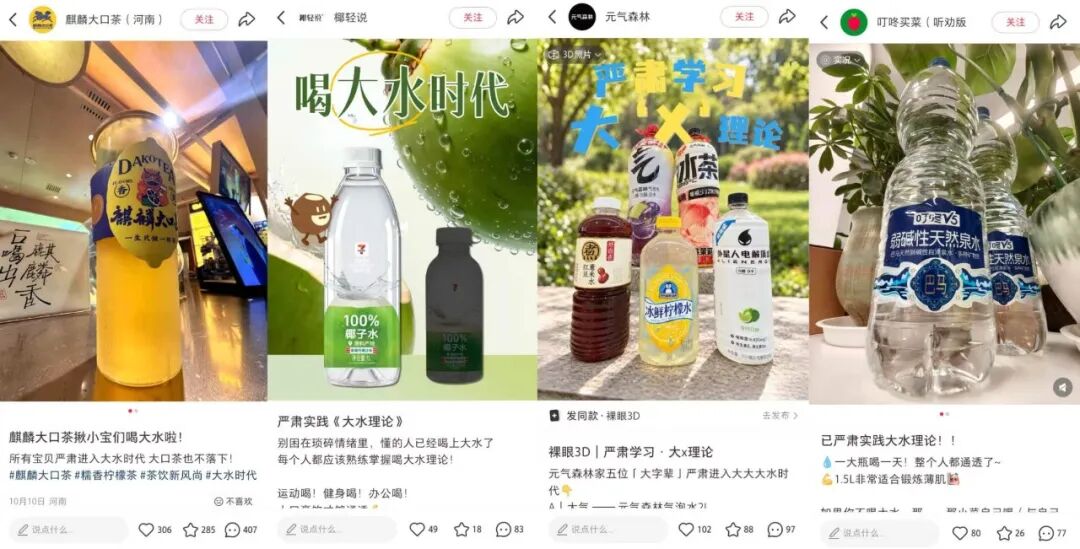
Image source: Xiaohongshu@Qilin Big Mouth Tea, Ye Qing Shuo, Genki Forest, Dingdong Maicai
This trend did not emerge out of nowhere today. In recent years, a "large-bottle" movement has quietly unfolded on beverage shelves. According to data from Nielsen IQ, as of June 2025, the sales proportion of ready-to-drink beverages with a capacity of 1 liter or more has risen to 18.7%, up 7.4 percentage points year on year.
This means that the Large-Volume Water Theory does not create a demand out of thin air. At least according to market data, large-capacity beverages have already accumulated a certain consumer base, and this online trend just gives them a chance to be noticed again.
Some brands have already reaped the benefits of large specifications.
Take Oriental Leaf as an example, its product specifications have been extended from regular size to 900ml and 1.5L. In the first half of 2025, the market share of the 900ml original jasmine tea increased by 4.0 percentage points year on year, reaching 15.2%; the market share of the newly launched 1.5L version also quickly rose to 2.8%.
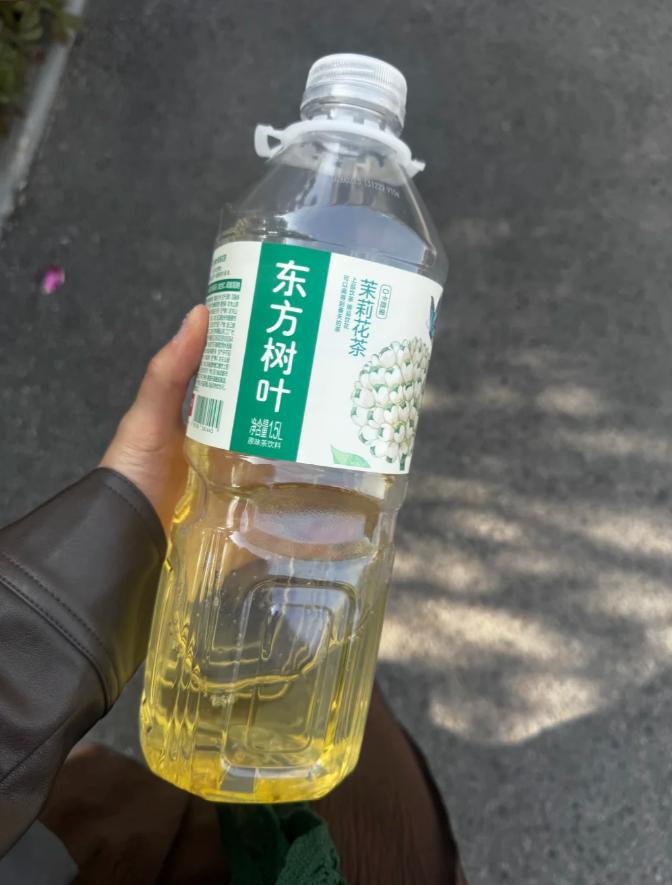
Image source: Xiaohongshu@There is caviar on the second layer of the fridge
Of course, the growth of a single brand cannot directly prove that large capacity is the decisive factor for growth, but it at least shows that: For mature products that have established brand awareness, specification innovation can indeed become a path to open up new growth space.
On the one hand, mature products do not need to build consumer awareness from scratch; on the other hand, capacity changes can bring new price bands, purchase reasons and usage patterns, allowing brands to reach demands that were not fully covered before.
However, making the bottle larger does not equal making the business bigger.
What the Large-Volume Water Theory really tests is whether brands can find the matching point between product specifications and consumer demands.
Beverages with strong taste and high sugar content are not necessarily suitable for consumers to drink in large sips for a long time; products that need to be refrigerated and are prone to flavor change after opening are also not suitable for being drunk throughout a whole day.
There is also a more realistic problem: how long will the popularity of large-volume water last? When the weather gets cold, will consumers still keep the habit of drinking large-volume beverages formed in summer? If large bottles only attract consumers to try for a short period of time, without forming stable usage scenarios, the sales volume may not be sustained after the trend fades.
The next step for large-volume water may be to find more matching opportunities. Including whether the bottle body is easy to hold, whether the bottle mouth is suitable for drinking, whether it can adapt to hot drink scenarios, whether it is easy to store after opening, and whether the product itself is suitable for drinking for a long time, etc.
Even the supporting products derived from large-volume water such as straws and cold brew tea bags provide new room for imagination for brands: can they further shift from selling a large bottle of beverage to operating a more complete drinking scenario?
In short, whether the Large-Volume Water Theory can continue to be popular remains to be tested by time. But one thing is certain: consumers' demand for beverages is never only about "whether it tastes good".
This article is from the WeChat official account "Foodaily Daily Food", written by Yomi Xue, and published by 36Kr with authorization.