Tesla's profits have plummeted by 40%, and Elon Musk can no longer sit tight, rolling out seven major initiatives in a row.
Tesla executives talk about FSD's entry into China again! L4 self-driving vehicles will go on sale at the end of this year, with 20,000 robots produced per week next year.
CheDongXi News on October 22, just now, Tesla has handed in its third-quarter financial report. In the third quarter of this year, Tesla's revenue reached 28.046 billion US dollars (about 187.232 billion yuan), down 0.2% year on year; its net profit was 787 million US dollars (about 5.254 billion yuan), down 43% year on year.
From the perspective of revenue structure, in the third quarter of 2026, services and other businesses have become one of the biggest highlights of Tesla's Q3 financial report, with revenue hitting 4.605 billion US dollars (about 30.743 billion yuan), up 33% year on year.
While the revenue of Tesla's automotive business, power generation and energy storage business all declined in the same period, among which the automotive business revenue was 20.560 billion US dollars (about 137.256 billion yuan), down 3% year on year. Correspondingly, Tesla delivered a total of 486,500 new vehicles in the third quarter, down 2% year on year. The revenue of power generation and energy storage business was 2.881 billion US dollars (about 19.233 billion yuan), down 16% year on year.
However, Tesla has also released two positive business signals. By the end of the third quarter, the number of undelivered orders for Tesla passenger vehicles has hit a new high in nearly four years; the order growth rate of the energy storage business and the backlog of undelivered orders have both reached all-time highs.
At the third-quarter earnings conference, Musk and many Tesla executives responded to 7 key issues that have drawn much attention from investors, including unsupervised FSD will be open to some customers by mid-2027, responding to the progress of FSD entering China and the competition with Chinese intelligent driving enterprises, revealing that Cybercab may open external purchase channels at the end of this year, and the Optimus humanoid robot is expected to be delivered externally next year, reaching a production rate of 20,000 units per week by the end of 2027, etc.
Although Tesla's net profit in the third quarter is declining, judging from a series of statements by Musk and executives, Tesla is investing heavily in the future.
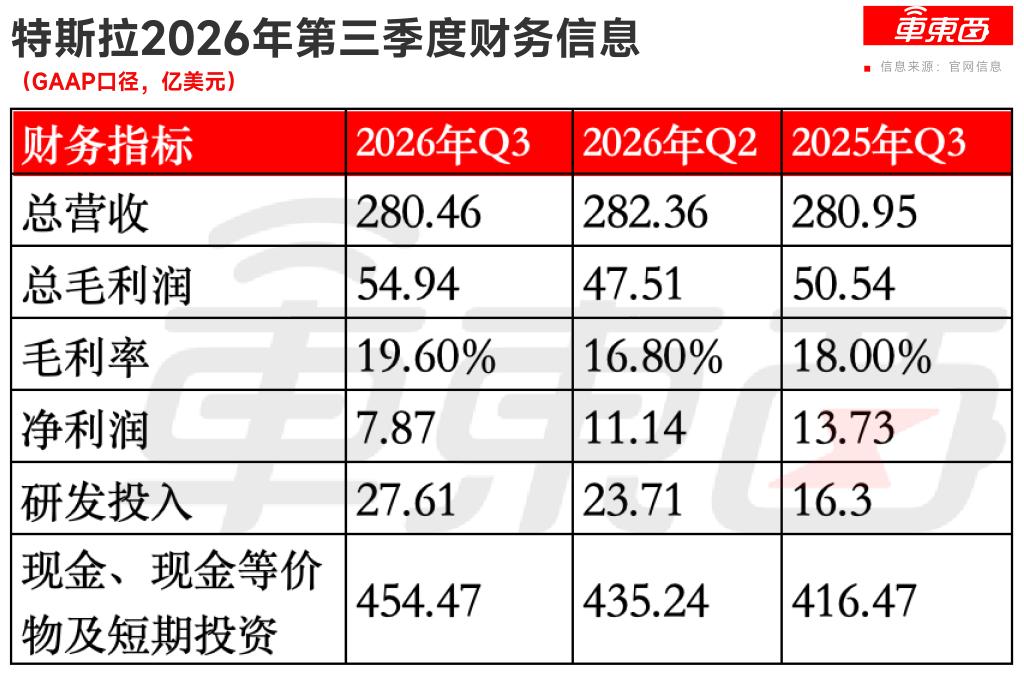
▲ Tesla's financial information for the third quarter of 2026
01.
Unsupervised FSD will be installed on vehicles next year
20,000 humanoid robots will be produced per week by the end of next year
The following are the key contents discussed at Tesla's third-quarter earnings conference. Musk and a group of Tesla executives responded to 7 core issues including the progress and version iteration of FSD entering China, robotaxi business, humanoid robots, TeraFab factory, etc. Tesla also stated that this earnings conference will not answer any questions about the potential merger between Tesla and SpaceX.
1. What is the progress of FSD approval in the Chinese market? Facing Chinese automakers and Chinese autonomous driving enterprises, does Tesla still have obvious advantages?
Tesla executives said: "We are working very hard to get FSD approved in China. It is very difficult, but FSD has been installed on some vehicles, and people who have tried it will understand how much better it is than competitors."
He also said that in terms of competition, it is relatively easy to complete the first 90% of the work, but it is very difficult to solve the long-tail problem of autonomous driving, especially to reach a safety level that allows the fleet to travel millions of miles without injuries. "I don't think competitors can achieve these in a few years."
2. When will the unsupervised version of FSD be available in customers' vehicles?
Tesla executives said that unsupervised FSD is expected to be open to some customers around the middle of next year, and then gradually promoted.
Tesla's additional requirement for FSD is to ensure that customer vehicles can access systems in Europe and other regions, and meet Tesla's redundancy management requirements to achieve full autonomous driving. It is expected that some functions will be enabled for the first batch of customers around next year.
3. When can Cybercab be sold to customers?
Musk said that external customers may have to wait until the end of this year to purchase Cybercab.
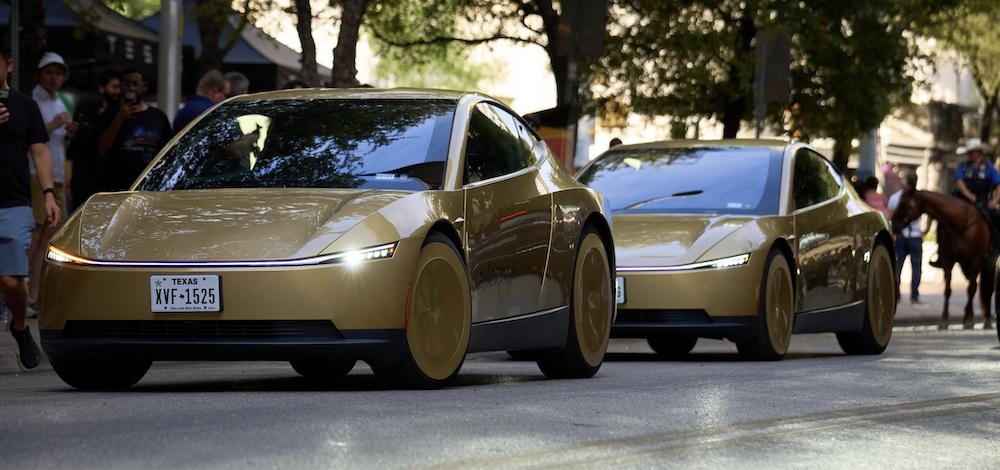
▲ Tesla Cybercab
He also emphasized that in the initial stage, Cybercab will be mainly owned and operated by Tesla, rather than sold directly to customers. Cybercab has been produced in Texas, but currently the vehicles are mainly used for Tesla's internal road tests and self-operated services.
4. What is the current operation status of Robotaxi, and what about its economy?
Tesla executives said: Robotaxi is currently mainly operating in Austin, and the profit margin has been improving, but it has not yet reached the company's target.
Tesla's current key task is to expand the operation scale. In the next few months, the Robotaxi service will be extended to more cities, and the cost will be gradually optimized based on operational experience including fleet management, pickup and drop-off, and cleaning.
The operating hours of Robotaxi will be gradually extended from the initial 9 a.m. to 9 p.m. to later hours. In the future, it hopes to achieve all-weather operation, and verify its performance in more weather conditions, day and night conditions, and high-speed scenarios.
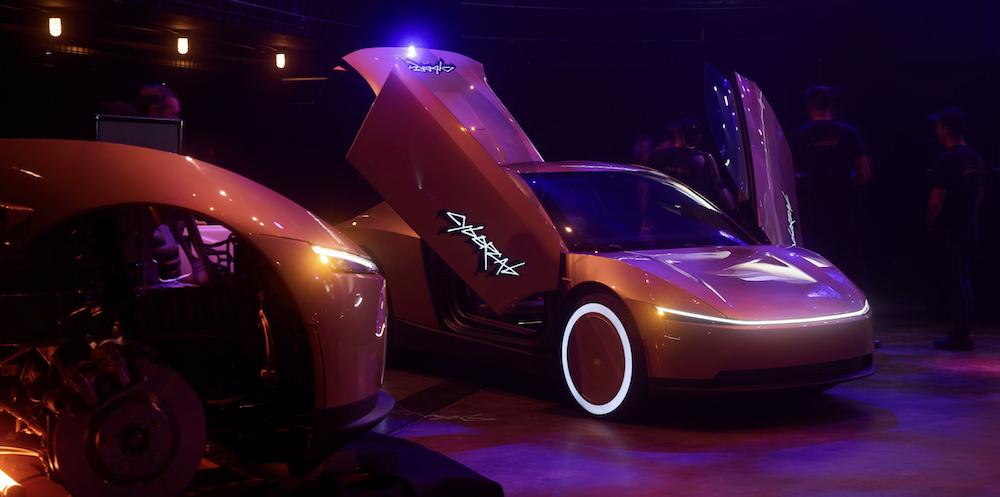
▲ Cybercab, the vehicle used by Tesla for the Robotaxi business
Musk said that if the unsupervised mileage maintains a double-digit week-on-week growth of about 15%, Robotaxi will become an important part of Tesla's revenue and profit by 2027, and may become a more important business around Q3 next year.
In terms of pricing, Tesla Robotaxi has no driver cost, and Tesla owns a large number of vehicles, so its cost economy is completely different from that of taxi platforms with drivers.
Musk also said that unless blocked by the government, Tesla will eventually become the provider of the majority of passenger travel miles in any country that allows free operation. As the scale expands, the unit economic cost is expected to reach the target of 0.37 US dollars per mile (about 2.47 yuan).
5. What stage is the humanoid robot in at present, and when can it be delivered externally?
Tesla revealed that Tesla's Optimus humanoid robot has been put into production on the mass production line of the Fremont factory. These are the first batch of mass-production quality humanoid robots built by Tesla, proving that the existing manufacturing process can be used to produce products that can be officially launched for sale.
When asked about the progress of humanoid robots, Musk said that Optimus "is currently only in early production, and the capacity ramp-up will be slow and somewhat bumpy, because this is such a brand-new product."
At the same time, he also mentioned that "there are still some parts of Optimus that need to be adjusted in design, because you need to deliver a safe, reliable and long-life robot that cannot break down in a month."
Musk said: "I still firmly believe that humanoid robots will be the largest product on the earth. Optimus is very important, but I don't want to lower expectations, because we still have a lot of work to complete, which will take about a year or so." Musk also said that no humanoid robot can be compared with Tesla's.
According to Musk's estimate, these problems will be solved by the end of next year, and Tesla will deliver Optimus to external customers around the end of next year. Musk also announced a goal: "Reach a production rate of 20,000 units per week by the end of 2027."
6. How to solve the training data of Optimus?
Musk said that the biggest difference between Optimus and cars is that cars are already running on the road and can continuously collect training data, while humanoid robots do not have such a ready-made data source.
Therefore, Tesla must first manufacture robots, write software, and then let the robots observe humans performing tasks in a way similar to human growth, and then practice repeatedly in simulation and the real world to form a reinforcement learning flywheel.
Musk said: "We are building the Optimus Academy to let robots practice a very wide range of tasks, and then feed the data back to the system."
He also said that Tesla may be ready to release an Optimus video in about a month, which shows non-pre-programmed, truly AI-driven movements, rather than pre-programmed demonstrations.
The AI 5 chip will be integrated into Optimus around April next year, and its improved computing power will significantly enhance the robot's ability to handle complex tasks.
7. What is the current progress of TeraFab, what are the capital investment and mass production schedule?
Musk said that the TeraFab wafer fab located in Austin is progressing very fast. Tesla will start equipment commissioning in the first half of next year, and hopes to launch the first batch of chip tests around May or June.
Musk also put forward a goal: "I require TeraFab to produce something useful by 2028, and the actual mass production may be in May 2028."
Tesla believes that until the beginning of 2028, the capital invested in TeraFab will be no less than tens of billions of US dollars, and may exceed 100 billion US dollars (about 6.676 trillion yuan) in the long run. Musk said that if TeraFab succeeds, it may become one of the most valuable buildings in the world, and it is also an extremely important or even necessary asset for Tesla to expand its scale.
02.
Gross profit margin increased in the third quarter, net profit fell by 40%
Tesla's third-quarter financial report shows that in the third quarter of 2026, Tesla's total revenue reached 28.046 billion US dollars (about 187.232 billion yuan), which is basically the same as the 28.095 billion US dollars (about 187.559 billion yuan) in the same period last year.
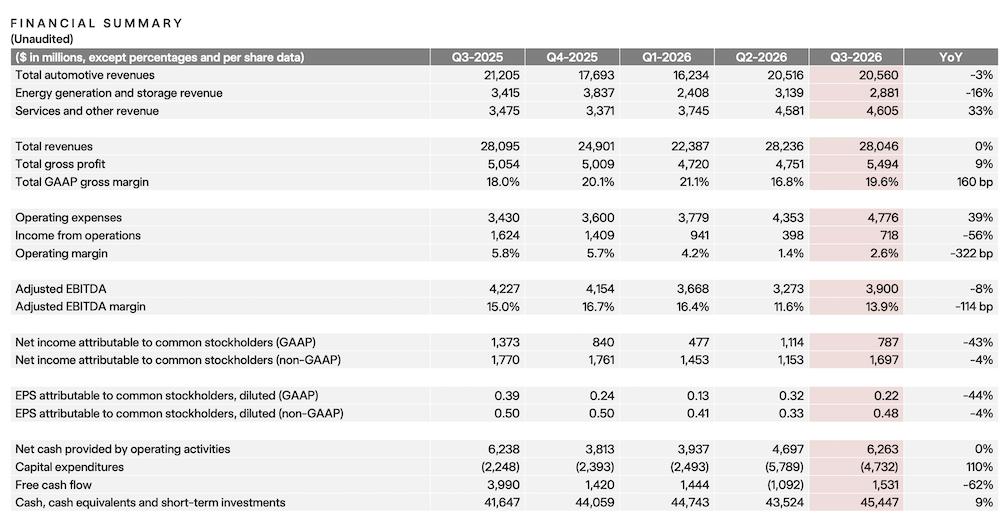
▲ Tesla's financial information for the third quarter of 2026
With revenue remaining flat year on year, Tesla's total gross profit in the third quarter of this year reached 5.494 billion US dollars (about 36.677 billion yuan), up 9% year on year. The overall GAAP gross profit margin rose to 19.6%, and the GAAP net profit attributable to common shareholders was 787 million US dollars (about 5.254 billion yuan), down 43% year on year.
In terms of cash flow, Tesla still maintains a certain cash "hematopoietic" capacity. The net cash provided by operating activities in the quarter was 6.263 billion US dollars (about 41.811 billion yuan), which was the same as that in the same period last year.
However, it is worth noting that the capital expenditure in this quarter surged by 110% to 4.732 billion US dollars (about 31.590 billion yuan), which directly led to a sharp shrinkage of free cash flow to 1.531 billion US dollars (about 10.221 billion yuan), a year-on-year decrease of 62%.
By the end of the quarter, the company's total cash, cash equivalents and short-term investments reached 45.447 billion US dollars (about 303.4 billion yuan), up 9% year on year.
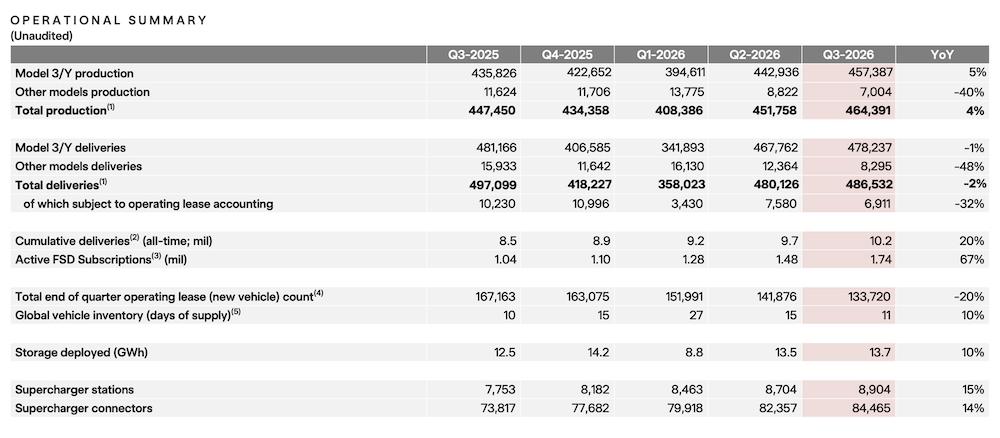
Specific to each business, Tesla's total vehicle production in the third quarter of 2026 reached 464,400 units, up 4% year on year, with a total delivery of 486,500 units, down 2% year on year.
▲ Information of Tesla's various business segments in the third quarter of 2026
Among them, the production volume of Model 3/Y reached 457,400 units, up 5% year on year, and the delivery volume was 478,200 units, down 1% year on year. Other models (Model S/X, Cybertruck, etc.) saw a significant decline in this quarter. Their production volume was only 7,004 units, down 40% year on year, and the delivery volume was only 8,295 units, down 48% year on year.
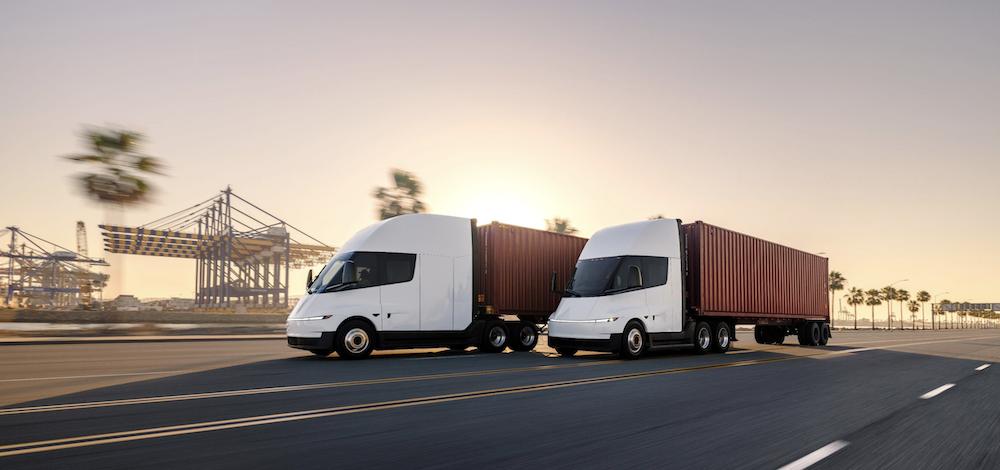
It is worth noting that Tesla officially released the new generation Roadster sports car this quarter. In addition, Tesla also revealed that Tesla's electric truck Semi has entered the stage of large-scale production. With the total weight of the vehicle, trailer and cargo at about 37.2 tons, the long-range version can reach a cruising range of about 805 kilometers, with energy consumption of about 1.06 kWh per kilometer. Under the same load condition, its energy consumption is only about one third of that of diesel trucks of the same class.
▲ Tesla Semi
In terms of software and subscription (FSD) business, this business has become one of the biggest highlights of Tesla's third