The absurd reality of Silicon Valley's medical technology industry: nearly half of the founders have no medical experience
In Silicon Valley's venture capital circle, a highly paradoxical phenomenon has long been circulating. Discussions in some industry research and on social media have torn off the glamorous fig leaf of this industry with several sets of cold hard data.
A practitioner named Wiki Milczyńska on Twitter once described that she felt a sense of dissonance when she engaged with Silicon Valley's medtech circle. Aggregated from industry research data, three figures are frequently cited:
Nearly half (about 46%) of the founders of medtech unicorns had no prior work experience in the healthcare industry before founding their companies.
More than 44% of digital health startups have not conducted any clinical trials or regulatory submissions.
Yet among the 100 most valuable healthcare companies founded in the United States since 1985, more than half (51%) were founded by physicians.
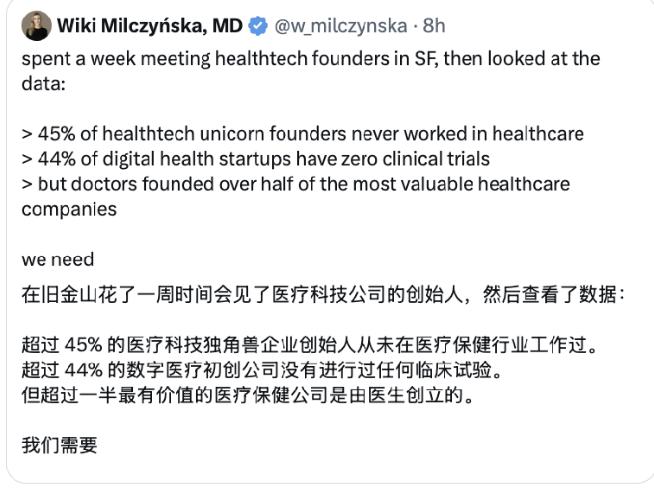
This set of figures has sparked a lot of self-deprecating discussions among clinicians on social media. Some people joked: "Should I go to San Francisco to see who I am supposed to meet?"
This set of data is like a resounding slap in the face of Silicon Valley's proud "geek wealth creation myth". It reveals an extremely absurd reality: a group of Internet elites who cannot even figure out the distribution of hospital departments are holding huge sums of money from top-tier venture capital firms, trying to "disrupt" human life and health; while the doctors who truly understand how to cure the sick and save lives are struggling to find technologies that can be truly implemented on the ground.
At the intersection of healthcare and technology, what on earth is happening?
Silicon Valley's myth of "dimensionality reduction strike": applying Internet logic to life sciences. Why do nearly half of the medtech unicorn founders not have even a single day of experience in the medical industry before starting their businesses?
The reason is that in the past decade, Silicon Valley's capital logic has extremely favored the "dimensionality reduction strike". Investors have grown accustomed to the wealth creation myths of the consumer Internet era: identify a pain point, develop an App, acquire users through viral marketing, and then monetize via subscriptions or advertising. This model features light assets, extremely low marginal costs, and an extremely steep growth curve.
When this group of geeks entered the healthcare track with the fanaticism of "changing the world", they tried to simplify the doctor-patient relationship and disease diagnosis and treatment into a "SaaS (Software as a Service)" model. They developed various applications with distinct "geek aesthetics": gorgeous health check-in software, cool online consultation platforms, and even AI-generated seemingly perfect medical data dashboards.
Yet in the eyes of VCs, this is precisely the perfect investment target. Because these founders are good at telling grand stories, know how to package the "data flywheel", and know how to use Silicon Valley jargon to outline a trillion-dollar market.
However, the only thing they do not understand is that the essence of the medical industry has never been traffic and code, but life, ethics, and extremely strict regulation.
Over 44% with no clinical trial records: invalid innovation concealed under the name of "digital health"
The most shocking figure in the data is that more than 44% of digital health startups have not conducted any clinical trials or regulatory submissions.
In the traditional pharmaceutical and medical device industries, clinical trials are the lifeline for products to hit the market. A new drug usually requires a decade of time and billions of dollars in investment to complete Phase III clinical trials; even minimally invasive medical devices require extremely long large-scale human controlled trials to prove their safety and effectiveness.
But under the guise of "digital health", this bottom line was easily breached.
Many so-called medical large models or digital therapeutics only simulate certain logics of doctors at the software level, or collect some unstructured patient data, yet they dare to claim that they can "assist diagnosis" or even "replace doctors". Without clinical data support, once these products enter the real clinical environment, their shortcomings are often exposed: for example, when facing complex patients with comorbidities, the model may hallucinate and give unreliable medication suggestions.
Silicon Valley geeks ignored a common sense: if there is a Bug in the code, you can just restart it; if there is a Bug in medical AI, the price paid is a living human life.
It is hard to say that bypassing clinical trials is not a tacit understanding between capital and entrepreneurs. Entrepreneurs aim to release products quickly and push up valuations, while capital wants to see data and growth as soon as possible to drive up the next round of financing. Both sides selectively ignore the most core "verification" link in healthcare. This is not only irresponsible to patients, but also overdrafts the entire medtech industry.
The underestimated physician entrepreneurs: only those who understand the pain best can create the greatest value
The most twisty figure in the data is that among the 100 most valuable healthcare companies founded in the United States since 1985, more than half (51%) were founded by physicians.
Different from those Internet geeks who are good at painting grand empty promises, physician entrepreneurship often appears "clunky". They are well aware of the complexity of the healthcare system, understand the strictness of medical insurance cost control, and know better how many compliance hurdles a new technology has to cross to enter a hospital.
But why is it them who have created the greatest commercial value?
First of all, physicians have an extremely keen "pain point sense".
They experience real hardships in outpatient clinics and operating rooms every day. They know which processes are extremely anti-human, and which links can truly be replaced by technology. For example, although Judy Faulkner, the founder of Epic Systems (one of the major medical information system suppliers in the United States), is a programmer, Epic's success is largely derived from its deep embedding in clinical workflows; and the implementation of many top medical AI companies (such as Viz.ai) is also inseparable from the collaboration between physicians and AI scientists.
Secondly, physicians have an extremely high "trust barrier".
Healthcare is the industry with the highest trust cost. Patients will not let you treat them just because your App interface looks good, and hospital deans will not open their core databases to you just because your PPT is beautifully written. Companies founded by physicians come with built-in clinical endorsement. They know how to cooperate with top medical institutions, design high-quality clinical trials that meet FDA or NMPA (National Medical Products Administration) standards, so as to obtain the most core commercial access pass.
Finally, physicians better understand the value of long-termism. They are accustomed to the long cycle of medical training, and can endure the hardships in the process of technology implementation. They will not be easily led astray by the short-term profit-seeking of capital, and will not do stupid things that sacrifice medical safety for rapid launch.
The era of large models: what kind of medtech do we need?
This discussion leaves an unfinished sentence: "We need..."
What do they need? How can Silicon Valley's medical venture capital circle correct its deviation?
Today, when AI large models are developing at a breakneck speed, medtech is standing at a brand new crossroads. The powerful natural language processing and medical knowledge throughput capabilities of large models have brought unprecedented opportunities to the industry. But the more this is the case, the more we need to return to common sense.
We need deep integration of "technologically literate physicians" and "medically literate geeks". The training of medical large models is by no means as simple as feeding a large number of medical literatures to GPUs. Without the deep labeling participation of clinicians and reinforcement learning alignment that conforms to medical logic, large models are nothing more than encyclopedias that can spout nonsense.
We need to re-establish the bottom line of verification. Large models cannot be used as an excuse to bypass clinical trials. Whether it is AI-assisted image reading or AI-assisted medical record generation, strict retrospective testing and prospective trials must be established. Capital should invest more money in "verifying effectiveness" rather than "buying traffic to acquire customers".
We need to shift our focus from "disruption" to "assistance". Current technology is far from reaching the level of replacing physicians. Truly valuable medtech is to reduce the documentation burden of physicians, optimize the tedious administrative processes of hospitals, and shorten the R&D cycle of new drugs, rather than arrogantly announcing that it will replace human physicians.
Conclusion: The end of life sciences is science and truth This set of data from the medtech industry is a sobering dose for all technology fanatics.
The Internet's law of "rapid trial and error, agile development" does not work in the medical field. Any attempt to reduce compliance standards in exchange for high growth will ultimately pay an extremely painful price.
The future medtech field is destined not to belong to those "code missionaries" who hold the Silicon Valley template and go around telling stories, but to those entrepreneurs who revere life, respect clinical laws, and are willing to work down-to-earth in operating rooms and laboratories. Because no matter how technology iterates, the end of life sciences will always be rigorous science and humanity that cannot be measured by algorithms.
This article is from the WeChat official account "Tech Business", author: Tech Business, published with authorization from 36Kr.