Can Tencent win this time in the dispute between Red Fruit and Green Bubble?
When we were kids, we loved watching Hong Guoguo and Lv Paopao on children's TV shows, and even as grown-ups, we still follow the Hongguo and Lv Paopao short drama platforms.
Recently, the new round of confrontation between Tencent and ByteDance quickly went viral across the public. Just as the short drama businesses of the two companies sparked widespread public discussion, Hongguo took the lead in launching new adjustments.
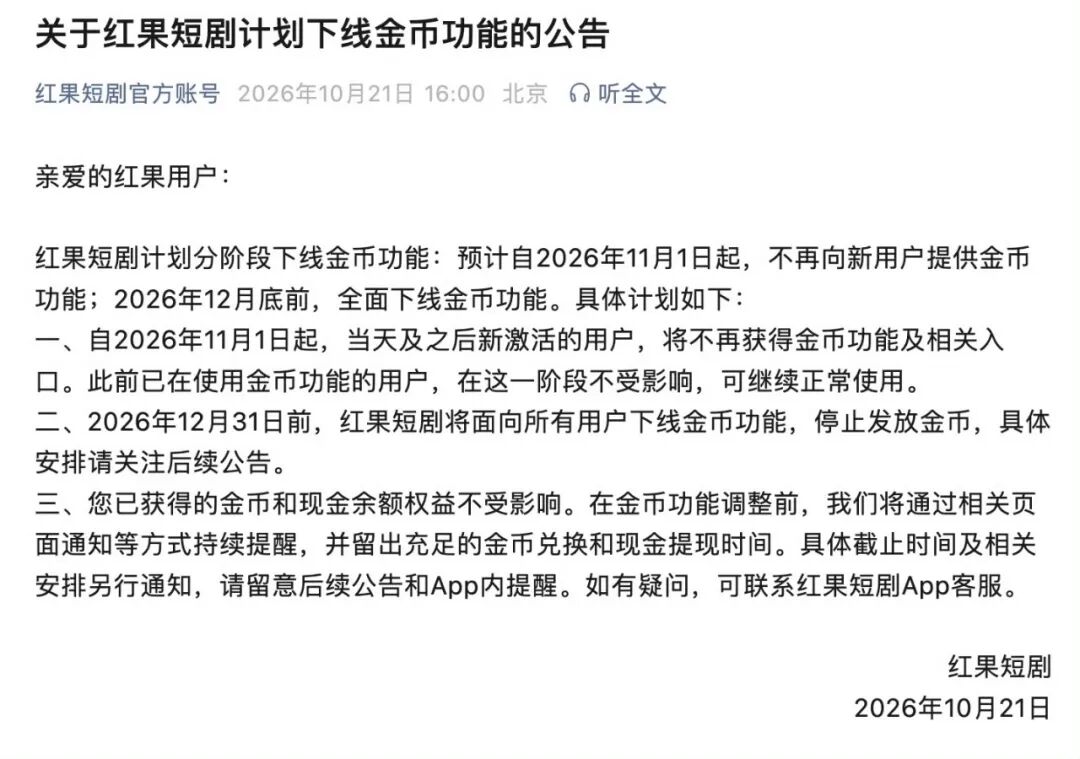
On October 21, Hongguo Short Drama announced that it will phase out its gold coin function: the function will no longer be available to new users starting from November 1, and will be fully shut down before December 31, while the rights and interests of users' existing gold coins and cash balance will not be affected.
Previously, watching dramas, checking in, and completing tasks to get gold coins that can be exchanged for cash was one of Hongguo's important ways to attract new users and boost user activity. Now that it voluntarily cancels this incentive mechanism, to a certain extent, it means Hongguo has finished the stage of acquiring new users through the "earn money by watching dramas" model, and will let the content itself take more responsibility for retaining users.
On the other side, "Lv Paopao Short Drama" under WeChat is ramping up efforts to compete for content supply.
On September 23, WeChat Open Platform launched the Q4 micro-short drama incentive campaign. From October 16 to December 31, high-quality new dramas accessed through Lv Paopao's co-distribution program can get up to 100% of the comprehensive revenue incentive after meeting conditions such as per capita playback duration, including 90% cash share and 10% advertising credit reward.
One side is gradually canceling the gold coin incentives for users, while the other side is increasing commercial support for content creators. Although the two types of subsidies are not the same, they reflect the different development stages of the two platforms. One is an industry giant backed by Douyin with a mature content ecosystem, and the other is a "new player" that holds WeChat traffic and tries to catch up from behind. The competition between Hongguo and Lv Paopao is becoming a turning point for the short drama market.
Then, can Tencent, which already has the successful experience of Video Account, win another battle in the content platform sector this time?
01
Having entered the track several times, why couldn't Tencent build a product comparable to Hongguo?
To understand the emergence of Lv Paopao, we first need to figure out what kind of short drama business Tencent has been running in the past.
As early as December 2021, Tencent Video launched its micro-short drama brand "Theater Ten", trying to integrate short dramas into the long-form video content system. In January 2025, "Mars Short Drama Club" was launched on WeChat, and later renamed "Mars Drama Watch"; in June of the same year, WeChat launched the official "Short Drama" mini-program. Until July 2, 2026, this mini-program was renamed "Lv Paopao Short Drama", and began to receive concentrated market attention at the end of September.
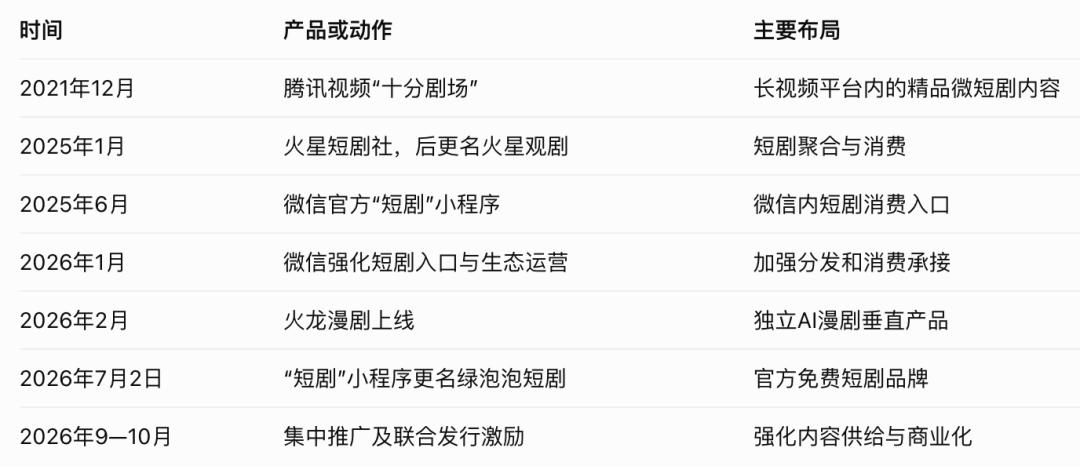
From long-form video platforms to independent short drama products, and then to official WeChat mini-programs, Tencent has made many layouts over the years. The problem is that different products are tasked with different missions.
For Tencent Video, short drama is part of its content matrix, with the core goal of meeting the diverse needs of members and audiences; for WeChat, short drama has long been a business within the ecosystem of mini-programs, Video Account, advertising and payment. They have their own value, but do not necessarily take building a unified short drama consumer brand as their common goal.
This business positioning is significantly different from ByteDance's path of building an independent content platform around Hongguo.
In fact, the early development of the short drama industry once relied heavily on WeChat. In the era when paid short dramas were prevalent, production teams placed advertisements on short video platforms to divert users to WeChat mini-programs, and obtained revenue by unlocking episodes or charging for full dramas. WeChat provided payment, traffic reception and technical infrastructure, while numerous third-party companies were responsible for specific content operations.
For WeChat, this is a good ecological business: the platform does not have to personally produce, procure and operate all short dramas, and can still benefit from the growing transactions, advertising and service demands. But for short drama production companies, the business is not always easy to run. Customer acquisition cost, payment conversion rate and hit cycle all directly affect the profitability of a single work.
Later, Hongguo provided another commercial option through the free model and advertising monetization, gradually centralized content procurement, user operation and commercialization into a unified platform system, and grew into the industry leader by leveraging this advantage.
According to QuestMobile data, in July 2026, Hongguo's daily active users reached 168 million, a year-on-year increase of 107%, exceeding the sum of daily active users of the four long-form video platforms iQiyi, Tencent Video, Youku and Mango TV (about 155 million).
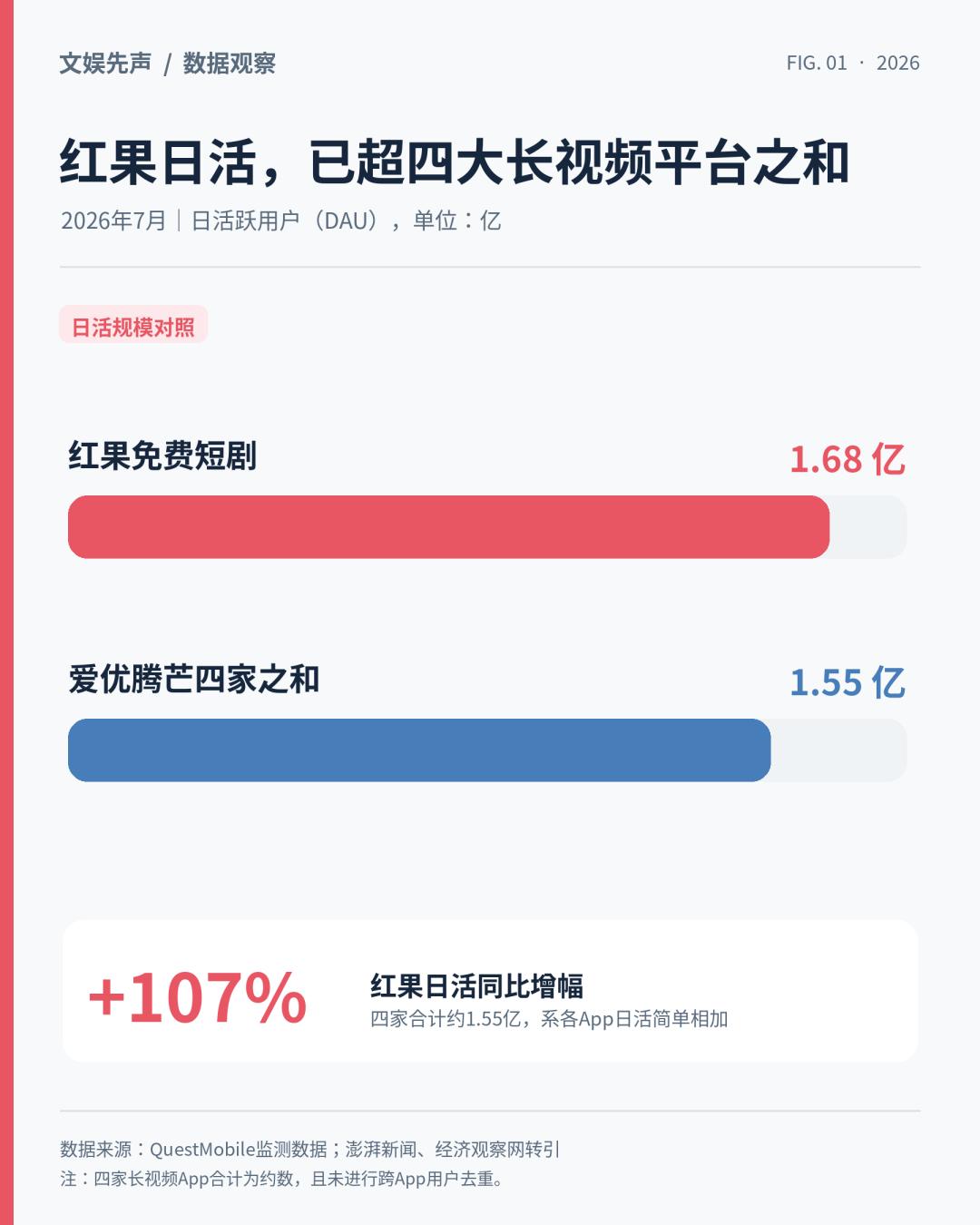
It is not hard to see that Tencent used to focus more on serving the short drama industry, while ByteDance has made short drama itself its core product.
The two models are not inherently superior to each other, but when free short dramas rise rapidly and Hongguo takes the lead in building independent brand awareness and scale advantages, Tencent has to reconsider its own position in the market.
It is worth noting that WeChat has not lost short drama users. QuestMobile data shows that in May 2026, the user scale of WeChat short drama mini-program channels was 508 million, while the overall user scale of independent short drama apps in the same period was 402 million, of which Hongguo's monthly active users reached 356 million.
Of course, 508 million is not the number of users of Lv Paopao itself, but the scale of the entire WeChat short drama mini-program channel. It shows that a large number of audiences are still used to watching dramas within WeChat, which also means that WeChat already has a considerable consumer scenario.
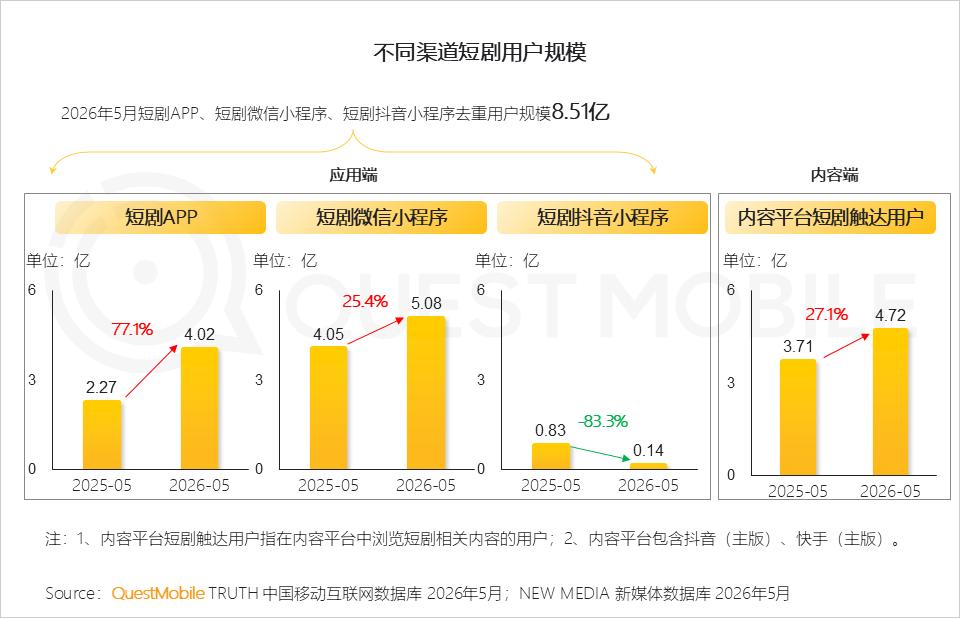
Therefore, the emergence of Lv Paopao is not so much Tencent's re-entry into the short drama market, but rather WeChat starting to personally operate a consumption entry that was previously mainly supplied with content by third-party developers.
What it needs to solve is how to gradually integrate the originally scattered short drama consumption through Video Account, WeChat Search, social sharing and official mini-programs, to form a unified content entry, and build an official platform with continuous viewing habits, content recognition and commercial value.
02
Hongguo's moat is far more than just traffic
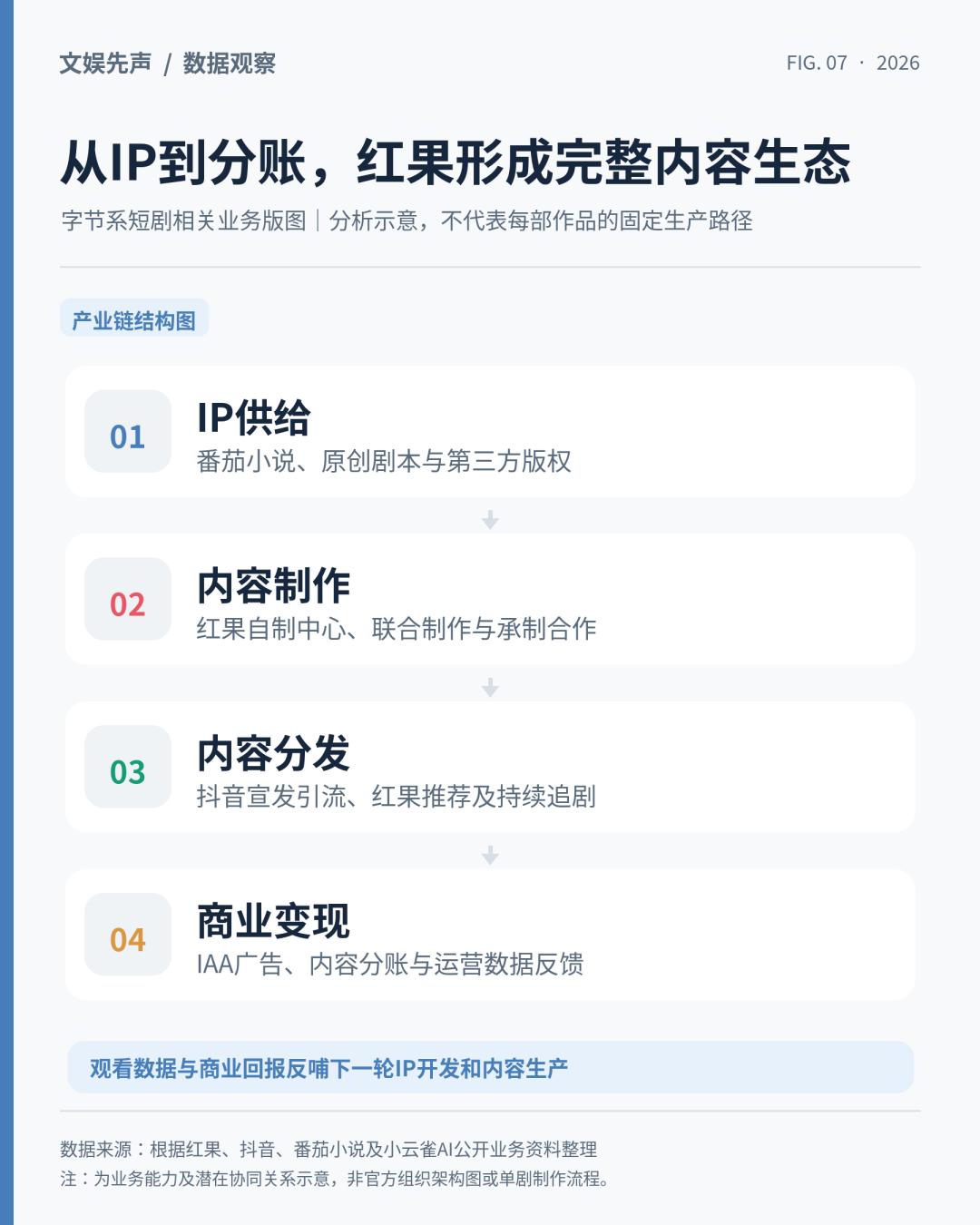
The competition Lv Paopao faces is not only the scale pressure brought by Hongguo's 168 million daily active users. After nearly three years of development, Hongguo has extended its business to multiple key links in the short drama industrial chain, forming a mature system from content production to commercial monetization.
The first is the upstream IP. ByteDance's Tomato Novel has a large number of web novel resources, which provides a continuous supply of stories for short drama adaptation. Through IP authorization, original development and cooperative adaptation, Hongguo can continuously expand its content reserve, and make short drama an important channel for web novel IP to realize commercial value.
The second is production. Hongguo not only purchases finished works from third parties, but also participates in upstream production through mechanisms such as self-production centers, co-production, and commissioned production cooperation, and has established long-term cooperative relationships with many leading production companies. For production teams, the value of the platform lies not only in the broadcast channel, but also in stable orders, clear content requirements and a relatively mature revenue distribution mechanism.
Further down is the distribution and commercialization that ByteDance is good at. Douyin can provide promotion and user reach for short dramas, while Hongguo relies on algorithm recommendation and massive content library to support continuous viewing, and realizes revenue conversion through IAA advertising and content revenue sharing. User viewing data can also be fed back to subsequent topic selection, production and operation processes.
As a result, ByteDance has gradually mastered multiple key nodes of short dramas from content supply to consumption monetization. When the platform controls more and more high-quality content, users and commercial return opportunities, the dependence of production teams on it will continue to deepen.
However, the entry of Lv Paopao undoubtedly means new choices for upstream companies. The high proportion of incentives WeChat offers for high-quality new dramas also has the opportunity to attract more production teams to try multi-channel distribution. But subsidies can buy content, but may not immediately buy mature industrial relations. The cooperation mechanism, exclusive content reserve and commercial return expectation established by Hongguo with leading companies are still thresholds that Lv Paopao cannot cross in the short term.
What's more, ByteDance's ecological layout is still extending upstream.
On March 19 this year, ByteDance's Skylark AI launched the short drama Agent function equipped with the Seedance 2.0 model, supporting uploading up to 100,000 words of scripts, and automatically completing the production processes such as story understanding, character design, and storyboard generation. In the internal test stage, the 60-episode comic drama "Beast Sovereign" produced by Chuangyi Media received over 100 million views on Douyin 4 days after its launch, and ranked first on the Hongguo comic drama popularity list. Together with tools such as Dream AI and Volcano Engine, ByteDance not only has mature short drama distribution channels, but also begins to participate more in AI content production links.

This does not mean that ByteDance has a monopoly on AI production capabilities.
In fact, the popularization of generative AI tools is lowering the production threshold of the entire short drama industry, bringing new opportunities to small and medium teams and even individual creators.
Conversely, when content production becomes easier, the importance of distribution channels may be further enhanced. After the number of works increases, the more difficult problem to solve is who can make good content accurately reach the audience, and who can enable production teams to get continuous commercial returns. This is exactly where Hongguo has already established its advantages.
The stronger the platform is, the more the industry needs new competitors, and the market will be more active. When Hongguo occupies multiple links such as IP, production, distribution and commercialization, whether high-quality content can get more distribution opportunities and whether production companies can have more sufficient bargaining space will also become issues of industry concern.
From this perspective, the value of Lv Paopao is not only to challenge Hongguo's market share, but also to bring a new benefit distribution mechanism to the short drama industry.
03
From Weishi to Lv Paopao, can Tencent catch up from behind again?
The competition between Tencent and ByteDance is no longer limited to short dramas.
In 2013, Tencent launched Weishi, three years earlier than the launch of Douyin, but failed to establish a competitive advantage of the same scale in the subsequent short video wave. It was not until the launch of Video Account in 2020 that Tencent found a development path more suitable for itself. Later, relying on ecological resources such as WeChat social connections, official accounts and mini-programs, Video Account gradually formed a system of content distribution, user interaction and commercialization, and continuously strengthened its algorithm recommendation capability in subsequent development, and finally grew into an important short video platform in China.
The success of Video Account shows that Tencent is not incapable of making good content products, nor can it only rely on first-mover advantages. As long as it finds a path that fits its own ecological characteristics, it can also achieve a latecomer advantage.

Conversely, ByteDance once tried to challenge WeChat's social status with Duoshan and Feiliao, but did not achieve the expected breakthrough; in the gaming sector, ByteDance's Nuverse significantly downsized its business in 2023, while Tencent maintained deep R&D and operation accumulation.
The confrontations between the two companies have always had wins and losses on both sides.
Comparatively speaking, Tencent is better at operating user relationships and open ecosystems, while ByteDance is better at building systems of algorithm recommendation, data feedback and advertising monetization around content consumption.
This difference is also reflected in Lv Paopao's product strategy. According to Huxu's report citing people close to the WeChat team, Lv Paopao's core team currently has only about 10 people, whose main tasks are to polish product experience and introduce high-quality content, and there are no aggressive short-term targets for daily active users, viewing duration or revenue.
This arrangement is very much in WeChat's style. Compared with investing a lot of resources to pursue rapid user growth, WeChat tends to gradually cultivate new scenarios in its existing ecosystem, while avoiding excessive interference to the original user experience.
The "Friends are Watching" feature is the embodiment of this idea. Lv Paopao tries to improve the efficiency of content discovery with the help of WeChat social connections, and handles viewing privacy issues through mechanisms such as fuzzy recommendation, public likes and private likes. Users can not only discover content from their friends' recommendations, but also find episodes that match their personal interests through algorithms.
But social connections can bring the first viewing, which does not necessarily mean the formation of a long-term drama-watching habit. Lv Paopao still needs to prove that after users accidentally open a short drama within WeChat, they are willing to stay in this product for more content.
In addition, Tencent has a noteworthy content IP library: China Literature.
In March 2025, China Literature announced that it would open more than 2