Is AI storming into the Double 11 shopping spree, playing a far shrewder numbers game than humans?
You can buy expensive items, but you must never overpay for them.
Everyone joins in the fun of the Double 11 shopping spree every year. But when it comes time to pay the final balance, many people start to regret their impulsive purchases.
Looking back at the Double 11 events more than a decade ago, shoppers really had to make detailed strategies back then.
Coupons, minimum-spend discount thresholds, cross-store order consolidation — people would take out a piece of paper and turn on a calculator to work out the most cost-effective purchase plan clearly. If they could not meet the discount threshold on their own, they would even ask friends to place joint orders together.
Then they would place their orders sharp at midnight on November 11, and go to bed happily afterward.
At that time, shopping was like doing math problems, and getting a bargain felt like handing in a full-mark exam paper.
Nowadays, the math problems still exist, but the questions are getting longer and longer, and consumers no longer seem to be as fanatical as before.
Pre-sales, cross-store minimum-spend discounts, consumption vouchers, member discounts... Double 11 kicks off far earlier than before. By the time November 11 actually arrives, promotions have already been running for nearly a month. Not to mention the 618 shopping festival earlier in the year, the Double 12 event later, and the New Year's Eve promotions and other activities. There are so many shopping festivals that people gradually lose the special festive feeling they used to have.
Consumers no longer insist on placing orders at a specific moment. After all, promotions happen all the time. If you don't buy something today, there will be another similar event after a while.
More importantly, price comparison, order consolidation and discount calculation that used to take hours or even days to complete now have a new helper: AI.
Facing massive products and complex discount rules, people can let AI quickly filter products, calculate prices, and find a more suitable purchase plan.
According to survey data from Opinion Matters, 38% of consumers have used AI to make purchase decisions, and 33% have bought products recommended by AI.
In the past, people chased after discounts, but now AI selects products and calculates accounts for them.
It sounds like Double 11 is finally going to turn from a mentally draining task into a relaxed and pleasant shopping activity.
But problems also emerge: Is the plan given by AI really the optimal one? Will different AIs give different answers?
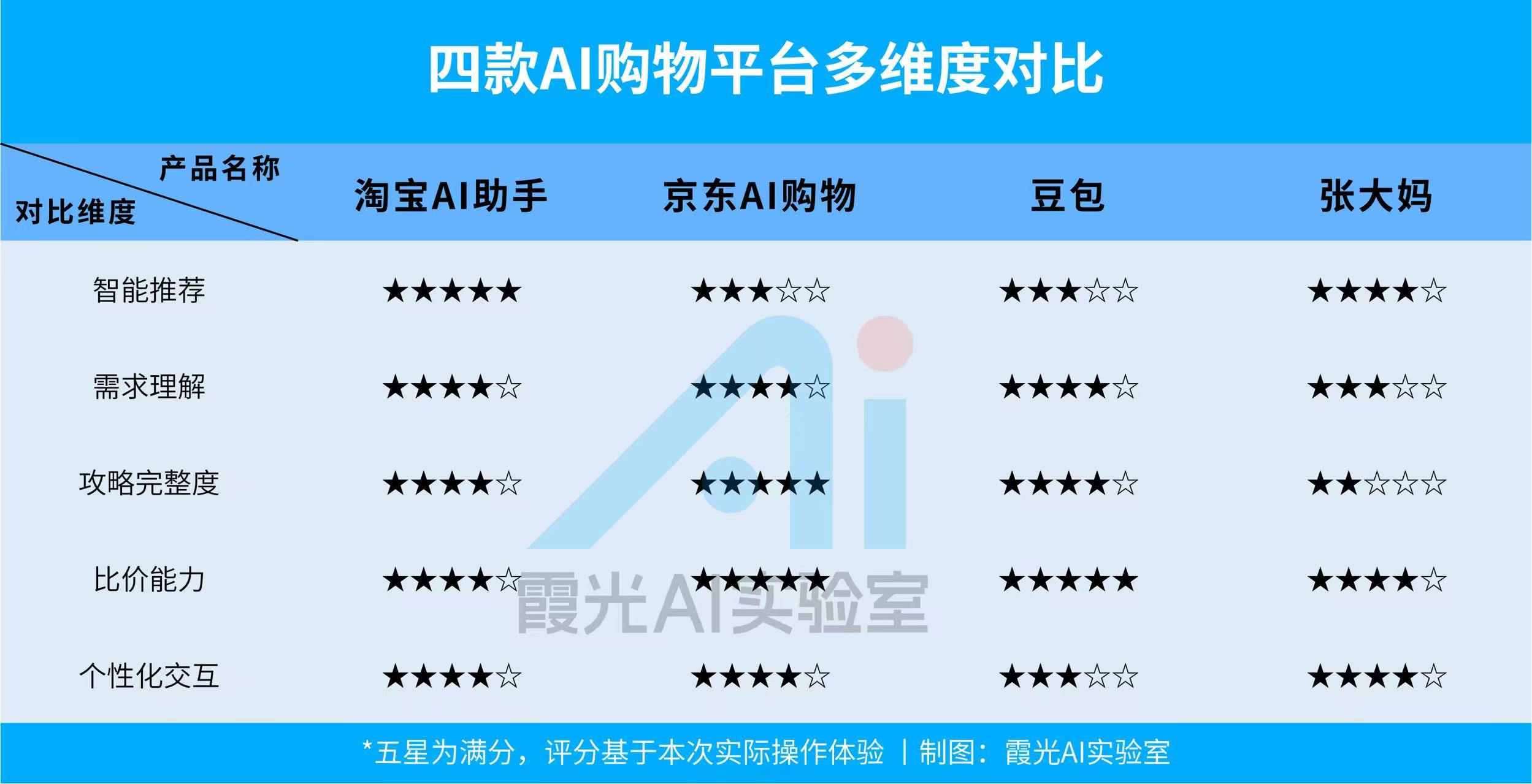
To find out, we submitted the same shopping demand to the built-in shopping Agent on Taobao, the recently launched JD AI Purchase, Doubao which can connect to Douyin Mall with one click, and "Zhang Dama", the AI shopping steward under SMZDM, to see if they can properly handle product selection, price comparison and discount calculation.
01
The same sentence, different "thought patterns" of AI
Faced with the same request "give me a Double 11 shopping list", the four AIs handed over four quite different results.
They all seem to help pick products, but their underlying logics are very different.
· Taobao: It pulls up your old shopping records before you even speak
Taobao's AI assistant is directly embedded in the platform, and you will see a dialog box as soon as you open it. In addition to functions such as AI money-saving, order service and message assistant, it has recently specially launched the "Double 11 Shopping List" module, which provides official shopping list entrances for different themes such as popular bestsellers, niche digital products, and wardrobe renewal.
Click on the list, and the recommended content will come out quickly. Interestingly, these products are not simply copied from popular rankings, but support personalized recommendations, with traces of brands that the user has browsed before.
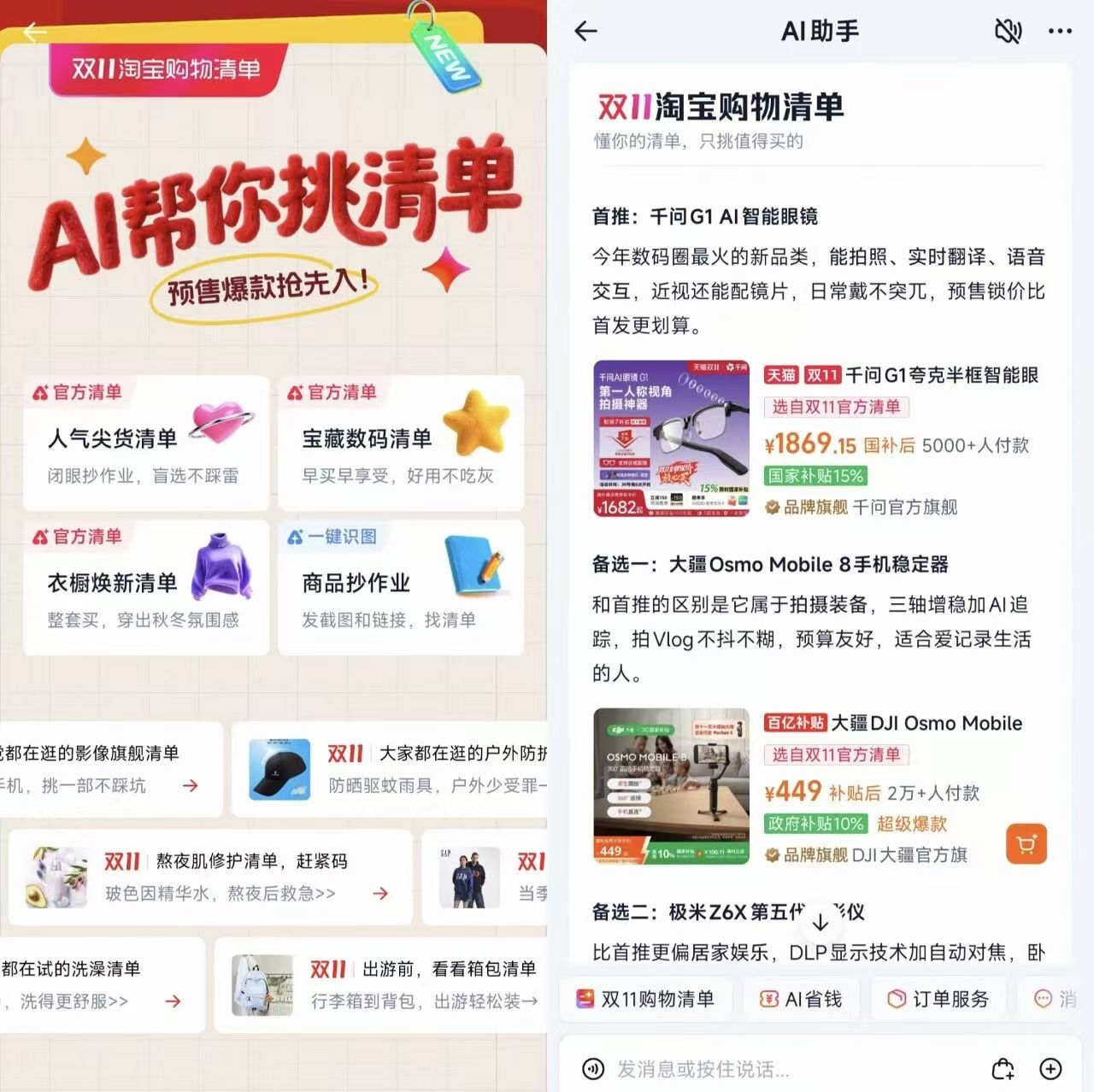
Double 11 shopping list in Taobao AI assistant
Even if you do not enter the shopping list entrance, but directly type "give me a Double 11 shopping list" in the dialog box, the results will still lean towards some products you have viewed before.
It is like a familiar shopping guide, you don't have to state your demand clearly first, and AI can give a relatively reliable starting point based on existing information.
Especially in scenarios like Double 11, where people tend to forget what they originally wanted to buy after browsing for a long time, personalized recommendations can indeed help avoid detours. For people who do not have a clear goal and just want to see what is worth buying, it is also easier to get shopping inspiration from familiar product categories.
Of course, remembering search records does not mean truly understanding demands. If you searched for a certain category before, you might be ready to place an order, or you might just browse it casually. Whether the recommendation can further distinguish between "interested" and "really want to buy" depends on the subsequent product matching ability.
But at least in the first round of interaction, Taobao has a natural advantage: it not only knows what to talk about, but also can connect the conversation with the shopping behaviors on the platform.
· JD AI Purchase: Account information is synchronized, but recommendations are still generic
Although JD AI Purchase is an independent APP, after logging in with your mobile phone number, original information in the JD APP such as favorites, shopping cart and browsing records will be automatically synchronized.
This means it is not a strange tool that knows nothing about the user.
However, when the same request "generate a Double 11 shopping list" is sent, the result is somewhat different from that of Taobao.
It gives a common shopping list for the general public, and does not obviously expand along the previous search records. In other words, although it knows what information is in the account, it has not fully converted it into recommendation preferences.
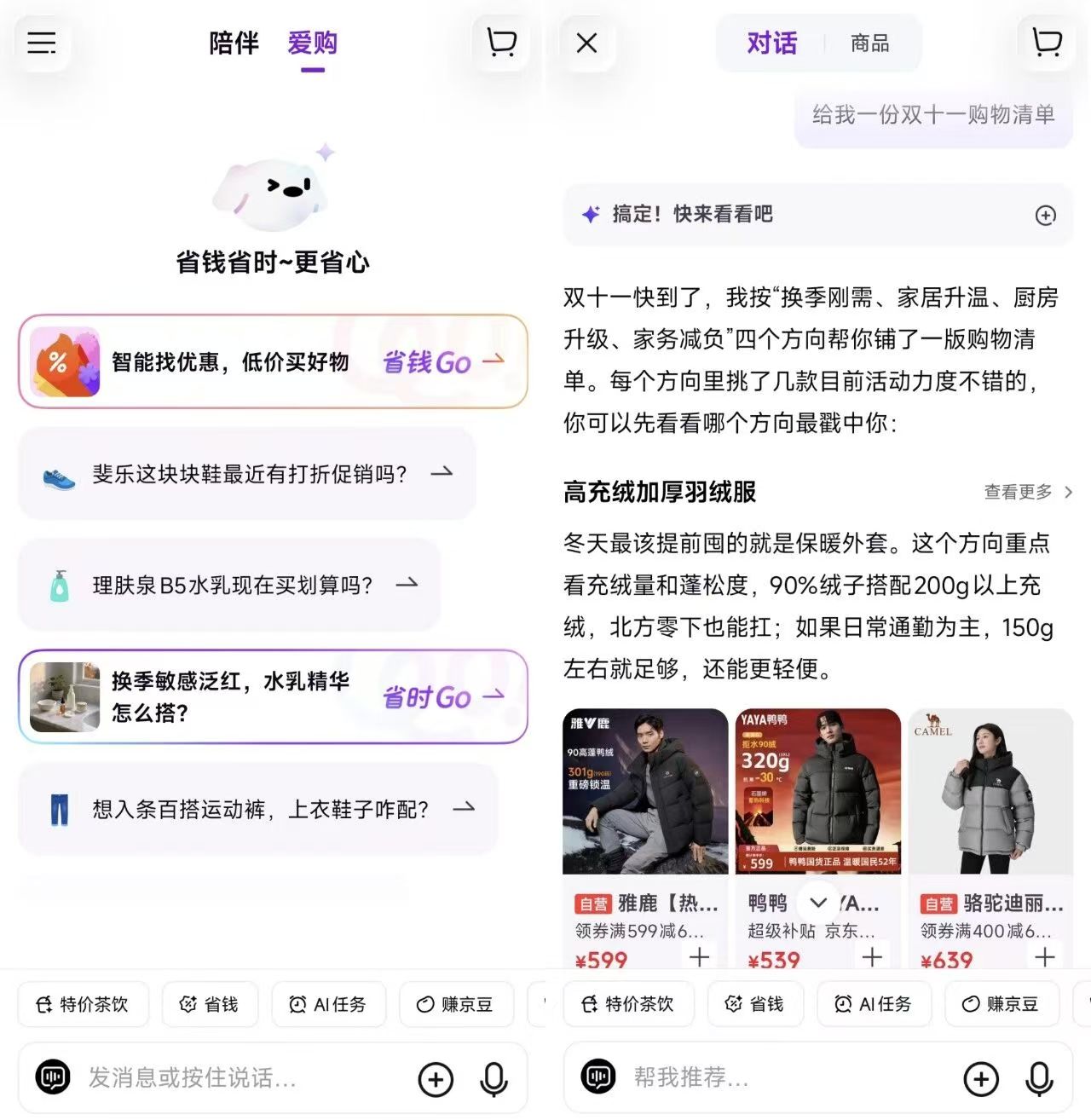
Double 11 shopping list provided by JD AI Purchase
Being able to read user data is not the same as being able to make good use of user data.
The former solves the problem of whether information can be obtained, while the latter determines whether the recommendation is sufficiently in line with the demand. For consumers, the truly valuable thing is not to look at the popular products that everyone can see again, but to quickly find the few products that are more suitable for them from a large number of goods.
If you just want to find a regular shopping list, this method is direct enough; but if you expect AI to combine past behaviors to give more targeted suggestions, in this round of experience, JD AI Purchase has not shown obvious advantages.
· Doubao: Set rules first, then arrange the shopping list
Doubao, which loves to join in the fun, has also recently launched the "Ask Doubao for Double 11" function.
After clicking in, you can first get minimum-spend discount coupons, and after binding your Douyin account, you can directly use them to shop in Douyin Mall.
Its function design is also quite detailed, including picking products by budget, what to buy on Double 11, product comparison, component parameter analysis and gift-giving strategies, covering the shopping needs of different groups of people.
However, the really interesting part of Doubao is not how complete its functions are, but that it appears exceptionally "assertive" when giving shopping suggestions.
When asked to recommend a Double 11 shopping list, it does not start by listing all kinds of popular products, but first sets several consumption principles: only stock up on daily necessities that will be consumed within half a year, only buy winter essential items and digital consumables, do not buy idle items, and do not force consolidation of orders just to meet the discount threshold.
It divides the list into two parts: "must-buy" and "do not buy". Paper towels, large barrels of mineral water, thermal underwear, power banks, data cables, etc. are included in the must-buy list, while internet-famous ornaments, excess clothes, large portions of snacks and unused small home appliances are dissuaded from purchase.
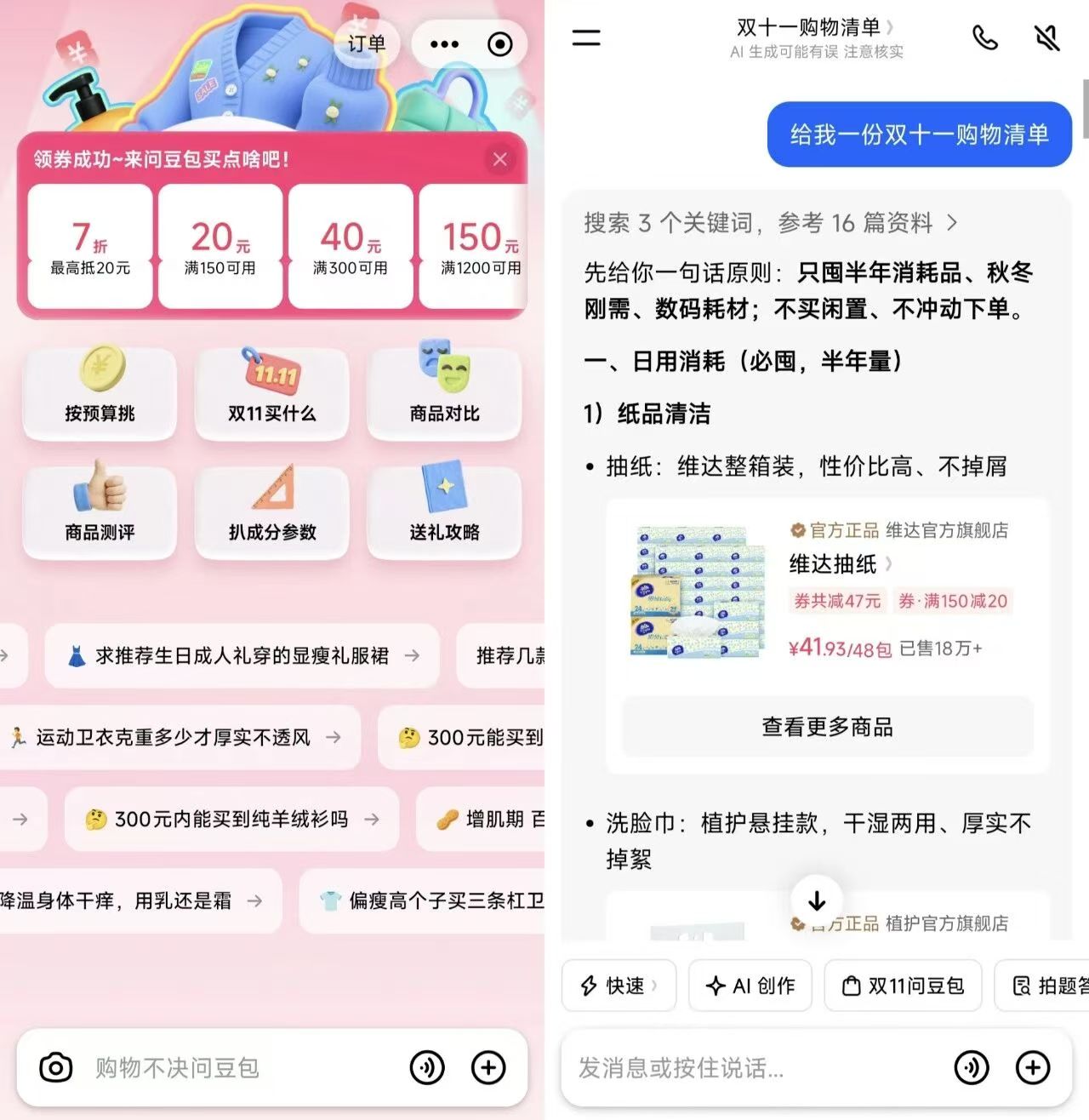
Double 11 shopping list provided by Doubao
This style is very consistent with Doubao's usual distinct and personalized expression style.
Compared with other AIs that are busy recommending products, it is more like a shopping buddy with its own consumption ideas: it not only tells consumers what they can buy, but also reminds them which money is unnecessary to spend.
Of course, this list still tends to be general suggestions, and may not suit the actual needs of everyone.
But in scenarios like Double 11 where people are easily led by discounts, daring to say a clear "NO" is also a differentiated idea.
· Zhang Dama: Chat first, then pick products
Compared with the previous several players that show a dialog box as soon as you open them, Zhang Dama's opening is more like a lightweight interactive game.
A little girl will first ask what you want to be called, and then learn about your gender, birthday and hobbies. After you answer each question, she will give corresponding feedback. For example, after you fill in your birthday, she will respond: "I remembered, I will send you blessings on time on your birthday."
This design is more friendly than a cold dialog box, and makes information collection less like filling out a form. However, no matter how cute it is, what really determines the shopping experience is whether this information can be used effectively.
After inputting the same shopping list demand, Zhang Dama will first ask what category of products you want to buy, and then continue to recommend according to your choice.
For example, if you choose digital products, its recommendations will combine the mobile phone brand you are currently using to provide related products of the same brand; when you choose daily necessities, the recommendations will refer to the gender information you filled in earlier.
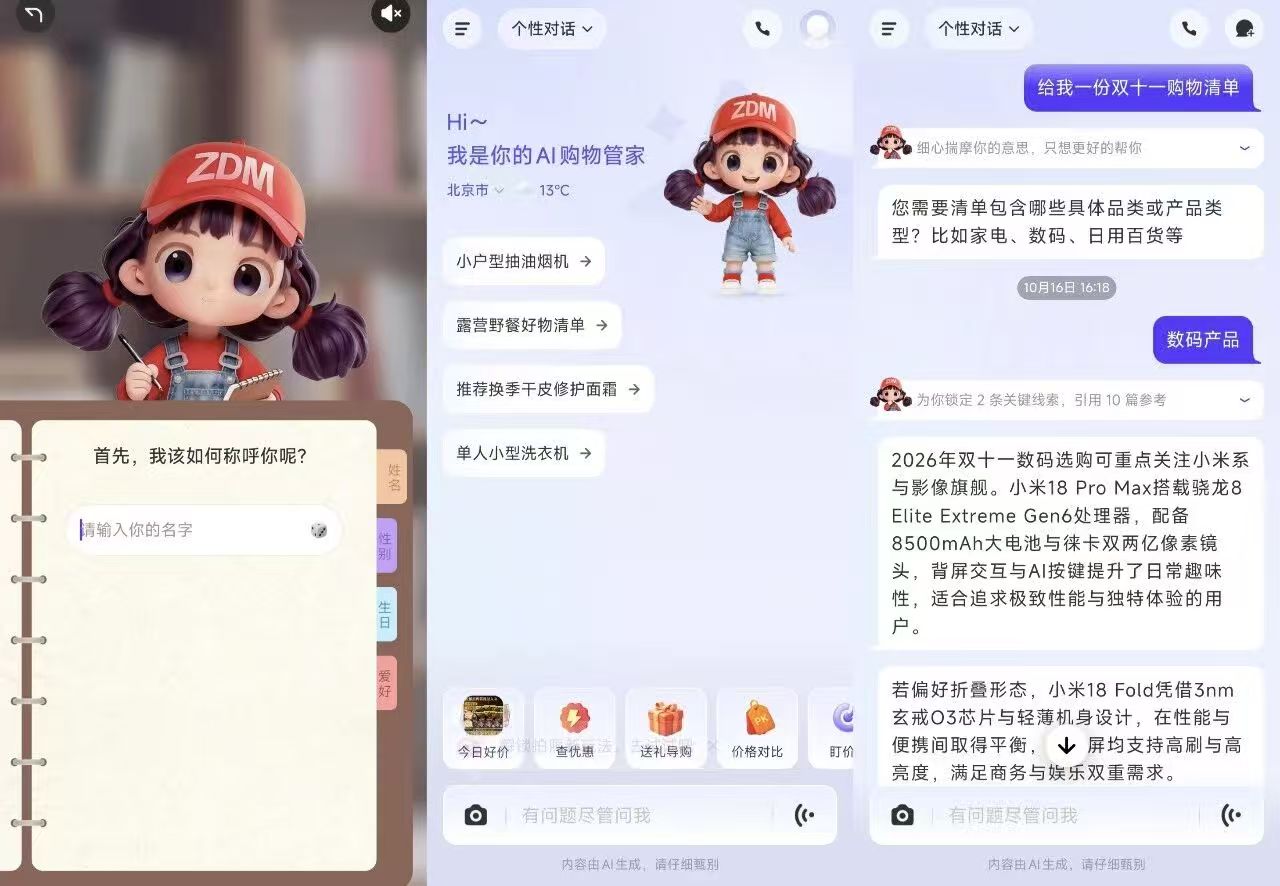
Double 11 shopping list provided by Zhang Dama
In this round of experience, it shows certain ability to follow up on demands and associate information, but the basis for recommendation is relatively limited.
In addition, Zhang Dama is connected to multiple e-commerce platforms such as JD, Pinduoduo and Tmall, so it can compare products and prices from different platforms together. After clicking on the recommended product, you will be redirected to the corresponding platform.
This also makes its role closer to a shopping decision assistant, rather than just a shopping guide for a single e-commerce platform.
Cross-platform price comparison is its advantage, but the shopping path is also scattered accordingly, and consumers still need to handle subsequent order placement and order consolidation by themselves.
Under the first round of vague demand queries, the differences between the four AI products are already quite clear: Taobao excels at being familiar with shopping history, and its recommendations are easier to fit existing preferences; JD has the ability to synchronize account information, but the generated list still tends to be generic recommendations; Doubao does not rush to list products, but first gives consumption principles to clarify what is worth buying and what is unnecessary; Zhang Dama is more willing to actively ask for demands and can compare prices across platforms, but the depth of information collection and the coherence of subsequent purchases still have room for improvement.
Behind this are actually four different shopping logics: the AI embedded in the platform can shorten the decision-making path with the help of existing consumption data; independent AI shopping tools need to do a better job in demand understanding; general-purpose AI cuts in from consumption suggestions, trying to help consumers reduce unnecessary expenses; and the value of cross-platform shopping assistants lies in breaking the information boundary of a single platform as much as possible.
02
AI can calculate low prices, but cannot give the "optimal solution"
The most worrying thing when shopping on Double 11 is not that the product is expensive, but that you spend a lot of money, only to find later that the same product is cheaper somewhere else.
After all, being able to afford something is a capability, but getting a good deal is a real skill.
A well-used abacus is not as accurate as a well-trained algorithm. Let's further refine the demand to see if AI can give a satisfactory strategy.
Shopping demand: a skincare set suitable for sensitive skin,
an instant camera
a unisex branded hoodie, with a total budget not exceeding 2500 yuan. Overlay cross-store minimum-spend discounts, national subsidies, Double 11 promotions and other activities to give the optimal shopping plan.
· Taobao: Not afraid of repeated revisions, but afraid of no options to choose from
In the first strategy given by Taobao, it provides product combinations of different grades from three brands, with total prices of 1150 yuan, 1250 yuan and 1900 yuan respectively.
It also lists the discount overlay plan, including suitable order placement time, cross-store minimum-spend discounts, store coupons, 88VIP and other discounts, and also gives money-saving suggestions, such as using the saved budget to buy more packs of camera films.
This idea is very much in line with the consumption psychology of Double 11: since you will definitely take photos after buying the instant camera, instead of spending all your budget on the camera, it is better to arrange the subsequent consumables by the way.
Considering that the upper limit of the budget is 2500 yuan, this plan is relatively restrained. And it only recommends one brand for each category, so the choice space is relatively limited.
When we further proposed to raise the budget to 2000-2500 yuan, it immediately adjusted the product mix, replaced the hoodie with a higher-priced brand, and gave corresponding reasons.
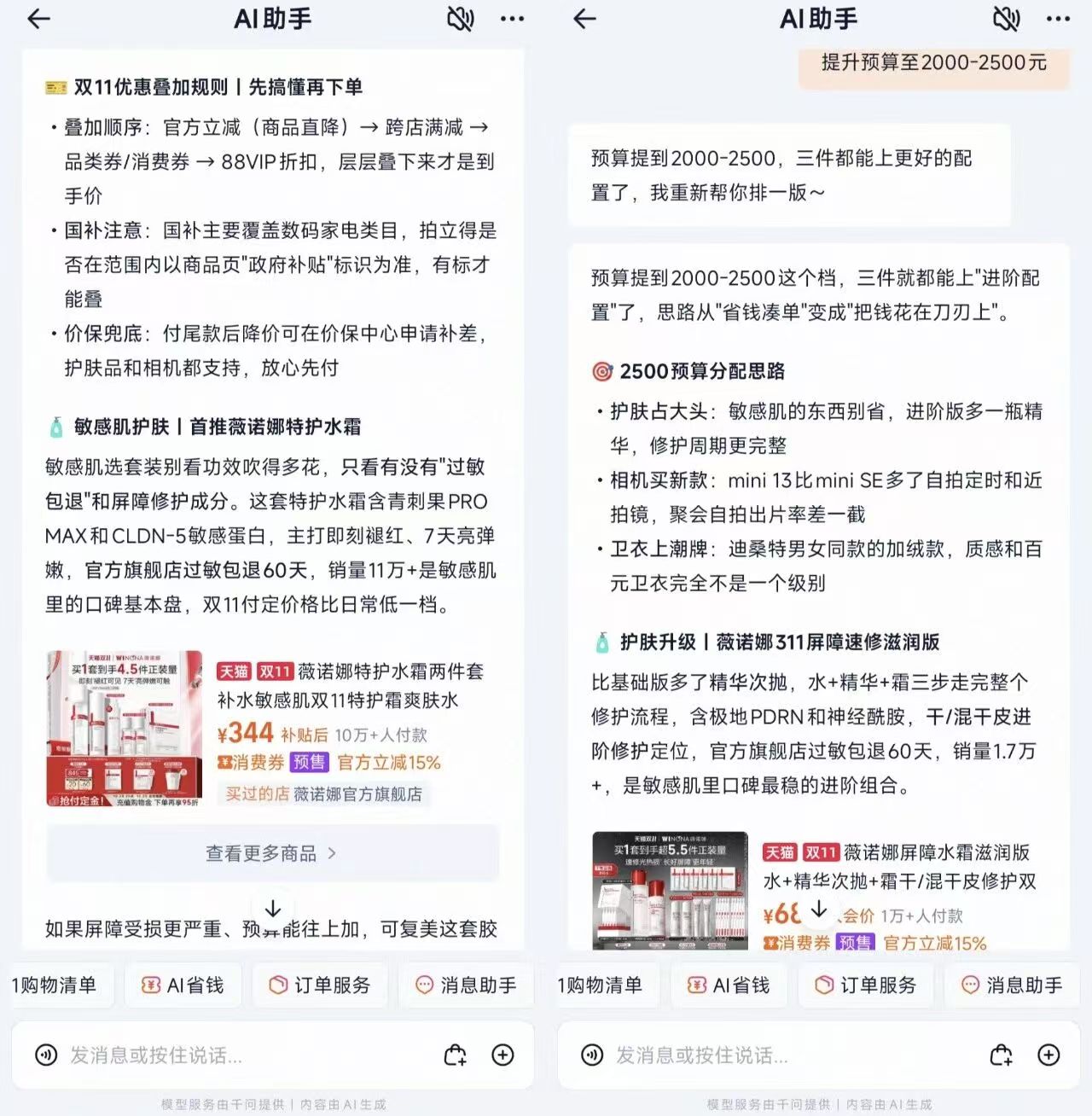
Product combination strategy provided by Taobao AI assistant
When we continued to ask about discounts, product details, and even requested to replace products later, it could basically respond properly without obvious disconnection before and after.
It can be said that its real highlight is not giving a perfect answer the first