Will SpaceX take over Tesla? Elon Musk does not have the final say.
First, let's state the judgment
The merger is highly likely to happen, but it will not come soon, nor will it be cheap. What truly determines the final result is one figure and one vote: the share exchange ratio, and the voting result of Tesla shareholders.
On October 20, during SpaceX's Q3 earnings call, the most widely raised question from investors was: When will SpaceX and Tesla merge?
Musk's response contained a large amount of key information. The boards of directors of both companies have set up special committees to discuss the merger, and he believes it is a good idea; but the terms have not been finalized yet, and treating the merger as a done deal is "overstating the situation".
If the merger is completed, it will be the largest corporate merger in history: based on the closing price of that day, SpaceX has a market value of about 2.01 trillion US dollars, Tesla about 1.48 trillion US dollars, with a total combined value of about 3.5 trillion US dollars.
How It Reached This Stage: Capital First, Then Factories, Finally the Board of Directors
Looking back at this year, the two companies have been moving closer to each other step by step.
2026.01 Capital
Tesla Agrees to Invest 2 Billion US Dollars in xAI
Tesla establishes a capital tie with Musk's AI company
2026.02.02 Capital
SpaceX Completes the Merger of xAI
Musk's entire AI business is fully integrated into SpaceX
2026.03.12 Capital
Tesla's xAI Investment Is Converted to SpaceX Shares
Tesla holds less than 1% of SpaceX, marking the first direct cross-shareholding between the two companies
2026.03 Factory
The Three Parties Announce Joint Construction of the Chip Project Terafab
This is the first heavy asset project jointly built by the two companies, and Intel joined the project in April
2026.06.12 Listing
SpaceX Lists on Nasdaq
The merger now has a tradable "currency" that supports direct share swap, and related speculations have heated up rapidly
Mid-October 2026
Barclays Releases a Report
The report states that the merger has increasingly become a market consensus, and the most likely scenario is that SpaceX acquires Tesla through share swap
2026.10.19
Tesla Submits the Shareholder Meeting Proxy Statement
The general meeting is scheduled for December 3, and there is no merger proposal on the agenda
2026.10.20 Board of Directors
Musk Confirms That Special Committees Are Established on Both Sides
The matter has officially entered the formal procedure for the first time, but the specific terms have not been determined
Before that, the merger was only a deduction made by industry analysts; after that, groups of independent directors from both sides sat at the negotiation table.
Why They Want to Merge: In Musk's View, These Two Companies Are Essentially One Single Entity
The reasons for the merger can be summarized into three categories: technical synergy, control right, and capital.
First, the two sides have long collaborated on technical work. Musk listed four cooperation directions on the earnings call: AI software, chip design, robotics and communication, as well as the Terafab chip plant jointly built by the two companies.
Barclays gave more specific examples: Tesla's Robotaxi fleet can use xAI's scheduling software, vehicles can be connected to Starlink, SpaceX's data centers can use Tesla's energy storage products, and the Optimus humanoid robot can use Grok for natural language interaction.
Barclays' judgment is that the merger will bring some financial synergies, but the real value lies in vertical integration. Two sets of boards of directors and two sets of decision-making processes will slow down joint projects like Terafab.
Second, the control right. Musk holds about 45% to 48% of the equity of SpaceX, and controls more than 80% of the voting rights through the dual-class share structure; in Tesla, he only holds about 20% of the shares. He has long stated that he hopes to have about 25% of the voting rights in Tesla to have enough influence to promote the development of AI and robotics.
If SpaceX acquires Tesla through share swap, Musk will hold about 37% of the equity of the merged company and about 56% of the voting rights. He will regain absolute control in a larger company.
Third, the capital factor. SpaceX's capital expenditure in the third quarter has approached 20 billion US dollars, and it is estimated to reach 35 billion to 40 billion US dollars in the fourth quarter; Tesla also plans to invest more than 20 billion US dollars in 2026 to build factories and AI computing power. After the merger, the financing channels will be more flexible, and of course, the total investment demand of the two sides will also be larger.
From Musk's perspective, the merger has almost no downsides. The problem is that this matter is not decided by him alone.
Why the Merger Is Difficult: Four Barriers Standing in the Way
The First Barrier | Conflict of Interest. Musk is the CEO and the largest individual shareholder of both companies, and he is defined as a "conflicted party" according to securities regulatory regulations, so he cannot participate in the discussions of the special committees. He described it as a strange situation where two groups of people are negotiating but he cannot enter the room.
The word "independence" will be reviewed repeatedly. Ira Ehrenpreis chairs both the Compensation and Nomination Committee of SpaceX and two relevant committees of Tesla; James Murdoch, a director of Tesla, also invested in SpaceX before.
This scene is not unfamiliar. When Tesla acquired SolarCity in 2016, a special committee was also established, and Musk also recused himself from voting. The transaction was finally completed, but it triggered shareholder lawsuits that lasted for several years.
The Second Barrier | Tesla Shareholder Voting. Musk said that on Tesla's side, the merger needs to get the support of more than half of all issued shares, and he admitted that this is a "quite high threshold". The denominator is all shares, not the shares present at the meeting to vote, and abstention and non-voting are both equivalent to opposition.
Musk himself only holds about 20% of the shares, which means he still needs to win more than 30% of the shares from other shareholders. Barclays also lists shareholder approval as the biggest obstacle, and the transaction also needs to pass the antitrust review.
The Third Barrier | Protection of Minority Shareholders. After the merger, Tesla shareholders will transfer from a company where Musk only has about 20% of the voting rights to a company where he has more than half of the voting rights. The dilution of governance voice itself is a cost, and Tesla's independent directors must fight for compensation for this.
The Fourth Barrier | Two Different Businesses, Two Groups of Shareholders. Tesla's automotive business does not have a high profit margin, while SpaceX is expanding its computing power at a rate of tens of billions of US dollars per quarter. Not all shareholders on both sides want the same thing: some people buy Tesla stocks for autonomous driving and robots, while some buy SpaceX stocks for Starlink and AI cloud.
Do the Math: The Share Exchange Ratio Determines Who Loses Interests
If the merger is to be carried out, there is only one most important figure: the share exchange ratio. The total market value of the merged company is about 3.6 trillion US dollars, and every 1 percentage point difference means that about 36 billion US dollars of value is transferred between the two groups of shareholders.
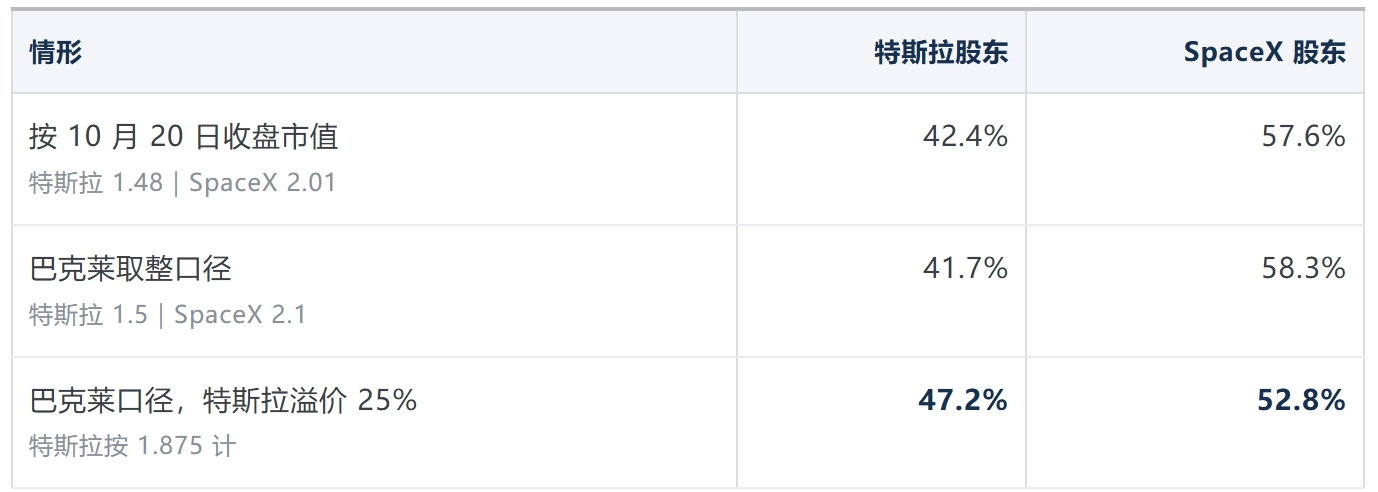
Valuation unit: trillion US dollars. "SpaceX shareholders" refers to the original shareholders of SpaceX; the proportion refers to the equity ratio of the merged company.
From the second line to the third line, Tesla shareholders get about 5.5 percentage points more, which is equivalent to about 200 billion US dollars of value transferred from SpaceX shareholders to Tesla shareholders. This is exactly what the two special committees will really argue about.
By the way, clarify a common misunderstanding: the widely circulated "0.7" in the market is the ratio of the market value of the two companies, not the number of shares exchanged per share. According to the stock price in mid-October, one share of Tesla is worth about 2.4 shares of SpaceX.
The most subtle conflict of interest is hidden here. Musk holds nearly half of SpaceX's equity, but only about 20% of Tesla's equity. The lower the premium given to Tesla, the higher his share in the merged company, which is exactly why he must recuse himself from the negotiation. The biggest obstacle is the pull between Tesla shareholders' voting and Musk's own interests.
Timing is also a bargaining chip. After the earnings report was released, SpaceX's after-hours stock price rose by about 8%, while Tesla's only rose by about 1.5%. If priced by market value, every additional rise in SpaceX's stock price will reduce the share that Tesla shareholders can get. It is best for the stock prices of both companies to rise together.
The Two Companies Will Come Together Sooner or Later, But It Will Not Be Soon, Nor Will It Be Cheap
In terms of direction, the merger is highly likely to happen. Capital, factories and AI businesses have been intertwined, Musk publicly supports the merger, Wall Street generally expects the transaction to be completed before the end of next year, and Dan Ives from Wedbush also bets that the transaction will happen in 2027.
In terms of pace, the merger will not be completed before the general meeting of shareholders on December 3. There is no merger proposal in the proxy statement. Barclays believes that the announcement may be made as early as the end of October or early November, but also admits that it will be increasingly difficult to get shareholder approval on that schedule. The more likely path is: negotiate the terms first, hire consultants, announce the intention, and then hold a special general meeting of shareholders separately.
In terms of price, there will be a fierce battle. Tesla shareholders will ask for a decent premium, and the SpaceX side will resist. The most likely form is that SpaceX acquires Tesla through share swap, because SpaceX's dual-class share structure can allow Musk to retain control.
We also need to leave room for another outcome: if the terms cannot be negotiated, the two companies will continue to cooperate in the mode of "no merger, but getting closer and closer", such as jointly building Terafab, mutual procurement, and cross-shareholding. For Musk, this is not perfect, but it is not bad either.
Epilogue: An Empire Belongs to One Person, and a Door That He Cannot Enter
If you count Musk's business territory from the ground up, you will see such a picture: chips are manufactured in Terafab in Texas, cars and robots roll off the production lines of Tesla's factories, energy storage batteries supply power to data centers, Grok runs in the computing power cluster, Starlink satellites weave a network over the head, and Falcon and Starship send all these to orbit.
This picture is being pieced together bit by bit. X has been merged into xAI, xAI has been merged into SpaceX, Tesla's investment has been converted into SpaceX's shares, and the two companies have jointly built a chip factory. Tesla will be the last and largest piece of the puzzle.
Once completed, it will be a company with a market value of about 3.5 trillion US dollars, extending from the ground all the way to orbit, and Musk holds about 1/3 of the shares and more than half of the voting rights. It is difficult to find a precedent in commercial history.
Its largest asset is Musk, and its largest risk is also Musk. His imagination makes these businesses depend on each other, and his control also makes it more and more difficult for external shareholders to say "no".
Therefore, the most thought-provoking part of this merger may not be whether it will happen, but how it will happen. The builder of the empire is standing outside the door at this moment, and it is the independent directors in the two committees and millions of ordinary shareholders with voting rights that determine its final shape.
This article is from the WeChat official account "Wu Duidui" (ID: esnql520), author: Wu Duidui, published with authorization from 36Kr.