Jensen Huang's full speech transcript at GTC Berlin 2026: AI is not software, but a manufacturing industry
At GTC Berlin 2026, Jensen Huang, CEO of NVIDIA, systematically expounded his judgment on AI: AI is not a mere software technology, but a manufacturing industry; it is like a "five-layer cake" stacked layer by layer from energy, infrastructure, models, applications to the final industries. During the speech, he launched key platforms including Vera Rubin, DSX Pod, OpenShell, Sentry and Hyperion, and put forward a core conclusion: Agents will become the new form of software, physical AI will be the next wave, and every company will eventually become an AI company.

The following is a collation of the core viewpoints of the speech:
I. AI is a manufacturing industry, a "five-layer cake"
Over the past decades, the computer industry has continued to evolve, and now we are standing at the dawn of a new round of industrial revolution. The key question of this revolution is: What exactly is AI?
My answer is simple: AI is a manufacturing industry. AI is far more than software technology. It certainly runs on computers, but the way these computers operate is fundamentally different. The tools we use are now part of machinery and infrastructure; factories are producing intelligence that integrates into every industry.
AI can be understood as a five-layer cake:
The first layer is energy, which powers the advanced computers in AI factories; the second layer is infrastructure, including computing, networking, storage, power and cooling; the third layer is models, including not only language models, but also various models for biology, chemistry, physics, robotics, motion, animation and more; the fourth layer is AI-native applications; the fifth layer is end industries and applications, covering automotive, healthcare, finance, manufacturing and other sectors.
You don't just want to be a consumer of AI, you also want to produce AI. Europe has begun to build its own AI economy, with representatives in every layer of this five-layer cake. The infrastructure layer must exist first, just as you need an internet connection to access the web, and electrification and power plants must be in place before you can truly enjoy the benefits of electricity.
II. NVIDIA does not only make GPUs, it is a full-stack AI factory
Most people believe that GPU is the area where NVIDIA makes the greatest contribution. That is true. We started developing graphics chips in 1993, eventually evolved GPUs, programmable shading GPUs, and later added CUDA acceleration, which completely revolutionized computer technology and gave birth to artificial intelligence.
But today, NVIDIA provides a complete end-to-end full-stack AI factory platform. From GPUs, CPUs, networking, storage, switching chips to system software, CUDA X libraries, models and tools, we cover the entire technology stack.
The essence of NVIDIA is an algorithm company that designs silicon chips to accelerate these algorithms. The CUDA X libraries are the crown jewel of our company. They cover a wide range of fields including computer lithography, signal processing, image processing, data processing, particles, fluids, sparse solvers and more. The model layer is brand new software, the engine for brand new applications that works in synergy with the CUDA X libraries.
III. Vera Rubin is in full production: a 100% liquid-cooled computer with no cables
Every generation of our architecture advances AI performance. From Pascal, Volta, Ampere, Hopper, Blackwell to the current Vera Rubin, we have launched six generations of architectures. Over the past decade, we have increased AI performance by 1 million times. Moore's Law would have delivered a 100x improvement in a decade, but through extreme code design and continuous innovation at the chip, system, software, algorithm and entire AI factory levels, we have achieved performance gains far exceeding Moore's Law.
Vera Rubin is already in full production. This is the world's first fully self-developed computer: No cables, no wires, 100% liquid-cooled. Previously, assembling a Grace Blackwell node took two hours, with cables and wires everywhere, and 80% liquid cooling; now Vera Rubin can be assembled in less than five minutes. This means shorter manufacturing cycles, higher reliability and better performance.
The MVLink switch tray connects 72 GPUs into one massive GPU. Each GPU has 20 small chips, and 72 of them are connected to form a giant system. Vera Rubin takes a huge leap forward from Blackwell: Blackwell is 30 times faster than Hopper in genetic algorithm operations and large language model construction, and Vera Rubin adds another 30x speedup. In just two years, Vera Rubin has achieved more than Blackwell.
IV. DSX: An AI factory cannot rely solely on good chips, it must be co-designed as a whole
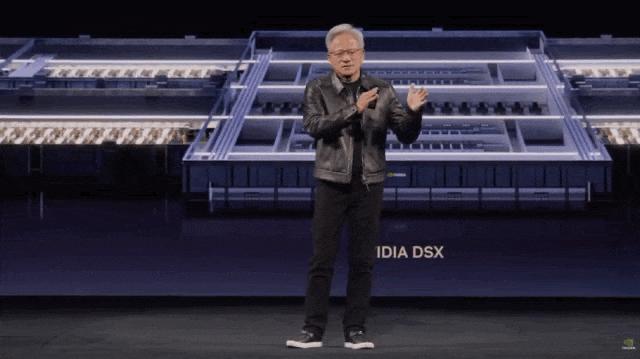
Artificial intelligence is building the largest infrastructure in history. Factories are huge in scale and require massive investment. But excellent chips alone cannot build an outstanding AI factory. NVIDIA DSX is a complete solution stack, a reference architecture co-innovated with the world's leading AI factory infrastructure companies, covering computing, networking, storage, software, power and cooling, co-designed as a holistic system and optimized from design to operation.
DSX starts with digital twins. Performance, power, water and scale are virtually verified before construction starts. PTC converts equipment designs into assets that can be used for simulation; DASO systems connect racks and facility designs; Schneider Electric simulates power distribution and liquid cooling; Jacobs integrates all of this into the Omniverse digital twin; Siemens evaluates thermal, acoustic and grid impacts; Procore supports construction phase planning.
Power limits the production capacity of AI factories. DSX Max LPS is an end-to-end control system that dynamically adjusts power according to workload demands, reducing power consumption by 30% at the same output power. DSX also redefines thermal management: the Vera Rubin system uses closed-loop liquid cooling, with coolant temperatures up to 45°C in suitable climates. Dry coolers release heat to the air instead of evaporating water. For a 2 GW AI factory, DSX can save 54 million liters of water per day, equivalent to the daily water consumption of 180,000 households.
V. DSX Pod: Turn AI factories into factory-prefabricated integrated systems
Today we are pleased to announce the launch of NVIDIA DSX Pod, which brings the full-stack platform into factory-prefabricated integrated systems. Based on the Vera Rubin NVL72, seven liquid-cooled computer racks are connected via 17 kilometers of Spectrum X cables to form the Vera Rubin DSX cabin. All wiring and testing are completed at the factory before being loaded into transportable containers for delivery. Dry coolers replace traditional evaporative coolers, and 800V DC power is connected to the racks for efficient power supply. Once on-site utilities are ready, on-site deployment time is expected to be shortened from months to days.
Why is this important? A 1 GW AI factory costs around 50 billion US dollars, with expected annual revenue of tens of billions of dollars. A delay of just three months could result in 10 billion US dollars in lost revenue. By moving wiring, assembly and testing inside the supply chain, we can shorten the time from installation to production tokens from 4-5 months to roughly one month. DSX Pod allows AI factories to be built at the speed of light: more intelligence per watt, shorter time to first token.
VI. Five elements of agents: models, exoskeletons, sandboxes, knowledge, tools
In the past year, AI has undergone a transformation. The open-source agent concept has truly unlocked the situation we see today. Now agents around the world are reasoning, iterating, using tools, consuming massive amounts of tokens, and they are becoming useful. More and more agents are being developed, becoming more popular and used by more people; because they need a large number of tokens to think, token consumption has skyrocketed, and GPU demand has also increased significantly.
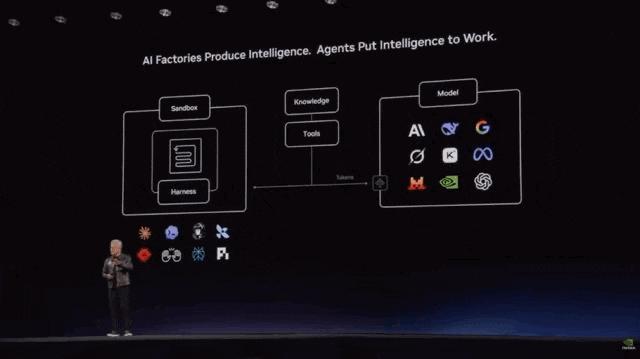
An agent consists of five elements:
First, large language models. It runs on GPUs, generates tokens, and is responsible for perception, reasoning, planning and decision-making. Second, exoskeleton. That is the "seatbelt" of the agent, which coordinates memory including active memory, working memory and long-term memory, and activates tools. Third, sandbox. The seatbelt runs inside the sandbox, isolating the agent from the rest of the system. Fourth, knowledge. Agents need access to company data to convert structured and unstructured data into a knowledge base. Fifth, tools. Agents must use tools to do practical work.
Models, sandboxes, toolkits, knowledge and tools, these five elements constitute an agent.
VII. OpenShell and Sentry: Agents must be secure, security is technology and engineering
Agents are autonomous systems that can access files, resources, networks and tools. We must ensure that these permissions are used effectively. Hope is not security, security is not a vision, security is technology and engineering.
We are launching NVIDIA OpenShell, a secure runtime environment that provides sandboxes for agents. You define policies for each agent, and OpenShell enforces them at system granularity: system calls, file access, network connections. Formal verification checks every policy change to cap permissions, so agents can never get more access than intended. It's like the early internet, where viruses were everywhere until browsers imposed strict restrictions on web page functionality. OpenShell does the same for agents: enforcement happens outside the agent, not just inside the LLM.
NVIDIA Sentry adds an optional layer that enforces runtime policies outside the host, far from the agent. It runs on NVIDIA BlueField 4, monitors agent activity, and enforces security policies in a hardware-isolated trust domain. Because agent inference traffic passes through Sentry, if an agent plans to perform certain operations, Sentry can immediately cut off the connection to that model and isolate it with millisecond precision. It also preserves records that operators can verify for detection, investigation and response.
OpenShell is open source software, under the Apache 2.0 framework, that can run wherever agents run, from edge to cloud. The utility of agents depends on the permissions you grant them. OpenShell and Sentry put access control in your hands. This is how we advance artificial intelligence: with both performance and security. Anthropic and NVIDIA are collaborating to create cloud-hosted OpenShell agents.
VIII. Model strategy: closed, open, customized, every company will use all of them in the future
In the future, we will not run only one type of model. We will use the best models, whether closed, open or customized. Sometimes the work is ordinary, general artificial intelligence will do a great job; sometimes the work involves a lot of proprietary knowledge and focused domains, and you want to enhance your own intelligence. In the future, every company will use both closed models and customizable open models at the same time.
NVIDIA has been advancing open models: Neotron for language, Cosmos as the world foundation model, GR00T for humanoid robots, Alpamayo for autonomous robot navigation, plus quantum-classical computing, Earth 2 physical AI and more. We not only provide open models, but also related data and complete recipes, so that you can understand the origin of the model and trust it completely.
Through customization and partnerships, open models can be transformed into cutting-edge capabilities. You can start with an open model, train and post-process it with your own data to achieve super intelligence for your use case. This is a very sensible approach, and the technology is now fully achievable.
IX. Knowledge base and tools: Let agents truly do practical work
Models and sandboxes are only the first two components. Ultimately, what turns agents into super agents is giving them access to your company's knowledge. That is the agent knowledge base.
Company data may exist in documents with messy formats, requiring AI to understand how to read PDFs and unstructured documents; it may also exist in structured databases. Neotron parsing is world-class, Neotron embeddings associate queries with internal knowledge, Neotron reranking discovers associations between queries and different sources and different parts, and sorts and summarizes them. Cosmos can predict what might happen based on structured databases. For example, a supplier notifies of supply shortages or delays, which is unstructured document information; company orders are stored in SQL databases; to predict which orders will be out of stock, you can use Cosmos for prediction, then use vector databases to search for engineering documents for replacement parts. These libraries and data processing capabilities constitute your knowledge base, allowing you to build your own artificial intelligence with proprietary data and proprietary knowledge.
Finally there are tools, that is, industry tools. NVIDIA has been developing the CUDA X libraries. For most people, this was a major challenge before the advent of AI. All our discussions revolve around how to accelerate simulators, solvers, data processing engines and domain-specific libraries. They are applied in scientific discovery, engineering, research, design, construction and creative arts. CUDA X libraries are algorithms, and algorithms are elegant. They are NVIDIA's crown jewels.
Agent assistants can be lab assistants, research associates, co-designers. Ultimately, what makes these agents useful are the tools. Models allow agents to reason, understand information, plan, iterate actions and use tools until the work is done. But in the end it all comes down to tools. And these tools run on the same computers, with processing speeds 10x, 50x, 100x faster than running directly on CPUs. CUDA X tools provide agents with the professional tools they need.
X. Physical AI: The next wave, from radio to robotics
The next wave of AI is physical AI: artificial intelligence that can understand and reason about the physical world. The physical world is diverse, complex, with an extremely long tail. Whenever people think of the physical world, they think of robotics. But one of my favorite physical world applications is radio and cell towers. It does not use speakers and microphones, but uses radio waves and cameras to perceive the world, reason, process information, and interact with the physical world through beamforming. This is perfectly suited for artificial intelligence, will completely revolutionize telecommunications, and greatly improve spectrum efficiency, just like what we did with ray tracing.
Another application of physical AI is robot-assisted radiotherapy. Tumors change, body shapes change, and the body changes during treatment. A robotic adaptive radiotherapy system must perceive changes, understand the tumor location, accurately segment and precisely guide radiotherapy. This is essentially robotic manipulation, a form of robotic surgery.
Of course, one of the largest physical AI applications is autonomous driving. Every car company wants their cars to be part of a ride-hailing fleet. In the future, self-driving taxis will be connected to ride-hailing services such as Uber, Bolt, Grab and Lyft, and will not come from just one brand. Building these systems is extremely expensive, especially the supporting software. So we decided to create a standard architecture: Hyperion. 14 cameras, 9 radars, 3 low-angle radars, ultrasonic sensors, powered by dual NVIDIA GPUs. This design is being adopted in fleets of car after car. We are also building self-driving taxi features and connecting to mobility services.
Today, I am very proud to announce that we will add four more brands and four more models to the Hyperion fleet: <