Three major giants and 19 applications are vying for the first ticket to the AI era.
Since the start of this year, office Agents have undergone rounds of rapid iteration, and competition among major tech giants has begun to show more intuitive data comparisons.
On October 20, QuestMobile released the AI Application Market Report for the third quarter of 2026. In September, the monthly active users (MAU) of the AI office track reached 142 million, a year-on-year increase of 50.6%. Among them, Tencent WorkBuddy ranks first in the office Agent track with 32.35 million MAU, followed by Baidu Dazi and Qianwen Office.
Another ranking of AI-native apps presents a different landscape: Doubao steadily takes the first place with 419 million MAU, while Qianwen and DeepSeek rank second and third with 158 million and 123 million MAU respectively.
The traffic scramble for general AI assistants has gradually entered the head competition stage with a stabilizing landscape, and major tech giants have shifted their sights to the office scenario. However, the existing leading edge may not be sustainable: Doubao is far ahead in the general AI assistant market, while Tencent has taken the top spot in the office Agent track first.
One track has a initially settled landscape, while the other has just started. Starting from these 19 applications, we can clearly see how the competition of AI applications extends from mobile phone screens to computer desktops, and what bets the major giants have placed respectively.
01. The top three AI assistants are initially confirmed, and major giants are competing for the next entry
The two rankings from QuestMobile are respectively the MAU ranking of AI-native apps and the MAU ranking of office Agents. Viewed together, they present two competition states in the AI application market.
First, let's look at the familiar battlefield of the AI-native app ranking.
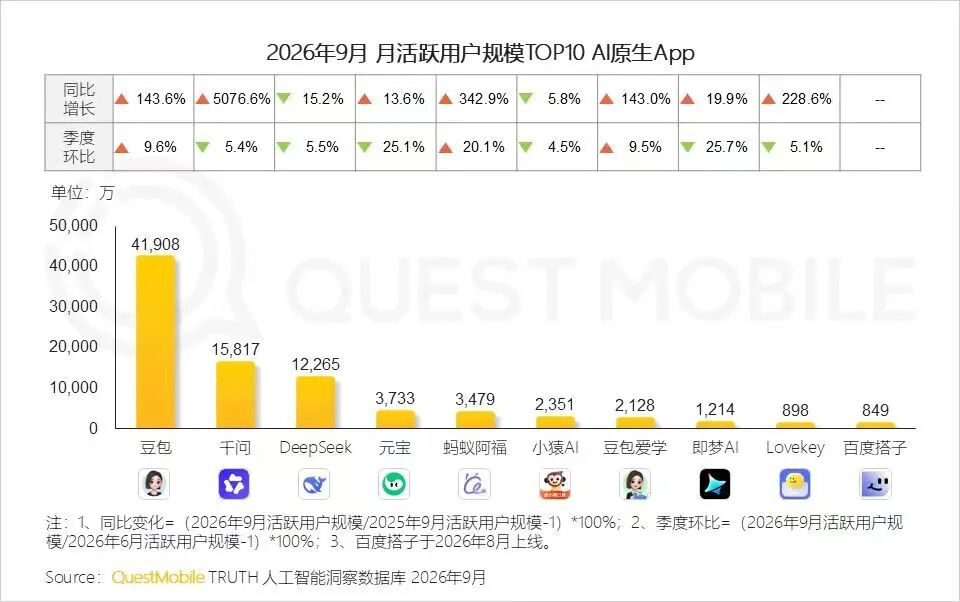
In September 2026, Doubao ranked first with 419 million MAU, while Qianwen and DeepSeek ranked second and third with 158 million and 123 million MAU respectively. The total MAU of the three products accounts for more than 80% of the total of the top 10 on the ranking, forming a clear gap with subsequent products.
Among them, Doubao has the most prominent leading edge, with its MAU about 2.65 times that of Qianwen which ranks second. Tencent Yuanbao, ranking fourth, has 37.33 million MAU, which is no longer in the same order of magnitude as the top three. This means that after more than a year of user competition, the general AI assistant market has formed a relatively clear head camp. For latecomers, it is getting more difficult to replicate Doubao's user scale in the comprehensive AI assistant market.
However, the initially settled head landscape does not mean that the ranking is fixed. The ranking shows that Qianwen's MAU increased by 5076.6% year-on-year, surpassing DeepSeek in one move; the latter decreased by 15.2% year-on-year. The rise and fall reveal two facts: first, the user migration cost in this market is far lower than imagined, and a model capability upgrade or a wave of traffic investment can rewrite the ranking; second, the first-mover advantage has not been transformed into irreplaceable user mindshare.
It is worth noting that beyond general AI assistants, a number of products focusing on segmented demands have also squeezed into the top 10. Their presence on the ranking indicates that segmented demands can still support independent products of considerable scale.
Among them, Ant Afu ranks fifth with 34.79 million MAU, Doubao Aixue ranks seventh with 21.28 million MAU, and Lovekey focusing on emotional companionship ranks ninth with 8.98 million MAU. The three products respectively target scenarios such as health, education and emotional companionship. For major tech giants, these products are ecological supplements beyond the general entry; for players without traffic entry, it shows that by accurately selecting a high-frequency just-needed scenario, there is still a chance to gain a firm foothold outside the head camp, and Lovekey is a typical example.
The truly noteworthy variable lies in the second ranking.
On the MAU ranking of office Agents, Tencent WorkBuddy ranks first with 32.353 million MAU, while Baidu Dazi and Alibaba Qianwen Office rank second and third with 9.77 million and 7.905 million MAU respectively. Products including Tencent QClaw, ByteDance Doubao Work and TRAE Work also enter the top 10.
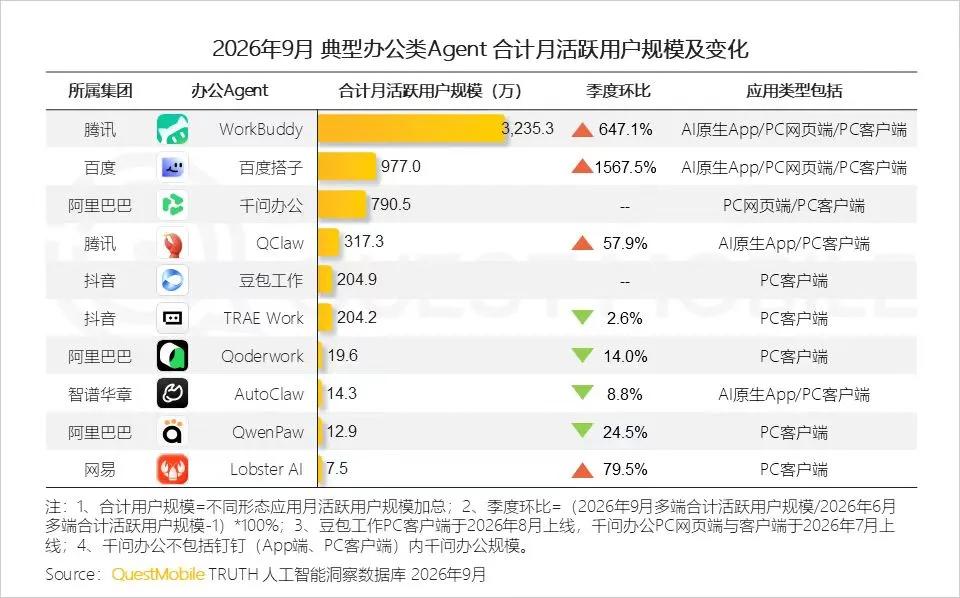
Compared with the hundreds of millions of MAU of general AI assistants, there is still an obvious gap in user scale for head products in the office Agent track, but their growth rate cannot be ignored. In the third quarter of this year, WorkBuddy's MAU increased by 647.1% month-on-month, and Baidu Dazi's MAU increased by 1567.5%. In just three months, the MAU of the two products increased by about 6.5 times and 15.7 times respectively.
However, compared with general AI assistants, the landscape of this market is still unstable. In terms of product development timeline, the PC version of Qianwen Office was launched in July, and the PC version of Doubao Work and the personal version of Baidu Dazi were launched in August. Many products have not been on the market for a long time. The current ranking more reflects the performance of all players in the early user competition, and is not sufficient to judge the long-term competition landscape.
Another noteworthy change is that the PC end is becoming a new growth entry for AI applications.
QuestMobile data shows that in September 2026, the user scale of the PC client of office Agents increased by 512.2% year-on-year, close to the 518.4% growth rate of the App end. This means that AI applications are undergoing entry migration, and the explosion of the PC end is mainly driven by the office scenario.
From AI assistants on mobile phones to office Agents on computers, the competition among major tech giants is extending to new scenarios. However, the accumulated user scale and traffic advantages in the past may not directly determine the outcome of the next round of competition.
02. ByteDance, Tencent, Alibaba and Baidu: four different strategies competing for the desktop
The same company has completely different positions on the two rankings. ByteDance's Doubao is far ahead on the mobile end, but Doubao Work only ranks fifth on the office ranking; Tencent Yuanbao lags behind on the mobile end, but WorkBuddy takes the first place on the office ranking.
The difference lies in the corresponding demands. The former mainly targets individual users, while the latter needs to truly enter enterprises and connect with work flows and internal enterprise systems. In the past few months, major tech giants have experienced multiple rounds of product iteration and business adjustment, with different routes and priorities.
First, ByteDance has the widest product layout and the most frequent strategy adjustments.
In the two rankings of September, ByteDance has five products on the list: Doubao, Jimeng AI, Doubao Aixue, Doubao Work and TRAE Work.
What is more noteworthy than the number of products is ByteDance's re-arrangement of these businesses in recent months.
At the end of July, the Feishu product team and the Doubao product team were integrated; on August 24, ByteDance once merged the TRAE and Coze teams into the Doubao system, and released the independent AI office product "Doubao Work" the next day, leading the outside world to once think that ByteDance would completely cut off TRAE. But on October 9, TRAE Work and TRAE Code were merged and upgraded to the new version of TRAE, retaining the independent brand, and putting office task execution and software development capabilities on the same platform. Doubao Work continues to target broader office demands.

Source / Doubao official website
From this perspective, ByteDance is actually doing two things: on the one hand, taking Doubao as the public AI entry to extend to scenarios such as education and office; on the other hand, retaining professional products like TRAE to undertake the complex development demands that general assistants cannot fully cover. The advantage of this layout is that Doubao has a user scale that other manufacturers cannot ignore, so ByteDance does not need to compete for AI users from scratch. But the difficulty is equally obvious: Doubao, which has more than 400 million MAU, has not allowed ByteDance to take the lead in the office Agent market.
Next, Tencent's route is to concentrate firepower, target the office scenario, and fully bet on WorkBuddy.
Tencent has three products on the list: Tencent Yuanbao, WorkBuddy and QClaw.
The multi-end MAU of WorkBuddy has been close to the App end of Yuanbao. Although the statistical calibers are different, the growth rate difference is obvious: the former increased by 647.1% month-on-month in the quarter, while the latter fell back significantly. Although there is a low base effect, Tencent's investment in it is real. At the second-quarter conference call, Tencent's management stated: after confirming that WorkBuddy is gaining momentum, it decisively tilted resources to it, and reduced the priority of some other new AI products in the portfolio. In addition, QClaw, which is on the ranking, also announced its shutdown in September, further concentrating resources on WorkBuddy.
This choice is directly related to Tencent's entry structure. WeChat and WeCom have ready-made, high-viscosity work communication scenarios, and WorkBuddy can be embedded in the collaborative processes that users are already using, without needing to complete user education from scratch like independent products. In contrast, facing the suppression from Doubao, Qianwen and DeepSeek, Yuanbao has less and less opportunities and cost-effectiveness to compete for the C-end entry.
Judging from the current results, this strategy does work: WorkBuddy not only ranks first in MAU, but also has a gap of more than three times with the products behind it. Before the office scenario enters commercialization, Tencent has at least occupied a leading position.
Alibaba is the only player among the four that has entered the top three on both rankings.
Alibaba has four products entering the two rankings. On the AI-native app ranking, Qianwen ranks second; on the office Agent ranking, Qianwen Office ranks third, and Qoderwork and QwenPaw rank seventh and ninth respectively.
Qianwen competes for the C-end general AI entry, Qianwen Office cuts into the work scenario, and products like Qoderwork explore professional task execution. From this perspective, Alibaba's layout and strategy are quite similar to ByteDance's.
The more striking figure is that Qianwen increased by 5076.6% year-on-year, surpassing DeepSeek in scale. But from the month-on-month data, Qianwen decreased by 5.4%, and its catching-up momentum has slowed down. The high year-on-year growth rate is also partially due to the low base in the early stage.
Zhang Yi, chief analyst of iiMedia Research, told AIX Finance that the rapid growth of Qianwen is related to Alibaba's strong ecological diversion capability and free strategy, and Alibaba's long-term accumulation in the To B market also provides conditions for its extension to office Agents.
But Alibaba's problem lies here: it has the user scale of Qianwen and the enterprise foundation of DingTalk, but it has not shown absolute advantage on any ranking. In addition, Alibaba previously integrated QoderWork, Wukong and MuleRun under the "Qianwen" brand, but how to divide product positioning and coordinate resources of different teams is also a problem that Alibaba needs to solve.
Baidu is the player that rushed the fastest in this round of office Agent competition, but its foundation is relatively weak.
Baidu Dazi ranks second on the office Agent ranking with 9.77 million MAU, second only to Tencent WorkBuddy, with a 1567.5% month-on-month quarterly growth rate, ranking first in the ranking. However, its App end was not launched until August, and a large part of this growth rate is brought by the launch of the new form.
In the view of Ding Bairan, investor of Dewu Capital, it is still uncertain whether Baidu Dazi can further enter the enterprise market. He believes that Tencent has WeCom, Alibaba has DingTalk, and ByteDance has Feishu. These products have been embedded in the daily communication and collaboration processes of enterprises. In contrast, Baidu lacks an enterprise collaboration entry of the same scale, making it more difficult for Agents to penetrate into the internal business flow of enterprises.
Of course, the lack of a self-owned enterprise collaboration platform does not mean that Baidu can only rely on independent products to acquire customers. Through third-party system docking, enterprise customization and professional agents, Baidu also has the opportunity to enter specific business scenarios. But whether the rapid growth of Baidu Dazi can continue and whether these users can be further converted into enterprise customers remains to be verified.
Putting the actions of the four companies together, Ding Bairan judges that the four companies will eventually become very similar, "Each exerts force on both to C and to B, and these two areas will become the focus of competition", while competing for the entry of personal AI assistants, and embedding Agents into enterprise collaboration platforms and business processes. But he believes that having a huge number of general AI users is only the starting point of competition. Because of WeCom, DingTalk and Feishu, Tencent, Alibaba and ByteDance have already got half of the tickets.
03. From Chatbot to Agent, what is the next round of competition for AI applications?
In September, the MAU of Doubao, Qianwen and DeepSeek all exceeded 100 million, while WorkBuddy, the top office Agent, had an MAU of 32.353 million. There is still an obvious scale gap between the two types of products. This means that the war for the office scenario has just begun.
In the past, users opened AI assistants mainly to get answers and generate content. Now, office Agents are trying to take over tasks further: what users hand over to AI is no longer just a question, but a piece of work that needs to be completed.
Zhang Yi believes that the competition of AI applications is shifting from traffic entry to task entry, and the indicators for measuring product value will change accordingly. Compared with simply pursuing MAU, office Agents also need to look at task completion rate and final delivery effect.
Moreover, this competition is no longer limited to their respective office ecosystems. Qianwen Office has begun to support importing local historical data from WorkBuddy, Doubao Work has also launched functions such as importing conversations, skills and work memory from other AI tools; WorkBuddy provides ways to access different collaboration platforms. Therefore, the accumulated work records, operation habits and tool configurations in the past are becoming new migration costs.
Now all players are seizing task entries and building data barriers, but beyond these, the core will eventually return to the possibility of commercialization.

Source / pexels
The high MAU of general AI assistants is built on large-scale free services, and monetization has always been difficult; office Agents directly face efficiency value from the very beginning, with a much clearer path. Personal subscription, enterprise procurement, pay-per-use or pay-per-task