What does the operational success of a livestream e-commerce project mainly depend on?
Over a decade ago, when I switched from copywriting in the offline traditional industry to researching the internet, I had no idea what operations in the internet field actually entailed. Back then, I blindly chased countless industry trends without figuring out the underlying logic. It was not until I started leading a team to sell goods that I gained first-hand insights into operations, which essentially refers to both operational execution and marketing.
We are now at a similar watershed period. Many enterprises, or friends who want to enter the AI sector for observation, may still be attracted by the rapidly evolving technologies and new models, just like getting lost in a sea of flowers. In fact, no matter how advanced AI is, an enterprise or a group of people can only survive by figuring out how to make profits, sell goods, and generate orders.
Therefore, directly researching how to conduct business online is far more practical. Currently, selling goods is almost inseparable from live-stream e-commerce. Apart from celebrity-led sales, influencer-led sales, and self-media-led sales, brand-led sales by enterprises have also emerged. If you ask what industries can still make profits now, at least in Wuhan, the jobs that generate relatively high income are streamers and operations personnel, which are almost all related to live streaming. Live-stream e-commerce has become the mainstream of the entire e-commerce sector and even the marketing industry.
In the previous article, taking Douyin E-commerce as an example Douyin E-commerce: A Rare Chance for Small and Medium-sized Enterprises to Turn the Tide, I roughly explained the logic for enterprises to develop live-stream e-commerce. This article focuses on the role division, functions and status of each link in live-stream e-commerce. Of course, the same logic applies to building WeChat Channels e-commerce, Xiaohongshu e-commerce, and Kuaishou e-commerce. Once you master the model, every platform is essentially a publishing channel for self-media content. As long as an enterprise cultivates a live-stream e-commerce team with relatively mature business capabilities, it can go wherever there is traffic, so it will not fear AI, nor feel anxious about survival.
Of course, I believe every self-media account should start live-streaming to sell goods! It will be very interesting to directly serve followers.
I. Live-stream E-commerce Team Structure: Operations Occupies the Hub Position
As an upgrade of the previous shelf e-commerce, live-stream e-commerce has obviously gone beyond the scope of traditional e-commerce, but the back end (the actions invisible to users) is almost the same. The work of traffic investment operations and e-commerce customer service is fully retained, and only streamers and on-site controllers are added to the front end of live-stream e-commerce, thus forming the overall pattern of live-stream e-commerce:
Front-end streamer — on-site controller, operations — back-end customer service.
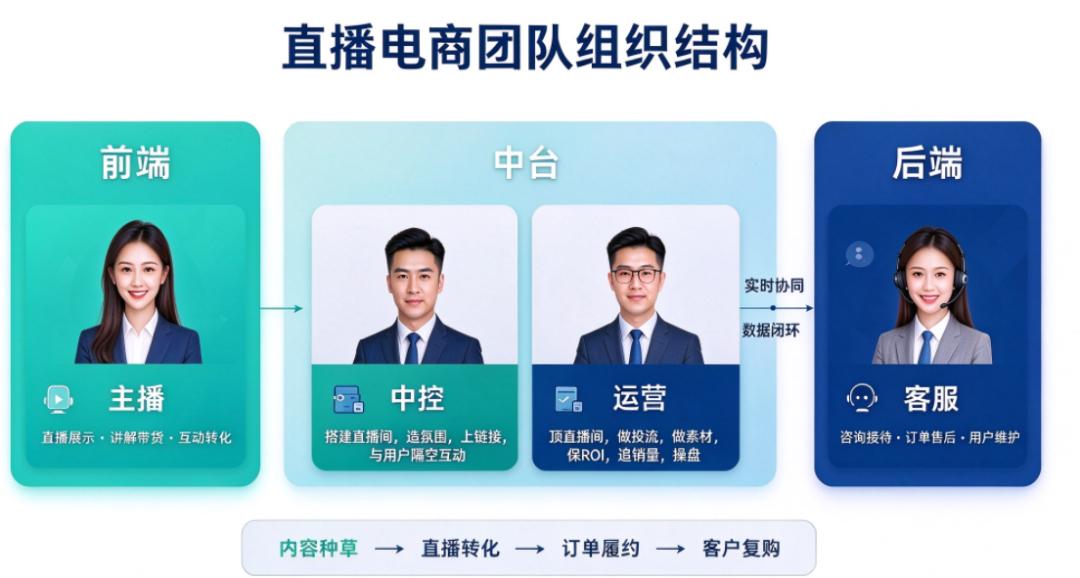
Since the term "operations" covers a wide range of scopes, it is often the "business middle platform" type of work that business owners attach the most importance to. In the industrial chain of live-stream e-commerce, operations includes traffic investment specialists, content operation personnel responsible for editing and producing materials, and personnel in charge of store management operations.
In this case, the most critical work in the entire live-stream e-commerce system is obviously operations. But that is not entirely the case, because as mentioned earlier, the biggest difference between live-stream e-commerce and traditional e-commerce lies in the different front-end settings. If an operation specialist does not take charge of the recruitment, training and screening of streamers, all their actions will be meaningless.
To put it plainly, live-stream e-commerce is still a sales-dominated business, which just moves the offline store sales scenario to the online space with technical support. Our training for streamers is mainly divided into three logical levels to introduce products: why customers need to buy our products (pain point highlighting and product value shaping); why customers choose to buy this product in our live stream (differentiated brand endorsement); why customers need to buy our products right now (urging orders). We follow this mode to continuously deepen user impressions.
For example, the performance ability of streamers, the writing, adjustment and iteration of sales scripts, and the design of sales activities all fall within the scope of work. After these basic tasks are completed, if a streamer wants to generate orders, the operation specialist needs to provide traffic support for the streamer, and the on-site controller helps the streamer set up equipment and the live stream room. Generally, many on-site controllers are only responsible for speaking on the stream, adding product links and assisting the streamer as a co-host. At this time, the operation specialist also needs to train the on-site controller, so that they can not only pop up product links, but also set up quick replies and automatic replies. If the on-site controller is well arranged, the operation specialist can save a lot of energy and time to focus on traffic investment.
From the perspective of streamers, the on-site controller (co-host) plays a very important role, and they are essentially partners in the sales process. If there is traffic entering the live stream room after traffic investment, but the streamer cannot receive the traffic or convert it, it will be very difficult to increase the ROI in the paid traffic live stream room, which will inevitably seriously affect the professional performance of the operation specialist.
With the support of an on-site controller, streamers will feel more confident, especially for new streamers, the presence of a co-host to maintain the live stream atmosphere is very necessary. Especially when the streamer's status fluctuates, the on-site controller can adjust the live stream rhythm appropriately. The on-site controller is essentially a role that monitors the whole process of the live stream, and can continuously feed back the abnormal situation in the live stream room. Otherwise, once an emergency occurs in the live stream activity, it will be difficult to continue the broadcast.
Therefore, the operation specialist and the on-site controller are an integrated whole. The on-site controller is the assistant of the operation specialist, and also a subset of the front-end work of the operation specialist. If an operation specialist can manage the on-site controller well, their business ability will definitely double. If the operation specialist only knows how to invest in traffic, but cannot make the front-end live stream work run in an orderly manner, sometimes the traffic cannot be invested smoothly even if there is available budget in the account.
Therefore, when an operation specialist is responsible for the live-stream e-commerce business, in addition to being able to build the live stream picture, debug various equipment such as computers, lights, cameras, live stream pictures, and combine various elements of the live stream room, they should also be able to complete the broadcast launch operation, and write the streamer's scripts in advance.
Why does the operation specialist write the script instead of the streamer? Because many streamers in the market are part-time, they do not have in-depth research and control over the products. The operation specialist and the on-site controller they lead have been staying in the live stream room to interact with the streamer and create a good atmosphere, and they can respond to various needs and problems of users, so they are very familiar with the feedback from the front line of the market. Even the on-site controller has access to the sales data and information in the background, they know the fluctuation of traffic and the traffic investment situation, and they know how many users are in the pending payment status, which can be directly viewed through the Douyin store background data. Even the on-site controller who follows different streamers to broadcast clearly knows which scripts can really impress consumers and promote transactions.
For enterprises, they can cultivate one or two full-time streamers, but most streamers have large market demand and high mobility, and part-time streamers are easier to manage. Therefore, the operation specialist also needs to have the ability to recruit and train (part-time) streamers, and the on-site controller has more say in judging which streamers are excellent and suitable for promoting specific products.
At present, having the right image and temperament is indeed a prerequisite for being a streamer. Because there are a large number of practitioners and the entry threshold is relatively low, the hourly payment method makes the employment very flexible. Fortunately, most of the practitioners are young people, so communication is simple and straightforward. Everyone has a very clear goal: to make money!
There is no need for complicated management, the main work is to provide good service and pay salaries on time. We also require the on-site controller to count the sales volume of streamers after they go off air. The corresponding data can be checked in the background of Ocean Engine, including the specific net transaction, return situation, and ROI, how much traffic fee is spent, and how many orders are generated. In addition, the operation specialist also undertakes part of the personnel performance management work and a lot of work as sales organizer.
II. Customer Service is the Basic Guarantee for the Sustainable Operation of Live-stream E-commerce
In the shelf e-commerce scenario, due to the lack of front-end live stream display and explanation, the most important role is customer service. In live-stream e-commerce, the importance of customer service has not been reduced.
In live-stream e-commerce, the work of customer service is not limited to after-sales service. In fact, customer service, streamers, co-hosts and operation specialists process orders at the same time. Users will consult customer service before, during and after placing an order. For some questions that are not convenient to answer in the live stream room, the streamer and the on-site controller will directly guide users to consult the back-end customer service.
At this time, customer service basically undertakes the work of stabilizing orders to support the streamer's order urging and transaction. In addition to answering the questions that customers do not understand, customer service should also complete the final step of stabilizing orders, to push users from pending payment status to pending delivery status. Of course, if the customer service background finds that there are a large number of closed orders, it is necessary to timely inform the on-site controller, so that the streamer's main script can shift from order urging to product value shaping. Many excellent customer service staff can also work part-time as on-site controllers.
The reason why customer service is said to be the foundation of the entire live stream operation is that any account that is not bound to a store can only use the Select Alliance platform to sell goods for other people's stores and get commission deducted. If an enterprise wants to build its own e-commerce business, it definitely needs to operate its own product store, its own self-media fan account, and its own Ocean Engine account. The operation of product stores requires customer service staff to research and develop, and even the work of product listing, product detail page optimization, positive review rate maintenance, store credit score and level management all need to be completed by customer service.
If you do not attach importance to customer service, work such as notifying the cloud warehouse to deliver goods in time, handling user returns and exchanges, inviting users to leave positive reviews, and dealing with user negative reviews will be ignored. You will inevitably fail to track the positive feedback or negative feedback from customers. Once there are too many complaints and reports from customers on the platform, the system will regard the enterprise as a merchant with product quality problems, or a merchant that conducts false publicity, over-promises to consumers or engages in fraudulent behavior. The platform will directly impose penalties such as blocking product links, limiting the daily transaction volume, or even directly closing the store. Once these situations occur, the streamer will find that the yellow shopping cart cannot be clicked, or the inventory is directly displayed as sold out, or the product link is directly removed from the shelves, resulting in the live stream being forced to interrupt and stop broadcasting.
Therefore, all links of live-stream e-commerce restrict and check and balance each other. The premise of stable and good sales performance is the good cooperation between all elements. There is no front end without the back end, and there is no back end without the front end. As the saying goes, "Front and rear follow each other, high and low lean on each other, sound and echo harmonize each other". If you only focus on one end and ignore the other, you cannot support the normal operation of the business.
III. The Final Competition of Live-stream E-commerce Lies in Marketing Capability and Product Capability
If you have to say which business element and sector in live-stream e-commerce is the most important?
The author, A Xing, believes that the most important thing is a kind of "marketing awareness", or a kind of "goods selling mindset".
If a streamer does not have this goods selling mindset, they will not be able to focus on the key points when they go to the live stream to talk, and the scripts provided by the operation specialist or the on-site controller cannot help them close the deal and generate orders.
The operation specialist also cannot judge what kind of crowd and what kind of materials can attract target users to enter the live stream room to complete transactions.
If the customer service staff does not have a strong awareness of closing deals and selling goods, they cannot insight into the real demands of customers, and cannot convert them into users who leave positive reviews instead of negative reviews, and sign for the goods instead of returning them.
That is to say, live-stream e-commerce is essentially a system that requires all links to have stronger goods selling awareness, master various marketing skills, be flexible to respond to changes, and cooperate closely to operate smoothly.
As for other technical operations, such as the picture quality of the live stream, whether the script involves violation points, whether the microphone is charged, whether the secondary screen is turned on, the price fluctuation of the product itself, and the setting of coupons, these trivial matters are not the main contradiction.
Now it is very easy for large language models like Doubao to generate pictures and write scripts. You can directly benchmark a competing live stream that performs well, or summarize the success factors in the live stream, and copy them directly. It can be said that large language models have helped operation specialists and on-site controllers reduce a lot of workload.
Therefore, I think live-stream e-commerce is not difficult. As long as you master the operation interface, you can find a new home court. Just like traditional writers used to write with pen and paper and publish works in newspapers or publish books, while now writers directly use computers and keyboards to write and publish works on the Internet or official accounts. Technical difficulties are not the main problem. The core capability of how to write and create content that readers are interested in has not changed at all after you break the limitation of operation interface and output form.
With good products, the most important thing is to sell the products. If you do not have products, the most important thing is the product selection capability, that is, supply chain, to see if you can get products with sufficiently low cost and sufficient marketing space. If you do not have your own source factory, you need to have brand endorsement capability and packaging operation capability.
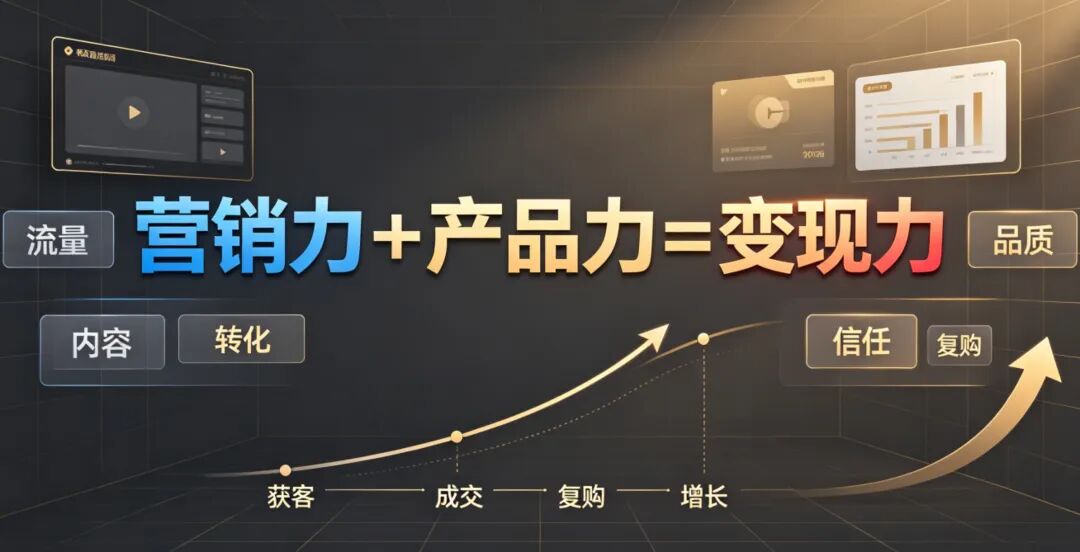
If the product cannot meet the usage needs of consumers, or there is a serious disconnect between the actual function of the product and the marketing direction, it will be difficult to achieve real success. Because the product is the leading 1, and marketing is the multiple zeros that follow. If the product is of poor quality, no matter how strong the marketing capability is, the result will only be negative, that is, loss.
Therefore, marketing capability and product capability, just like the relationship between operation specialists and customer service staff mentioned earlier, are complementary and mutually reinforcing.
Conclusion:
Of course, different enterprises have different live stream operation methods, different team business capabilities, and different products and categories. The above content only introduces a relatively general framework. The specific operation should be based on the actual effect. Generally speaking, as long as an enterprise can sell goods in large quantities on the Internet and continuously generate orders, it must have done a good job in operation and customer service, and adopted a two-pronged approach in both marketing and product development. The industry is currently in a hot period. If you master this set of methods, you can go all out to do business! Because no one can accurately predict what the next marketable marketing model for enterprises will be. Now the economy is in a downward period, and many people's incomes are declining. Indeed, only selling goods can solve all kinds of worries.
This article is from WeChat official account "Reliable A Xing", author: Reliable A Xing, authorized for release by 36Kr.