Teaching parents how to cut strawberries and raking in millions of US dollars in monthly revenue, another money-spinning product has emerged in the parenting track.
Teaching parents how to feed babies, what size to cut strawberries, at what age babies can eat honey, and how to handle peanuts to avoid allergies, these things in our cognition mostly come from the words and deeds of the previous generation. Nowadays, some people have turned this into a business.
An app called "Solid Starts: Baby First Foods" saw its monthly revenue exceed 1 million US dollars for two consecutive months in April and May. It still reached 1.07 million US dollars by August, and dropped to 670,000 US dollars in September (data from Diandian Data). It has long been ranked around 10th in the US education bestseller list (currently 30th). For reference, the baby sleep aid app "Huckleberry" we paid attention to before also has a monthly revenue of the million-dollar level, and the two products are comparable.
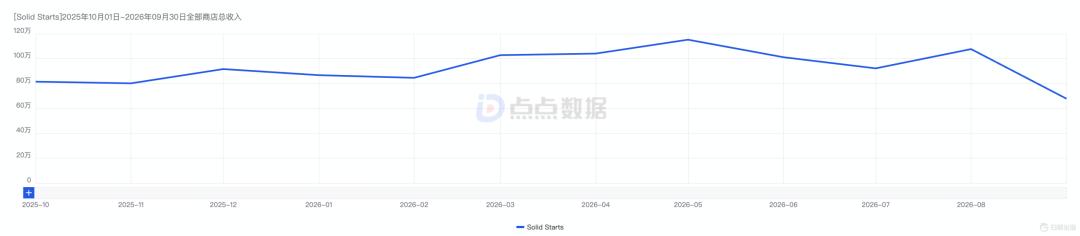
Solid Starts: Baby First Foods' revenue data in the past year | Image source: Diandian Data
The baby tool track can continuously attract money, which is no longer an isolated case.
But compared with "Huckleberry" which satisfies the efficiency anxiety of "when the child sleeps and wakes up", "Solid Starts" cuts into a more interesting scenario - the complementary food introduction period. In this scenario, parents are not pursuing efficiency, but looking for the sense of security of "I have professional basis". This sense of security has precisely become the starting point of payment.
I. Every introduction of a new food is an adventure
The complementary food period is the transition stage for babies from drinking milk to normal diet, which generally starts from half a year old and lasts for more than half a year. During this period, children will experience the transition from liquid to solid food, and from single food to diversified diet.
Teaching children how to eat sounds not complicated, but for new parents, this process is almost full of minefields. Every year, 17,000 children in the United States are admitted to the emergency room due to food suffocation, and another 8%-10% of children have food allergies, the vast majority of which first occur during the complementary food period.
Since babies' chewing and swallowing abilities are not fully developed, and the allergen reaction is not clear, every time a new food is introduced, parents have to make a judgment - can they eat it? How to cut it? Will it choke? Is there any risk of allergy?
Different from the baby sleep aid scenario, complementary food introduction is not a problem that can be "handed over to the algorithm". There is no suitable prediction model, and there is no optimal solution for "what to feed at the next meal". Parents are faced with high-frequency, scattered decision-making pressure that involves the bottom line of safety every time.
What's more difficult is that the reliable information about complementary foods is extremely fragmented. Professional content is often hidden behind paywalls or in academic literature, while the suggestions on social media are mixed, and it is difficult for ordinary parents to obtain and judge systematically.
This is exactly the gap that "Solid Starts" targets. To put it simply, it helps parents figure out one thing: can this food be given to the child, and how to feed it.
II. Solve anxiety for free, manage the whole process with paid services
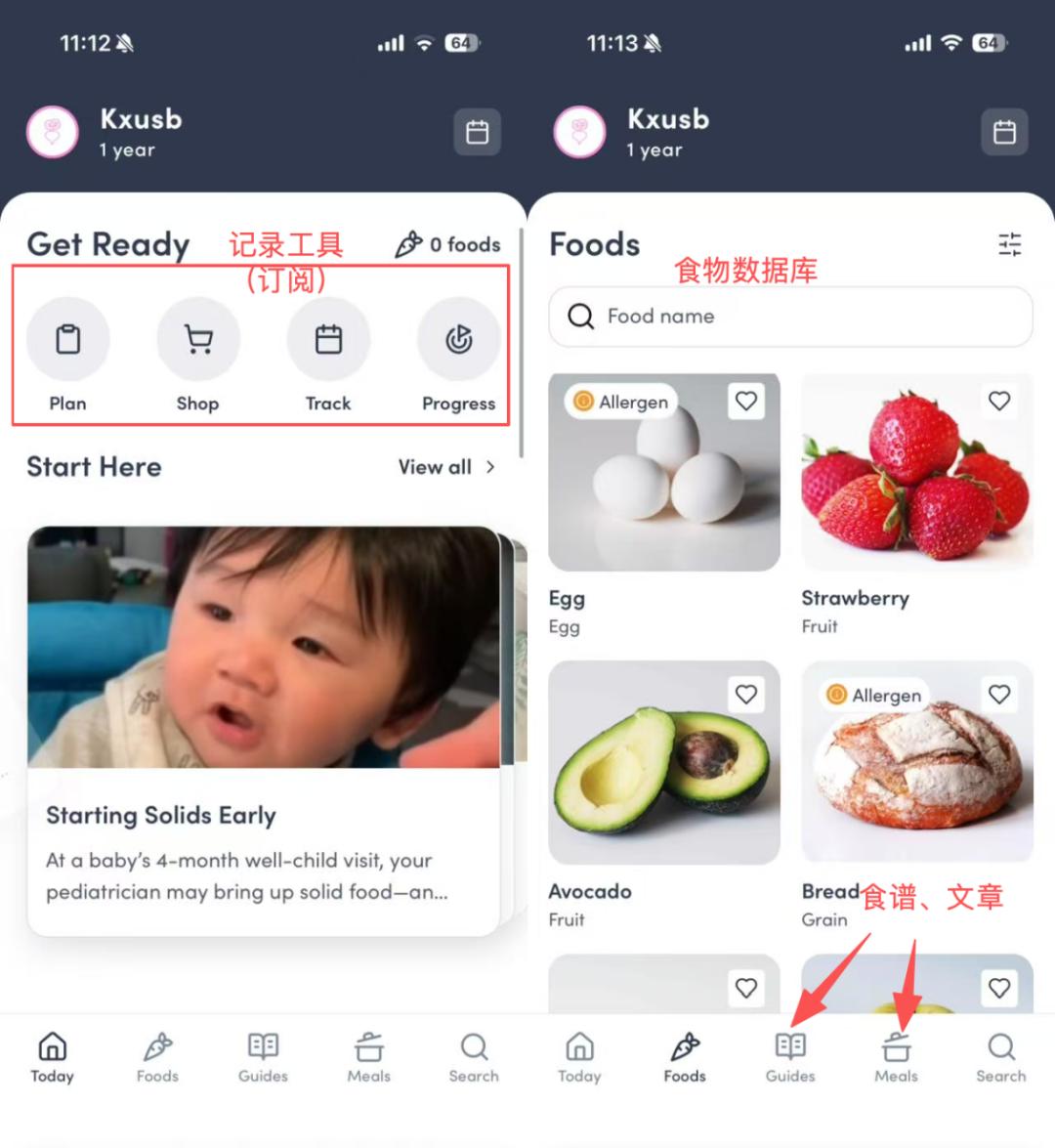
Solid Starts' landing page and food database page | Image source: Solid Starts
The landing page of Solid Starts includes recording tools (available by subscription), articles (curated content under the Guides tab is pushed on the home page), etc., which is not much different from the home page of ordinary health or parenting apps. But from the feedback of app store reviews and Reddit users, the most frequently used function is the food database, which is the second primary tab "Foods".
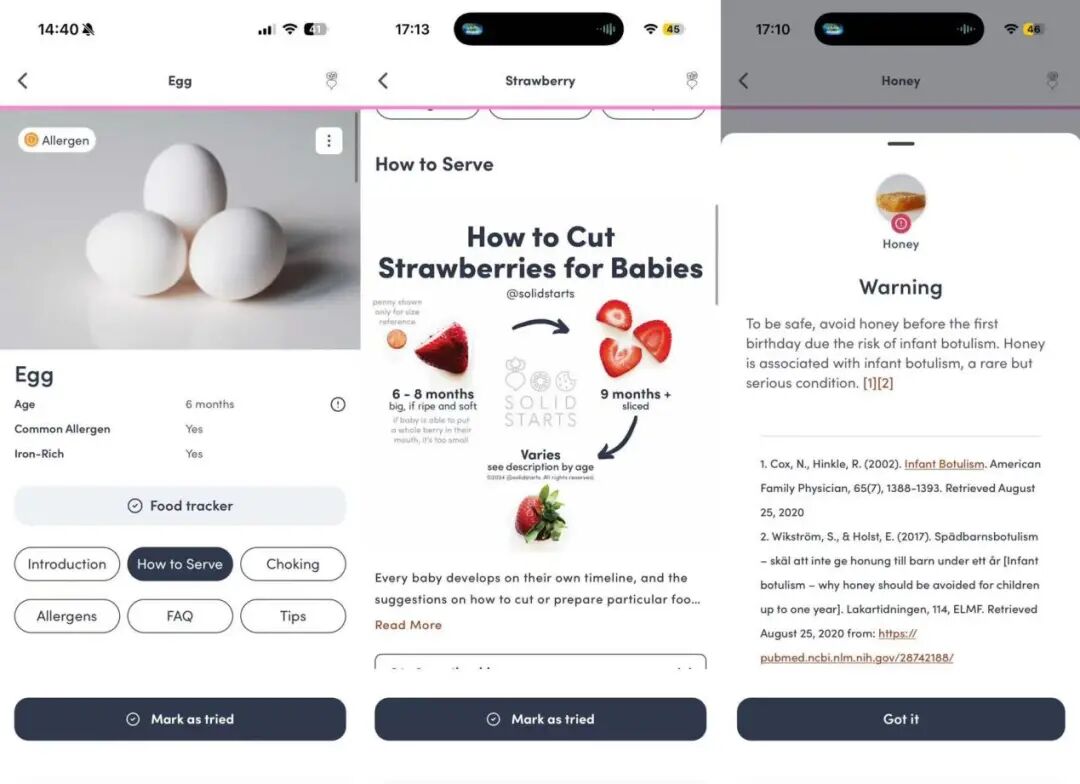
This database contains more than 400 common foods, and users can directly search to find the corresponding food details page. Each food is comprehensively analyzed in terms of introduction, feeding method, suffocation risk, allergen, common problems, feeding tips and other aspects.
For example, the middle picture above introduces the feeding method of strawberries: children aged 6-8 months should be given large pieces to prevent suffocation, and they can only be sliced after 9 months old. The honey details page in the right picture above directly marks Warning: due to the risk of botulism poisoning, honey must not be eaten before one year old, and two clinical documents are attached at the bottom to enhance the persuasiveness.
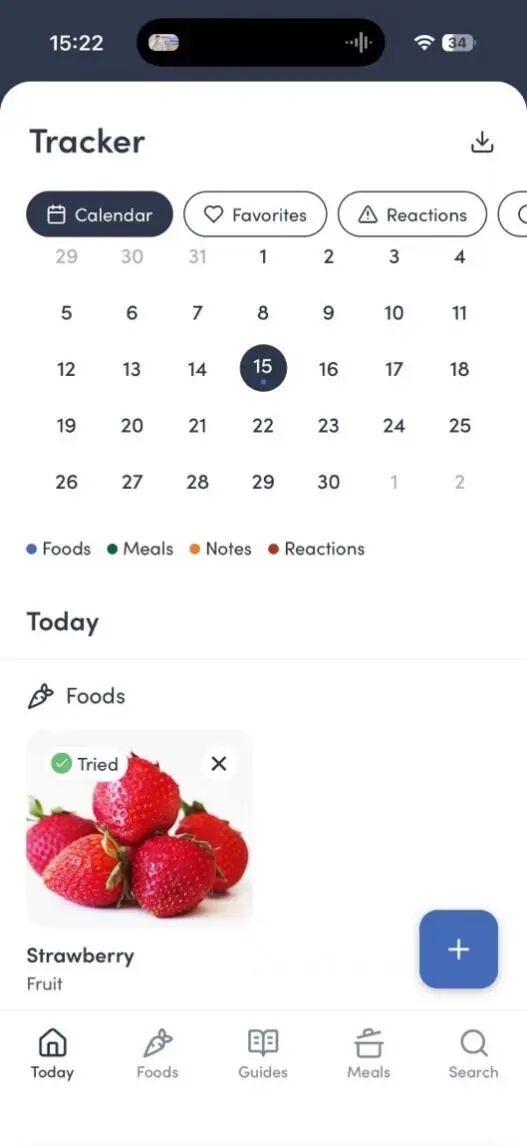
Up to this point, users can use it for free. And the paid conversion is hidden in a button, "Mark as tried". After checking the food information and clicking "Mark as tried", users will be guided to the Tracker function, which requires a subscription to use. Solid Starts offers free trials of 3 days for monthly subscriptions and 7 days for annual subscriptions.
Since the biggest goal of the complementary food period is to let the baby try all kinds of foods, recording what they eat every day and what they are allergic to after checking becomes a natural next step. Combined with the free trial, it further lowers the user's decision-making threshold.
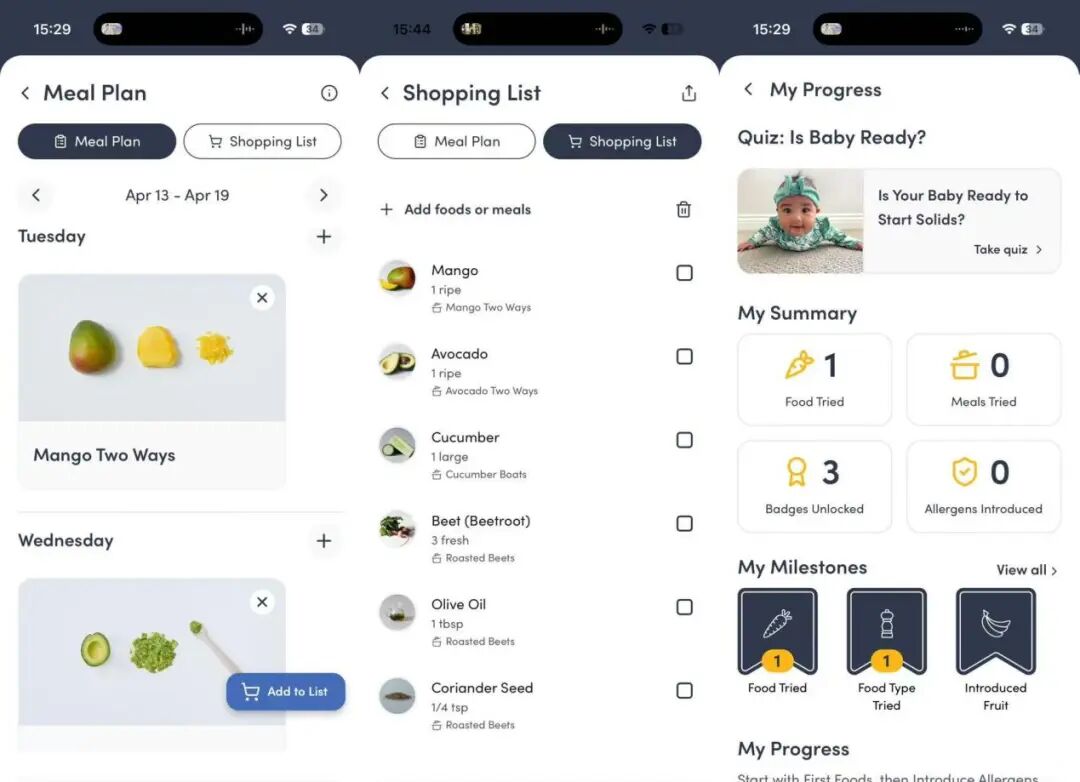
Solid Starts' diet plan, Shopping List, and My Progress pages all require a subscription to use
Once the recording behavior starts and data is accumulated, "Solid Starts" is no longer a tool to "check before feeding", but an entrance to systematically manage the entire complementary food period. Subsequent products will also provide functions such as diet plan, one-click generation of Shopping List, and My Progress. From what to feed today, what to buy in the supermarket, to what stage the child's overall dietary diversity has reached and which allergens have not been introduced, all are included in a set of frameworks. Users no longer check temporarily before each feeding, but go through the child's complementary food process completely in the App.

This path from "query" to "management" has sufficient free value for Solid Starts, and the paid conversion is also natural enough. From the subscription data, although the annual subscription ranks second and third, the sum of them accounts for more than 40% of the total revenue, and there are not a few users who choose long-term payment after going through the above path.
But what's more interesting is that users pay for "Solid Starts", which may not be entirely paying for the functions.
There is a discussion on Reddit that left a deep impression on us. A user confessed that although he subscribed to Solid Starts, his usage is very simple: he buys his favorite food, and uses the app to check whether these ingredients can be given to the child and how to feed them.
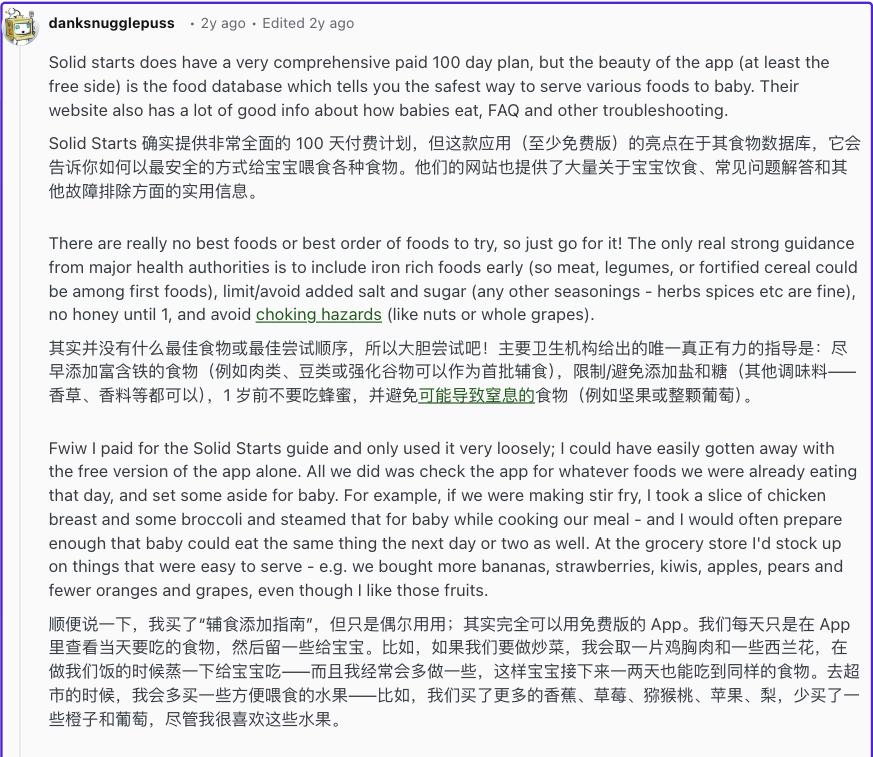
Image source: Reddit
The replies under the same post are even more interesting. Another mother described such a scenario: the mother-in-law asked "Can this be given to the child?" After she checked Solid Starts, she said "Yes, but it needs to be cut like this". The mother-in-law said "Cut so big?" She said "That's what the app says" - the conversation ends, no need to argue. Solid Starts is not just a tool for mothers to feel at ease, but a three-party authority to convince husbands and elders.
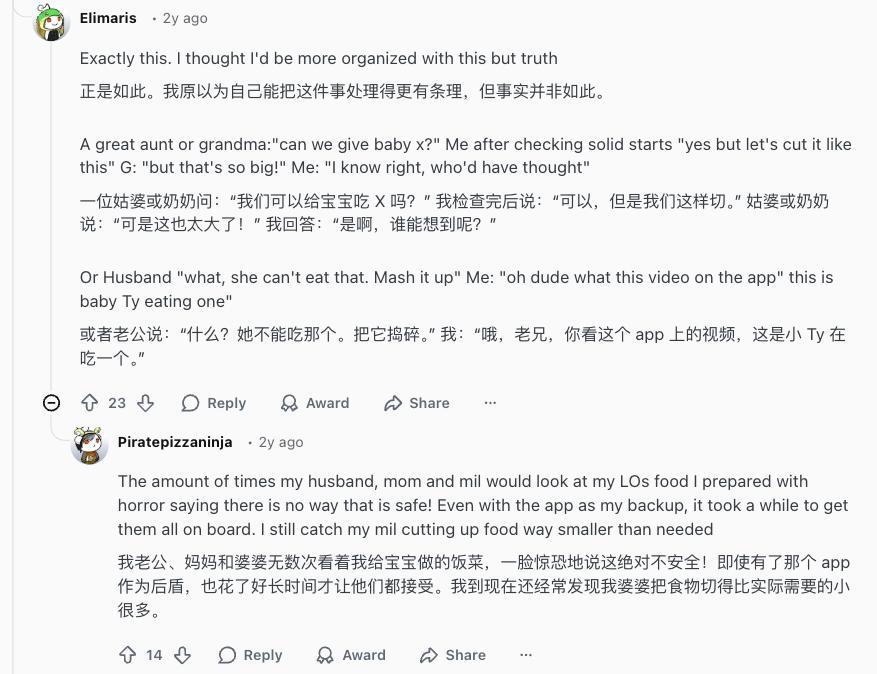
Image source: Reddit
The underlying logic of users' payment is not so much the functional barrier, but the professional database superimposed with the trust premium brought by "complementary food anxiety".
And the answer to the achievement of this trust is hidden in the founder's experience.
III. A new mom tortured by complementary food, started on Ins
Solid Starts, which cuts into the market with professionalism and trust, is not developed by a professional research institution or hospital, but a "new mom" tortured by complementary food. The founder of Solid Starts is Jenny Best, who can be called an atypical entrepreneur. She used to be a professional dancer of the New York City Ballet, then switched to government public services, and then worked for an anti-hunger NGO in Kenya for many years, with no entrepreneurial experience at all.
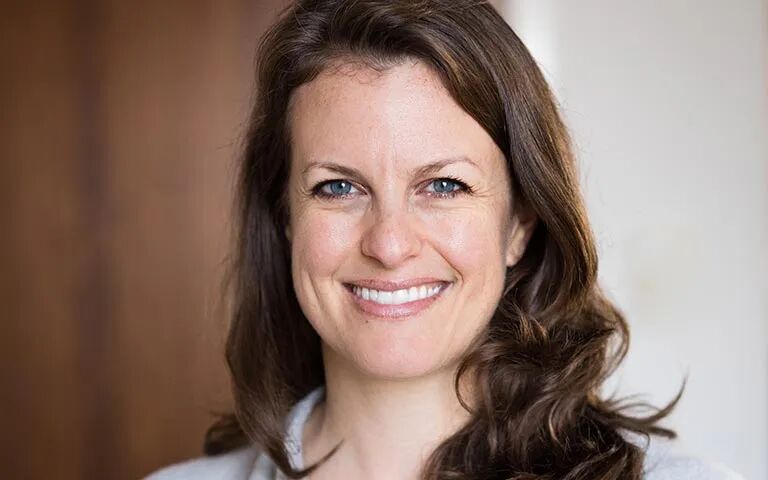
Jenny Best, founder of Solid Starts
In 2015, Jenny's first child Charlie was born. Like most American mothers, she fed him pureed complementary food with a spoon. Charlie was obviously not interested and full of resistance. By the time he was 1 and a half years old, Charlie almost rejected all foods, and the pediatrician had already discussed the solution of installing a nasogastric tube. After collapsing, Jenny began to study various knowledge related to complementary food, during which she came into contact with the concept of BLW (Baby-Led Weaning), which means that babies can grab solid food independently from the beginning, instead of passively accepting pureed feeding.
After changing the feeding method, Charlie's condition improved, but Jenny found that the information about complementary food was either extremely fragmented or hidden behind paywalls, and it was difficult for ordinary people to learn systematically. So in March 2019, she opened an Instagram account and started sharing complementary food information. At first, she just sent out the complementary food safety information for free. The content form was very simple, that is, the feeding method of each food, what risks there are, and with intuitive pictures, new moms can understand it at a glance.
Although the content form is simple, no one shared this information systematically at that time.
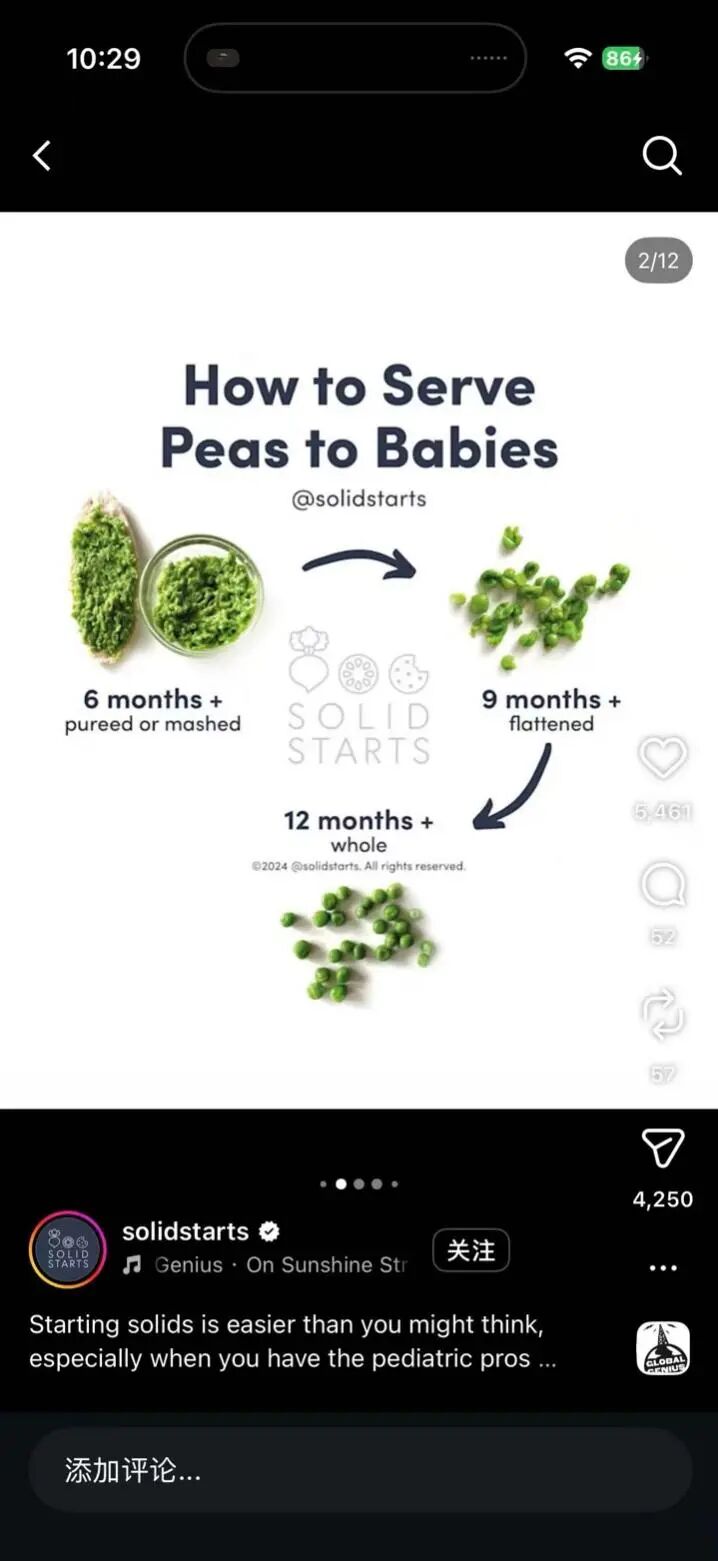
Content shared by @solidstars on Ins, which currently has 4.16 million followers | Image source: Instagram
At first, Jenny didn't want to make a product, but regarded it as a "social media movement", attaching great importance to the density and professionalism of the content. Later, many pediatric experts were attracted to join. When the content accumulated to a certain level, trust naturally arose. After the database covered 185 kinds of food and the number of fans exceeded 1 million, Jenny launched a fundraising for app development on the crowdfunding platform iFundWomen, and finally raised 75,000 US dollars. After the app went online, the fans on Ins also became the first batch of seed users.
In conclusion
Solid Starts has no financing records. In addition to crowdfunding, app subscriptions are the only source of income. The founder also said that she hopes to protect the integrity and professionalism of her brand from being polluted by business logic, and the goal is to make Solid Starts as trustworthy as the American Academy of Pediatrics or the Mayo Clinic.
In the same baby market, the problems solved by Huckleberry and Solid Starts are completely different, and the paths they take are also completely different. Huckleberry targets efficiency anxiety: parents want to take care of their babies easily, and want to know when the child will sleep and wake up next time. This kind of demand can be met with data and prediction, the product logic is clear, and it is feasible to make the app first and then achieve growth.
Solid Starts faces risk anxiety: there is no algorithm that can give a standard answer to such questions as whether this food will choke the baby, whether it will cause allergies, and how to cut it safely. Therefore, Solid Starts took the opposite path: first create content, then go back to make products and realize monetization.
But all roads lead to Rome. Both products accurately hit the same payment psychology: new parents are willing to pay for "sense of certainty" at a moment of high anxiety. The baby tool track can continuously produce money-absorbing products, essentially because the information asymmetry and anxiety density of new parents at this stage are almost the highest among all consumption scenarios. Efficiency anxiety and risk anxiety are two of them. What will be the next "anxiety moment" that can be productized and build a payment model is worthy of continuous attention.