It is not recommended to follow the trend of Personal Agent
The intrusive ads for AI office tools are still looping in elevators, while major tech firms have already set their sights on the Personal Agent, this massive new industry trend.
Alibaba's Qwen Assistant has been upgraded to Qwen GO, which can operate independently outside Alibaba's ecosystem, and access various authorized platforms to complete complex long-horizon tasks.
ByteDance is also reportedly rushing to develop a personal intelligent agent codenamed "Spell", as an extension of the Doubao mobile assistant in the Personal Agent direction — it turns out to be the full revival of the previously shelved Doubao mobile assistant project.
Tencent is not sitting idle either. Since the end of September, multiple internal Personal Agent products have been unveiled one after another, marking the start of a new round of internal horse-racing competition.
The chatbot war during the Spring Festival is still fresh in memory, and this time there are no red envelope giveaways for user acquisition, which is a welcome progress.
Where Does This Trend Come From?
The collective bandwagon effect of domestic tech giants can largely be attributed to developments in the US market.
On September 8, Meta launched its personal Agent product Muse, initially available only in the US and Canada. Shortly after release, it topped the App Store free app chart, outperforming ChatGPT's historical short-term performance data, and exceeded 10 million downloads 40 days after launch [1].
Among major US AI companies, Meta had taken many detours and remained relatively low-profile for a long time. But the surprise launch of Muse instantly transformed Meta from the US equivalent of Baidu into a leader in the Personal Agent track, with its market value surging by more than 200 billion US dollars (before partially falling back later), a result that made every peer green with envy.
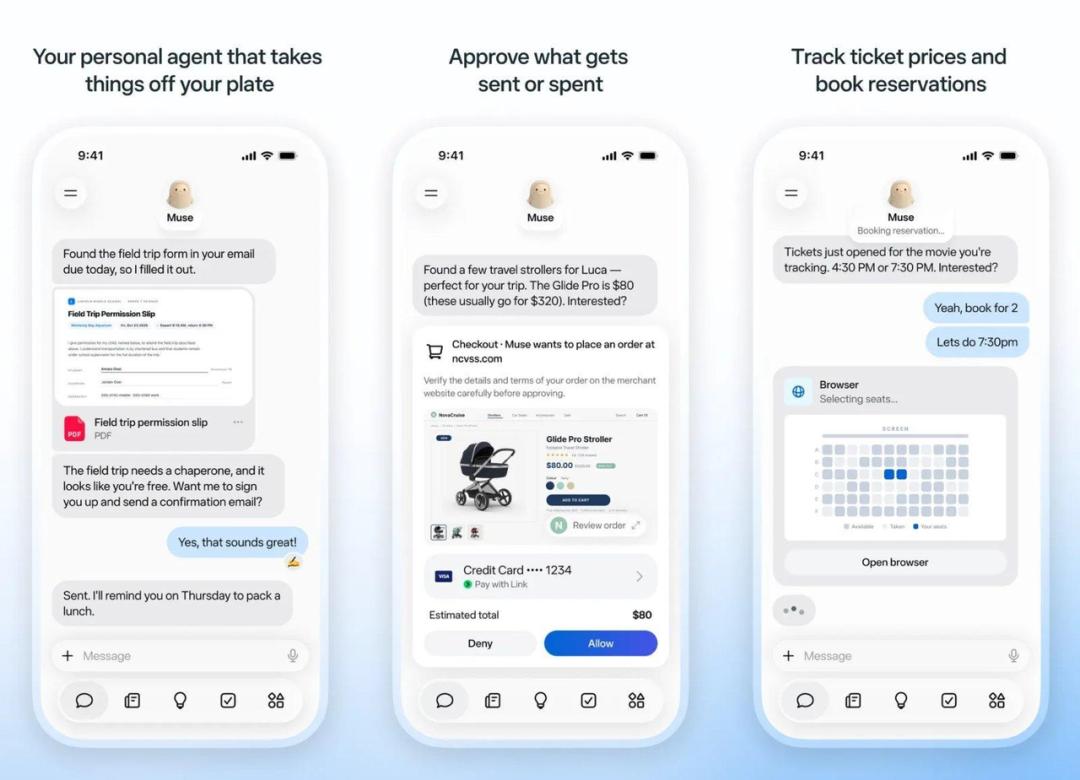
Muse is positioned as an AI assistant that operates autonomously and handles users' daily life affairs around the clock, capable of completing a wide range of long-horizon tasks.
For example, a traditional assistant that only provides travel suggestions stays at the level of "information services", while a Personal Agent can go further to book flights and hotels, and arrange full itineraries. Even without explicit instructions, Muse can actively capture user context, proactively take on tasks, making it a highly proactive AI that always looks for things to do for users.
In addition, Meta has equipped Muse with an independent cloud environment, so even when users turn off their phones or close their computers, the AI can continue running, operating across different apps, delivering a dedicated personal butler experience for every individual user.
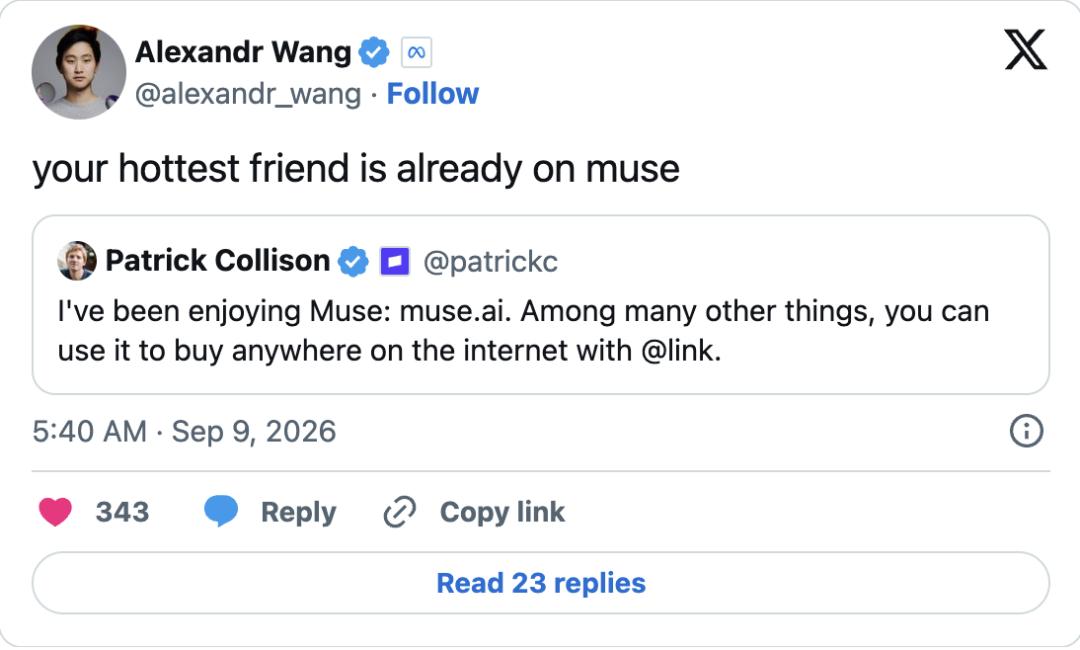
Meta attaches great importance to Muse: it leverages the traffic advantages of its own platforms such as Facebook and Instagram to run high-intensity ad campaigns, and its chief AI officer Alexandr Wang, who was hired at a cost of 14.3 billion US dollars, personally promoted the product heavily on rival platform X.
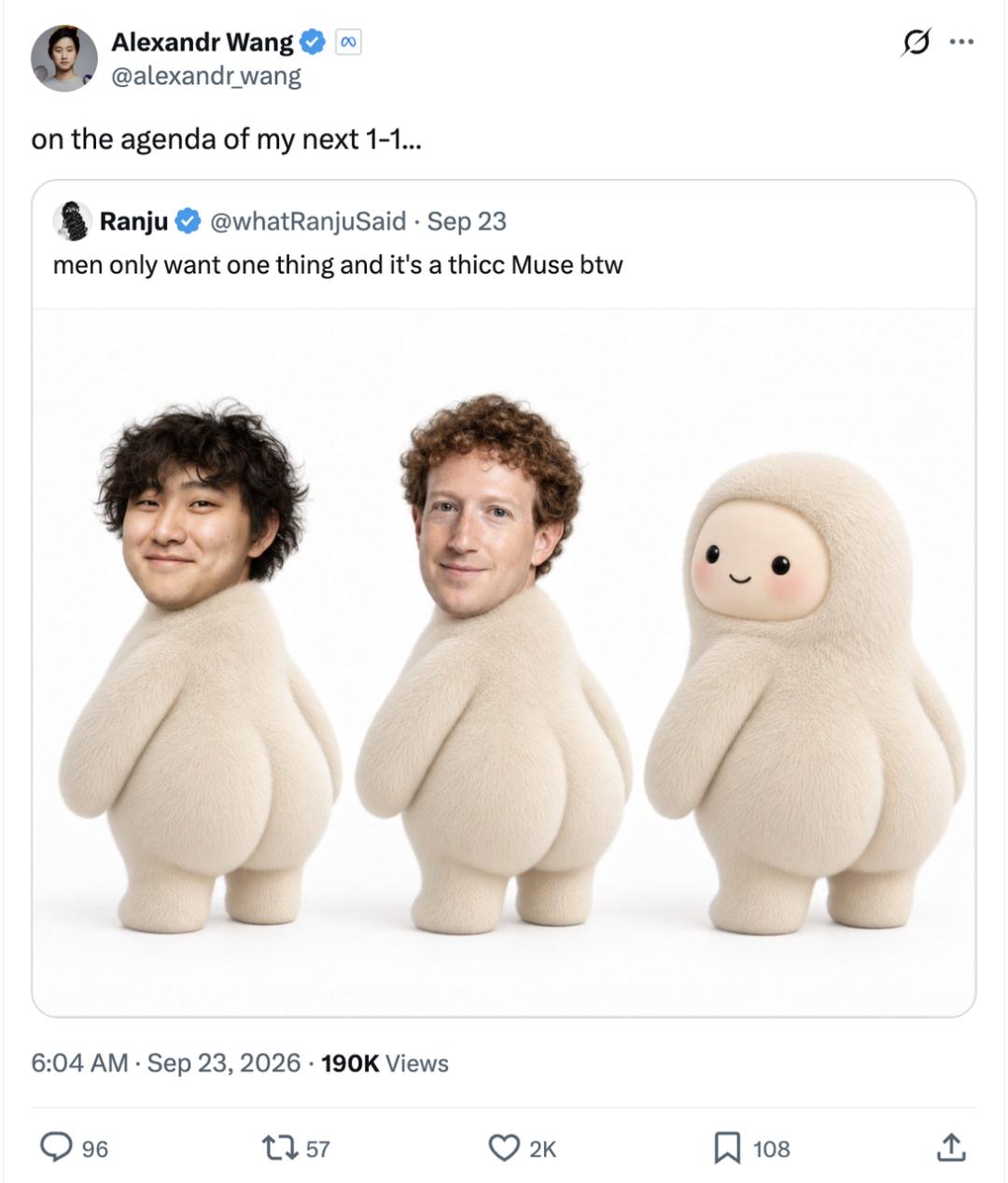
For instance, he posted a meme showing himself, his boss, and the Muse mascot all transformed into plush toys with prominent curvy figures, saying he would add this topic to the agenda of his next one-on-one meeting with his supervisor.
Muse has also driven the boom of a large number of startups in the same track. For example, Noah Shinn, once hailed as the "most popular post-2000s entrepreneur", saw his company Instinct complete a financing round at a valuation of 2.5 billion US dollars at the end of August, and its valuation skyrocketed to 10 billion US dollars by mid-September.
Instinct works like a real human assistant in your contact list that you can reach out to at any time. Users do not need to download a dedicated app, as it communicates with users via SMS, iMessage, WhatsApp, or even phone calls.
Users can send it instructions just like messaging a friend, asking it to book restaurants, arrange trips, call customer service, sort out emails, or even contact merchants to solve problems. It can also remember user preferences, keep processing tasks, and actively report progress, being equally highly proactive.
Regarding this situation, Alexandr Wang commented:
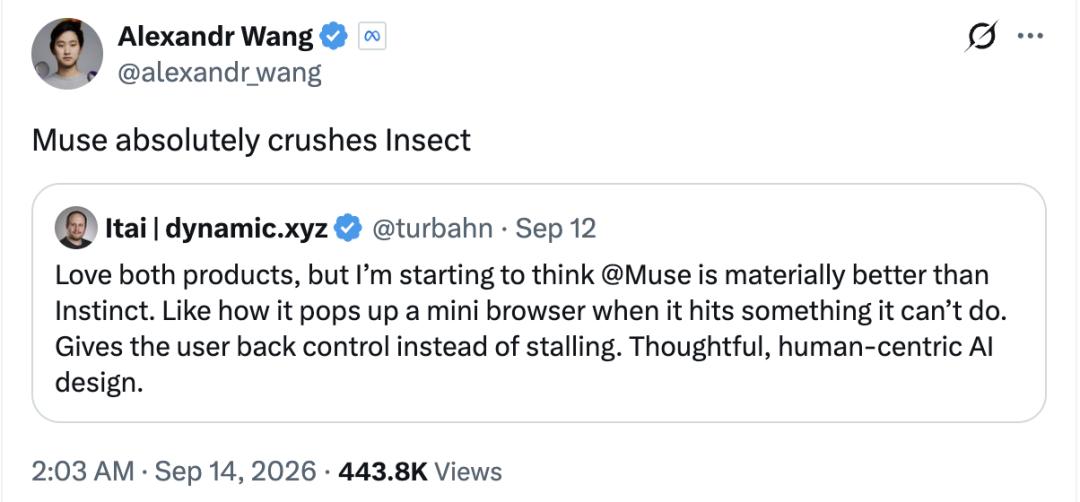
Muse completely outperforms Insect (Instinct)
Three weeks after Muse's release, OpenAI also quickly launched its personal Agent Dots, which focuses on round-the-clock task execution and integrates into individual and team work processes.
In general, compared with previous applications for shopping, ride-hailing, and ordering milk tea, Personal Agent can access context hubs such as emails, SMS, and calendars to understand user context, thus handling more complex tasks. It has less of a tool attribute and more of an assistant attribute.
The Doubao mobile assistant team expressed confusion: we already have all the features Muse offers!
Local Adaptation Challenges
On the day Muse went public, Mark Zuckerberg talked about commercialization in an interview: revenue will come from user subscriptions in the short term, and transaction commissions in the long term [2].
First, let's look at the subscription model. On the eve of SpaceX's IPO, Elon Musk calculated the numbers in the prospectus: out of the total AI market size, infrastructure accounts for 2.4 trillion US dollars, enterprise applications account for 22.7 trillion US dollars, and even the bold Musk only estimated the C-end subscription and advertising market at 1.36 trillion US dollars [3].
Back then the Personal Agent concept had not gained such popularity, but even in the programming sector where a commercial closed loop has been formed, the current situation is not very optimistic.
In October this year, SemiAnalysis released a report measuring Anthropic's revenue structure: its main revenue comes from API customers charged on a pay-as-you-go basis, while Claude's subscription users consume 41.7% of the computing power but only contribute 10% of the revenue [4].
With roughly the same computing power consumption, the cost per user differs by nearly ten times. Everyone is careful with their own money when buying Tokens, but spend lavishly when they can submit an expense report to the finance department.
Compared with monthly subscription fees, participating in users' daily consumption and drawing commissions brings far greater commercial imagination. But this model does not seem to fit the actual market conditions in China.
For an Agent to handle various affairs on behalf of users, it needs to access existing internet products. In this regard, there are notable differences between the Chinese and US internet ecosystems.
Internet services in the US are relatively fragmented. For shopping and hotel booking, users sometimes have to visit official websites, where they need to open different sites, register accounts, fill in addresses, enter credit card information, and complete payments, making the whole process extremely cumbersome. This gives browser-based Agents plenty of room to play their roles.
China's mobile internet ecosystem is extremely prosperous, even to an unhealthy degree: users can browse Xiaohongshu content on Dianping, watch short videos on Alipay, book hotels on Douyin, watch short dramas on Meituan, apply for car loans and register as a ride-hailing driver on Amap.
Almost all high-frequency consumer demands can be fulfilled within super apps. Users can finish most operations with just a couple of taps themselves, while using an AI assistant requires explaining demands, granting permissions, waiting for execution, and finally reviewing the results. In front of super apps, AI assistants do not necessarily have competitive advantages.
At the same time, the very concept of Personal Agent directly clashes with the business models of the mobile internet industry.
The prerequisite for monetization for most mobile internet business models is to keep users interacting within the products as frequently and for as long as possible, to realize user "monetization" through advertising, e-commerce and other channels. That is why "app usage duration" is so critical: Attention Is All I Need.
Personal Agent requires internet products to provide services, but the time it saves for users is exactly the foundation of those internet products' monetization. The traffic entry, ad exposure opportunities, and part of transaction revenue that originally belonged to these platforms may be siphoned off by Agents.
On the day Muse launched, Amazon took the initiative to block it, claiming it was "for your own good": Muse involved unauthorized automated access, violating platform rules and threatening user security.
In China's highly concentrated super app internet ecosystem, it will be even more difficult for AI assistants to cross the high walls built between different platforms.
In October this year, one month after the consumer version of the Doubao mobile assistant launched, it released a tearful statement saying it had been blocked by 151 apps. How could the platforms allow a third-party assistant to share their own territory?
It is worth noting that less than two weeks after Muse's launch, it dragged down the stock prices of hotel booking platforms such as Expedia. Back then, Bloomberg, which watched the drama without getting involved, put forward a hypothesis: if Personal Agents divert 5% to 10% of business from platforms in the tourism, ride-hailing, and food delivery sectors, the relevant companies could lose more than 5 billion US dollars in revenue [5].
Translated to the domestic market, such costs are unbearable for business departments with strict OKRs, for the management of large tech firms, and even more so for deep value investors in the Hang Seng Tech Index.
Entry Point Anxiety
According to Sensor Tower, Muse's 1-day retention rate after launch reached as high as 73.3%, almost twice that of ChatGPT [6].
But the novelty fades just as quickly: by the 14th day, Muse's retention rate had dropped to 22.5%, overtaken by ChatGPT's 26.8%.
Growth is also cooling down. Data from TickerTrends shows that Muse's daily active users are still increasing, but the AI market now focuses on second-order derivatives: the daily net new DAU growth rate has dropped significantly.
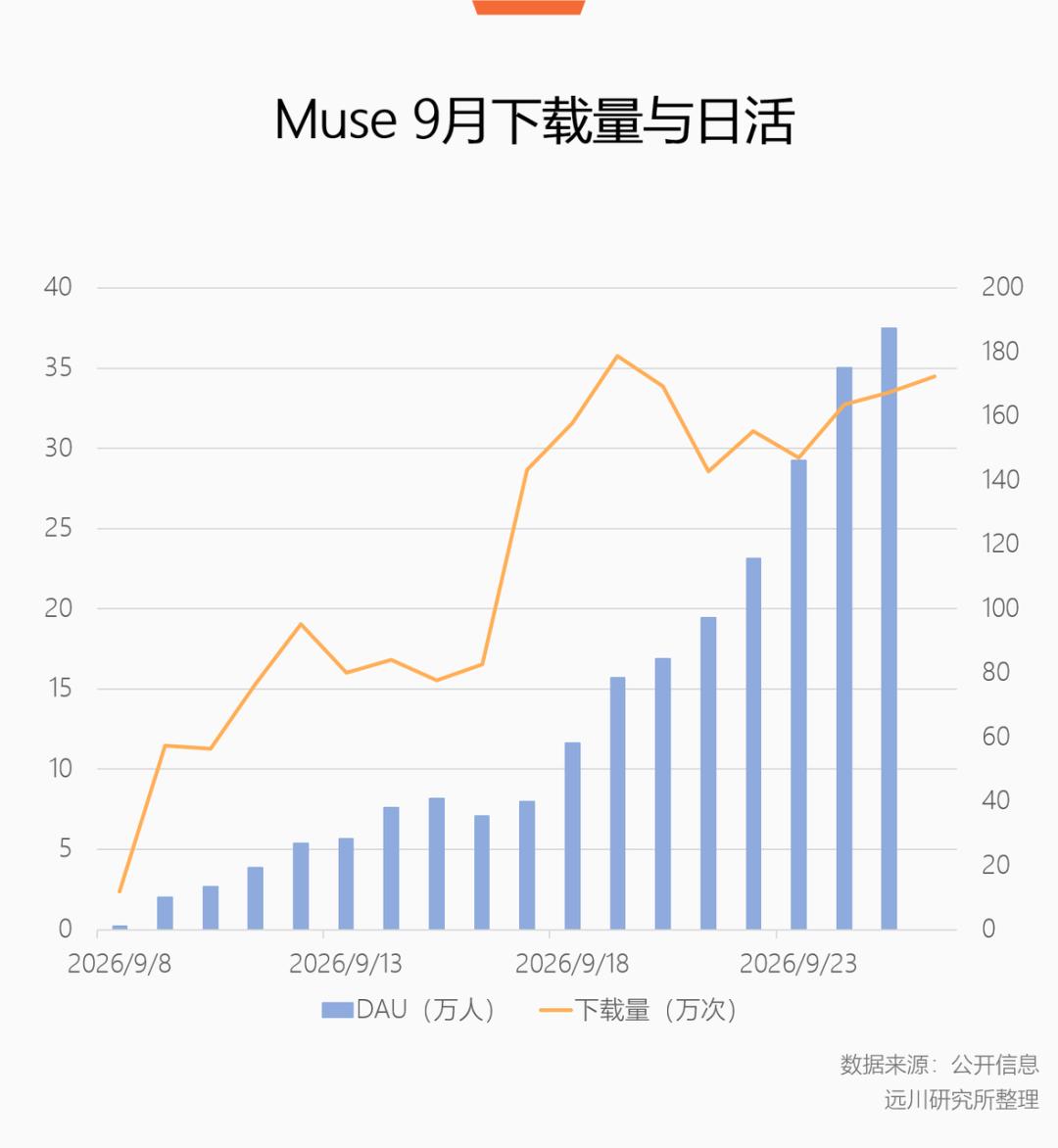
Yet running an Agent business is by no means cheap. Every time a large model serves a user, corresponding costs are generated.
Morgan Stanley estimates that depending on Token consumption, the monthly cost for Muse to serve a single user ranges from 3 US dollars to 128 US dollars [7].
There is a big background behind Meta's development of Muse: Meta's own large models are not competitive enough, so the computing power it procures has to be leased out, meaning its computing power supply is not that strained. Coupled with Meta's deep pockets, it can afford such long-term investment.
Compared with the US, China's computing power resources are more scarce, but that cannot stop major tech firms' determination to move forward.
Chinese internet companies have a peculiar anxiety over traffic entry points, to the point that they will fight over every inch of territory. Even for the niche market of AI short dramas, Tencent does not want to sit back and watch ByteDance grow bigger, and is ready to use its WeChat ecosystem to compete fiercely.
The vision of Personal Agent coordinating all apps is so tempting that companies that miss the trend early may face the risk of restructuring their original business models. Even if the market size is not clear, the costs can be calculated, but the risks of missing out are immeasurable. When the outcome is uncertain, the default choice is to bet on survival.
Everyone wants to block the Doubao mobile assistant, but everyone also wants to become the Doubao mobile assistant. If every company only allows Agents to operate within its own ecosystem, what consumers will finally get is a group of digital assistants that each occupy their own territory and cannot interoperate with each other.
Microsoft Research put forward a hypothesis in "The Agentic Economy": even if Agents already have the technical ability to communicate with each other, commercial interests will still push platforms to build closed Agent ecosystems, the so-called "Agentic Walled Gardens" [8].
In this case, the fragmentation problem of internet services that Personal Agent was supposed to solve will resurface in another new form.
Epilogue
Personal Agent provides a new narrative for the fragile sentiment in the capital market.
The industry generally believes that if coding is the only trillion-dollar-level large market, the current capital expenditure intensity is already sufficient.
But the theoretical market space for Personal Agent is far larger than that of coding, and its computing power consumption is naturally higher, which keeps the computing power and storage industry booming. Agents deployed in the cloud will also drive demand for CPUs, and AMD has already reaped the corresponding valuation gains from this part.
But no matter how good the shovel business is, someone still needs to dig out the actual gold. If you acquire a large number of users, consume massive amounts of computing power, but the Hang Seng Tech Index does not go up, you will end up suffering huge losses.
References
[1] Meta’s Muse Hits 10M US Downloads in 40 Days, TechCrunch
[2] Mark Zuckerberg on How Meta's Muse AI Agent Will Make People Money, Sources with Alex Heath
[3] Space Exploration Technologies Corp. — IPO Registration Statement, SpaceX
[4] Claude Subscription Worth 5x ChatGPT, SemiAnalysis Finds, Knowhy
[5] Meta’s Muse Drags Down Stocks That Depend on ‘Consumer Inertia’, Bloomberg
[6] Meta Stock Jumps as Muse AI Retention Data Lands, WEEX
[7] 23 Days of Musing: Top Investor Questions and Our Answers, Morgan Stanley
[8] The Agentic Economy, Microsoft Research
This article is from the WeChat official account "YuanChuan Institute" (ID: YuanChuanInstitution), written by Zhang Beijia, authorized for release by 36Kr.