The largest U.S. automaker has been developed into a small yet high-quality niche enterprise.
Chinese automakers are heading to Europe in droves. Yet General Motors is nowhere to be seen on this bustling battlefield: back in 2017, it sold Opel to French PSA and withdrew from the mainstream European market.
This withdrawal did not shake its foundation. Today, GM still sells around 6 million vehicles globally every year, ranking after Toyota, Volkswagen and Hyundai Kia. Its market value stands at about 68 billion US dollars, second only to Tesla, Toyota and BYD among global automakers. It has long ranked first in its home US market, with a 17% market share in 2025, and holds over 40% of the full-size pickup and SUV market, the most profitable segment.
On October 20, this giant released its financial results for the third quarter of 2026. The data is nearly impeccable at first glance: revenue reached 50 billion US dollars, up 2.9% year on year; adjusted EBIT hit 4.1 billion US dollars, up 21.6% year on year; adjusted earnings per share stood at 3.7 US dollars, beating market expectations. The North American market posted a profit margin of 8.7%, 2.5 percentage points higher than the same period last year. The management also approved a 20-billion-US-dollar stock repurchase program.
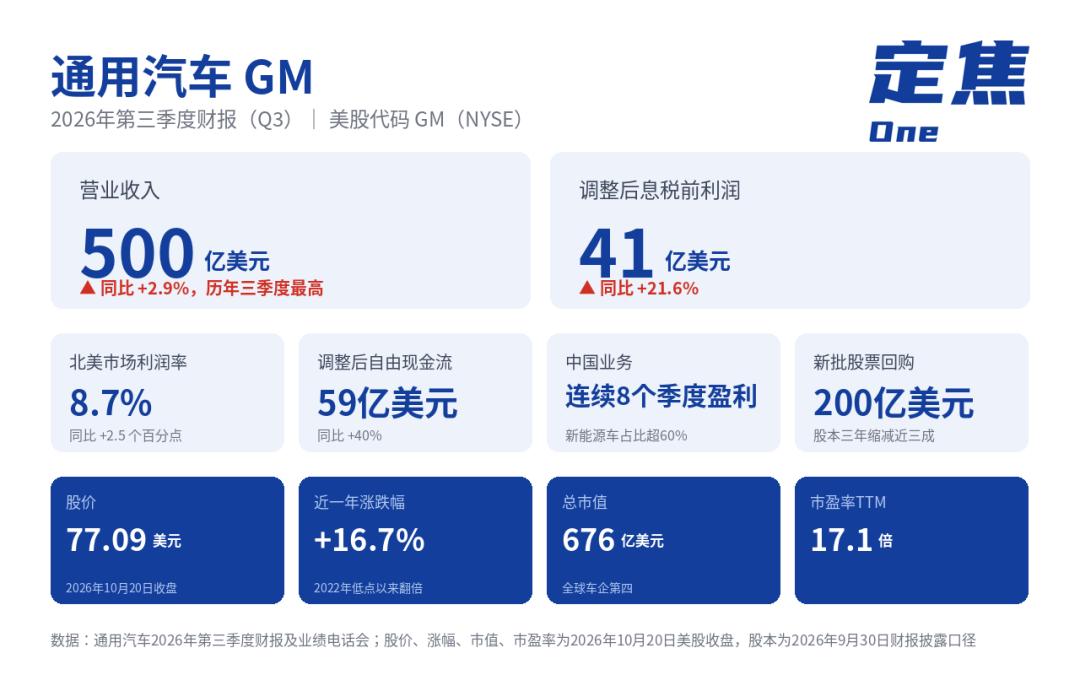
However, the market poured cold water on the results. Its stock price tumbled 6.8% on the same day, making it the worst-performing stock among S&P 500 constituents.
Why did the stock price plummet? The problem lies in the management's full-year forecast. Every time GM releases its earnings report, it updates its full-year profit estimate. In the first two quarters of this year, it raised the estimate twice in a row, raising market expectations higher and higher. This time, it narrowed the profit range from 140-160 billion US dollars to 145-155 billion US dollars, which essentially told investors that the period of fastest profit growth might be over, and there would hardly be any positive surprises in the future.
Interestingly, GM's rise to this high profit level is precisely driven by contraction. Over the past two years, it shut down autonomous driving company Cruise which lost 1.7 billion US dollars annually, spent more than 5 billion US dollars restructuring its China business, accrued over 11 billion US dollars in total provisions for electric vehicle production capacity, and cut its share capital by nearly 30% through repurchases. After these adjustments, its profit margin and cash flow returned to the best level in recent years. Its global wholesale sales in the third quarter stood at 1.39 million units, down 11% year on year, while China's sales hit 358,000 units, nearly a quarter less than the same period last year. With sales down 10%, profits rose 20%.
Now, Chinese automakers are waging a scale war in Europe, making collective appearances at the 2026 Paris Motor Show. Chinese automakers' sales in Europe reached 811,000 units in 2025, with their market share doubling from 3.1% to 6.1%. What lessons can GM, which is not obsessed with fighting every market, bring to Chinese automakers that are enthusiastically expanding overseas?
01. North America is a profit machine, but it also has a ceiling
If you only look at the income statement, GM is more like a North American truck company that runs a side financial business.
In the third quarter of this year, out of the company's total 4.1 billion US dollars in adjusted EBIT, the North American market alone contributed 3.6 billion US dollars. The profit of international businesses plummeted nearly 90% year on year to only 28 million US dollars, which also includes a loss of about 100 million US dollars from marking its investment in Chinese autonomous driving company Momenta to market value. Auto finance contributes a stable 600-700 million US dollars every quarter.
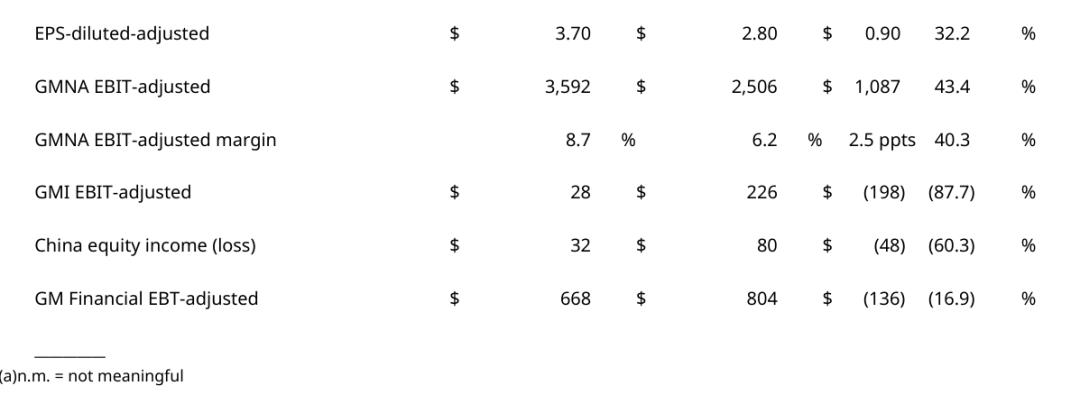
GM's segmented income statement for 2026 Q3
Full-size pickups and full-size SUVs are the pillars of North American profits.
In these two segments, GM has been the best-selling brand in the US for 7 years and 52 years respectively, holding a market share of over 40%. Consumers who buy full-size pickups and SUVs are not very price-sensitive, and they are brand-loyal. GM's sales incentive expenditure in the US is still below the industry average to this day.
GM also has policy advantages. Import tariffs raise the costs of foreign competitors, relaxed emission regulations make large-displacement models more profitable, and the phasing out of EV subsidies has caught rivals off guard first.
But this structure also has hidden risks. The management admitted on the earnings call that its core products are already constrained by production capacity, and even if the overall US auto market improves, the incremental gains it can get are limited. In other words, this North American profit machine is running very fast, but it has almost hit the ceiling.
The reason why GM is so profitable today is not that it keeps expanding its territory, but a series of retreats and contractions.
At the end of 2024, GM shut down autonomous driving company Cruise which lost 1.7 billion US dollars a year, and the loss of this business immediately dropped to 270 million US dollars. After the US EV policy shifted, it took the opportunity to cut its EV production capacity, accruing more than 11.2 billion US dollars in provisions in total. It no longer mentions the slogan of "full electrification by 2035", but follows market demand, and its EV losses are narrowing at a rate of 1-1.5 billion US dollars per year.
None of these moves look decent on their own: shutting down Cruise is an admission that GM lost the autonomous driving race, and cutting EV investment is an admission that its transformation was too hasty. But reflected in the earnings report, profit margin and cash flow have both improved, and the stock price has doubled from its 2022 low. Analysts at JPMorgan said in a report that after withdrawing from multiple international markets including Europe, GM's management is more focused and more capable of executing strategies.
How does it spend the money it earns? It neither builds new factories nor expands into new markets, but uses most of the money to buy back its own shares. Its adjusted free cash flow in the third quarter was 5.9 billion US dollars, up 40% year on year, with the full-year estimate ranging from 11.5 to 12.5 billion US dollars. Most of this money has been used for repurchases and dividends. GM's share capital has shrunk from 1.2 billion shares in 2023 to 849 million shares now. Therefore, a considerable part of the growth in earnings per share comes from the reduction of share capital.
The reason why the stock price fell after the latest earnings report was released is that the management's expectations for 2027 have changed.
In previous quarters, GM has kept saying that "2027 will be better than 2026". This time it still holds this view, but emphasizes that the development path has become "more challenging", and the premise of performance improvement is that customer demand remains strong, while commodity, logistics and other cost pressures are eased.
The cost side is indeed deteriorating. Copper prices are at historical highs, hot-rolled steel prices have hit a four-year high, and logistics costs are also rising. GM estimates that full-year commodity-related costs will be around 2 billion US dollars, at the upper end of its previous guidance range, mainly driven by rising logistics costs and DRAM memory chip price hikes. CFO Paul Jacobson said that current inflation costs keep rising while vehicle pricing remains largely stable, and whether the company can pass on the cost to consumers through price hikes next year depends on whether consumers are willing to accept higher prices.
At the same time, the new generation of full-size pickups will enter the generation change ramp-up period in 2027. New vehicles can bring better pricing, but the ramp-up means production capacity uncertainty and extra costs. The management needs to factor these variables into expectations in advance.
02. Stopping losses in China, saying goodbye to Europe
GM has made more thorough subtraction in overseas markets.
Its China business was once GM's biggest trouble. In the first three quarters of 2024, SAIC-GM alone lost a total of 2.48 billion RMB. Its sales declined year by year, a large amount of production capacity was idle, and the outside world even once speculated that the joint venture might be dissolved.
But GM did not withdraw, but stopped losses and carried out restructuring.
First, it shut down the Shenyang Beisheng factory, cut staff, optimized product lines, and accrued more than 5 billion US dollars in impairment and restructuring expenses in one go. Then it adjusted operations, rolled out the "one-price" pricing strategy across the country, and eliminated disorderly price cuts at the terminals. At the same time, it concentrated product resources on the Buick and Cadillac brands, and the Chevrolet brand is no longer a key priority.
The effect is better than expected. By the third quarter of this year, GM China has achieved profitability for eight consecutive quarters. The proportion of new energy vehicle sales in this quarter exceeded 60%, hitting a record high for the same period. In August this year, GM and SAIC officially signed a renewal agreement, extending the joint venture term for 20 years to 2047.
More importantly, the role of China's business has changed. In the past, China was a source of sales and profits; now, it is more like an export base and technology source. The Buick E7 developed based on local R&D is being exported to South America and Southeast Asia. Its intelligent driving system is jointly developed with China's Momenta, in which GM also holds equity. The management said that this model of leveraging China's R&D strength to deliver global products can be replicated in other markets.
Of course, this does not mean that GM's China business is completely free from worries. The joint venture renewal only gives it the qualification to continue participating in the market. In a market where local Chinese brands have obvious advantages, whether it can truly gain a firm foothold still remains uncertain.
GM has almost "completely said goodbye" to the European market: in the third quarter, it sold only about 1,000 vehicles across Europe, with a market share close to zero.
In 2017, when GM sold Opel to French PSA, many market voices thought it was short-sighted. Europe is the third largest auto market in the world, and giving up Europe means abandoning the ambition of globalization. But GM's logic is very simple: Opel has been losing money for nearly 20 consecutive years, with cumulative losses exceeding 20 billion US dollars. In a market where local brands, labor unions are strong and emission regulations are strict, it is very difficult for an American brand to make real money.
More critically, that year was the most frenzied period when the global auto industry bet on the electrification transformation. Europe took the lead in launching an aggressive fuel car ban timetable, forcing all automakers to pour money into electrification. GM did the math: to survive in Europe, it needs to invest tens of billions of US dollars to rebuild product lines and supply chains, but the returns are highly uncertain. Instead of fighting a losing battle in Europe, it is better to concentrate resources on the North American market with the highest profit.
In hindsight, this decision helped GM escape a disaster. After 2017, the European auto market experienced the impact of the epidemic, chip shortages and energy crises. Local giants such as Volkswagen, Mercedes-Benz and BMW have all suffered a lot, let alone foreign players.
Selling Opel is not GM's first retreat in Europe. In the 2000s, it introduced low-cost Chevrolet cars produced in South Korean factories to Europe, with annual sales once reaching hundreds of thousands of units, but the brand failed to build up, and it withdrew completely in 2015. Relying only on vehicle exports and low prices cannot hold market share.
This is also the strategy Chinese automakers adopted in their first phase of expansion into Europe. The EU launched an anti-subsidy investigation in 2023, before tariffs were even levied, BYD announced that it would build a factory in Hungary, followed by Chery's move to set up a base in Spain, and their shift to local production is much faster than GM's move back then.
Looking at PSA, which took over Opel, it made Opel achieve its first annual profit in about 20 years in its first full year of ownership. The real threshold in Europe is not factories, but intangible things such as brand awareness, distribution networks, labor relations and compliance systems. Leapmotor simply handed over its European operations to Stellantis, and Xpeng adopted Magna's OEM manufacturing in Austria, both of which are choices made after recognizing this reality.
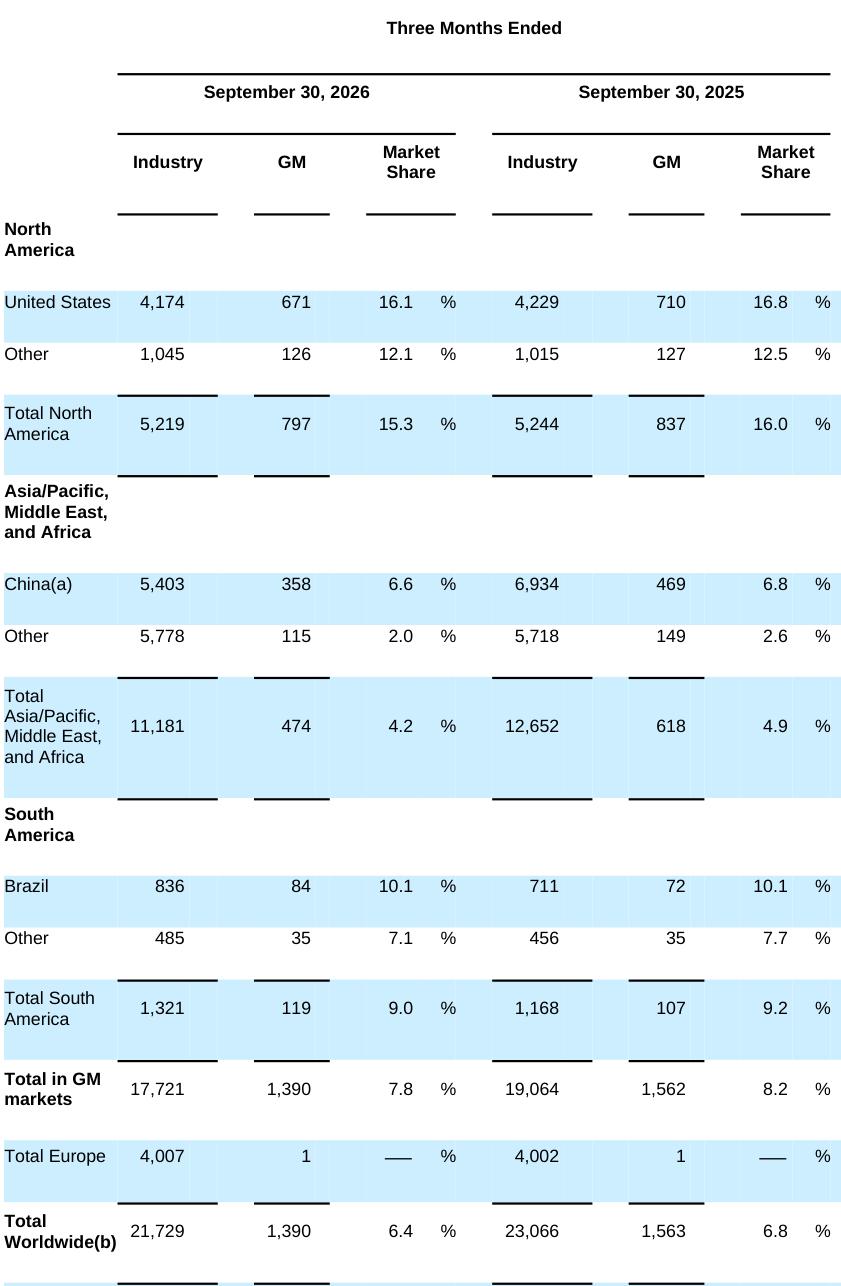
European quarterly wholesale sales hit 1,000 units; 6.6% share in China GM's sales and share table by market
Similar choices are now in front of Chinese automakers. Their move to Europe is essentially for profit. In 2025, the profit margin of China's domestic auto industry fell to 4.1%, the lowest on record, less than half of Toyota's (about 10%).
In the same year, Chinese automakers sold 811,000 units in Europe, with their share doubling to 6.1%, but most brands are still in the investment phase. The EU's anti-subsidy tariffs have been reflected in product prices, brand awareness takes years to build, and distribution networks and service systems require substantial capital investment. GM did not make up its mind to exit after losing money for more than a decade, and Chinese automakers must calculate clearly before setting off, to make sure they can see the path to profitability within a few years of investment.
Now that GM is no longer competing for market share, it has to tell a new story to the capital market, and this story is software subscriptions. As of the end of 2026, the management's caliber is that OnStar and Super Cruise have about 13 million subscribed users, recognizing 3.1 billion US dollars in revenue a year with a gross profit margin of over 70%, 30% to 40% of users will renew their subscriptions after the free period ends, and the unearned revenue pool on the books is close to 7.5 billion US dollars.
This path is also a reference for Chinese automakers. Intelligence is originally the strong suit of Chinese brands, but most of these features are given away for free with vehicles in the domestic market. If they can make software a second source of income like GM, the profit calculation for the European market will be much easier.
GM's orderly withdrawal from overseas markets has proved one thing: contraction can improve profits. Chinese automakers are taking the initiative to expand, and need to make trade-offs between profits and scale. But the two sides hold different cards: GM back then had no technical advantages in Europe, so its loss was inevitable; Chinese automakers are entering the market with advantages in three-electric technology, hybrid power and intelligent driving, so this battle is worth fighting.