Who is funding Anthropic?
"Claude hunts down Chinese users" is by far the most popular AI meme on the current Chinese internet, no exceptions.
Some people gathered Anthropic's restriction measures together and created a role-playing game, where players can act as Anthropic's auditors to spot disguised Chinese users among a group of Claude users.
Turning access to AI applications into endless cat-and-mouse games is clearly not the normal relationship between a legitimate AI company and its users. This weirdness, however, fits perfectly with the consistent style of Anthropic.

Its accounts are circulated through various channels, and workarounds for access restrictions are well-known inside the AI community. Its executives once mentioned at a public event: "The region with the largest traffic volume is Singapore." Everyone present shared a tacit smile.
The founder's past experiences and the rumors related to Baidu also keep adding a layer of confusing mystery to the company.
Such a company is heading to the capital market with a huge valuation of 2 trillion US dollars, and is sprinting for the largest IPO in history. Yet it confuses some rational analysts and the public, who are flooded with unverifiable rumors and playful memes. This is not normal. To put it another way, the risks are extremely high.
What kind of company is Anthropic exactly? The fact that Chinese users rack their brains to bypass restrictions and keep their accounts alive, is that strong proof to support its sky-high valuation?
There is more and more information that glorifies Anthropic. To figure out how much it is really worth and whether its value can be sustained, we need to peel off the layers of confusion like Sherlock Holmes, and extract the truly important clues from all the mysteries.
Next, let's go deep into Anthropic's actual business operation scene together.
01
Step into the lobby, who is making all the noise?
When you search for Anthropic online, the first thing you see are all kinds of rumors that make the company look extremely mysterious. Some people are discussing how to get access to Claude, some are exchanging what tricky programming problems CodeX has solved, and others are inquiring about accounts and sharing usage tips.
These stories together form our first impression of Anthropic. But is that all there is to it?
If you take a closer look at these active discussants on public social platforms, they can be roughly divided into three categories:
The first category is programmers, who spread word-of-mouth about the product's capabilities, share CodeX's irreplaceable experience in AI programming, compare the performance of different models, and regard Claude as an indispensable tool in their daily development work. An AI company that most ordinary people cannot access and are not familiar with has fascinated so many technical users, which creates a sense of scarcity.

Thus comes the second category: account scalpers. The more thresholds Anthropic sets, the harder it is to use its services smoothly, the more it arouses the curiosity of the public. For those who do not have the technical capabilities of programmers, some people start businesses selling accounts, providing purchasing agent services and third-party services. Obviously, none of this revenue flows to Anthropic.
What on earth is wrong with Anthropic that it doesn't even want to make money from the Chinese market? These strict restrictions that go against the logic of maximizing commercial interests have sparked all kinds of speculations, which attract the third category of discussants: onlookers who love gossip.
They are not heavy AI users, and may never have actually used Claude. But that doesn't stop them from participating in discussions. Some people connect the founder's work experience at Baidu with Anthropic's strategies, and think the CEO might have developed PTSD related to China.

Others analyze Anthropic's corporate culture: a tough, unapproachable tech geek temperament, which doesn't care about Chinese users, nor does it care about copyright giants like Disney and Marvel. The content it generates has no taboos, showing a reckless, "come at me if you have the guts" vibe.
At this point, we can see clearly that Anthropic's image on Chinese internet is mainly built by these three groups: the small group of programmers, the gray market profiteers who make money from scarcity and anxiety, and the gossipers who don't care about the product itself.
Therefore, the people who discuss Anthropic most enthusiastically are not the core of the company's business, and cannot really explain what kind of company Anthropic is or what its revenue situation looks like. We can't just stand in the lobby and listen to second-hand rumors. We have to go to a place closer to the truth: the finance room.
02
Sneak into the finance room,
Who is paying for Anthropic?
Hard cash doesn't lie. Compared with rumors that are hard to tell true or false, the numbers on the financial statements obviously reveal much more clearly what kind of business Anthropic is running.
Thanks to its IPO plan, Anthropic has released some public data that can be used as clues for our understanding. Looking through its account books, the first key clue is its 4.6 billion US dollars in revenue, and who contributed all of that?
According to Reuters reports, Anthropic's revenue in 2025 was close to 4.6 billion US dollars, an increase of about 12 times over the previous year. It is this astonishing growth rate that supports the extremely high valuation the capital market has given it. So who contributed the 12-fold revenue increment?
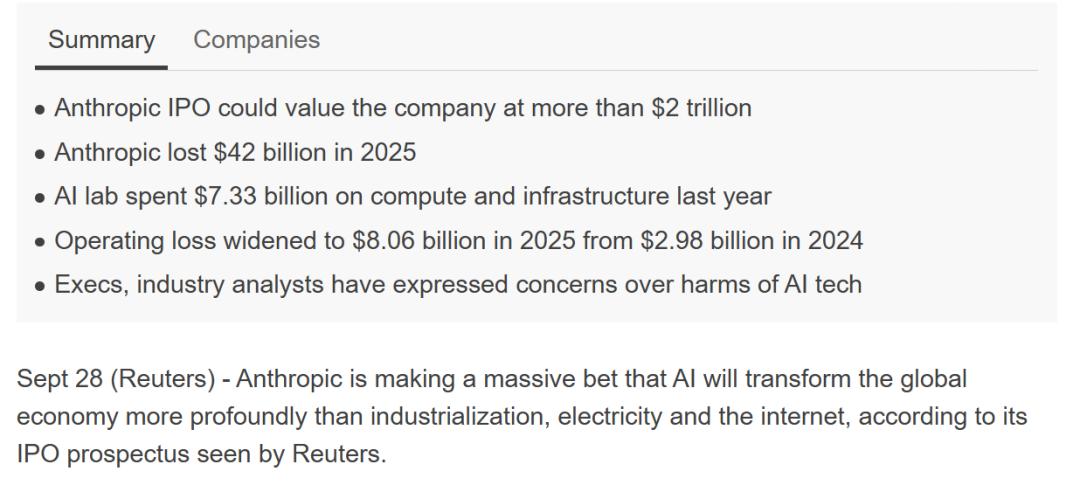
(Screenshot of Reuters' report)
More than 80% of the revenue comes from usage-based billing services, namely API and token charges. These are generally professional users, such as developer programmers, or continuous calls from enterprises, which belong to the B-end market in the AI business landscape. Only less than 20% comes from subscription services, which are monthly and annual membership packages that individual consumers can buy directly on the APP.
Now we know that the B-end market of enterprises and developers is the main source of revenue for Anthropic. What about the cost items then?
The next key clue is that the two cloud platforms Amazon and Google contributed about 47% of Anthropic's total sales.
Reuters reports show that in 2023, only 11% of Anthropic's revenue was generated through cloud platforms, and by 2025 that proportion was close to half. This is an important indicator: the B-end AI business is highly dependent on the customers' original digital infrastructure.

Anthropic's growth depends not only on how good Claude itself is, but also on whether it can sell its models to more customers through large cloud platforms. Imagine that an enterprise is already using AWS or Google Cloud. When it wants to integrate AI into its business systems, purchasing model services through the familiar cloud platform can more easily fit into the enterprise's original technical architecture and office processes, and will become their first choice.
This is a double-edged sword for AI model companies.
On the one hand, it can leverage the sales channels of the two tech giants to reach a large number of enterprise customers. But channels are not free lunches. Anthropic needs to pay distribution fees and computing power costs for these cloud platforms.
In 2025, Anthropic's operating loss exceeded 8 billion US dollars, of which computing and infrastructure expenditures reached as high as 7.3 billion, far exceeding its revenue. Obviously, this is the old story where "the shovel seller makes the first pot of gold".
In addition, the tech companies running these large cloud platforms are often also developing their own large AI models, or supporting invested enterprises in R&D, for example, Amazon invested in OpenAI, and Google independently developed Gemini. They have the motivation to check and balance Anthropic.
A small side note: even though Claude is hyped to be very expensive on Chinese internet, the US market actually contributes nearly two-thirds of Anthropic's sales. It cannot be ruled out that some of these users are Chinese users using bypass methods, but the proportion is very limited. What really determines Anthropic's commercial value is B-end customers who continuously call the model, and the cloud platforms that bring Claude into more business scenarios.
The next question is, how loyal can Anthropic's customers really be? Will they keep paying for it in the long run?
03
Top-level meeting,
What is Anthropic's moat?
How can we ensure user loyalty to consolidate revenue? Making models better than OpenAI and Google is a truism that doesn't help. There are countless examples in the technology market where companies with excellent technology and products still end up failing commercially.
Build good relationships with cloud platforms and convert cloud users into AI customers? This advantage can also be very fragile, because many enterprise customers do not want to put all their models in one basket, and cloud platforms will also support customers to do so by actively providing more model options.
Serve several top key customers, embed the model into their workflows, and increase the replacement cost? This model is completely unsuitable for the overseas IT market where labor is scarce and expensive, and cannot reduce marginal costs through large-scale operations, so it cannot support a high premium at all.
Which path leads to Rome? The answer is every path, but add an extra buff to each option.
For example, Anthropic regards technology R&D as the core of commercial competition, but at the same time, it will place special emphasis on AI safety. The way it emphasizes this is to create a crisis that is difficult to verify, claiming that AI is unsafe, but it can provide prevention solutions.
For example, last June, Anthropic published a long article claiming that Claude had already participated in a large amount of internal code production, and AI was already self-correcting and self-building, so everyone should slow down the speed of AI R&D, otherwise the consequences would be unimaginable. Four months have passed now, and no unimaginable consequences have been found. But this "AI doomsday theory" can attract a lot of followers in Western societies with Christian cultural backgrounds. Since AI is so dangerous and people can't stop using it, they will turn to the safer Anthropic for shelter.
Its cooperation with cloud platforms is not just a simple buying and selling relationship. It also ties its interests with cloud vendors through long-term procurement agreements.
According to Reuters reports, over the next seven to ten years, regardless of actual usage, Anthropic will pay at least 111.1 billion US dollars to Google, 110 billion US dollars to Amazon, and 31.4 billion US dollars to Microsoft for its long-term infrastructure service obligations.
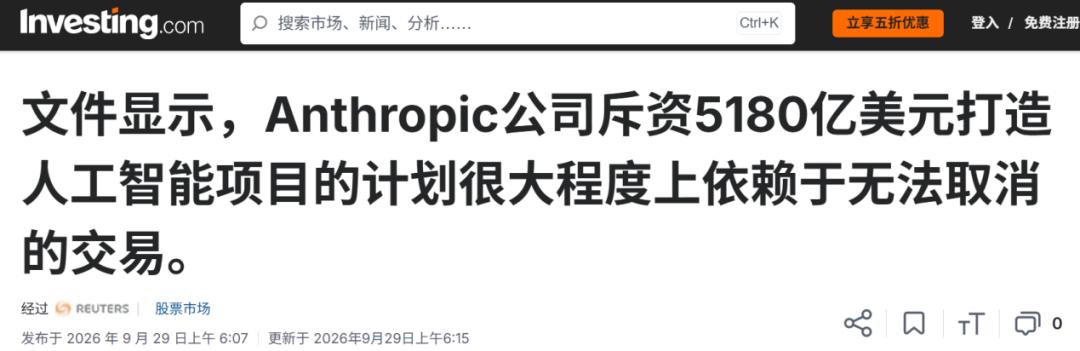
Obviously, this is an aggressive computing power expansion plan that does not match its own business needs. Anthropic is not only betting on business growth, but also building long-term relationships with cloud vendors, so as to reduce competitive frictions in the model market.
Locking in computing power in advance will increase Anthropic's financial burden and even expand its losses, but it also forms a stronger alliance between Anthropic and cloud vendors, because cloud vendors are currently trapped in the risks of the AI bubble. Both sides will prosper together and suffer together.
At this point, a tightly interlocked closed loop is formed: to support model training and long-term competition, Anthropic must obtain sufficient computing power; to obtain computing power and expand customer coverage, it needs to cooperate with large cloud platforms and bear huge costs. And whether these costs can be sustained depends on whether the product team can turn the expensive computing power into tools that users are willing to pay for.
Of course, this cycle can also reverse. If competitors narrow the model gap, customers switch to alternative products, and computing power costs cannot be effectively converted into revenue, then Anthropic's huge investment may turn from an advantage into an inescapable financial burden.
04
Outside the building
After going through all this, we seem to have uncovered the secret of this company. Its revenue is growing fast, but it carries huge infrastructure investment commitments, with enormous costs in the future, and its competitive landscape is also full of uncertainties.
Anthropic's operating situation and logic are not hard to understand. Why are the market flooded with confusing rumors and stories? Perhaps because only stories can add a mysterious aura to a commercial company. Tech enthusiasts find hope in the stories, gossipers get excitement from the stories, and early investors cash out their money through the stories.
Anthropic itself is not mysterious. Someone just smeared a new layer of mysterious paint on a familiar commercial story we all know, and took it to auction again. And the place where this new story is auctioned is outside the building.