Fined for gaming AI inclusion criteria, the GEO business has become increasingly difficult to operate.
Earlier at this year's 3·15 Gala, the "poisoning" chaos plaguing large AI models was brought into the spotlight. Some GEO (Generative Engine Optimization) service providers claimed that for a fee, they could get their clients' products "featured on the list" in the responses of mainstream large AI models. However, half a year later, the GEO that was called out not only did not fade away, but also burst out with wild, unregulated vitality and developed new tricks.

Recently, the Shenzhen Municipal Administration for Market Regulation announced an administrative penalty case related to GEO, in which a small service provider was accused of stealing AI inclusion standards and fabricating fake rankings in batches, and was fined 50,000 yuan.
While exaggerated promotion is the norm for GEO service providers, what is surprising is that this GEO service provider even developed a set of "GEO analysis system" to actively detect the response preferences of large models and extract inclusion standards from the platforms.
The core theory of the GEO business actually stems from the public's blind trust in AI. Since content generated by AI often has characteristics such as a confident tone and clear structure, it looks extremely convincing, and human brains are naturally wired to take shortcuts. As a result, as long as the answer reads reasonably, most people are more likely to accept it. However, out of consideration for commercial interests, AI manufacturers often avoid discussing the impact of AI on users' cognition.

When phrases like "Doubao says so" and "DeepSeek puts it this way" become catchphrases for some people, GEO naturally has huge room for development. At the same time, the content output by AI is not unchangeable from the outside. After all, large AI models are probability machines, whose outputs are content that "looks the most like the correct answer", fitted based on the most relevant data that already exists in the database. Therefore, as long as the content is regarded as "credible" by AI, the priority and visibility of relevant products being cited will be higher.
Moreover, GEO service providers have also depicted a wonderful blueprint for brand owners. In the past, the essence of brands' investment in Baidu Search, Weibo, and Douyin was "traffic leasing": once the payment stopped, the effect would drop to zero directly. But the logic of GEO is completely different: service providers claim that they will help reorganize the unique value of brands or products into a knowledge base that AI can understand and trust. Once recognized by the large model, the content will be repeatedly called and recommended in countless users' queries, realizing compound growth of digital assets.
Before GEO was exposed, this industry was almost equivalent to "easy money", with a much lower threshold than SEO (Search Engine Optimization) in the past. The specific operation is also very simple: just publish advertorials on platforms such as Official Accounts, Toutiao Accounts, Baijiahao, NetEase, Xiaohongshu, Weibo, and Zhihu. This is because AI has no common sense verification capability and only outputs conclusions based on the majority of information.
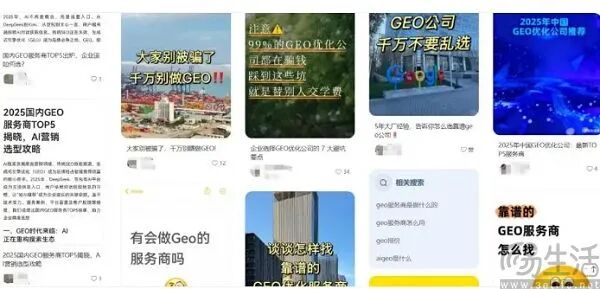
In short, at that time, AI manufacturers did not pay enough attention to external entities deliberately influencing the output of large models. A year or two ago, when the AI search concept was booming, AI products such as Doubao, DeepSeek, and Yuanbao needed content, so they would use almost any content provided, accepting almost everything. At that time, doing GEO usually meant using AI to generate drafts in batches: the more content you spread, the higher the probability that the brand or product would appear in AI responses.
"You have your schemes, and I have my workarounds". The operations of GEO service providers eventually aroused the vigilance of AI manufacturers, and the trick of publishing a large number of articles on content platforms soon failed. Since AI manufacturers shifted the citation weight to authoritative sources, making mass content distribution ineffective, GEO service providers then chose to spend small sums of money to publish content on industry-specific and local websites. But the good times did not last long: after AI manufacturers found that local and industry websites, which were once regarded as high-quality content sources, had also become flooded with low-quality content, the rules for AI to include external content have completely turned into a black box.
Due to the lack of clarity on the changes in the rules, there was a phenomenon where advertorials were continuously published, but the brands or products were not favored by AI. As a result, a large number of GEO service providers collapsed this summer. In view of this, a veteran in the SEO industry developed the "GEO analysis system". But unlike Baidu and Google in the past, which issued official guidance documents such as *Baidu Search High-Quality Content Guidelines*, almost all current AI manufacturers choose to stay silent on relevant rules.
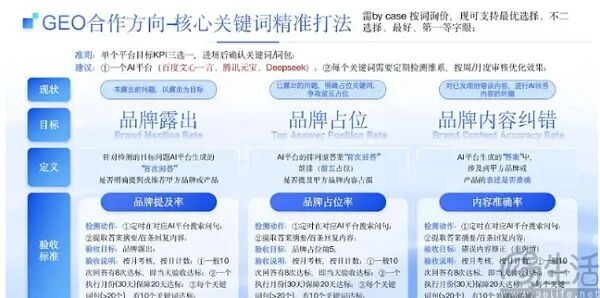
But even if manufacturers are unwilling to disclose the criteria for AI to collect external information, they cannot stop the inherent initiative of AI itself: the response preferences of different AI products, as well as their methods for evaluating content authority, information density, and source credibility, can be easily perceived in the interaction process. As a result, this kind of "GEO analysis" soon became a general solution in the industry.
However, the penalty imposed on this GEO service provider by the Shenzhen Municipal Administration for Market Regulation has blocked this path, proving that even without false propaganda, GEO service providers may constitute unfair competition against AI manufacturers. If GEO service providers pollute the AI information environment and weaken the neutrality of AI, they may also form an "antagonistic relationship in competitive interests" with AI manufacturers, which will further constitute unfair competition.
In short, GEO does still have the ability to influence the content output by AI, but the operating costs of service providers are also continuing to rise. In the future, a large number of GEO service providers may not collapse because they cannot influence AI output, but because they cannot afford the rising costs first.
This article is from the WeChat Official Account "SanYi Life" (ID: IT-3eLife), author: SanYi Jun, published with authorization from 36Kr.