Embodied Intelligence, Hot Money Shows No Sentiment for Old Ties
The confidence in embodied intelligence seems to have returned.
In the past three trading days, the share price of Unitree Robotics has surged by nearly 30% cumulatively, and its market cap has returned to a high level above 200 billion yuan. Although it has not reached the peak of over 400 billion yuan on the first day of listing, it is also a rare strong rebound in the past month, with the single-day increase once second only to that on the listing day.
Facing the continuously rising share price, Unitree Robotics issued an announcement last night, stating that the company's operation is normal and there are no major matters that should be disclosed but have not been disclosed.
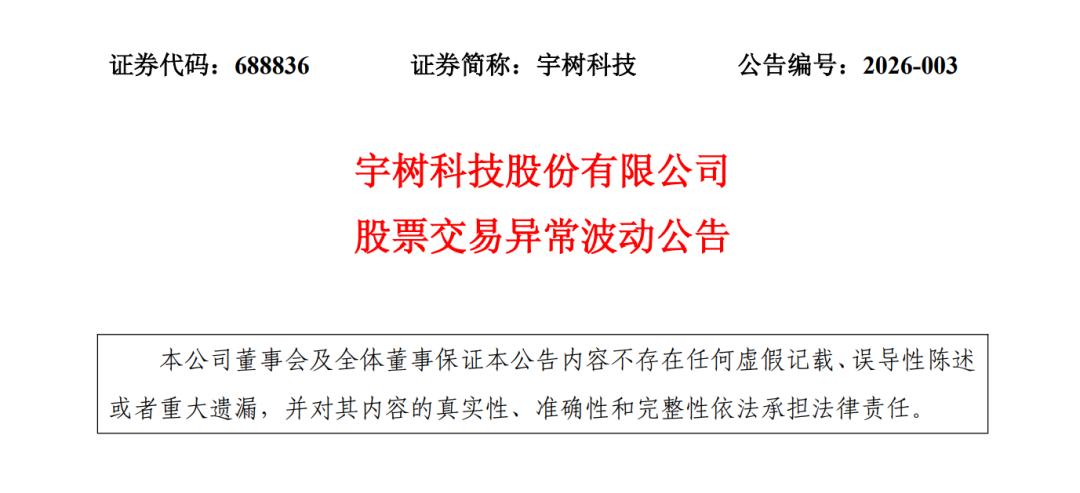
Unitree Robotics Announcement
Unitree also reminded that the company's rolling price-to-earnings ratio has reached 388.25 times, nearly 10 times the average level of the general equipment manufacturing industry. The humanoid robot industry is still in the early stage of commercialization. If the implementation falls short of expectations, the company will face the risk of valuation regression.
Against the backdrop of Unitree's rebound, another once high-profile star robot company is facing bankruptcy liquidation.
On October 19, Heyi Robotics held its first creditors' meeting after bankruptcy liquidation. Heyi Robotics had a high starting point, spun off from Yifeng Group under He Jianfeng, and had previously received investments from ByteDance, GSR Ventures and Meituan-affiliated enterprises, with a peak valuation of over 500 million US dollars.
Even so, Heyi still failed to escape the fate of bankruptcy, and it only took two years to slide from its peak.
Heyi is not an isolated case. In the past two years, a large number of robot companies including Zhicheng Power, Dark Blue Robotics, CloudMinds, Longhui Medical, and Cone Robotics have gone bankrupt one after another, many of which are star projects incubated by industry leaders, backed by well-known investment institutions and industry giants.
On one side is the rebound in share prices, on the other side is the quiet exit. The robot industry has never lacked capital attention, but the targets chased by hot money have changed a round. Even the problems faced by these robot companies are similar - the same beautiful vision, the same difficult implementation, and the same slowly fading confidence.
Apart from Unitree, more robot companies are still waiting in line for listing, and it seems that there is not much time left for them.
The first batch of robot companies can no longer hold on
Different from people's inherent impression, most of the robot companies that have gone bankrupt in the past two years are no mediocrities, and all have remarkable backgrounds.
Heyi Robotics goes without saying, backed by He Jianfeng, the son of He Xiangjian of Midea, and received support from Yifeng Group from the very beginning. Its founder Shen Gang is a big shot in the robot industry, who has worked for Fanuc, the Japanese robotics giant, for many years.
Zhicheng Power, which focuses on swimming pool robots, can be regarded as a representative of industry star projects. The company's founder Pu Hanlai graduated from Microsoft Asia Research and Development Institute, once led Moxiang Technology, an enterprise in the Xiaomi ecological chain, and the core team all came from Microsoft, Xiaomi, DJI and other enterprises. Last year, it also received tens of millions of RMB in strategic investment from Ecovacs.
Founded in 2015, CloudMinds has received multi-round support from SoftBank China and Foxconn, and once planned to list in the United States. Dark Blue Robotics, backed by Dark Blue Technology, also previously disclosed that it had won an order of over 700 million yuan from South Korea's LG, planning to deliver tens of thousands of robots within three years.
But none of these could support them to move forward. Like many high-profile embodied intelligence projects today, most of them received huge financing and expected orders at the initial stage, but after several years they still failed to deliver as scheduled, and never obtained a stable source of income, so they could only survive by relying on financing.
In 2021, Heyi won a nearly 100 million yuan large order from Foshan Lighting, undertaking the construction of the intelligent manufacturing workshop project for bulb lamps. However, the project failed to pass the acceptance inspection after being overdue for two years. The two sides eventually went to court. Heyi failed to recover about 104 million yuan, but was instead sentenced to return 26.904 million yuan and dismantle the equipment at its own expense.
The LG order that Dark Blue Robotics widely publicized also failed to be executed on a large scale. According to previous media reports, after the market demand for disinfection robots ebbed, the order was not executed. Relevant employees told the media that "many products cannot be effectively implemented in real scenarios, and can only be used for demonstration."
With products never being able to be implemented, the two companies expanded wildly at the initial stage, with a huge and complex business line. Only one year after its establishment, Heyi settled in Shunde with a 10-billion-yuan investment scale and a 500-acre R&D and production base, claiming to use "robots to manufacture robots".
Dark Blue was simultaneously involved in robot products in multiple fields such as cleaning, disinfection, distribution, mowing, and even manned AGV. While Dark Blue's Changzhou factory was in arrears of wages, Dark Blue also put its second factory into operation in Shangqiu, with a planned production capacity of 20,000 units.
Huang Xiaoqing, founder of CloudMinds, later reflected in an exclusive interview that the biggest mistake he made in starting a business was failing to enable the company to achieve self-sustainability as soon as possible. "Put it bluntly, we need to make things that make money, and let the company recover on its own first." According to media reports, CloudMinds had more than 800 employees at its peak, with as many as 6 planned product lines, which consumed a lot of capital.
While being unable to achieve self-sustainability for a long time, investors' interest in these early-stage robot projects is also gradually weakening. Different from the current popular embodied intelligence concept, most early robot projects focused on segmented service scenarios such as cleaning and distribution, which are inferior to general-purpose robots in both market imagination and technical narrative.
Huang Xiaoqing said that their financing has become particularly difficult since 2024. One of the reasons is that many new startups have poured into the humanoid robot track, and investors can invest in early-stage projects at a lower valuation, while late-stage high-valuation projects like CloudMinds are left unattended. At that time, CloudMinds had fallen into an operating crisis due to the interruption of financing, and began to shrink its team and office space.
Not only in China, overseas star robot companies also failed to escape the capital predicament. In July this year, American surgical robot company Vicarious Surgical launched bankruptcy liquidation. Founded in 2014, the company once received support from well-known tycoons such as Bill Gates and Jerry Yang, and its valuation reached 1.1 billion US dollars when it went public through a backdoor listing in 2021. But until this year, its products were still not approved for commercialization, and eventually it had to withdraw from the market quietly.
Hot money is pouring into new players
Most of the previous batch of robot companies failed to get financing after a long wait, but hot money is still pouring into the robot track.
According to statistics from IT Juzi, the total financing of domestic embodied intelligence in the first half of 2026 exceeded 93 billion yuan, a 5-fold surge over the same period last year. There are as many as 22 embodied intelligence enterprises with a valuation of over 10 billion yuan, while there were only 3 last year.
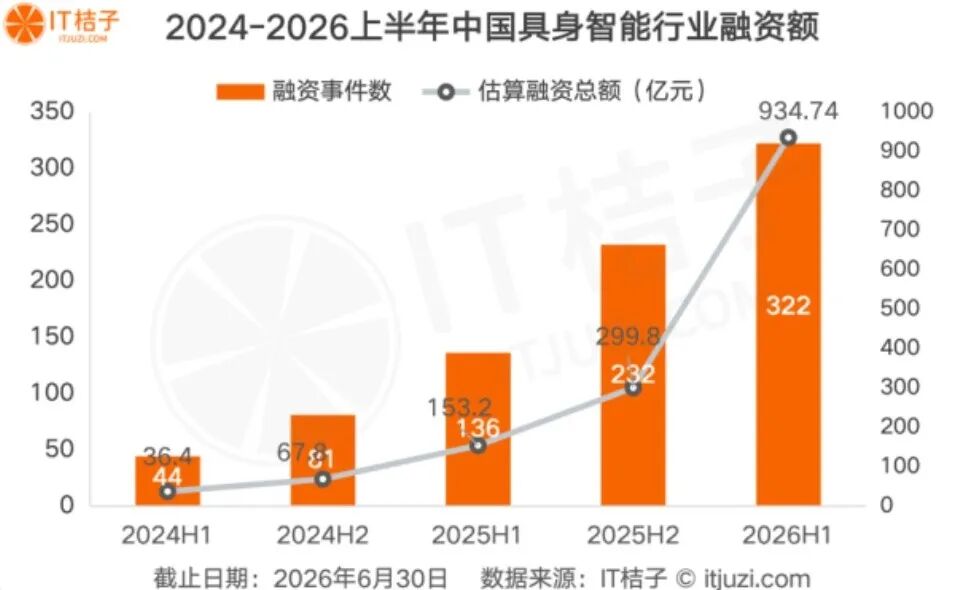
IT Juzi Data
The financing speed of new companies has far outpaced their predecessors. CloudMinds spent nearly ten years and experienced five rounds of financing, receiving a total of about 40 billion yuan. Zhipingfang's series of financings in the first half of this year is close to 50 billion yuan, while Ziliangshu completed four consecutive rounds of financing in two months. Both sides claim to be the first embodied intelligence company in the Greater Bay Area with a valuation of 200 billion yuan.
The bubble seems inevitable, but no one is willing to stop. According to incomplete statistics from Yicai, in the first half of this year, HSG participated in at least 20 embodied intelligence financings and invested in 14 enterprises. GL Ventures participated in at least 18 financings, and also invested in 14 enterprises. Sometimes they even appear in clusters and jointly lead the investment.
The most heated moment of market sentiment was the first day of Unitree Robotics' listing. On that day, the intraday increase of Unitree Robotics' share price reached as high as 629.44%, and its market cap once approached 4500 billion yuan, which was higher than the sum of the market caps of four vehicle companies Nio, Li Auto, Xpeng and Leapmotor, while Unitree Robotics' revenue last year was only 17 billion yuan.
After Unitree's success, investors may become even crazier. According to incomplete statistics, there are already more than 20 embodied intelligence enterprises targeting IPO this year, including not only complete machine players such as Agibot and Galaxy Universal, but also a large number of players in segmented fields such as embodied models and dexterous hands.
But this listing boom soon cooled down.
The Information previously reported that the China Securities Regulatory Commission has given informal guidance to some investment banks and investment institutions to raise the approval threshold for humanoid robot enterprises' IPO. Reuters reported that the regulatory authorities are particularly concerned about the high valuation of enterprises and whether the revenue relying on government projects truly reflects commercial demand.
DeepMotion, whose IPO application was accepted in May this year, had a revenue of 340 million yuan last year, and its attributable net profit to shareholders was 28.68 million yuan, turning losses into profits. In the first half of this year, DeepMotion's revenue doubled year-on-year, but it returned to losses.
The prospectus shows that DeepMotion sold a total of only 4 units of DR series humanoid robots in the past two years. In the first round of inquiry from the Shanghai Stock Exchange, special attention was paid to issues such as the sustainability of DeepMotion's revenue, when humanoid robots will achieve large-scale sales, and the order structure.
Some star enterprises began to postpone their listing plans. As early as July this year, Agibot announced the launch of preparation work for Hong Kong stock listing. At that time, some investors expected that the company could be listed as soon as August. But a few months later, Agibot still did not go public smoothly as expected.
Caijing reported last week that Agibot has instead sought a new round of financing, with a financing amount of about 1-1.5 billion yuan and a valuation of about 50 billion yuan, and this round of financing is nearing completion.
According to the requirements of the Hong Kong Stock Exchange, if the listing applicant completes new financing after submitting the application and before listing, without special exemption, it can be listed for trading 120 days after the completion of the financing. In other words, Agibot's IPO within this year is hopeless.
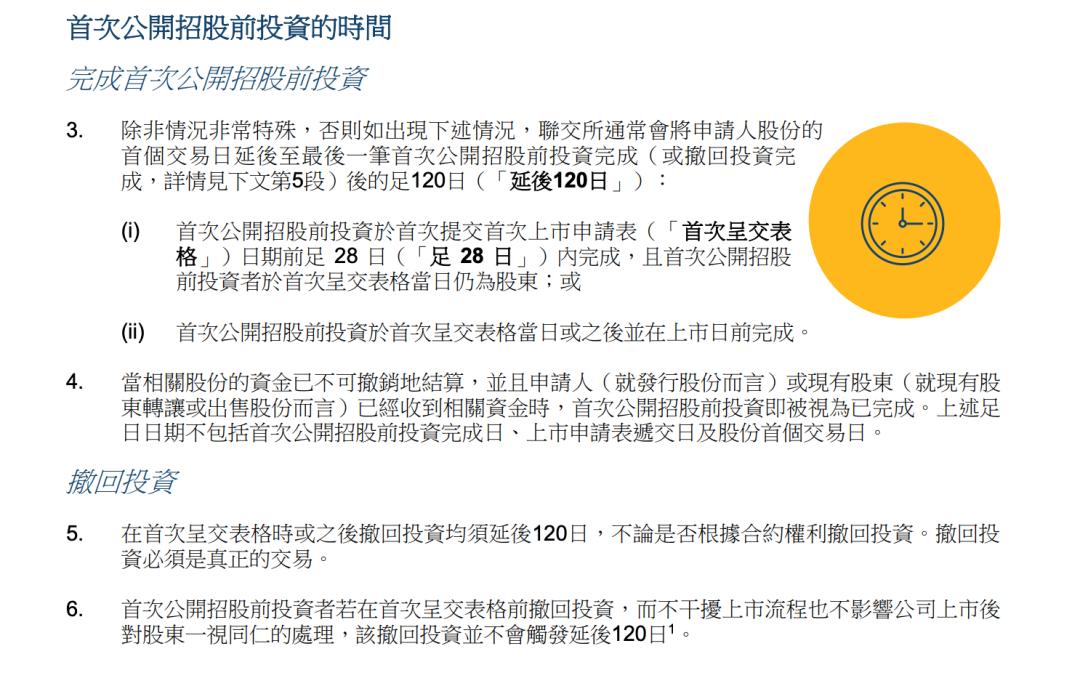
Hong Kong Stock Exchange "Guide for New Listing Applicants"
But even with the cooling of IPO, investors are still full of enthusiasm. While Unitree Robotics' share price rebounded, many embodied intelligence enterprises have completed multiple rounds of financing recently. Stardust Intelligence announced on October 13 that it has completed a new round of financing of 10 billion yuan, with a company valuation of 150 billion yuan. Fao Robotics also announced in October that it has successively completed C+ round and D round of financing, with the two rounds totaling nearly 1 billion yuan.
Who is paying for the robots?
Even though the new batch of embodied intelligence enterprises mostly have more ambitious visions and more touching demonstrations than the previous generation of robot companies, the problems they face are somewhat similar: how to achieve real commercial implementation and how to continue to achieve self-sustainability.
According to statistics from Counterpoint, in the first half of this year, the global shipment of humanoid robots exceeded 22,000 units, a year-on-year increase of nearly 300%. However, cultural and entertainment performances, scientific research and data collection still account for more than 60%, and intelligent manufacturing and warehousing logistics account for only 13% and 5% respectively. That is to say, the robots that are really used in actual production are still a minority, and most robots only provide emotional value.
Just like the domestic robots that appeared on the Spring Festival Gala in batches this year, they are more keen on performance than production. Even these performances cost a lot. It is circulated in the industry that the cooperation fee for each robot company that appeared on the Spring Festival Gala is 100 million yuan - which is roughly equivalent to more than half of Unitree's R&D investment last year.
Previous media reports said that the main source of income for some robot companies is data collection factories cooperating with local governments. Data collection is equivalent to a resource reuse within embodied intelligence: robot companies sell robots to data collection factories, and then spend money to buy back data from the data collection center.
In September this year, Shao Tianlan, founder of Mech-Mind, posted on Moments, criticizing that there is a group of "scheme-gathering" enterprises in China's embodied intelligence track, which use a large number of related transactions of "data collection centers" to create false and unsustainable revenue.
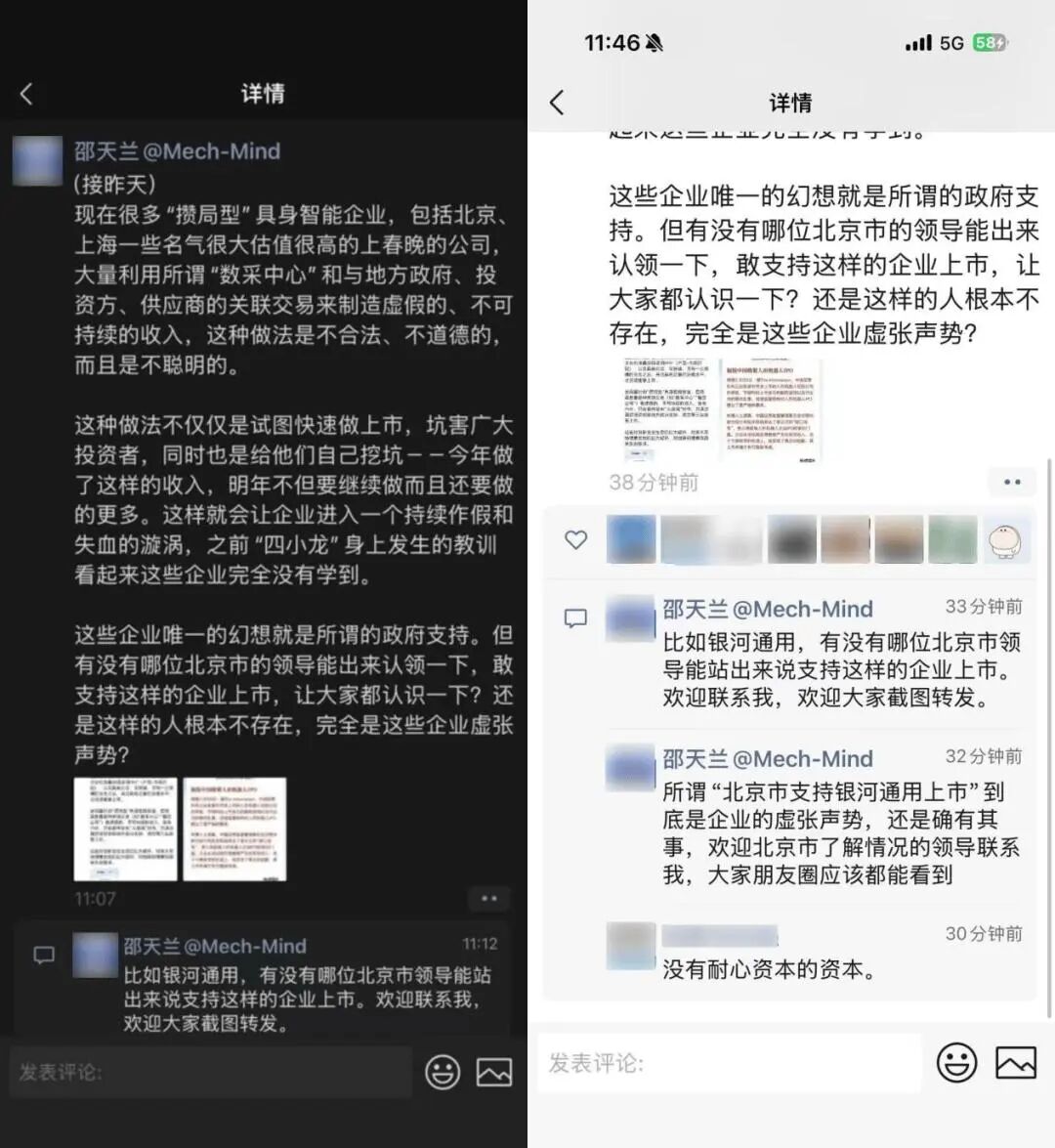
Shao Tianlan's WeChat Moments
Shao Tianlan named Galaxy Universal in his WeChat Moments. Galaxy Universal responded publicly that they will not participate in unnecessary verbal battles and will not be disturbed by short-term noise.
Data collection is indeed one of the main sources of revenue for some embodied intelligence enterprises. The previously released prospectus of Leju Intelligence shows that in 2025, the company sold 577 units of its full-size humanoid robot Kuafu series, generating revenue of 178 million yuan, of which about 45% of the revenue came from the data collection field, and the revenue from the industrial manufacturing field accounted for 3.88%.
In contrast, the progress of robots entering factories is much slower. Even after entering the production line, the tasks undertaken by robots are quite limited.
Overseas robot company Figure disclosed that its robots have accumulated more than 1250 hours of operation in BMW's US factory, handling more than 90,000 parts and participating in the production of more than 30,000 cars.
Sounding impressive, what it is specifically responsible for is taking the sheet metal part off the material rack, placing it on the welding fixture, and then handing it over to the traditional industrial robot to complete the welding. Around this single action, the two sides spent months testing and debugging before and after.
The International Federation of Robotics pointed out in its report released in September this year that the current application of humanoid robots is still dominated by special tasks, and often requires manual teleoperation, with excessively high training and maintenance costs and insufficient economic returns for industrial applications.
Except for some leading companies, more robot companies may not even have truly delivered orders. According to Counterpoint statistics, the