Total cumulative financing exceeds 200 million US dollars, Today AI will understand you better and better starting from today.
Recently, Personal AI assistant startup Today AI announced that it has raised a total of over 200 million U.S. dollars in financing, with investors including IDG Capital, Tencent, 5Y Capital, Ant Group, HSG, Transsion Holdings, Tongge Venture Capital and SJTU Hanyuan Asset.

This round of financing comes amid the continuous boom of the personal AI assistant track. Over the past year, AI has evolved from a simple question-and-answer mode to executing tasks per instructions, with operations such as searching emails, accessing calendars, and manipulating computers gradually becoming its basic capabilities. In just the past month, personal AI assistants have become another highly sought-after application direction overseas following AI Coding, with tech giants entering the market one after another and capital accelerating its deployment.
This upsurge is aimed at solving a long-standing unresolved proposition: Whether it is question-and-answer interaction or task execution based on instructions, the starting point always requires users to state their needs and relevant background information first. Today AI wants to take a different approach: it remembers the goals and recent status shared by users, and proactively proposes the next step at the right time.

In China's AI industry, Today AI chooses to build independent products centered on personal AI assistants, and regards this as the core positioning of the company. Today AI is one of the earliest entrepreneurial teams in China to explore this direction. The team is committed to creating a personalized proactive AI system, providing every user with an AI assistant that understands them better and offers more active support.
"The technical capabilities are already in place, but the trust relationship between users and AI has not yet been established", the Today AI team once explained their original intention in this way.
AI can do more and more things, but it still takes a lot of effort to make good use of it: you have to first figure out what to ask, then explain the relevant background, and often have to start all over again the next time you use it. Today AI aims to help users save this part of energy and offer active assistance at the right time.
To achieve this, continuous adaptation and optimization are required in daily use. That is why Today AI chose to deliver the product to users first: it launched its overseas public beta in September, the domestic version went online on September 24, and this round of financing was officially disclosed only now. Previously, a large number of users have used it to plan work, arrange trips, organize fitness plans and manage schedules, and the product has been tested in these real life scenarios.
Remember your past, and keep up with your present
The help a person needs often depends on the specific situation they are in at the moment.
When traveling, people may not start considering where to go the next day until nightfall; after the holiday ends, the plan to resume exercise also needs to be adjusted according to their recent status. Many needs emerge gradually as life changes, making it difficult to turn them into clear AI instructions in advance.
This puts higher requirements on personal AI assistants: They need to not only remember the experiences and preferences shared by users, but also keep up with their recent arrangements and status. By connecting the two, the AI can timely bring up matters worthy of attention.
A user living in Xizang once asked Today AI to sort out materials such as travel photos. Not long ago, he was considering the itinerary for the next day. That night, Today AI proactively recommended a list of little-known temples that local Tibetan residents often visit in its daily briefing, and also attached the departure time of shuttle buses, opening hours, and the best light periods suitable for photography.
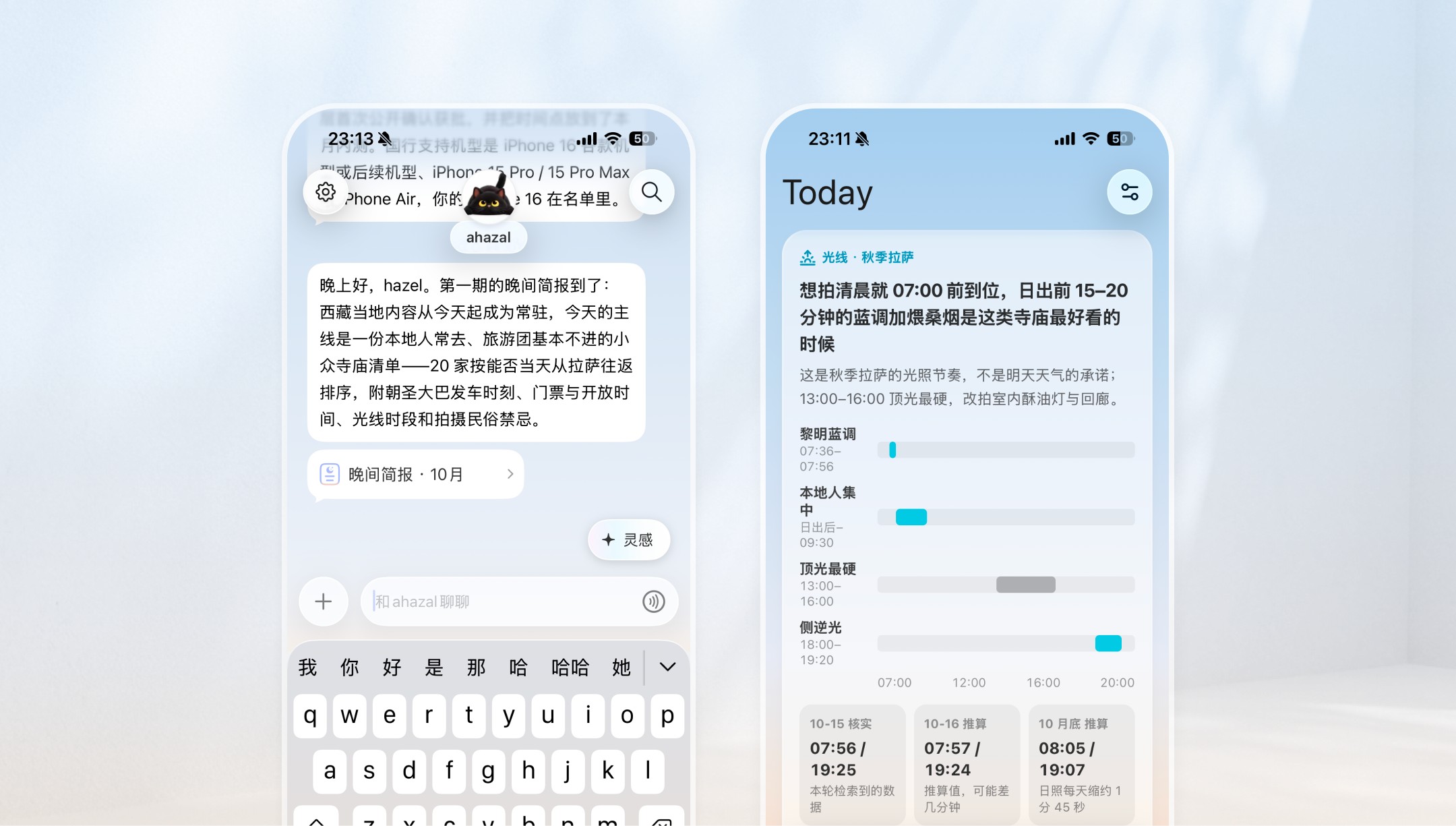
Screenshot from user @ahazal, used with authorization
This recommendation surprised him a lot, because these temples perfectly matched his interests. The travel photos and experiences sorted out last time were put to good use on this trip.
According to the Today AI team, what the product mainly remembers is the basic information that users actively share, as well as the preferences shown in past interactions. These memories are also managed by users. Users can view the personal information and preferences recorded by Today AI, modify inaccurate parts, and delete content they do not want to retain.
But to provide effective help, it is also necessary to combine the user's current situation.
A user who has practiced boxing for a long time usually analyzes sports records with Today AI and connects her own health data. On the first day back to work after the holiday, Today AI noticed that her amount of exercise during the National Day holiday decreased significantly, so it reminded her in the morning briefing: do not rush to increase the intensity when you resume training.
This reminder is not complicated, but it takes into account the changes in the user's recent life status. Even for the same person, the suitable suggestions may vary with time and situation.
However, proactive service puts higher demands on the AI's judgment: What information is worth remembering for a long time, and what needs to be updated in time? When is the right time to send a reminder, and what matters do not need to disturb the user?
These tiny judgments determine whether the AI can offer help at the right time, and also affect how much daily burden it can reduce for users.
Reduce delegation costs, so that more tasks are worth assigning to AI
For many tasks assigned to AI, you still need to repeatedly explain the background and confirm the progress, and the energy you spend may be more than doing it yourself. The Today AI team calls this cost the "delegation cost", and hopes to reduce it, so that users can assign tasks to AI more naturally.
Schedule arrangement is a typical example, as plans often cannot keep up with changes. A user preparing for the CET-6 English test usually uses Today AI to arrange her study plan and daily schedule.
Once, she received an admission email for volunteer work and learned that she had to attend a temporary training the next morning. Combining her previous exam preparation arrangements and the newly added schedule, Today AI suggested adjusting the original word memorization time to the evening.
She does not need to restate her exam preparation arrangements, nor does she need to rearrange the schedule by herself, so the delegation cost is reduced.
This is also the reason why Today AI organizes information around the same person: arrangements in study and life are often interrelated, and a temporary change may disrupt the original plan.

This idea is also reflected in the interactive design. Today AI adopts a continuous single-session design, where users can assign different tasks one after another in the same conversation, and specific tasks are processed in parallel in the background, with their progress available for separate view. Users do not need to switch sessions frequently, and they can continue to talk about the tasks they discussed before.
In the words of the Today AI team: "You hand over the tasks, then go and live your life. When you come back, the AI is still there."
The proactivity of personal AI assistants also requires clear execution boundaries. In the CET-6 preparation example, Today AI only gives adjustment suggestions, and it is up to the user to decide whether to modify the schedule or not. For operations involving payment and important decisions, the AI will also obtain user confirmation first before executing relevant actions.
Reducing delegation costs is to enable more people to truly make good use of AI, and leave their energy to more important matters. To achieve this, it is far from enough for AI to offer help once.
Long-term reliable support relies on unseen efforts behind the scenes
To make such help happen continuously, the AI needs to accurately remember the user's situation, provide timely reminders, and complete tasks smoothly.
The Today AI team is also making continuous investments for this goal. In terms of memory management, it reduces the interference of outdated information on judgment through the Dreaming mechanism, compression and update; in terms of proactive reminders, it adjusts the reminder strategy according to the user's reading and response to push notifications, so as to reduce invalid disturbances.

At the same time, the team is also polishing the system infrastructure, task queue and cross-device communication, to ensure that long-running tasks will not get stuck or lost, and their progress can be checked at any time.
From Today AI's perspective, personal AI assistants are supported by high-quality products, appropriate models and solid infrastructure together. It is not difficult to make a stunning demo, but it is hard to offer reliable help every day, and most of these efforts are not easily noticed by the outside world.
For personal AI assistants that need to understand users over a long period of time, there is another question worth answering: The longer you use it, will the AI really understand you better?
One-time AI tasks are usually evaluated by the final delivery results, but personal AI assistants also need to examine the changes brought by time: as historical information continues to accumulate, will the suggestions provided next time be more appropriate, and can the AI identify needs and complete tasks more accurately?
To this end, Today AI has built a set of simulated user evaluation system: the simulated users have continuous life experiences, and the team compares the performance of the AI in three scenarios: no historical information, only personal profile, and 30 days of accumulated interaction history, to observe how its help effect changes.
Today AI hopes to verify through this method whether long-term accumulated memories can be transformed into more accurate and effective help. The team stated that relevant research methods, test scenarios and phased results will be gradually made public, and more researchers, developers and users are welcome to participate in the joint verification.
Today AI still has many areas to be polished. The ease of operation, the smoothness of conversations, and the clarity of function prompts are all aspects that the team keeps improving based on user feedback.
Today AI admits that the current stage is only the starting point. To enable AI to understand a person for a long time and provide help at the right time, there is still a lot of work to be done in product, model and engineering aspects.
The total financing of over 200 million U.S. dollars enables Today AI to continue to promote this long-term project, and allows the team to move step by step towards the vision of "Intelligence for All" — to make AI affordable and usable for more people, so that even users who are not familiar with technology can get their own exclusive help, and leave more time for the life they care about.
At present, this forward-moving team is recruiting more partners. If you are also excited about such a future, willing to make long-term investments and turn this vision into reality with your own hands, you are welcome to join Today AI.