What stage have China's leading companies reached in the practical commercialization practice of flying cars?
On October 15, 2026, Tesla demonstrated a demo of "cars that can also fly", which is essentially a short-term stunt driven by a cold gas thruster. It stops working once the high-pressure gas is exhausted, can only stay off the ground for a short period of time, and cannot sustain continuous flight. The "rocket version" equipped with a propulsion system is most likely not legal for road use and is limited to demonstrations on closed tracks.
It is worth noting that the cold gas thruster of the Tesla Roadster comes from SpaceX rocket technology. According to data from the China Automotive Technology and Research Center, the industrial chain overlap between eVTOL and smart vehicles is about 70%, which is one of the important reasons why domestic new energy vehicle manufacturers are betting on flying cars. The structural differences between the two technical routes in China and the United States also imply different industrial ecosystems and regulatory logics.
Looking back at the domestic "flying car" track, the public narratives over the past few years have been highly homogeneous: scaled-down models, full-size prototypes, first flight, transition flight, and letters of intent for orders. The common point of these actions is that they are all controlled and defined by the enterprises themselves.
Since 2026, the low-altitude economy has entered a more prudent stage in terms of safety supervision, airworthiness management and operation management. The establishment of the Low-altitude Safety Administration means that the regulatory role has shifted from pre-approval to in-process and post-event management. Now that the track has developed to this point, it is time to "show real results". There are only three indicators that can truly distinguish enterprises:
The first is the airworthiness certificate. Type Certificate (TC), Production Certificate (PC), Standard Airworthiness Certificate (AC), Operating Certificate (OC) — without certificates, no matter how many demo flights are conducted, they are just demonstrations.
The second is delivery and flight sorties. How many units have been delivered, how many cumulative safe flight sorties have been completed, and whether these flights are carried out in test sites or on real routes.
The third is recognizable revenue. The order amount is only an intention, and recognizable revenue is real cash.
Measured by the two metrics of capital and operation, it can be found that the enterprise with the largest amount of financing is not the one with the fastest business implementation.
I. Where the capital flows
Let's first look at the choices of capital.
According to data from IT Juzi, there are a total of 78 companies under the "eVTOL" label. From January to October 20, 2026, at least 45 financing events have taken place, and the total financing amount of the entire track this year has reached 88 billion yuan. (Note: When flying cars adopt electric vertical take-off and landing technology, they can be regarded as a type of eVTOL product. This article combines the concepts of eVTOL and flying cars in a broad sense for statistics)
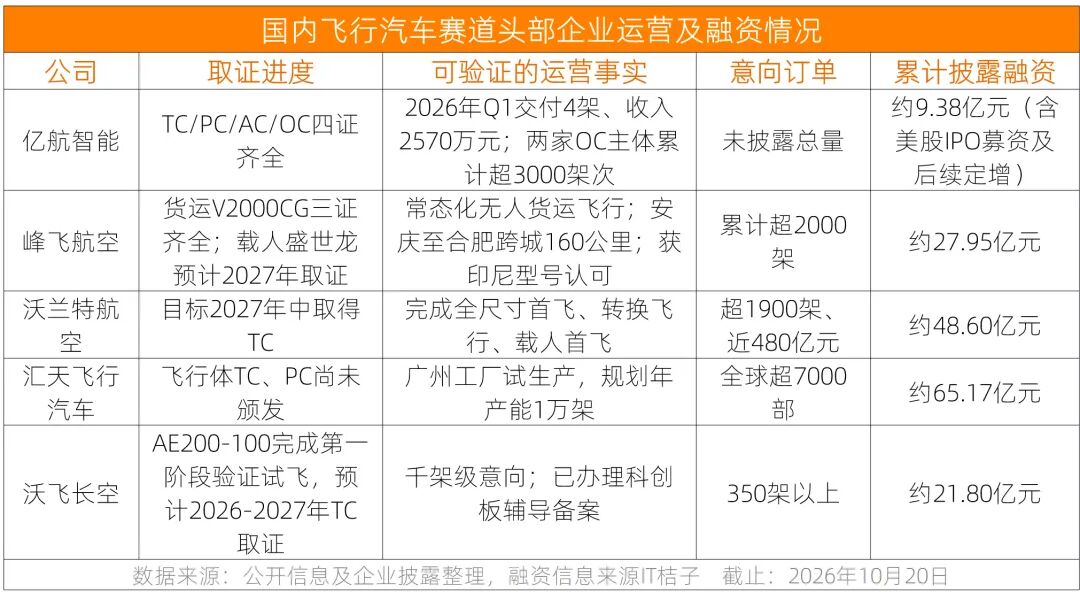
Ranked by cumulative financing amount, the top five domestic companies in turn are: XPeng's subsidiary HT Flying Car with about 65.17 billion yuan, Volant Aerospace with about 48.60 billion yuan, Autoflight with about 27.95 billion yuan, Volocopter (Geely) with about 21.80 billion yuan, and Zero Gravity Aircraft Industry with about 17.60 billion yuan.
The first four companies have reached the unicorn level with a valuation of over 1 billion US dollars, and their financing pace is also relatively fast.
HT Flying Car (XPeng HT) was established in Guangzhou in December 2020. In October 2021, it obtained a 500 million US dollar Series A round of financing, with investors including IDG Capital, Yunfeng Capital, 5Y Capital, HSG, GGV Capital, Zhongding Capital, GL Ventures and XPeng Motors. In August 2024, it obtained another 150 million US dollar Series B round of financing. In July 2025, it obtained a 100 million US dollar Series B round of financing. In March 2026, it completed a 200 million US dollar Series C round of financing, with investments from HSG, Dachen Caizhi, Gaorong Ventures and GL Ventures.
The land aircraft carrier of HT Flying Car adopts a split design. The land vehicle part is a 6-wheel range-extended electric vehicle, and the flying part is folded and stored in the trunk, and the take-off process can be completed within 5 minutes. The cumulative global orders have exceeded 7,000 units, and the first batch of 600 orders in the Middle East may reach 140 billion yuan. The company plans to start mass production and delivery at the end of 2026.
In terms of production capacity, the flying car factory of XPeng HT in Huangpu, Guangzhou has a construction area of about 120,000 square meters. It started trial production in November 2025, with a planned annual production capacity of 10,000 units and an initial phase of 5,000 units. When operating at full capacity, one unit can roll off the production line every 30 minutes. On March 5, 2026, 5 aircraft completed production off the line on the same day and completed multi-aircraft test flights.
However, according to public information, the TC (Type Certificate) and PC (Production Certificate) of HT's flying part have not been officially issued.
Volant Aerospace is the company with the highest financing density in the past two years.
The company was established in June 2021, headquartered in Minhang, Shanghai, and has completed 13 rounds of financing in total: in April 2026, it obtained a 300 million US dollar Series C round of financing, with investors including Stone Venture, Legend Capital, Futeng Capital, Mingshi Venture Capital, HSG; one month later, it obtained another 10 billion yuan Series C+ round of financing, with the entry of China Internet Investment Fund, China Life Equity, Jigsaw Capital, Zero Bay Venture Capital and NIO Capital.
Autoflight has the least number of financing transactions, only two: a 100 million US dollar Series A round in September 2021, and a strategic investment of hundreds of millions of US dollars from CATL in August 2024. For more than two years after that, no new equity financing disclosure has been seen in public channels.
Backed by Geely, Aerofugia completed a 10 billion yuan Series C+ round of financing in February 2026. On April 2 of the same year, the company went through the counseling and filing procedure at the Sichuan Securities Regulatory Bureau, planning to sprint for the Sci-Tech Innovation Board, and is regarded by the market as the potential "first eVTOL stock" on the A-share market.
The Aerofugia AE200 is a 6-seat pure electric manned eVTOL with manual driving, which is specifically optimized for low-altitude cultural tourism scenarios, targeting the pain point of congestion in scenic areas during holidays. The AE200-100 has completed the first phase of verification test flights, and it is expected to complete TC certification from the second half of 2026 to 2027.
In terms of orders, Aerofugia signed 50 confirmed orders with China Dragon Aviation, and reached a total of 300 procurement orders with AVIC Leasing and Suyin Financial Leasing, with cumulative thousand-level letters of intent for orders.
II. Only a handful of players are actually running
If we put a real industry issue on the table: how far is it between being able to fly (technology) and being able to operate (commercialization)?
At present, most domestic leading companies are stuck between L3 and L4, mid-tier companies are at L2-L3, and a large number of tail companies are still at L1.
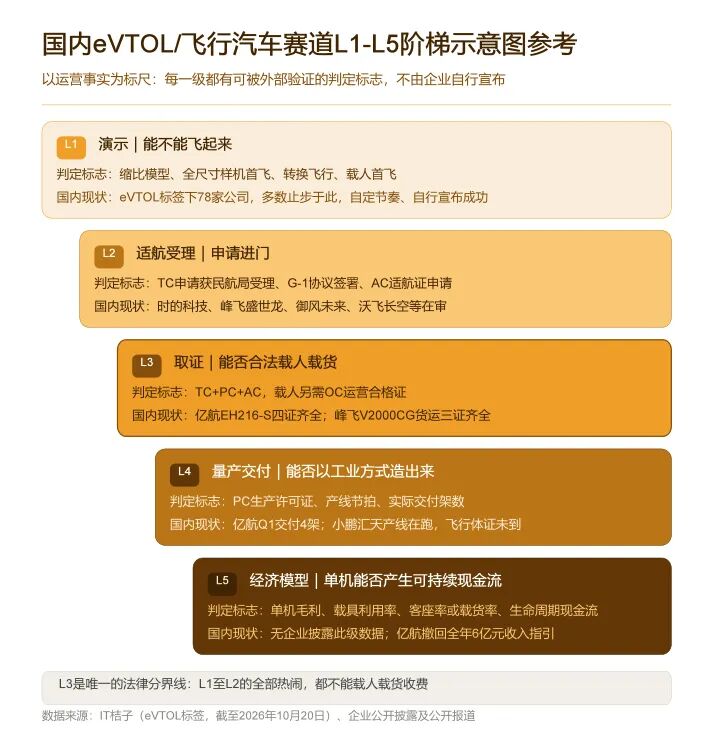
1. EHang: The only "four-certificate" enterprise with actual delivery
At present, there is only one company in China — EHang that has really crossed the line of "revenue facts". It is a veteran company founded in 2014 and listed on the Nasdaq stock market in the United States in 2019.
Its EH216-S is the world's first manned eVTOL that has obtained all four certificates: Type Certificate, Production Certificate, Standard Airworthiness Certificate and Operating Certificate. It is the first and currently the only enterprise in China that has all four certificates.
In March 2026, the EH216-S launched commercial trial operation in Hefei. Two OC-licensed entities, Guangdong EHang General Aviation and Hefei Heyi Aviation, have completed more than 3,000 cumulative safe flight sorties, including 434 manned flights, and their flight footprints have expanded to 23 countries across five continents around the world.
In the first quarter of 2026, EHang sold and delivered 4 units of the EH216 series, realizing operating revenue of 25.7 million yuan. The revenue in the second quarter was 77.9 million yuan, a 203% increase quarter-on-quarter, but a year-on-year decline of more than 30%.
The more critical move is: the company announced the withdrawal of the previously released full-year 2026 revenue guidance of 600 million yuan, and will not provide alternative digital guidance for the time being. The reason given is that the regulatory policies and supporting mechanisms related to low-altitude manned commercial operation are still in the process of improvement, and the visibility of operation needs to be managed prudently.
Hu Huazhi, the founder, revealed on the conference call that affected by the overall prudent regulatory orientation of the low-altitude industry, the approval progress of manned commercial operation in Hefei has been delayed, and the originally planned public-oriented low-altitude sightseeing ticket sales operation plan scheduled to start in March 2026 has been stranded; there is uncertainty in the timing of regulatory approval. He used the UK's Red Flag Act more than 100 years ago as an analogy — the act required that when motor vehicles drove on the road, a dedicated person had to walk in front to clear the way with a red flag.
His judgment is: in the face of disruptive transportation technologies, safety verification, operation rules and regulatory systems all require a gradual maturation process.
2. Autoflight: Making cargo transportation a viable business first
Autoflight has chosen a path that is more in line with industrial logic — prioritize cargo transportation, and then follow up with manned transportation.
Its 2-ton class unmanned cargo aircraft V2000CG "Kerry Osprey" has obtained the Type Certificate, Production Certificate and Airworthiness Certificate from the Civil Aviation Administration of China. It is the only ton-class unmanned aerial vehicle in China with all three certificates, and has carried out regular unmanned flights in scenarios such as offshore oil platform operation and maintenance, island material support, and emergency rescue.
In August 2025, the aircraft completed a cross-city flight from Anqing to Hefei, with a total distance of about 160 kilometers, a duration of nearly 1 hour, and a load of nearly 200 kilograms of materials.
In June 2026, the V2000CG further obtained the Type Acceptance Certificate from Indonesia, becoming a landmark case of China's eVTOL airworthiness system being mutually recognized by overseas regulatory authorities; one month earlier, Autoflight also completed the first large-scale eVTOL demonstration flight in Central Asia in Almaty, Kazakhstan, and signed a memorandum of understanding for the procurement of 50 units.
The 2-ton class manned eVTOL "Prosperity Dragon" (V2000EM) has entered the fourth stage of conformity verification, and the enterprise is expected to complete certification in 2027.
Autoflight's path solves the problem of "getting revenue first", but the unit value, route density and operating profit margin of cargo eVTOL may not be able to support the same level of valuation multiple as passenger travel.
3. Volant Aerospace: The largest number of letters of intent for orders
Volant is the one with the most aggressive financing and the largest number of letters of intent for orders among the three, but mass production delivery and airworthiness certification are still in the early stage.
On the technical side, the VE25-100 has completed its full-size first flight, transition flight and manned first flight.
The company completed the manned conversion flight subject for passenger eVTOL in Zigong, Sichuan — which is one of the most difficult subjects in eVTOL certification. According to public reports, both Volant and Aerofugia announced the completion of this subject, and each claimed to be the third enterprise in the world to master this technology.
The figures on Volant's order side are quite astonishing: the cumulative number of letters of intent for orders exceeds 1900 units, with an amount of nearly 480 billion yuan. Among them, a single contract with Thailand's Pan Pacific is 500 units, worth about 1.75 billion US dollars; Indonesia's Whitesky Group ordered 60 units, worth about 221 million US dollars; 95 units were signed at the China International Import Expo, worth 2.375 billion yuan.
On the capital side, the $300 million Series C round in April 2026 was led by UAE's Stone Capital. This institution is not only a capital provider, but also a channel entry point for the Middle East market.
However, Volant still does not have a Type Certificate so far, and the goal is to obtain it by mid-2027. How much of the nearly 480 billion yuan of letters of intent can be converted into recognizable revenue? It remains to be seen.
In addition to the leading players, the mid-tier players on this track are rapidly stratifying, and all companies are using "technical route + scenario selection" to mark their own positions.
TCab Tech is betting on tilt-rotor technology. Its E20 can carry 5 people with a maximum speed of 320 km/h. It signed the G-1 agreement with the Civil Aviation Administration of China in December 2024, completed the tilting transition flight in December 2025, and its Wuhu intelligent manufacturing base has started construction. The cumulative orders at home and abroad have exceeded 1000 units. In July 2026, it signed a procurement agreement of 350 units worth about 1 billion US dollars with UAE's Autocraft, setting a new record for the largest single letter of intent for eVTOL procurement in China. It plans to complete the manned airworthiness certification in 2027.
Zero Gravity Aircraft Industry is based in Hefei, focusing on the aviation cultural tourism scenario, has signed 80 procurement orders for ZG-ONE "Quefei", completed a 500 million yuan Series B round of financing in June 2026, with cumulative financing of about 17.60 billion yuan.
Yufu Future follows the steady route of "cargo first then passenger, isolation first then integration, suburban areas first then urban areas". Its 2-ton class M1B cargo version is expected to complete airworthiness certification and start commercialization within 2026, and the manned version is planned to be launched around 2028. It has signed 200 letters of intent for orders with a total amount of more than 2 billion yuan, and completed the B+ round of financing in September 2026.
Huayuan Xiangxiang signed a letter of intent for the procurement of 100 Honghu eVTOL units with Xiangjiang General Aviation in Changsha, with a signed amount of more than 1 billion yuan. Ant Group appeared in its Pre-A round of financing in May 2026.
INFLYNC's L600 is the world's first full-size tilt ducted wing eVTOL, adopting a hybrid range-extended route. It completed a Series A round of financing of more than 100 million yuan in February 2026, and is expected