The largest source of liquidity in the primary market
Start with a formal document.
This week, 11 government departments including the People's Bank of China jointly issued the *Guiding Opinions on Financial Support for the Construction of International Science and Technology Innovation Centers in Beijing (Beijing-Tianjin-Hebei), Shanghai (Yangtze River Delta), and Guangdong-Hong Kong-Macao Greater Bay Area*, which clearly states:
"Make good use of the already established social security science and technology innovation funds to provide financial support for the sci-tech innovation field in a steady and orderly manner."
After sorting out, six social security sci-tech innovation funds have been launched across the country, all with a scale of tens of billions of yuan, aiming to guide more social capital to focus on national strategic industries and provide stable financial support for technology enterprises with long innovation cycles. The policy vane implication of "making good use of the established social security sci-tech innovation funds" is self-evident.
"Make Good Use of Social Security Sci-Tech Innovation Funds"
Specifically, the *Guiding Opinions* consists of 4 parts and 19 work measures, focusing on the three core functions and international positioning of international sci-tech innovation centers, aiming to optimize the financial service model and supporting mechanisms.
In terms of equity financing, it clearly proposes to optimize the "raising, investment, management and exit" cycle, and support investment in early-stage, small-sized, long-term projects and hard technology ——
First, give play to the role of the national venture capital guidance fund as patient capital, and invest in a number of sub-funds and projects in the fields of emerging industries and future industries. Second, make good use of the already established social security sci-tech innovation funds to provide financial support for the sci-tech innovation field in a steady and orderly manner. Third, support the development of M&A funds, strengthen the coordinated connection of regional M&A financial services, remove the blocking points in M&A implementation, and stimulate the vitality of M&A and restructuring. Fourth, give play to the role of venture capital government investment funds and angel investment, and focus on supporting the cultivation, incubation and entrepreneurship of strategic scientists, leading sci-tech talents, young sci-tech talents, outstanding engineers and high-level innovation teams.
The social security sci-tech innovation fund refers to a special equity investment fund funded by the National Council for Social Security Fund, focusing on supporting the field of sci-tech innovation. Over the past year, a number of social security sci-tech innovation funds have been launched across the country one after another, and are moving towards substantive operation as long-term capital of patient capital.
It is recorded that last October, the social security sci-tech innovation fund landed in Zhejiang, with an initial scale of 50 billion yuan. This is the first signed and filed provincial-level social security sci-tech innovation fund in China, jointly established by Zhejiang Province, the National Council for Social Security Fund, and the Agricultural Bank of China, investing in key industries such as artificial intelligence, new-generation information technology, high-end equipment, new materials, and biomedicine.
Subsequently, the Jiangsu Social Security Sci-Tech Innovation Fund with an initial scale of 50 billion yuan was signed. The fund adopts a two-tier structure of "mother fund + direct investment" and a joint management model, conducts investment around the whole life cycle of enterprises, and focuses on supporting high-quality sci-tech innovation projects with breakthrough technologies, high growth potential and the ability to enhance the resilience and security level of the regional industrial chain.
More followed: Fujian (Xiamen) Social Security Sci-Tech Innovation Fund, Hubei Social Security Sci-Tech Innovation Fund, and Sichuan Social Security Sci-Tech Innovation Fund have been established one after another, with an initial scale of 20 billion yuan each, mostly arranged around national innovation development strategies and regional characteristic, advantageous and strategic emerging industries.
This year, the first social security sci-tech innovation fund in northwest China —— the Shaanxi Social Security Sci-Tech Innovation Fund was officially signed, with an initial scale of 10 billion yuan, jointly established by Shaanxi Province, the National Council for Social Security Fund, and the Bank of China, focusing on investment in key fields such as new materials, semiconductors, aerospace, high-end equipment manufacturing, and artificial intelligence.
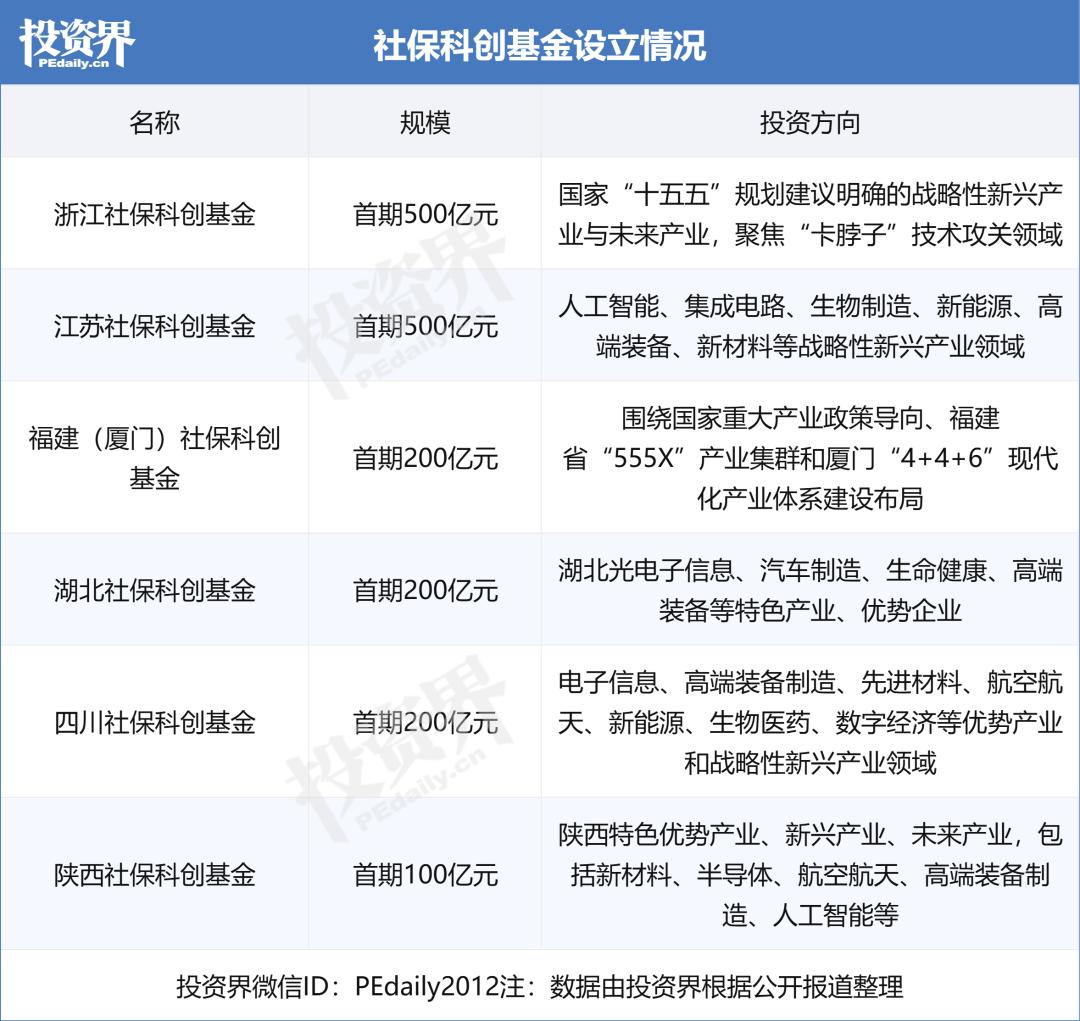
So far, in less than a year, six regions including Zhejiang, Jiangsu, Fujian, Hubei, Sichuan and Shaanxi have set up social security sci-tech innovation funds, with a total initial scale of about 170 billion yuan, and many of these funds have already started operation. Among the 10-billion-yuan SDIC Sci-Tech Innovation Fund unveiled in Shanghai this year, the National Council for Social Security Fund is also one of the founding parties.
Flowing Capital in the Primary Market
This is the long-awaited long-term capital flowing into the venture capital circle.
Back to the beginning of 2025, the General Office of the State Council issued the *Guiding Opinions on Promoting the High-Quality Development of Government Investment Funds*, which clearly proposed to guide long-term capital and patient capital such as social security funds to invest in the field of sci-tech innovation, making the policy orientation of serving sci-tech innovation obvious.
As a typical "patient capital", the social security fund's attribute of long-term capital is consistent with the law of sci-tech innovation development —— it adapts to the characteristics of long cycle, high investment and high risk of sci-tech innovation, and can fill the capital gap of early-stage sci-tech investment.
The government work report of that year also pointed out that we should improve the innovation capacity of advantageous regions such as Beijing-Tianjin-Hebei, Yangtze River Delta, and Guangdong-Hong Kong-Macao Greater Bay Area, and at the same time promote strategies such as the rise of central China and the large-scale development of western China, so as to build a regional economic layout with complementary advantages. From this perspective, social security sci-tech innovation funds have become an important carrier to undertake national strategies and regional needs.
As early as 2023, the National Council for Social Security Fund began to lay out special sci-tech innovation funds, and successively established the Social Security Fund Zhongguancun Independent Innovation Special Fund, the National Social Security Fund Yangtze River Delta Sci-Tech Innovation Special Fund, and the Social Security Fund Guangdong-Hong Kong-Macao Greater Bay Area Sci-Tech Innovation Special Fund, with the National Council for Social Security Fund as the main investor, laying a foundation for the subsequent nationwide establishment of such funds.
Since then, the social security fund has made successive moves, and a number of sub-funds and direct investment projects have been launched one after another: the Jiangsu Social Security Sci-Tech Innovation Fund has invested in 3 sub-funds in the first quarter; 6 special funds under the Zhejiang Social Security Sci-Tech Innovation Fund have been officially launched; 3 sub-funds under the Sichuan Social Security Sci-Tech Innovation Fund have completed registration; 3 sub-funds under the Hubei Social Security Sci-Tech Innovation Fund have all completed industrial and commercial establishment registration...
After sorting out, funds across the country have clear track division, anchored at the links that conform to the direction of new quality productive forces and await long-term achievement transformation —— for example, Zhejiang focuses on AI, integrated circuits and biomedicine, Jiangsu focuses on advanced manufacturing, new energy and new materials, and Hubei arranges the layout of optoelectronics, automotive industry and life health, injecting source flowing capital into the development of sci-tech innovation.
After all, positioned as a "market-oriented fund serving national development", the social security sci-tech innovation fund aims to unblock the channels for financial resources to enter the real economy, increase effective investment that supports the deep integration of sci-tech innovation and industrial innovation, and its determination to use long-term capital to support sci-tech innovation and industrial upgrading accurately and on a large scale is self-evident.
Up to now, the fundraising end of the venture capital industry is picking up. The report from Zero2IPO Research Center shows that in the first half of 2026, the number and scale of newly raised funds in China continued to grow —— a total of 3981 funds completed a new round of fundraising, up 95.8% year on year; the raised amount reached 10,494.64 billion yuan, up 49.6% year on year.
More flowing capital is pouring in gradually.
This article is from the WeChat official account "Decoding LP", author: Yu Mengying, published with authorization from 36Kr.