Why does the Australian Open place heavy bets on the Chinese market?
Author: Xie Yunzi
Editor: Zhang Fan
On October 11, at the China Open women's singles final, Zheng Qinwen scored an ace directly from a serve, eventually defeating the rising Russian star Andreeva and lifting the championship trophy at home — this is also the first time since the China Open was founded that a Chinese player has won the championship at the home court.
The highlight moments of Chinese tennis are increasingly taking place on home soil. But in the collective memory of the vast majority of "tennis practitioners", the starting point of Chinese tennis still traces back to 2014. That year, Li Na lifted the Australian Open championship trophy at Melbourne Park, becoming the first Asian singles champion of the Australian Open. Since then, the Australian Open has become a "blessed land" in the hearts of Chinese fans.
Nowadays, this "blessed land" is bringing more and more key events to China.
This October, the Australian Open's self-created event "One Point Slam" landed in China. The qualifiers will cover five cities: Hangzhou, Beijing, Shanghai, Shenzhen and Chengdu. The champion of the China division will get direct access to Melbourne Park, compete in the global finals during the opening week of the 2027 Australian Open, and fight for the A$1 million prize. At present, China is the only international market outside Australia where this event is launched.
Recently, 36Kr conducted an exclusive interview with Roddy Campbell, Director of Partnerships and International Business at Tennis Australia. Below is the edited and sorted record of the conversation.
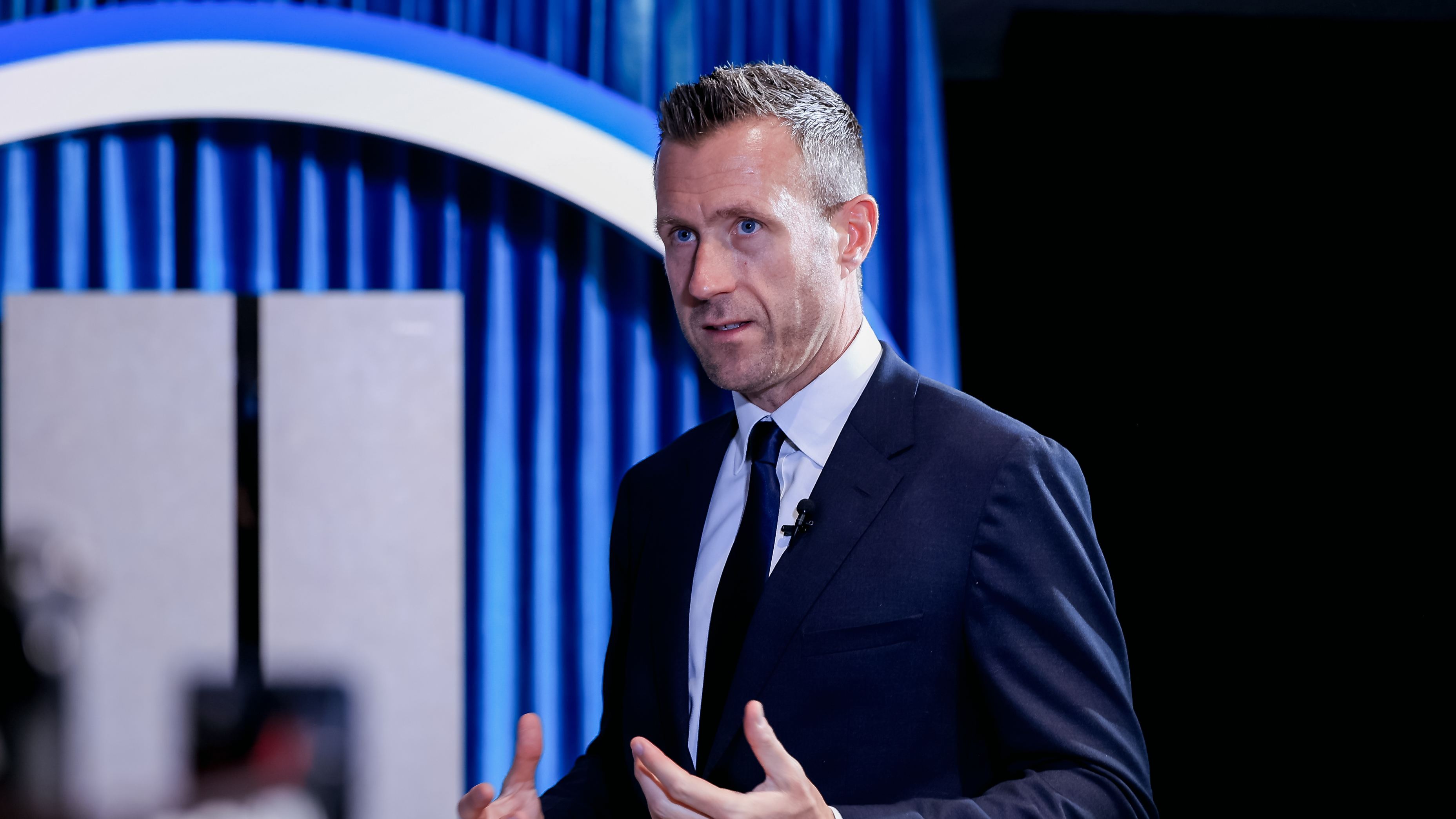
Roddy Campbell, Director of Partnerships and International Business at Tennis Australia
36Kr: What key moments of Chinese tennis have impressed you the most?
Roddy Campbell: Of course it was Li Na winning the Australian Open, and Zheng Qinwen reaching the Australian Open final in 2024 — that year our audience in China doubled and has remained at a high level ever since, Zheng Qinwen's career has also been advancing all the way.
But the impressive things are not just one or two peak moments. We have had a local team in China for nearly ten years, and together with our partners, we have held at least hundreds of events. We are very happy to witness and participate in the growth of this market.
36Kr: How many viewers does the Australian Open currently have in China?
Roddy Campbell: The Australian Open has a total of 6.5 million followers on social media in China. The total cumulative viewing duration of AO26 in the Chinese market reached 126.5 million hours, with 300 million to 400 million independent broadcast viewers; the total social media mention volume reached 2.1 billion — this number is already quite huge, but we believe there will be growth in the new year.
36Kr: In addition to the number of viewers, what changes have taken place in the consumption behavior of Chinese fans?
Roddy Campbell: Especially in recent years, young fans' consumption of events is no longer limited to traditional live broadcasts and pure tennis content, but more diversified and more lifestyle-oriented; another point is that fans no longer only watch matches, but hope to participate in depth.
We also create content to cater to this demand. For example, the Australian Open One Point Slam invites fans to personally step onto the court to experience the event atmosphere; we have also launched more event peripherals and consumer derivatives, turning the entire event into a lifestyle, not just tennis competition itself — this is a more immersive experience.
36Kr: Audiences' attention is getting more and more scattered, how to adapt to this change from the perspective of communication?
Roddy Campbell: In terms of content, we will create pan-sports content such as celebrity and lifestyle related content. At the same time, we have different strategies for different platforms. For example, on Weibo, WeChat and Xiaohongshu, each platform has different algorithms and user habits, so we will promote different content forms, which may be a topic, a limited product, or a match clip. In other words, the communication of the Australian Open is no longer limited to the three-hour match, but expanded to more diversified content.
36Kr: What do you think of the changes brought by AI to event communication?
Roddy Campbell: We embrace AI with an open attitude.
In the past four or five years, in the field of media communication, we have used AI tools very frequently: Grand Slam events have a huge amount of content, AI helps us output content of different languages and different specifications in real time for different markets based on the same match, allowing us to interact with global fans at the fastest speed, and making the content more localized.
Tennis Australia also has an official venture capital department called AO Ventures, which communicates with thousands of start-ups around the world every year, and invests in technologies that are helpful to event development and operation. In addition, almost all of our partners' products are more or less embedded with AI technology — PongBot's serving machine has AI technology, and Haier's home appliances are also intelligent.
36Kr: What are the criteria for the Australian Open to select partners?
Roddy Campbell: Among the 7 Chinese brands, the largest one is Luzhou Laojiao. Luzhou Laojiao has been our co-sponsor since 2019. Luckin Coffee is a regional partner covering China and Southeast Asia, which will launch limited-edition products around the Australian Open IP during the event. In addition, there are Didi and Augusta under Tsingtao Brewery, each brand has different cooperation points and forms.
As for the criteria, we value the fit of values most, especially innovation — the Australian Open itself is a brand that loves to keep moving forward, and we hope to create new asset-based projects together with brands, not just a one-time logo exposure. Now with the help of technologies such as virtual advertising spaces and customized social media placement, brands can choose cooperation and exposure in specific regions according to their own needs.
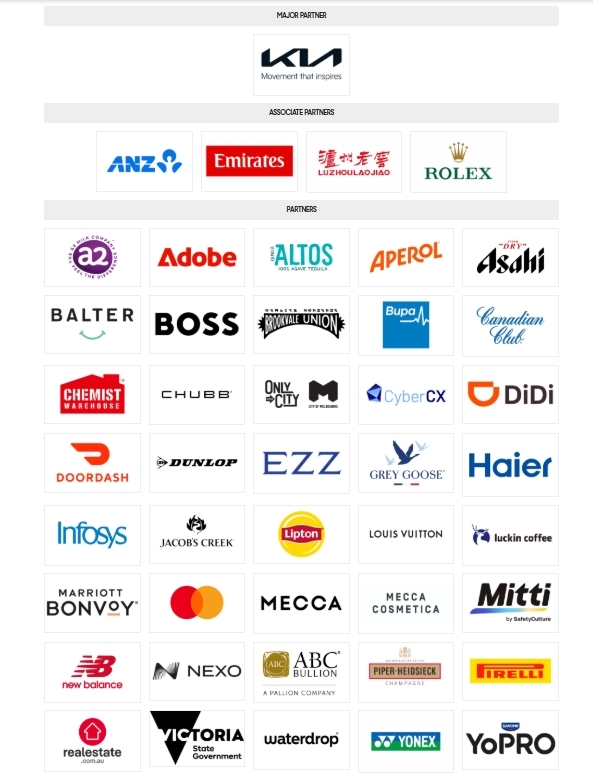
Some partners of the Australian Open; the picture is captured from the official website
36Kr: Last year, Jay Chou also participated in the final of the One Point Slam.
Roddy Campbell: This January, we held the One Point Slam final at Rod Laver Arena. Jay Chou's participation brought us extremely high popularity, and we saw that Chinese fans and followers were all eager to try.
So the starting point for this innovative event to land in China is very pure — through the China regional qualifiers, we can get closer to the market and fans, and at the same time give Chinese fans a chance to fulfill their Grand Slam dream. This year, China is the largest overseas market for the One Point Slam outside Australia, and it may be expanded to other markets next year.
36Kr: In addition to the One Point Slam, what other new moves are there for the 2027 Australian Open?
Roddy Campbell: The entire Australian Open schedule usually lasts three weeks. This year, there will be a very rich opening week at the Australian Open site. In addition to the One Point Slam, there will also be activities such as music performances and fan interactions.
We will also launch a global recruitment program called "Super Fan", which will select 6 fans from all over the world to come to the Australian Open, get a real behind-the-scenes experience and become part of the Australian Open story. There will also be an opening ceremony, and new catering brands and music performance lineups will be announced one after another.
There are also new stories in brand cooperation: BOSS will become our new official apparel partner, providing uniforms for ball kids, referees and event staff. There is also PongBot, an AI-driven Chinese innovative enterprise, whose serving machines will become the official serving machines of the Australian Open and the official serving machine supplier of the National Tennis Academy of Australia. We hope to cooperate in all aspects of technology and products, so that more people can experience and participate in tennis in new ways.
In terms of sports brands, we currently cooperate with New Balance on professional sportswear and footwear, and many brands are in talks for the racket category. For different brands, we will find a balance to see how we can better cooperate with everyone.
36Kr: From the perspective of Tennis Australia, what is the strategic position of the Chinese market?
Roddy Campbell: China is an important market with strategic status for the Australian Open around the world, and it is also our largest viewer market.
Up to now, the Australian Open and Tennis Australia's series of events have a total of 66 partners around the world, among which there are 7 official Chinese brand partners of the Australian Open, and the number is growing every year — there are global-level partners such as Luzhou Laojiao and Haier, as well as regional partners such as Luckin Coffee. We will work with our partners to develop this market.
We are also planning youth-related projects, such as summer camps and tennis youth training camps. We believe that current fans do not just want to be spectators watching matches, but to participate in them. Therefore, in the future, the Australian Open hopes that more and more Chinese audiences will not only become fans of AO, but also participants in the sport of tennis.

Follow us for more information