Liang Wenfeng open-sourced the secret to making money.
Apart from the new model, DeepSeek has successively launched self-developed search, inference framework and codec components within a week. While the search service will start charging on November 1, the rest are all free and open-source.
These three products can actually be connected in a complete line: no matter what computing power platform, harness or model you use, as long as you are equipped with these three tools, you can use the exact same products as DeepSeek and call the exact same interfaces of DeepSeek.
Liang Wenfeng's view on open source for inclusive public benefits is exactly consistent with this logic. He once stated at a closed-door meeting: "We will not release a slightly inferior version as open source, while reserving a better version for our own deployment."
At the same time, DeepSeek also publicly announced the specific hourly revenue data per single GPU of DeepSeek in its published article.
And there is a sentence in the latest article on DeepSeek's official WeChat account: "Do good deeds together with all people, and share exquisite skills so that everyone can master them."
This sentence comes from *Yin Wenzi · On the Great Dao*, a classic work of the Logician School during China's Warring States Period. Translated into modern language, it means that when doing good things, you should lead the public to do them together; when learning professional skills and crafts, you should let all people have the ability to master them.
This is also the most fundamental motivation for Liang Wenfeng to release these three products. Users can take and use these products for free, and DeepSeek can obtain data streams and access entrances through this process, finally achieving a win-win result for both sides.
Liang Wenfeng's practice seems "maverick". After all, OpenAI, Anthropic, and even all AI companies around the world have never dared to carry out open source to such a frank and unreserved degree.
However, if you look at the whole picture from a higher perspective, you will find that Liang Wenfeng's business strategy is surprisingly consistent with that of Coca-Cola.
What are the functions of these three products?
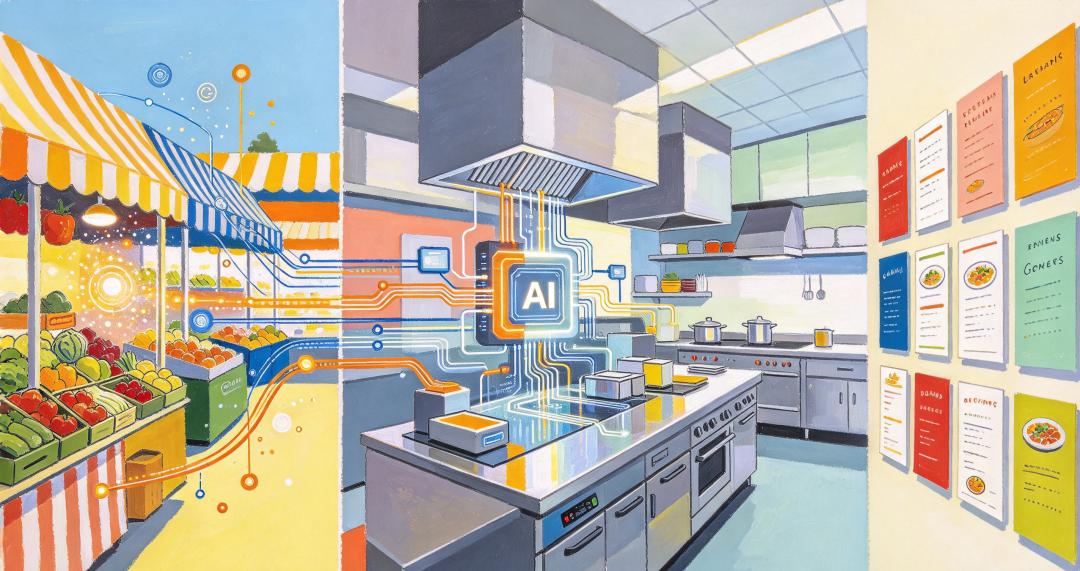
Let's first give a brief introduction to these three products. To sum up in one sentence, Search and Fetch are the "procurement staff" of the restaurant, who are responsible for purchasing ingredients from the external market; DeepInfer is the "back kitchen", the place where the model runs and works; deepseek-recipe is the "multilingual recipe book", so that people from different countries can clearly recognize what they are using.
Let's start with Search and Fetch, which is a search tool specially built for AI.
The search engines we use in daily life are designed for human users. A single result page contains advertisements, recommended content, and a large number of links that require manual judgment, and after clicking the link, there are navigation bars, pop-up windows and sidebars. Humans can ignore these redundant contents, but the model cannot. Every extra word will occupy its context window, and all these contents are tokens that generate costs.
DeepSeek's Search and Fetch are two native JSON interfaces. They are used in the same way as calling DeepSeek API, and use the same Bearer key for authentication.
Search is responsible for the "search" process. Each result not only includes the title and URL, but also carries a short abstract, a long abstract, optional web page text and release time. In addition, there are two scores specially designed for model reference: rerank_score (correlation reranking score) and authority (source authority level).
Fetch is responsible for the "crawling" process: after you provide it with a URL, it will return the cleaned Markdown format text content of the page.
In other words, it is not a traditional "search box", but "raw material that can be directly inserted into the model's context".
The pricing of Search and Fetch is also designed according to the usage scenario of Agent. Each 1000 successful requests costs 5 RMB, which is equivalent to only 0.005 RMB per search.
Official documents show that Search and Fetch called through server-side tools in the three tools of DeepSeek Harness, Claude Code and Codex will not be charged before 00:00 on November 1, 2026 Beijing Time, and will be charged per request after that date.
In addition, Search and Fetch are not bound to DeepSeek's models. You only need a DeepSeek API to call Search and Fetch on any model.
The second product is DeepInfer.
DeepInfer is the inference framework that DeepSeek is using for large-scale online services. This time, its offline inference version and core capabilities are open sourced, under the Apache 2.0 license, and it can run on NVIDIA and domestic computing power platforms.
Many people think that once a model is released, and the weight file is downloaded to their own computer, the whole thing is finished.
In fact, it is not. The weights are just a large set of numbers. To make it run efficiently, there is a complete set of engineering systems in between, and this engineering system is called the inference framework.
The model is like a book full of words. Even if the book contains all the valuable knowledge, it cannot speak on its own, let alone answer your questions.
DeepInfer is the program that makes this book "speak". You send a sentence to it, it feeds this sentence to the model file, the numbers in the model file are mobilized to calculate the answer, and then return the result to you.
DeepSeek officially stated that the capability boundary of a model is defined by the model itself, and how to make these capabilities serve a large number of users at a reasonable cost is the core problem that the inference framework needs to solve.
The third product is deepseek-recipe.
Just like greeting in different countries, people in China say "Ni Hao", and people in the United States say "Hello". Different models have different output formats: OpenAI's formats are called Chat Completions and Responses, and Anthropic's format is called Messages.
Although all of these are essentially "asking questions to the model and getting answers from the model", different formats are completely different, and even the same conversation cannot be used between different models.
For example, if you want to run the DeepSeek model on your own server, but your client software is written in the OpenAI format, the DeepSeek model cannot understand the requests sent in OpenAI format. At this time, a translation layer is needed to convert the content.
What deepseek-recipe does is exactly this intermediate translation layer. When you send a request in OpenAI format, it translates it into the internal language (prompt words) that the DeepSeek model can understand, and then encodes it into the characters (tokens) that the model recognizes. After the model generates the answer, it translates the answer back to the OpenAI format and returns it to you.
You do not need to change your input format, and two different models can still understand the content normally.
The official technical article mentions two real problems it solves.
The first one is anti-injection: special tokens are originally used to mark roles and boundaries, but users may also deliberately enter the same string in the input to impersonate the system to issue instructions. The solution of recipe is that only the tokens explicitly inserted when the prompt is constructed will be mapped to the real special tokens, and the same text in the user input will be encoded as ordinary text.
The second one is to speed up long text processing: ordinary text between special tokens can be encoded independently, so it first locates the boundaries, then encodes each segment in parallel, and finally splices them back in order, which reduces the tokenization delay of long context requests.
In real scenarios, these three products can be connected in series. For example, if a company wants to deploy V4.1 Flash on its own, it needs to use DeepInfer. If it wants to cooperate with other models, it can connect recipe to complete format conversion.
The execution layer then uses this call to request Search and Fetch, inserts the cleaned results back into the conversation, and the model continues to output the following answers.
Why is DeepSeek similar to Coca-Cola?
These three things also have a common feature: each of them leaves an open door, so that no matter what scenario you are in, you can use DeepSeek's products.
If you have enough computing power and want to deploy the same inference capability as the official DeepSeek service on your own, you can use DeepInfer together with the publicly released model weights.
No matter you use NVIDIA GPU or domestic GPU, DeepInfer is fully compatible with all of them.
If you already have your own inference backend, want to run DeepSeek's models but do not want to rewrite the protocol conversion and prompt rendering logic by yourself, you can use deepseek-recipe.
If you are using models or Harness from other vendors and the networking capability is insufficient, you can connect Search and Fetch to make up for this shortcoming.
In the final analysis, it is just two words: "arrangement". You don't have to worry about any situation, Liang Wenfeng has arranged everything properly for you.
In addition, there is another interesting thing: Liang Wenfeng has shown all his hole cards to the public.
In DeepSeek's deployment practice article, it not only describes "how we should do and how to deploy", but also writes out the specific cost data: the throughput of a single cluster reaches 155 trillion Tokens per day, the overall income calculated at the valley electricity price is an average of 38 US dollars per card per hour; Prefill throughput is 60,000 to 1.5 million tokens per card per second; Decode throughput is 14,000 tokens per card per second, the output speed seen by a single user is about 230 tokens per second, and about 300 tokens per second in code scenarios; the average first token delay is 400 milliseconds, and P99 is 1000 milliseconds.
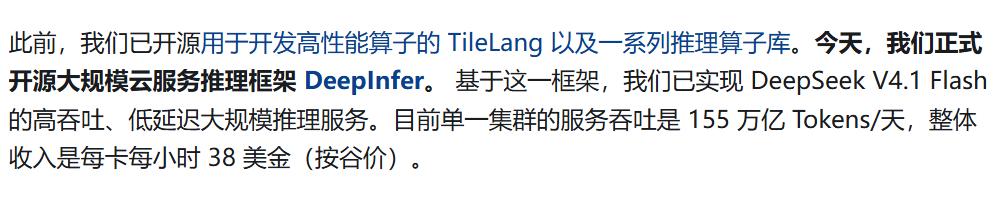
This is equivalent to telling the whole industry: how to build the hardware architecture, how long to retain the cache, and how much revenue a single GPU can generate per hour. 38 USD multiplied by 24 hours and then multiplied by 30 days, the monthly revenue of a single GPU is about 27,000 USD.
And 96% of the 77K tokens in the average input of each request hit the cache, and the throughput per GPU increases by 25 times after cache hit.
Liang Wenfeng once said at a closed-door investor meeting: "Our API pricing is a reasonable profit. It takes about 10 months to recover the cost after we purchase a batch of equipment from the market, and I think this is a reasonable profit margin."
The money earned by each GPU is essentially the same as our salary. No matter what unit you work in, the salary is usually kept confidential. Neither OpenAI nor Anthropic has ever disclosed the unit economics of each of their GPUs.
Liang Wenfeng broke this unspoken rule, which is also in line with his own philosophy. At the closed-door meeting, Liang Wenfeng said that DeepSeek only earns reasonable profits, and those who take less profits will defeat those who pursue excessive profits.
Judging only from the revenue and the price of DeepSeek's own API, it is obvious that DeepSeek belongs to the group that takes less profits. Disclosing this set of data is also to prove the sentence Liang Wenfeng once said: "We only earn a reasonable profit, not maximize the profit."
On the other hand, the reason why Liang Wenfeng dares to disclose these data also shows that "DeepSeek's moat is not built on cost at all."
DeepSeek is the Coca-Cola in the AI era. Its formula is fully open to the public, but the core of making money is never the formula itself.
In 2011, the formula of Coca-Cola was leaked, but the final result was "nothing happened".

Coca-Cola stated that it does not recognize this as the formula currently in use, it is an early historical manuscript, and the mass-produced version has long been iterated and modified.
The podcast program *This American Life* invited the flavorist of Jones Soda to help reproduce the formula. After the blind test, some testers could not distinguish the difference, while other senior cola enthusiasts thought there were differences between the two formulas.
Even so, Coca-Cola's stock price did not change, and its sales volume even increased slightly. Because the real moat of Coca-Cola has never been the syrup formula, but the bottling and distribution network, brand mindshare and cost discipline.
Coca-Cola itself is not the point, the act of drinking Coca-Cola is the point.
The same is true for DeepSeek. Almost all the content that can be open sourced has been open sourced, and anyone can download it by themselves. Companies that dare to make their "formula" public all hold something more valuable than the formula in their hands.
What is Liang Wenfeng pursuing?
Liang Wenfeng is not a philanthropist after all. Everyone needs to survive, especially now that DeepSeek has reached a scale of hundreds of employees.
Liang Wenfeng once clearly said: "We clearly need to achieve commercialization. We must be able to survive in the end."
"We are essentially a company. We just have our own choices about what money to earn, when to earn, how much to earn, and what to rely on to earn money."
When it comes to making money, what Liang Wenfeng prefers more is to achieve a "win-win" situation with users. DeepSeek provides cheap or even free products, users gradually get used to DeepSeek's mode, and expand DeepSeek's influence and scale.
The current situation is that the competition between models has passed. The gap between flagship models of different vendors is narrowing, and it is difficult to widen the gap only by parameters and public leaderboards. The focus of competition is shifting from "who has a stronger model" to "who controls the entrance, data flow and unified format".
Just like Coca-Cola, it does not sell soda directly to you. Instead, it sells concentrated syrup to authorized bottling factories around the world. The bottling factories buy bottles by themselves, build sales channels and do local marketing, and Coca-Cola collects syrup fees plus brand licensing fees.
Up to now, DeepSeek has not sold direct subscriptions like OpenAI and Anthropic, and it only provides API services all the time.
The returned data flow and format lock-in are the really valuable assets. Laying Search and Fetch into Claude Code and Codex during the free period is equivalent to putting Coca-Cola refrigerators into the stores of competitors. Open source business is a syrup business, not a soda business.
The model is still important, but it is no longer the only battlefield.
The most thought-provoking part of Search and Fetch is that it can help DeepSeek seize the entrance.
Every time an Agent needs to look up information, there must be a search tool to provide answers. The one that is called by default will occupy an entrance, and users can use any model through this entrance.
It does not end there. Every query, crawling action and reference selection of every connected Agent may become the training signal of DeepSeek, forming a flywheel of "entrance, data, better model, stronger entrance".
recipe directly makes the official processing logic into a public library. All vendors use it