OpenAI forays into the AI pharmaceutical industry: it has acquired another startup whose CTO is from Peking University
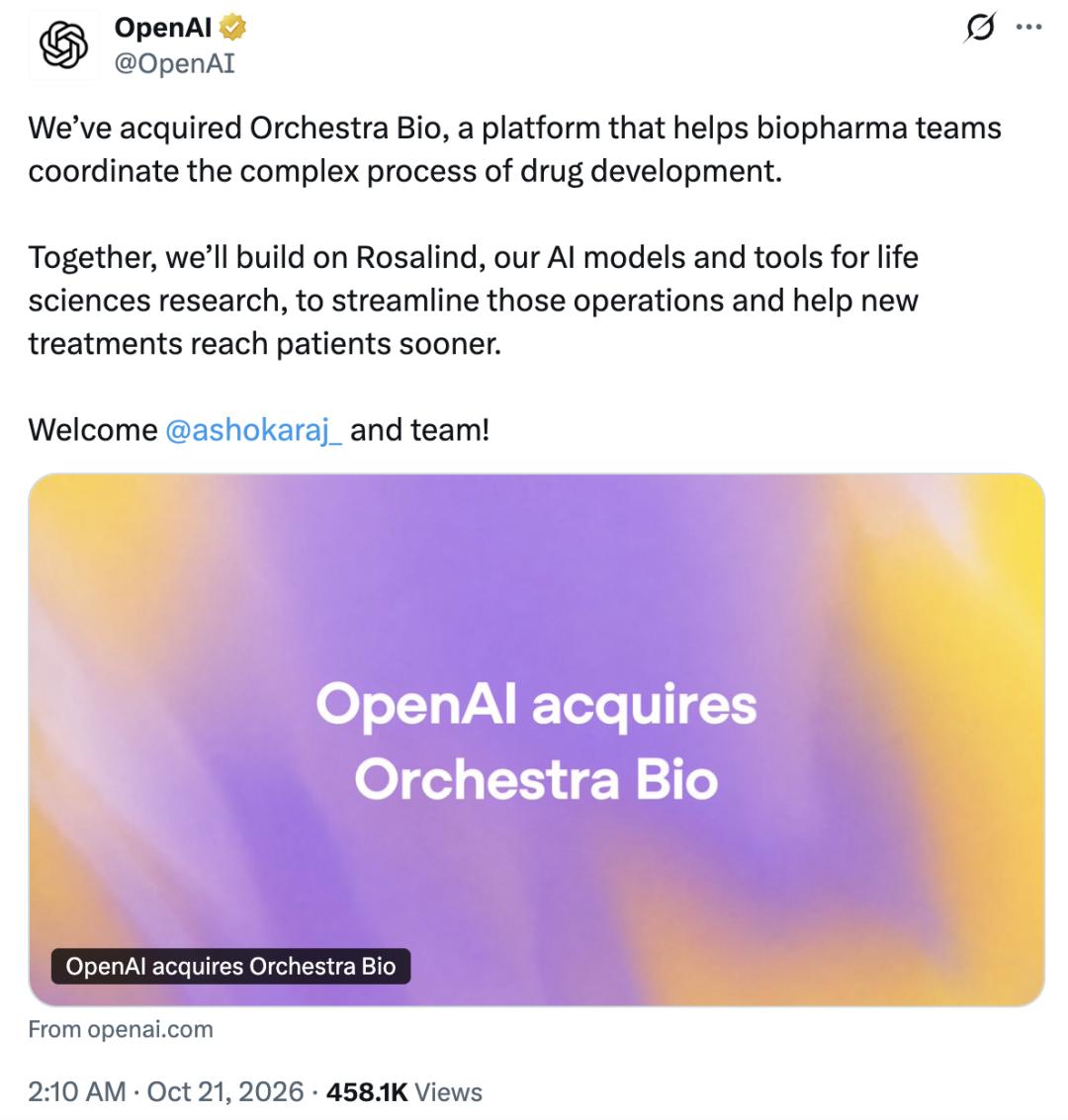
OpenAI has made another acquisition to expand its footprint in the life sciences sector!
The target this time is Orchestra Bio, an AI collaborative platform for drug R&D.
OpenAI stated that it will integrate the company's team and technology into Rosalind, its in-house life science research platform. The specific transaction amount has not been disclosed yet.
Among a large number of biopharmaceutical AI startups, Orchestra Bio stands out slightly from the crowd.
Instead of focusing on the relatively mainstream new drug molecule generation or protein structure prediction, it helps pharmaceutical companies manage drug R&D projects, enabling AI Agents to participate in task planning, progress tracking, risk identification and cross-team collaboration.
This means that OpenAI is extending its AI capabilities to the organization and execution links of drug R&D.
Coincidentally, Anthropic announced its latest research achievements in biology this morning, stating that Claude generated more than 300,000 protein designs within 64 hours to find candidate molecules that can bind scorpion venom neurotoxins.
17 of them have been verified through experiments.
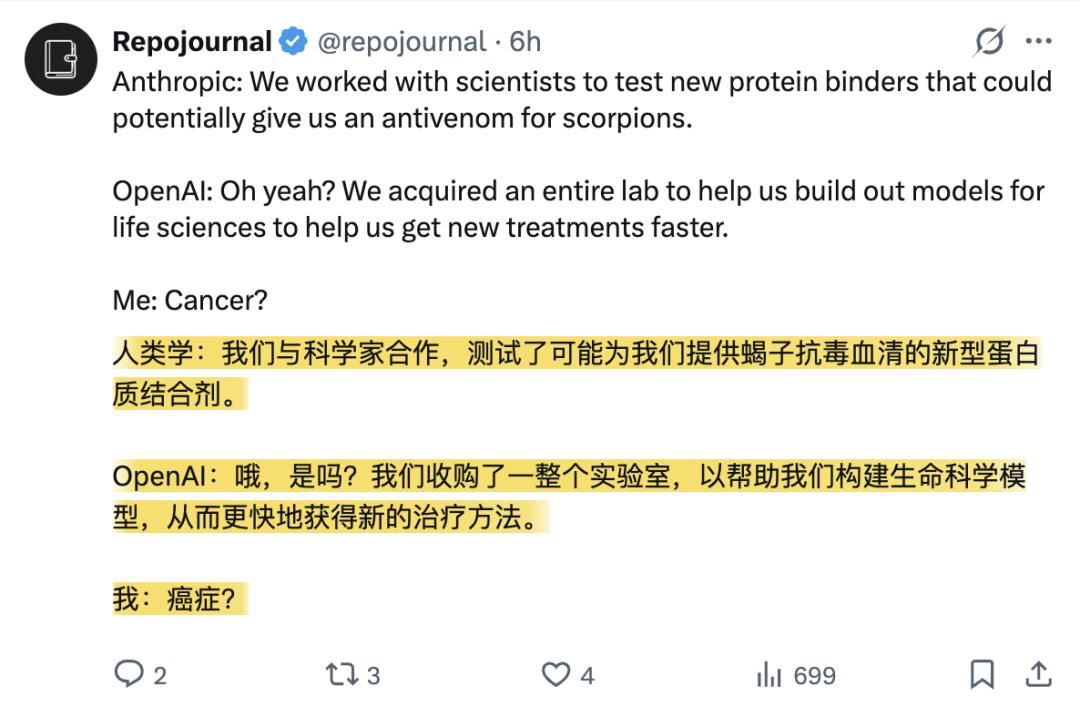
After seeing these two pieces of news, I feel exactly the same as the netizen following the gossip:
This biopharmaceutical AI company has a Peking University alumnus serving as CTO
Orchestra Bio was founded in 2022 in San Francisco, California, the United States. It mainly targets biotechnology companies and pharmaceutical enterprises, and develops AI tools for managing drug R&D projects.
(However, the company did not publicly exit stealth mode and make its public debut until August 2025)
The company's team is small, with only a dozen people when it exited stealth mode.
There are two core members in its team. One is Ashoka Rajendra, CEO of the company, who was previously in charge of product management at biotechnology software company Benchling, covering R&D and manufacturing related businesses.
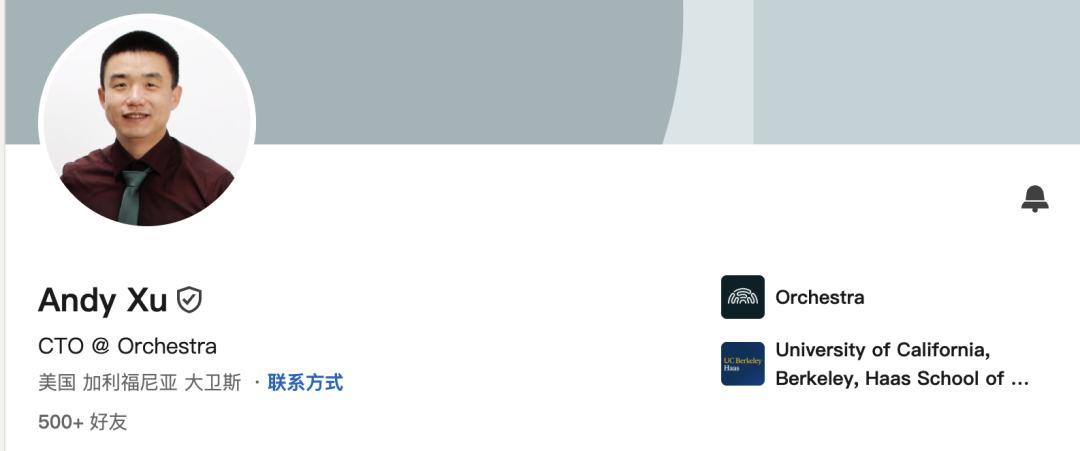
CTO Andy Xu holds an educational background in computer science from Peking University, then pursued further studies at Johns Hopkins University, and obtained an MBA degree from Haas School of Business, UC Berkeley.
Andy Xu once worked at Microsoft for 18 years and 10 months.
After joining Orchestra, he is responsible for technical work, promoting AI capabilities to enter the task planning, information integration and process coordination links of drug R&D.
Drug R&D is a closely linked work.
From early-stage research and experimental verification to manufacturing and clinical trials, each link has its own tasks, rhythms and resource requirements, which often involve different teams, different systems, and mountains of data.
For R&D leaders, they need to always figure out where the project is currently? Which tasks are starting to go wrong? If a certain link changes, what impact will it have on the subsequent process?
Orchestra tries to use AI Agents to undertake such work, focusing on the thorny project management and multi-party collaboration problems in the process of new drugs moving from the laboratory to industrialization.
On the one hand, Agents can sort out R&D tasks and continuously follow up the progress, so that the team can clearly understand the real-time situation of all work.
On the other hand, it can analyze the dependency logic between tasks, predict potential delays and cascading impacts, and help leaders evaluate alternative solutions and plan subsequent arrangements.
Why did OpenAI buy it?
OpenAI has been putting effort into the AI biology field for quite a long time.
As early as January 2025, Sam Altman personally invested in longevity research company Retro Biosciences, and OpenAI specially trained a model called GPT-4b micro for it (essentially a biologically specialized version of GPT-4o).
OpenAI has taken relatively more actions in this area this year.
First, it officially launched the GPT-Rosalind series, a dedicated reasoning model for life sciences in April this year.
This series of models focuses on scientific research reasoning and calling professional tool libraries, which is used to assist literature sorting, target research, protein and pharmaceutical chemistry reasoning, and experimental protocol design, helping scientists form research hypotheses earlier.
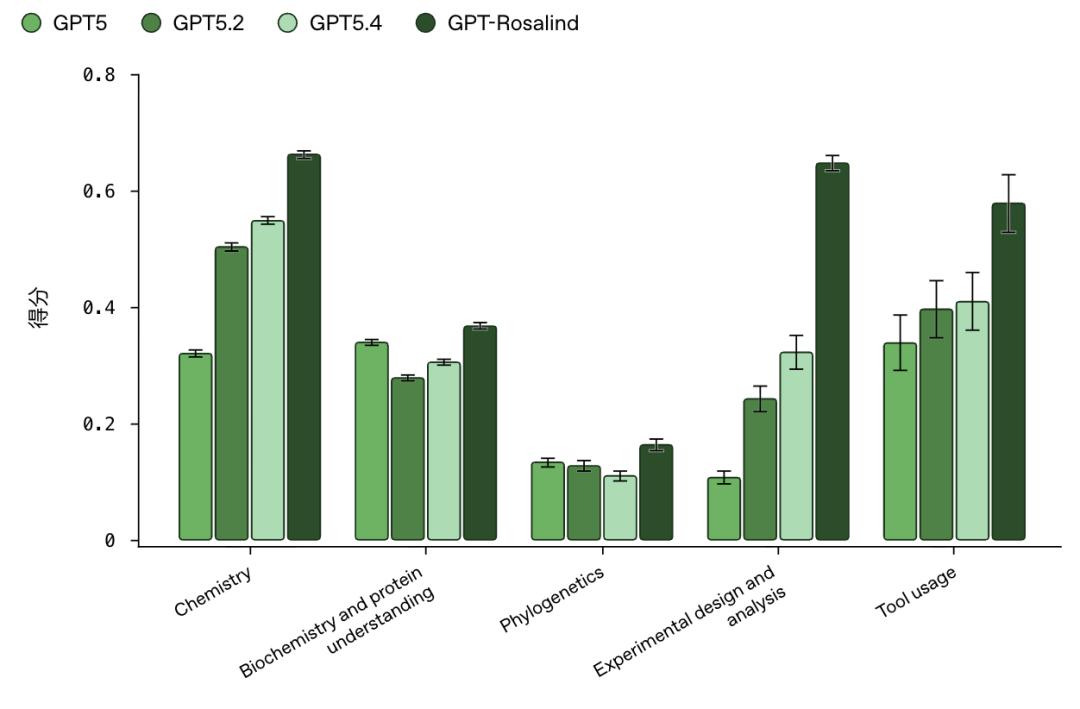
Around this model, OpenAI is also continuing to build supporting scientific research tools and working environment Rosalind Workbench, so that researchers can combine professional models, data and tools to carry out their work.
This series of models has derived a separate Rosalind Biodefense Initiative.
OpenAI funds trusted institutions to use Rosalind for epidemic modeling, early pathogen detection, biothreat screening, pandemic emergency tools and so on.
Before Rosalind, OpenAI had internally developed GPT‑4b micro, a dedicated model for protein engineering, which is specially used to generate and modify protein sequences and can process many intrinsically disordered proteins.
It can almost be regarded as the pre-technical accumulation of Rosalind, but it was not promoted to the public as the main commercial product.
Now OpenAI has supplemented the complex multi-party collaboration and pipeline management capabilities in new drug development by acquiring Orchestra Bio.
In addition, OpenAI has also in-depth cooperation with pharmaceutical companies such as Moderna, Novo Nordisk and Amgen, embedding the model into the complete links of pharmaceutical companies from early discovery, clinical development to production.
According to public information, OpenAI's life sciences team has covered research, product and engineering deployment directions.
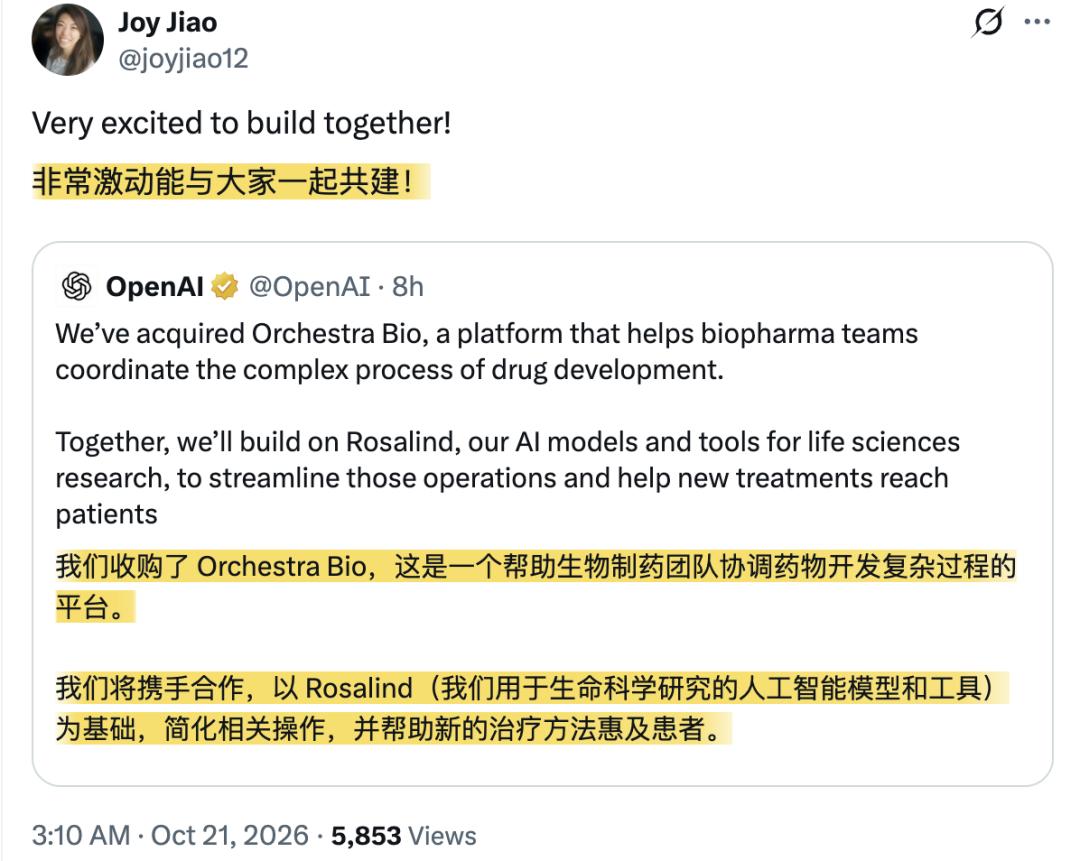
Among them, Joy Jiao serves as the head of life sciences research at OpenAI. She graduated from MIT and Harvard successively, with a doctorate in systems biology, and is responsible for promoting the application of models in life sciences research.
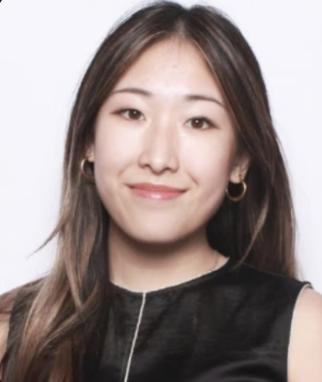
Yunyun Wang serves as the head of life sciences products, participating in transforming model capabilities into specific research tools and workflows.
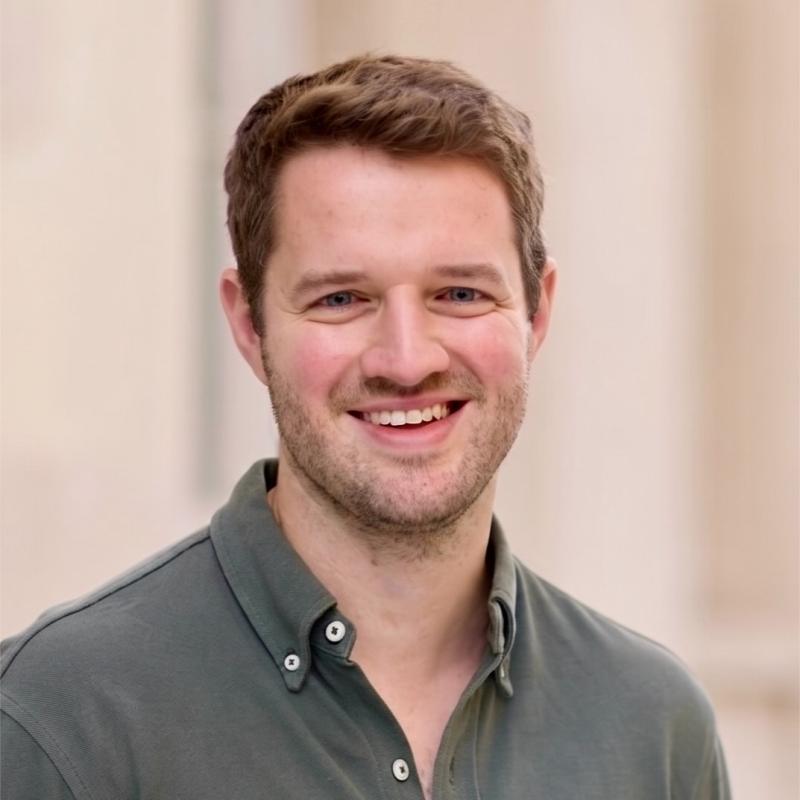
Another member worthy of attention is Konstantin Hemker.
He previously engaged in research on multimodal machine learning and spatial biology at the University of Cambridge. His research background connects machine learning, biomedical data analysis and scientific tool construction, and he has also publicly participated in projects related to Rosalind Workbench.
Overall, GPT-Rosalind focuses on scientific reasoning to help researchers understand problems, analyze evidence and advance research; Rosalind Workbench is responsible for connecting scientific tools and data; Orchestra focuses on the organization, coordination and management of R&D projects, and the three cover different links.
For OpenAI, the acquisition of Orchestra Bio can largely complement Rosalind's capabilities in organizational coordination and project implementation in drug R&D.
If these capabilities can be combined more closely in the future, AI will have the opportunity to further participate in longer-term R&D work involving multiple teams, from answering scientific research questions and assisting in completing individual tasks.
Two AI giants begin to seize the AI pharmaceutical market
OpenAI's expansion in life sciences should also be viewed in the layout of another model company.
Who is it?
It must be Anthropic led by Dario, the lifelong rival of Sam Altman.
Different from OpenAI, Anthropic's layout focus in the life sciences sector leans toward building a closed loop of drug discovery from AI hypothesis generation to wet lab verification.
In October 2025, Anthropic launched Claude for Life Sciences, supporting researchers to carry out work such as literature integration, omics data analysis, and experimental protocol design.
In June this year, it was upgraded to Claude Science, an integrated scientific research workbench, which is connected to mainstream biological databases and bioinformatics tools such as PubMed, UniProt and Benchling, and supports flexible calls to external scientific research tools relying on the MCP protocol.
In April this year, Anthropic was exposed to acquire AI biotechnology startup Coefficient Bio for about 400 million US dollars.
Public reports mentioned that its founding team members have worked in drug R&D and biotechnology companies, covering directions such as computational drug discovery, machine learning and biological research.
At the same time, Anthropic has built an in-house wet laboratory, trying to realize the iterative closed loop of rapid experimental verification after AI designs molecules and proteins. It has publicly disclosed research results such as Claude independently designing binding proteins and discovering new CRISPR-like enzyme systems. This morning, it released the latest progress of generating more than 300,000 protein designs within 64 hours.
Overall, although both OpenAI and Anthropic are bringing AI into life science research, their layouts have different focuses.
Anthropic has moved the experimental bench into the company, wanting to see if AI can make new biological discoveries on its own; OpenAI has set its sights on the large and complex project management behind drug R&D.
One is worried that AI can't do the work of scientists, and the other has already started to worry about the KPI of project managers...
This article is from WeChat official account "QbitAI", author: Focus on cutting-edge technologies, authorized for release by 36Kr.