Do companies selling toothpaste in the US stock market all have higher P/E ratios than technology stocks?
In October, investors fleeing tech stocks found a safer haven: consumer staples stocks of enterprises that produce and sell daily consumer goods such as toothpaste and laundry detergent. However, a problem emerging with these so-called "havens" at the moment is that their valuations are becoming more expensive than the high-growth AI stocks that investors decided to sell off!
So far this month, the consumer staples sector in the S&P 500 has unexpectedly become the top gainer of the broad market benchmark index. As tech stocks suffered a sharp sell-off that dragged down the growth segment, some traditional defensive stocks have gained room for performance.
FactSet data shows that since the start of this month, the consumer staples sector has risen by nearly 9% in total. This category of stocks covers enterprises that sell food and household necessities, products that people cannot do without regardless of economic conditions.
In contrast, the S&P 500 posted a gain of less than 1% in the same period, while the information technology sector even fell by 3.8%.
The rapid rise of the consumer staples sector has also overturned the long-standing pattern of the US stock market.
The tech sector is no longer the segment with the highest valuation multiples in the S&P 500. For a long time, the US stock market has granted tech enterprises the highest valuation based on their faster profit growth and higher profit margin potential. But now, consumer staples enterprises including Costco, Walmart and Colgate-Palmolive have taken their place, becoming the highest-valued segment in the US stock market.
Consumer staples stocks usually enjoy lower defensive valuation multiples due to their stable growth and reliable dividends. But right now, this situation seems to no longer hold...
FactSet data shows that as of intraday trading on Tuesday, the forward price-to-earnings ratio of the S&P 500 consumer staples sector stood at 23.8 times, while that of the information technology sector was only 19.8 times.
Is the market over-defensive?
In this regard, Mark Hackett, chief market strategist at Nationwide Investment Management Group, said that in the face of excessive concentration of positions in tech stocks and uncertainty over AI prospects, the relative attractiveness of consumer staples stocks as a hedging tool has risen. But this round of rally has made the valuations of some leading consumer staples stocks, and even the entire sector, no longer cheap to a certain extent. However, Hackett also believes that this does not mean that all stocks in this sector are universally overvalued.
When a single stock or a sector is considered "overvalued", it usually means that its valuation based on earnings expectations is on the high side.
From the perspective of the price-to-earnings ratio, some individual stocks in the current consumer staples sector do appear to be overvalued — even though the expected earnings growth of Walmart and Costco is far lower than that of the tech sector, their forward price-to-earnings ratios are as high as about 42 times and 48 times respectively.
All of this seems to be related to the overall risk-aversion sentiment that has emerged in the market over the past few weeks. When investors are worried about the prospects of AI trading or economic conditions, they tend to turn to defensive sectors such as consumer staples. If this type of trade also becomes too crowded, there will be fewer and fewer safe havens for investors to avoid risks.
The recent sharp sell-off in the bond market shows that as enterprises raise massive financing for AI infrastructure construction and governments issue debts to cover fiscal deficits, investors' interest in holding US Treasury bonds is being squeezed. In addition, the price of silver has fallen back to the "halved line" from its historical high, which also indicates that the market's concerns about economic slowdown are intensifying.
Hackett pointed out that it is reasonable for investors to be willing to pay a premium for the "reliable earnings" of consumer staples stocks, but some of the best-performing stocks may have already reflected the unusually optimistic expectations for this sector.
He said, "If inflationary pressures erode profit margins, consumers turn to buy cheaper products, or corporate earnings disappoint, then these high-valued stocks may face risks."
Past Experience
From past experience, the consumer staples sector tends to outperform the overall US stock market during economic recessions. According to Dow Jones Market Data, during the past four recessions (defined as two consecutive quarters of decline in real gross domestic product), this sector rose by an average of 2.2% in the first six months after the start of the recession, and the increase was close to 6% one year later (see the table below).
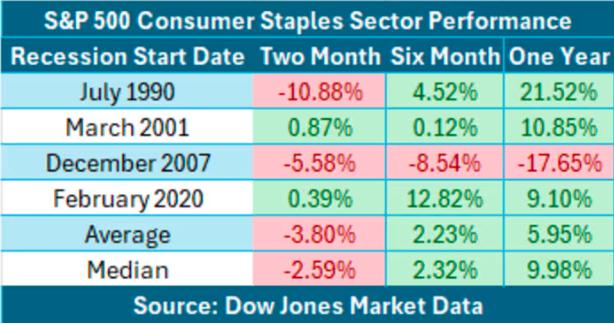
Although the US economy is not currently in a recession, affected by stubborn inflation and high borrowing costs, the labor market and consumer spending are showing obvious signs of cooling, which has significantly increased the cost of big-ticket consumption such as home and car purchases for US consumers.
But in Hackett's view, the recent lead of the consumer staples sector is more like a defensive capital rotation, rather than a sudden improvement in consumer demand. He said: "Due to concerns about AI-related capital expenditure, financing costs, valuations and the sustainability of earnings expectations of tech enterprises, investors have been reducing their risk exposure. This trend is beneficial to enterprises with sustained demand, pricing power and relatively stable cash flow."
Of course, some market participants currently believe that the consumer staples sector is expected to strengthen further. According to SentimenTrader analysts, technical analysis shows that the extreme shift in market sentiment towards consumer staples stocks often indicates a bullish trend for consumer stocks in the coming months, although a short-term pullback may occur in the near term.
At the beginning of this month, the proportion of consumer staples stocks whose stock prices were above the 50-day moving average was less than 10%, but in just over two weeks, this proportion jumped to more than two-thirds. When an asset trades above its 50-day moving average, it usually means its medium-term trend is bullish.
In other words, this means that this rally has quickly spread from a small number of consumer stocks to most stocks in the entire sector. SentimenTrader analysts wrote in a report sent to clients on Monday: "Over the past few years, we have found that such rapid shifts often signal a reliable change in market sentiment. The consumer staples sector follows the same pattern. Among 10 similar signals, negative returns five months or later are extremely rare."
"While aggressive traders should be alert to possible short-term pullbacks in the coming week, strategic investors can regard any short-term weakness as an excellent opportunity to build positions before the broader recovery that is highly likely to arrive," said the SentimenTrader analysts.
This article is from the WeChat official account "CLS.cn", author: Xiaoxiang, published with authorization from 36Kr.