SpaceX: From "Rocket Bro" to "Space Landlord", who will foot the bill for Elon Musk's new trillion-dollar business blueprint?
Early morning of October 21 Beijing time (post-market of October 20 US Eastern Time), SpaceX released its second financial report after going public: its performance comprehensively exceeded expectations, and its guidance was even more "explosive". The details are as follows:
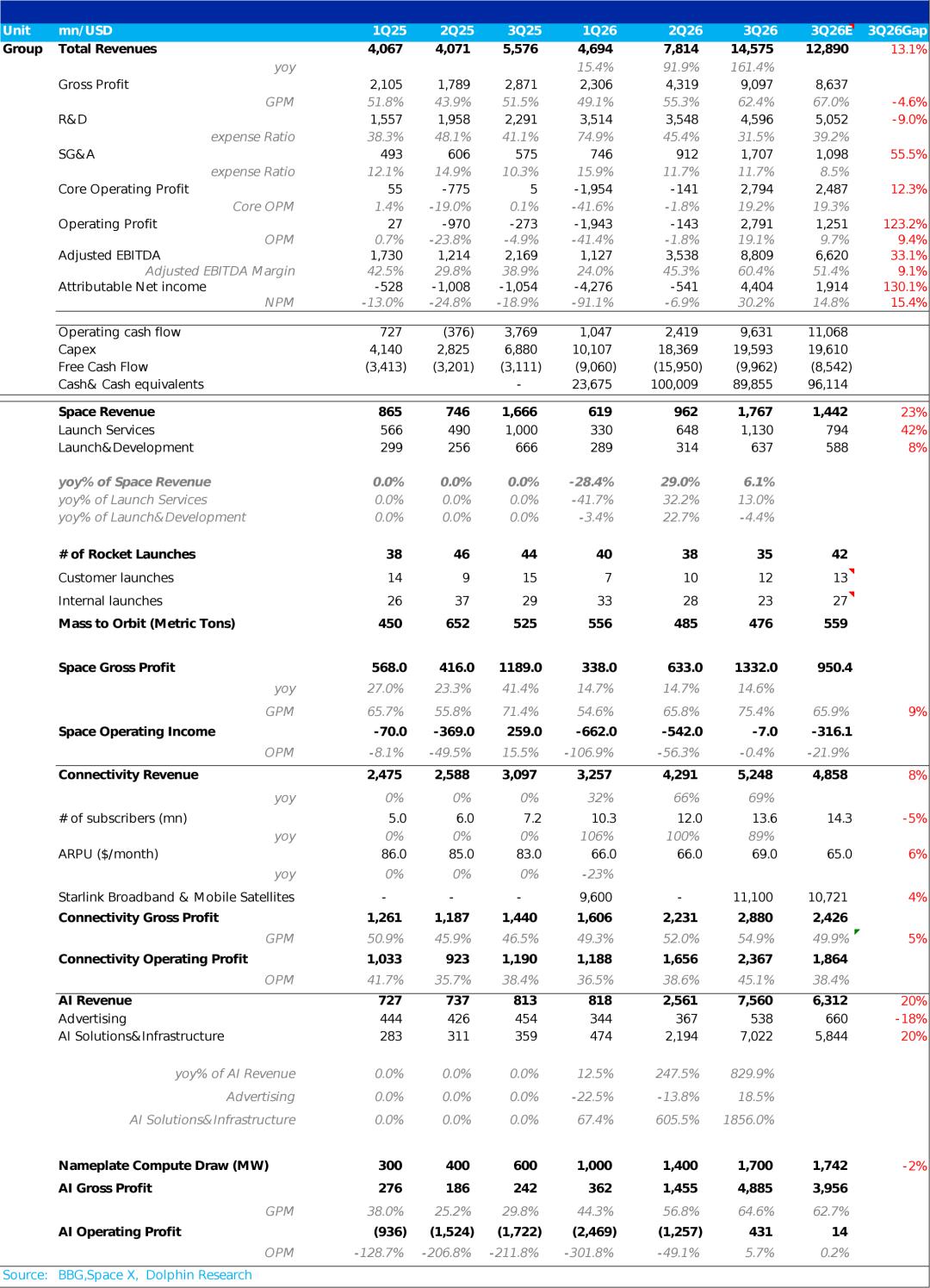
① Total revenue far exceeded expectations, and full-quarter recognition of AI computing power leasing drove revenue to nearly double month-on-month: Total revenue in Q3 reached 14.58 billion US dollars, 13% higher than market expectations (about 12.9 billion US dollars), a year-on-year increase of 161%, further accelerating from Q2 (+92%).
Revenue from the three divisions of Aerospace, Starlink and AI all exceeded expectations. Among them, AI revenue was 7.56 billion US dollars, accounting for 52%, exceeding 50% for the first time, mainly from the full-quarter contribution of computing power leasing and the increase in Grok revenue.
② Gross margin increased significantly, but including one-off factors, it will fall back in Q4: Gross profit was 9.1 billion US dollars, exceeding market expectations (about 8.64 billion US dollars); gross margin rose 7.1 percentage points month-on-month to 62.4% (55.3% in Q2).
The increase mainly came from three aspects: 1) The proportion of high-gross-margin computing power hosting rose sharply, and AI gross margin increased from 56.8% to 64.6%; 2) High-value aerospace tasks were intensively implemented, and gross margin rose from 65.8% to 75.4%; 3) Starlink had a one-off tariff refund of about 3 percentage points.
However, the management guided that the gross margin in Q4 will return to the Q2 level (about 55%), because Q3 included one-off gains and a relatively favorable customer structure, and the high point of this quarter should not be linearly extrapolated.
③ Operating leverage was released significantly, GAAP operating profit turned positive for the first time and far exceeded expectations: Operating profit was 2.8 billion US dollars, more than twice the market expectation (1.25 billion US dollars) (-140 million US dollars in Q2), and operating margin rose by about 21 percentage points month-on-month to 19%.
④ Details of the performance of each business:
a. Aerospace business: High-value customer tasks drove revenue to far exceed expectations, Starship R&D investment increased, but the division is close to break-even
Revenue side: Aerospace revenue was 1.77 billion US dollars, exceeding market expectations (about 1.44 billion US dollars), up 6% year-on-year.
Launch services: Revenue was 1.13 billion US dollars, exceeding market expectations (800 million US dollars), mainly due to the increase in the proportion of high-value customers and the unit price exceeding expectations.
In terms of launch volume, there were 12 customer launches (10 in Q2), slightly lower than the expected 13, including the Falcon Heavy launching the Roman Space Telescope for NASA, and 6 national security launch missions.
There were 35 total launches (38 in Q2), including 23 internal launches (21 Falcon 9 Starlink launches + 2 Starship test flights). After the last Falcon 9 Starlink launch in Florida on August 26, the Starlink deployment in Florida was gradually transferred to Starship, and the frequency of internal launches continued to decline.
In terms of launch unit price, the revenue of a single customer launch was about 94 million US dollars, a significant increase from about 65 million US dollars in Q2, mainly due to the concentrated implementation of high-priced tasks such as Falcon Heavy and national security missions.
The newly signed orders are also full: 3 Dragon manned missions (scheduled to 2028), 18 national security launches, 3 Starfall missions, the Artemis 3 Starlink communication contract and the Starship lunar payload contract.
With its near-monopoly position in transportation capacity (accounting for about 90% of the global orbital injection mass), SpaceX still firmly holds the pricing power.
Launch and R&D services: Recognized 640 million US dollars, doubling month-on-month (310 million US dollars in Q2).
This business is recognized according to milestones/construction progress. The increase this quarter comes from Starship's breakthrough: Flight 13 deployed real V3 satellites for the first time, Flight 14 entered orbit for the first time, deployed 26 V3 satellites and completed the controlled deorbit ignition, corresponding to the milestone nodes of contracts such as the NASA HLS lunar lander.
Profit side: Aerospace gross margin rose by about 10 percentage points month-on-month to 75.4%, benefiting from high-priced missions and the increase in the number of Falcon 9 reuses.
The operating loss was only 7 million US dollars, far better than the market expectation of -320 million US dollars. The costs of the two Starship test flights were mainly included in R&D expenses (aerospace R&D was 1.23 billion US dollars, up 14% month-on-month), which was the main reason for the small loss in aerospace; adjusted EBITDA was 360 million US dollars, turning positive again.
b. Starlink business: ARPU rebounded unexpectedly, To B/G drives growth, but the number of consumer users is lower than expected
Revenue side: Starlink revenue was 5.25 billion US dollars, up 69% year-on-year, exceeding market expectations (about 4.86 billion US dollars).
Enterprise and government business: Revenue was 2.13 billion US dollars (expected about 1.96 billion), up 91% year-on-year. Starshield and aviation are the two major drivers: the two new US Space Force Starshield contracts signed in Q2 (Space Data Network Backbone about 2.29 billion US dollars, Space-Based AMTI about 4.16 billion US dollars) entered the execution period;
Aviation has signed contracts for about 12,000 aircraft (accounting for about 1/4 of the available fleet, covering three of the four major US airlines), with more than 3,800 aircraft installed by the end of September. The production capacity of aviation terminals has been increased 4 times within the year, and will double again before the end of the year. The management expects enterprise and government revenue to exceed consumer revenue in the future.
Consumer business: Revenue was 3.12 billion US dollars (expected about 2.84 billion), up 57% year-on-year.
Number of users: The number of consumer users increased to 13.6 million, a net increase of 1.6 million month-on-month (about 1.7 million in Q2), lower than the expected about 14.25 million.
The main reason is that the new generation of household terminal V5 (antenna "dish") has just started to increase in volume, and the production capacity was limited before. Prior to the holiday, priority was given to stocking for retail channels and not activated, and it is expected that activations will increase significantly in Q4.
In addition, starting from this quarter, "Starlink users" were renamed "Starlink consumer users", excluding hundreds of thousands of enterprise and government users.
ARPU: The average monthly ARPU of consumers was 69 US dollars, up 5% month-on-month (66 US dollars in Q2), higher than the expected about 65 US dollars, the first rebound in recent quarters, mainly because new users are mainly from developed markets. It should be noted that ARPU only counts subscription revenue; calculated back based on the average users in the quarter, about 400-500 million US dollars of consumer revenue comes from non-subscription revenue such as terminal hardware.
Mobile communication business: At present, it mainly wholesales satellite direct connection capacity to operators in various countries, with monthly active users exceeding 22 million, up 37% month-on-month.
The next step is to build its own operator: on October 8, it announced the acquisition of Grain's 800MHz low-frequency spectrum (expected to be delivered in the first half of 2027), superimposed on the previous 2GHz intermediate frequency from EchoStar; FCC has approved about 15,000 mobile V2 satellites (to be launched from 2027). The management plans to launch services with its own spectrum in early 2028, targeting to become a major mobile operator in the United States.
As of the end of 3Q26, there were about 11,100 satellites in orbit (starting from this quarter, the caliber includes about 400 deorbiting satellites that have been approved, and the old caliber was about 10,700; 10,200 in 2Q26). Flight 14 carried only about half of the payload and deployed about 26Tbps downlink bandwidth, equivalent to 10 Falcon 9 Starlink launches.
Profit
Operating profit was 2.37 billion US dollars, operating margin was 45%, up 6.5 percentage points month-on-month, significantly higher than the expected about 38.4%. The SaaS-like scale effect of Starlink is still being released, and the rebound in ARPU also eased the previous concerns of Dolphin Research.
c. AI business: Full-quarter hosting recognition + Cursor consolidation, revenue tripled, operating profit turned positive for the first time
Revenue: AI revenue was 7.56 billion US dollars, far exceeding expectations (about 6.31 billion US dollars), up 195% month-on-month and 830% year-on-year.
AI solutions and infrastructure: Revenue was 7.02 billion US dollars (expected about 5.84 billion), mainly from:
① Computing power hosting: The Anthropic contract (about 325,000 GPUs, 480MW, about 1.25 billion US dollars per month) contributed a full quarter for the first time, corresponding to about 3.75 billion US dollars (about 1.6 billion US dollars in Q2); the Google contract (110,000 GB300, 220MW, 920 million US dollars per month) ramped up in September and reached full capacity in October; Reflection AI (150 million US dollars per month) started leasing in July.
Excluding Cursor, this item of revenue was 6.41 billion US dollars, up 192% month-on-month. Dolphin Research estimates that the hosting revenue among them is about 4.5 billion US dollars.
② Cursor was consolidated for the first time: The delivery was completed on August 14, and it was consolidated for about 1.5 months, contributing 608 million US dollars in revenue, with an annualized rate of about 4.7 billion US dollars.
③ Grok model: Grok revenue is expected to rise from about 600 million US dollars in the previous quarter to about 1.9 billion US dollars, benefiting from the successive releases of Grok 4.6 (August 12) and 4.7 (September 21), as well as the launch of the resident agent Grok Bot: paid weekly active users reached 800,000 in early October, more than doubling in the past month, and enterprise deployment will be fully opened within a few weeks.
X platform advertising revenue: 540 million US dollars, up 47% month-on-month, but lower than the expected about 660 million US dollars.
After the reconstruction of AI advertising infrastructure in the first quarter (automated delivery, AI attribution, Grok-driven brand security risk control), advertising has rebounded for two consecutive quarters, but whether it can continue to recover lost advertisers remains to be seen.
Profit operating profit was 430 million US dollars, improving 1.7 billion US dollars month-on-month, turning positive for the first time (expected to be roughly break-even), mainly due to the leasing premium under the shortage of computing power supply.
⑤ Capital expenditure and cash flow: Q3 is in line with expectations, Q4 guidance nearly doubles, free cash flow is still deeply negative
Capital expenditure in Q3 was 19.6 billion US dollars, basically in line with expectations, of which AI was 16.4 billion US dollars, aerospace 1.6 billion, Starlink 1.5 billion, and AI is still the absolute majority of capital expenditure.
In terms of computing power, the nominal computing power at the end of 3Q26 was 1.7GW (1.4GW in 2Q26), slightly lower than the expected 1.74GW; but it was nearly 2.2GW at the end of October, and it is expected to be 2.5-3GW by the end of the year (higher than the original 2GW guidance). At present, about 200,000-220,000 GB300 are launched every month, and Vera Rubin will be the main one in 2027.
Due to the new capacity added this quarter, the management guided that capital expenditure in Q4 will rise to 35-40 billion US dollars, nearly twice that of Q3, corresponding to about 830-880 billion US dollars for the whole year, significantly higher than the previous market expectation of 650-700 billion US dollars.
Operating cash flow this quarter benefited from the improvement of profits, improving to 9.6 billion US dollars month-on-month, but capital expenditure was still as high as 19.6 billion US dollars, and free cash flow was about -10 billion US dollars.
Dolphin Research's overall view:
Overall, SpaceX delivered a financial report that comprehensively exceeded expectations: revenue increased by 161% year-on-year, and net profit margin rose 37 percentage points month-on-month to 30.2% (net profit of 4.4 billion US dollars is higher than operating profit, mainly from about 1 billion US dollars of other income, about 900 million US dollars of interest income and about 400 million US dollars of tax income).
In terms of revenue structure, SpaceX has switched from "rocket + satellite broadband" to "taking AI computing power as the largest increment": AI revenue accounted for more than 50% for the first time (52%, about 33% in Q2).
The turn to positive operating profit also mainly relies on the AI business shifting from "burning money for growth" to contributing profits, behind which is high-gross-margin computing power leasing.
More critically, the guidance comprehensively exceeded expectations: 1Q27 revenue guidance far exceeded expectations, and 2027 targets 13GW computing power and 500-1000 billion US dollars ARR:
1Q27 revenue guidance is 33-37 billion US dollars, 40% to 60% higher than market expectations (about 23.4 billion US dollars);
The target of 100 billion US dollars ARR at the end of 2026 remains unchanged (annualized by December revenue), and the overall ARR of the company at the end of 2027 is expected to reach 500-1000 billion US dollars.
Supporting the guidance is a more aggressive computing power plan: nearly 3GW will be settled within the year, 10GW of new computing power in 2027 is "highly certain", the probability of exceeding 20GW is rising rapidly, and 20GW of new power and cooling have been planned by the end of 2027 (total about 23GW).
The confidence comes from the shortage of computing power supply: the unit price is slightly higher than the upper edge of the 30-50 US dollars/W range, the payback period of newly deployed computing power is less than 1 year, and it may even be shortened to 6 months next year; the demand is several times the supply, and the rent of old H100 cards is already