16.6 billion, a unicorn has unexpectedly emerged from within Li Auto
A financing deal exceeding 1 billion yuan has been completed.
Recently, Li Auto released a financing press release on its IR official website, stating that "Li Auto Inc. announces equity financing for its chip business". The subject of the release is Li Auto's chip subsidiary "Shanghai Maheart Technology Co., Ltd." (hereinafter referred to as "Maheart"), which is Maheart's first round of equity financing, with a total financing amount of 1.625 billion yuan. Specifically, in this round of financing, the Li Auto ecosystem contributes 1 billion yuan, while external investors including Hangzhou Jingtao, BlueRun Ventures, Huaye Tiancheng, MiraclePlus and other parties contribute a total of 625 million yuan. After the financing is completed, Li Auto will still maintain control over Maheart and consolidate its financial statements.
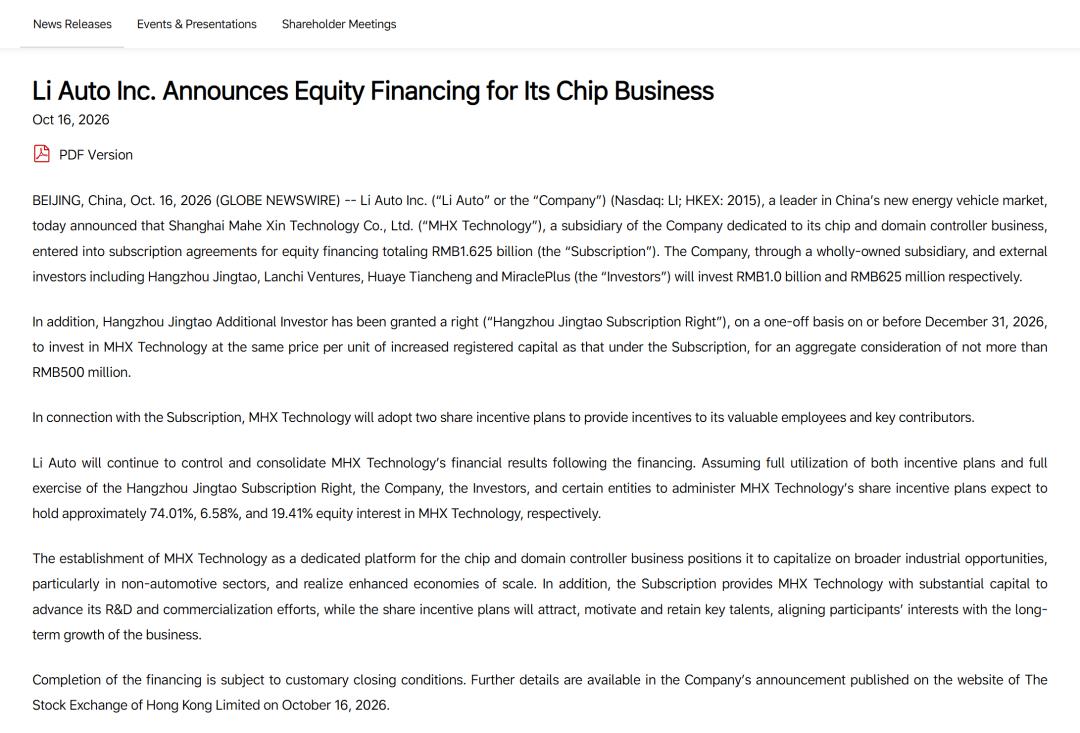
According to industrial and commercial information, Maheart was established on August 12 this year. However, the self-developed chip project of this enterprise, which has been established for less than a year, has been under development for several years.
According to Xie Yan, CTO of Li Auto, who revealed in an earlier media interview, Li Auto had the idea of self-developed chips back in 2021. The project was officially approved in November 2022, tape-out was completed in 2024, and mass production for vehicle installation was realized in 2026. The entire R&D cycle is more than 3 years, and the R&D pace basically meets expectations, even faster than expected at some nodes.
Regarding this financing, multiple media outlets have reported the valuation, "post-money valuation is about 16.63 billion yuan, with a maximum of 17.1 billion yuan". In other words, Li Auto has independently incubated a unicorn valued at over 10 billion yuan.
Li Auto-affiliated Unicorn
This is a very new company.
On July 14, 2026, Li Auto established Mach Intelligent Cores Limited in Hong Kong. On August 4, Shanghai Maheart Intelligent Technology (hereinafter referred to as "Maheart Intelligent Core"), which is wholly owned by it, was established, with Xie Yan as the legal representative. A few days later, Maheart Intelligent Core established Maheart.
From the establishment of Maheart in August to the announcement of financing in October, the interval is only two months.
However, the project represented by Maheart is by no means a newly approved project. In 2021, Li Auto came up with the idea of developing chips on its own. The project was approved in November 2022, R&D was carried out on a large scale in 2023, tape-out was completed in 2024, chip verification after returning from the foundry was done in 2025, and the self-developed chip was installed on the all-new Li Auto L9 in 2026.
For the self-developed chip project, Xie Yan said the entire cycle "actually took three and a half years". The team has about 200 people, who are responsible for the core AI computing architecture design, while the integration, peripheral and back-end work are handed over to suppliers. As for the total investment over the past four years, Xie Yan replied that "it is not convenient to disclose".
This self-developed chip is called "Maher M100", a general-purpose AI chip adopting 5nm automotive-grade process, without Chiplet design. It is a large SoC with a single-chip computing power of 1280 TOPS. The Livis version of the new L9 is equipped with 2 chips, with a total computing power of 2560 TOPS. In early 2024, the team carried out a round of optimization for Transformer. Xie Yan said the internal team was very efficient, "it was done in just one month".
The chip began mass production in May this year. As of the data in August, more than 50,000 Maher M100 chips have been delivered.
Turning back to this financing, of the total 1.625 billion yuan financing, 1 billion yuan comes from Li Auto itself, subscribed by Maheart Intelligent Core, and external investors contribute a total of 625 million yuan. Hangzhou Jingtao, BlueRun Ventures, and Huaye Tiancheng each subscribe for 200 million yuan, and MiraclePlus Phase III subscribes for 25 million yuan. The subscription price is 23.35 yuan per unit, with a pre-money valuation of 15 billion yuan and a post-money valuation of about 16.63 billion yuan. After the transaction is completed, Maheart Intelligent Core will remain the controlling shareholder of Maheart, and Li Auto will hold shares indirectly through it. The closing still needs to meet the usual precedent conditions.
Hangzhou Jingtao also has an additional subscription right, which allows it to invest additional funds at the same price before December 31, 2026, with a total cost not exceeding 500 million yuan. If the right is fully exercised, the total financing amount of this round will be up to 2.125 billion yuan, and the maximum post-money valuation will be about 17.1 billion yuan. It is worth mentioning that the additional subscription right is the right of investors to increase their investment at the agreed price within the agreed period. Investors can choose to exercise or waive it, so the 17.1 billion yuan is a conditional upper limit.
But the 10-billion-yuan valuation is already a certainty.
Cross-border Self-developed Chips, Not a New Thing
Why develop chips on its own? Li Auto has its own considerations.
In an interview, Xie Yan did the math: "Chips from suppliers are quite expensive, and our self-design will be cheaper." His calculation logic is "shipment volume × single chip area". At the same time, Xie Yan also said, "If the supplier's chip has half the price and 3 times the performance, we don't need to develop it ourselves."
The other side of the ledger is scale. According to the calculation of CITIC Securities, the full life cycle shipment volume of self-developed chips needs to reach the million level to be economical. As of August, the shipment of Maher M100 has exceeded 50,000 units. Therefore, the next step for Maheart is to "supply external customers and expand to fields beyond the automotive industry".
This is not unfounded. In May this year, Xie Yan also said that Li Auto's chips "serve our own products rather than being sold externally", and the demand for production capacity is very straightforward without much uncertainty. But five months later, the idea changed. In addition to the M100, Li Auto is also considering selling silicon carbide modules and range extenders to external parties.
When it comes to cross-border self-developed chips, capital is naturally the most concerned topic for the outside world. After all, it is well known that self-developed chips are capital-intensive.
For Li Auto, the sense of urgency for capital is not that strong. As of the end of the second quarter of 2026, Li Auto's cash reserves, including cash, cash equivalents, time deposits and short-term investments, totaled 87.5 billion yuan, while the external capital contribution for Maheart is only 625 million yuan. Even if the additional subscription right is fully exercised, it will only be 1.125 billion yuan.
Li Auto is by no means the only one making such a choice. "Stones from other hills may serve to polish the jade."
NIO is such a case. While Li Auto spun off Maheart, NIO separated its chip business into "Shenji", which was established in June 2025. In February this year, it completed the first round of financing of 2.257 billion yuan, with a post-money valuation of nearly 10 billion yuan. NIO is expected to hold about 62.7% of the shares, with Hefei Investment, Hefei Haheng, SMIC PE, Yuanhe Puhua, and IDG Capital all among the investors.
Coincidentally, William Li, founder of NIO, also calculated the account for Shenji. NIO once spent 300 million US dollars a year to purchase NVIDIA Orin-X, corresponding to a single-vehicle chip cost of about 11,000 yuan. After the mass production of self-developed chips, the single-vehicle cost is reduced by about 10,000 yuan. Calculated based on NIO's 2025 sales volume, it can save more than 1.8 billion yuan per year. The public statements on the shipment volume of Shenji's NX9031 vary, ranging from 250,000 units to 550,000 units, and it is also in contact with Leapmotor and Geely for cooperation.
XPeng, another new EV maker, has taken a different path. It is reported that the cumulative shipment of Turing chips has exceeded 200,000 units as of March this year, with the annual target close to 1 million units. In June, it obtained a mass production order from Volkswagen. He Xiaopeng said that each chip is about 1,200 yuan cheaper than externally purchased ones. However, XPeng has not disclosed any news about independent financing of Turing chips so far.
Compared with the three new EV makers Li Auto, NIO and XPeng, BYD, the established car manufacturer, has gone further.
In 2020, BYD spun off its power semiconductor business into BYD Semiconductor. It completed a Series A capital increase of 1.9 billion yuan and a Series A+ round of about 800 million yuan, bringing the overall valuation to 10.2 billion yuan after completion. On November 15, 2022, BYD announced that it would temporarily terminate the spin-off and listing of BYD Semiconductor on the ChiNext board, on the grounds that after the outbreak of new energy vehicles, wafer production capacity has become a bottleneck, and it will focus on production capacity construction first. On May 28 this year, at BYD's intelligent strategy conference, the self-developed intelligent driving chip Xuanji A3 was unveiled, adopting 4nm process, with a single-chip computing power of about 700 TOPS, and three chips in total deliver more than 2100 TOPS.
Of course, some people pour cold water on the practice of car manufacturers developing chips across borders.
Cui Dongshu, Secretary-General of the China Passenger Car Association (CPCA), holds the view that car manufacturers do not have sufficient shipment volume to support self-developed chips, and it is difficult to form a closed loop in business. Zhu Jiangming, founder of Leapmotor, also mentioned that the annual demand for intelligent driving chips is only 10 million to 20 million units, but there are already 14 products on the market, and all current Leapmotor models use Qualcomm chips. Data from the Gaogong Intelligent Automotive Research Institute shows that in the first half of 2026, among the urban NOA chips of self-owned brand passenger cars, NVIDIA accounts for 39.43%, Horizon accounts for 22.82%, and the three parties of NVIDIA, Horizon and Huawei account for nearly 80% in total.
Therefore, whether self-developed chips by car manufacturers is a long-term business remains to be tested.
Li Auto's Investment Landscape
Back to this Maheart financing. In the list of investors, there is an old acquaintance: BlueRun Ventures. BlueRun was among the follow-on investors in Li Auto's Series C financing in 2019. Seven years later, it subscribed 200 million yuan in Li Auto's chip subsidiary again. At the same time, the affiliated funds of MiraclePlus and Huaye Tiancheng have also received investment from Li Auto's investment entity Chezhiyuan.
This single financing reveals several lines of Li Auto's presence in the primary market.
The clue starts with Li Xiang himself, who is an active "angel investor".
Back in 2014, Cao Yi left HSG to found Source Code Capital. At the very beginning of Source Code Capital's establishment, Li Xiang became one of its first batch of LPs, and can be regarded as a "veteran-level" LP of Source Code Capital. According to Cao Yi's recollection, "We raised the first fund in just one month, and each of these LPs just met for a chat, some even just made a phone call", and Li Xiang was one of them.
It is worth mentioning that in the LP list behind Source Code Capital's first fund, there are also well-known entrepreneurs such as Wang Xing, founder of Meituan, and Zhang Yiming, founder of ByteDance. Another person who has a deep connection with Li Xiang is Huang Mingming, founder of Mingshi Capital. Huang Mingming established a deep friendship with Li Xiang when Li Xiang founded Autohome. Many years ago, Huang Mingming, together with Xue Manzi and Cai Wensheng, invested in Autohome founded by Li Xiang, and was also one of the first-round investors of Li Auto. When Huang Mingming founded Mingshi Capital, Li Xiang also entrusted part of his capital to Huang Mingming and became an LP of Mingshi Capital.
This virtuous cycle of "entrepreneurs contributing capital to support VCs, and VCs accompanying the growth of enterprises" ushered in a landmark verification in May 2016 — at that time, Chehejia (the predecessor of Li Auto) completed Series A financing of 780 million yuan, with Source Code Capital, Mingshi Capital and other institutions participating in the follow-on investment. The VC institutions supported by Li Xiang as an LP in turn became investors in his own startup. This two-way supportive relationship laid the underlying logic for Li Auto's subsequent industrial investment.
"You give me a peach, I repay you with precious jade", the capital has completed a full cycle.
Back to Li Auto itself, the evolution context of its investment landscape is extremely clear. In March 2020, Neolithic, an unmanned delivery vehicle company, completed a nearly 200 million yuan Series A+ financing led by Li Auto. In February 2022, Sunwoda's power battery business introduced 19 investors with a total capital contribution of 2.43 billion yuan, and Li Auto's affiliated entity contributed 400 million yuan. In the same year, Li Auto established Chezhiyuan. According to Qichacha data, this company has 6 investment events so far, including its participation in the Pre-A round of Qianjue Robot in 2025.
In 2026, Li Auto made more frequent investments. In April, Xienuo Intelligence completed its first round of financing, jointly invested by Yuanjing Capital and Li Auto. In May, Xinuo Future, a dexterous hand company, completed a several-hundred-million-yuan Series A financing, jointly led by Li Auto Strategic Investment, CITIC Construction Investment Capital and CITIC Construction Investment Investment. On September 4, Li Auto planned to contribute 2.65 billion yuan to increase capital in Sunwoda Power. After the subscription of the capital increase, it will hold 8.79% of the shares. Together with the original shares held by its affiliated entity Chezhiyuan, the total shareholding reaches 11.17%, making it the second largest shareholder. Calculated based on the 2.65 billion yuan corresponding to 8.79% stake, the post-money valuation is about 30.15 billion yuan.
Interestingly, many of the startups in the current entrepreneurial wave are founded by "former Li Auto employees" who left Li Auto. Chen Wei, founder of Xienuo Intelligence, used to be Li Auto's chief AI scientist, and Zhang Xiao used to be the president of the second product line. Zhijian Power, which completed 5 rounds of consecutive financing within 8 months of its establishment, was jointly founded by Wang Kai, former CTO of Li Auto, and members of the intelligent driving team. Kunlunxing has Ren Geng as its CEO, and Lang Xianpeng, former president of intelligent driving of Li Auto, as co-founder and CTO... The list goes on and on.
At the earnings call on March 12 this year, Li Xiang generously mentioned when asked questions: "I hope every backbone of Li Auto who can go out to start a business can perform better and become the main force in market competition."
This phenomenon has its internal logic. The R&D system accumulated by Li Auto in the fields of AI and intelligent driving over the past few years is "spilling over" to the entire embodied intelligence industry through talent flow. Li Auto itself also chooses to take capital as the link to maintain industrial connections with these former employees who left to start businesses.
Obviously, the "Li Auto ecosystem" in the future capital market will grow stronger and stronger.