This Double 11, large models have penetrated deep into the core hinterland.
This year's Double 11 sees large language models taking a far more proactive stance, stepping directly into the arena one after another.
Ahead of the Double 11 kickoff, Qwen Office launched its e-commerce version; on October 15, Douyin E-commerce announced that during this year's Double 11, it will distribute consumer coupons in batches across product terminals including Doubao and Toutiao, extending promotional activities beyond the Douyin App. In addition, Doubao has specially set up a dedicated "Ask Doubao for Double 11" navigation bar.
For consumers, the changes are also intuitive.
For example, users can choose not to open the search box, but open the dialog box and ask "I want to buy XX, what recommendations do you have".
When users hesitate in the face of platform marketing terms such as full reduction, the lowest price across the network, and in-stock delivery, they will also turn to large language models for inquiry to screen information.
This year's Double 11 may well become another watershed moment.
01
Double 11: When People Start Asking AI "What to Buy"
Li Ran, a resident in Beijing, took a different shopping path this Double 11 compared with previous years.
Li Ran found that recently Doubao added a new entry for the "Ask Doubao Before Purchase" dialog box for Double 11. Tapping into the entry shows "Doubao surprise subsidies to be claimed", with functions including "What to buy on Double 11", "Product comparison", "Pick by budget" and more.
Doubao's introduction states that "Check before buying, avoid pitfalls and save money" and "Ask Doubao when you are confused about shopping".
Out of curiosity, Li Ran opened the App and input: "I want to buy a massage device for my parents, with a budget of around 800 yuan, easy to operate, and preferably with a hot compress function." Later, Doubao gave a comparison of specific models of several brands, and attached the product link of Douyin Mall at the end.
Li Ran said that this kind of AI experience has actually been tried on traditional e-commerce platforms before, "But I only noticed such a prominent entry in Doubao recently. In the past, I liked to watch reviews on social platforms, compare prices and check pitfall avoidance guides, and now I will also refer to the suggestions from the dialog box."
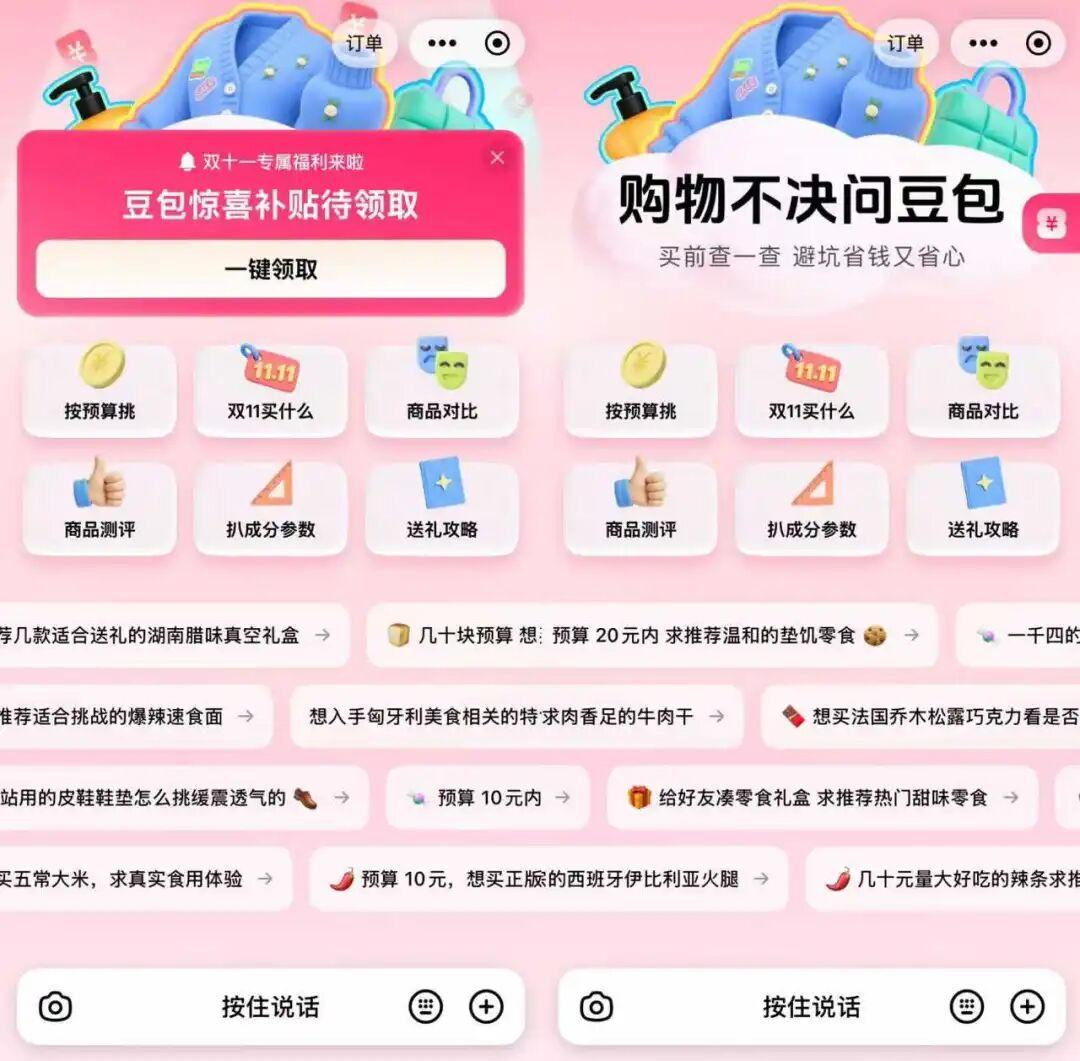
Figure: Doubao Double 11 exclusive welfare dialog box Source: Screenshot from Doubao App *Tingtong Tech*
This is not an isolated case.
On social platforms, posts about "asking large language models for shopping recommendations" have also emerged during this year's Double 11. Some netizens shared their experience of using DeepSeek to compare the prices of the same hair dryer on three platforms. Others asked Kimi to generate a skincare product list based on their description of sensitive skin in autumn and winter as a reference for placing orders.
"The main reason is that there are too many choices, making people hesitant. All platforms are emphasizing cost-effectiveness, which confuses me a lot. Perhaps I can ask AI to help screen the information."
Of course, Li Ran also tried the in-app AI e-commerce function of Taobao.
During the Double 11 period, Li Ran opened Taobao, directly put forward the demand to the "AI Assistant" at the top right corner of the App: "Help me make a skincare product list, with a budget of 1500 yuan, for anti-aging products suitable for sensitive skin."
Soon, the page jumped to the embedded "Qwen", which popped up a list including ingredient analysis, price comparison and coupon validity period. Li Ran took a glance and placed the order quickly.
"The special and convenient part of Taobao AI Assistant is that it has my previous consumption tracks and records, so the recommendations are more in line with my consumption preferences." Li Ran admitted, "It used to take two hours to make shopping strategies, but now I feel AI knows me better than myself."
At present, there is still a shopping list on Li Ran's mobile phone, including portable coffee machines, noise-canceling headphones, and outdoor jackets, and Li Ran marks each item with labels such as "best cost-effectiveness" or "new product recommendation".
"In the past, the AI e-commerce functions we directly experienced were one-click outfit changing and customer service. Now AI can quickly generate purchase plans, and the recommended products are quite reliable, which is a kind of progress." Li Ran said.
However, Li Ran also admitted that he does not rely entirely on the large language model-based e-commerce shopping mode. "For some products I have bought before, I will directly place the order without recommendations. I refer to the large language model only when I am hesitant, or when I want to jump out of conventional recommendations to see different options."
02
Why "Large Language Model + E-Commerce"?
A notable signal is that traffic entrances themselves are being driven to shift.
A clear example is that Qwen's e-commerce services are not only for consumers, but also for merchants.
Ahead of Double 11, Qwen Office released the e-commerce version Agent, positioned as an independent third party, serving all e-commerce platforms and merchants.
The product form of Qwen AI e-commerce version is not complicated. Users do not need to download a new App, and can use it by switching to the "E-commerce Operation" mode in Qwen Office. The first batch of functions covers four modules: cross-platform operation dashboard, trend insight and selling point analysis, mass generation of popular product materials, and cross-platform ROI intelligent optimization.
Take a specific scenario as an example: when a merchant inputs "This year's Double 11 revenue target is 5 million yuan, please formulate product, delivery and live streaming plans combining last year's promotion performance and the operation performance in the last 30 days", the system will generate a command center, updating the sales, inventory and advertising consumption of each store on a daily basis.
In fact, whether users turn to large language models for inquiry, or merchants start to hand over their business to AI, it means that the traditional "search, recommendation, conversion" funnel operated by e-commerce platforms is being pried open by the dialog box.
That is to say, when consumers get used to "asking AI what to buy" instead of "searching for what they want to buy", the role of AI in merchant operation will become more prominent, and AI will truly integrate with e-commerce step by step.
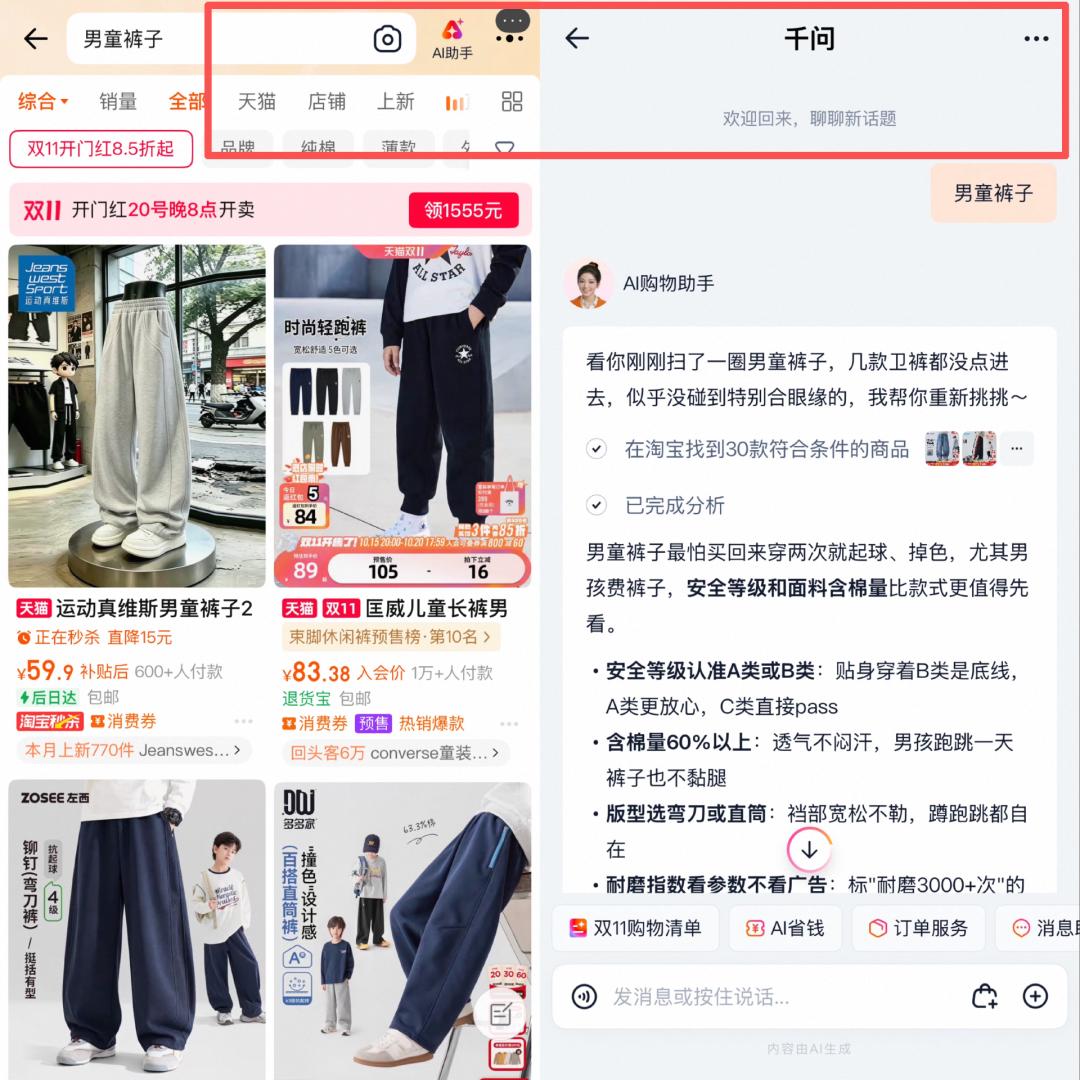
Figure: Usage effect of Taobao in-app AI Assistant Source: Screenshot from Taobao App *Tingtong Tech*
Of course, large tech companies have long been committed to AI e-commerce. As applications gradually scale up and become popular, large language models have become the core focus of AI e-commerce development.
Public information shows that as early as October 2025, Doubao was connected to Douyin E-commerce. In March 2026, the in-app shopping function was released for public beta, and in April, the "Help You Choose" navigation bar entry was launched. In May, Doubao promoted its core function "Ask Doubao Before Purchase", and has realized the closed loop of product selection through conversation, order placing and payment.
On October 15, Douyin E-commerce announced that during this year's Double 11, it will distribute consumer coupons in batches across multiple product terminals including Doubao, Hongguo Short Drama and Toutiao, extending promotional activities beyond the Douyin App. Doubao has specially set up a "Ask Doubao for Double 11" navigation bar. On this page, clicking the order button at the top right corner can directly jump to the order page of Douyin Mall, and users can also watch e-commerce live streams, receive coupons and place orders directly in Doubao.
In the traditional e-commerce market, Taobao also leverages Qwen to implement AI e-commerce scenarios.
In May this year, Qwen was fully connected to Taobao, and the "Qwen AI Shopping Assistant" was also launched synchronously in the Taobao App. Ahead of this year's Double 11, Qwen Office further released the e-commerce version and opened invitation testing.
In the view of Dalin, an e-commerce observer, the value of large language models in e-commerce scenarios will truly grow from an AI tool to a full consumption link only after users gradually form corresponding habits.
However, as for why large language models are the core, Dalin said, "The core reason is that in the past, AI was a single-point tool that solved the efficiency problem of a certain link: recommendation algorithms managed distribution, and customer service robots managed reception. Large language models are link reconstructors, which connect search, recommendation, price comparison, decision-making, order placing and even after-sales into a complete closed loop with dialog as the entrance."
In other words, "Large language models make it possible for the first time to 'complete a transaction with one sentence'. This is also the path that e-commerce and model manufacturers have been exploring through continuous development." Dalin said frankly.
In fact, the combination of e-commerce and large language models has been tried abroad long ago. Public information shows that as early as September 2025, OpenAI grandly launched Instant Checkout, trying to allow users to complete shopping directly in the ChatGPT dialog box.
But less than half a year later, this function was taken offline.
"The reason is straightforward: ChatGPT has a 'smart enough brain', but lacks capable 'hands and feet'. When users ask for sunscreen suitable for sensitive skin, ChatGPT can give recommendations, but it cannot handle the most basic e-commerce capabilities such as real-time inventory status, accurate delivery, and return and exchange processing." Dalin pointed out.
Until now, models are smart enough, and e-commerce platforms are willing to provide their 'hands and feet', so the 'large language model + e-commerce' mode can truly operate smoothly.
03
Moving towards Each Other?
The term AI e-commerce has been talked about in the industry for several years.
But before that, merchants had a stronger perception of it.
Previously, some merchants said that in daily operations, AI will automatically generate titles and selling point copies when launching new products, AI can independently receive customers during peak customer service consultation periods, and AI can generate short video materials during large promotions. "All these are more cost-effective than temporarily expanding the customer service team in previous Double 11 events."
Data also confirms the changes. During the Double 11 in 2025, JD.com said that the number of internal running agents exceeded 30,000, and the merchant intelligent customer service Jingxiaozhi 5.0 has served 160 million person-times in total. During the 2025 Double 11, Taotian Group announced that 5 million merchants have used "AI Business Steward" to assist in large promotions, with an average efficiency increase of 1.5 times.
But it is also a fact that end users did not have strong perception of these changes before.
Li Ran said, "I tried AI fitting before, and I know about AI customer service. But the experience was not good enough. The AI felt too mechanical to solve practical problems." Until recently, Li Ran felt that large language models are indeed changing his shopping habits, and the experience is "quite smooth".
After all, large tech companies have been looking for the landing point of AI e-commerce, and keep trying and optimizing.
After all, e-commerce is the most "cost-effective" scenario for AI implementation. The consumer retail decision-making chain, which features vague demands, numerous options and high decision cost, is naturally suitable for conversational interaction. It is a test field that no team can resist, with high frequency, rigid demand and quantifiable effects.
In addition, model manufacturers also need monetization outlets. E-commerce is a field close to cash flow in the internet industry. Every increase in conversion rate corresponds to real revenue. Model manufacturers are also eager to prove that they are not only capable of burning money, but also capable of making profits.
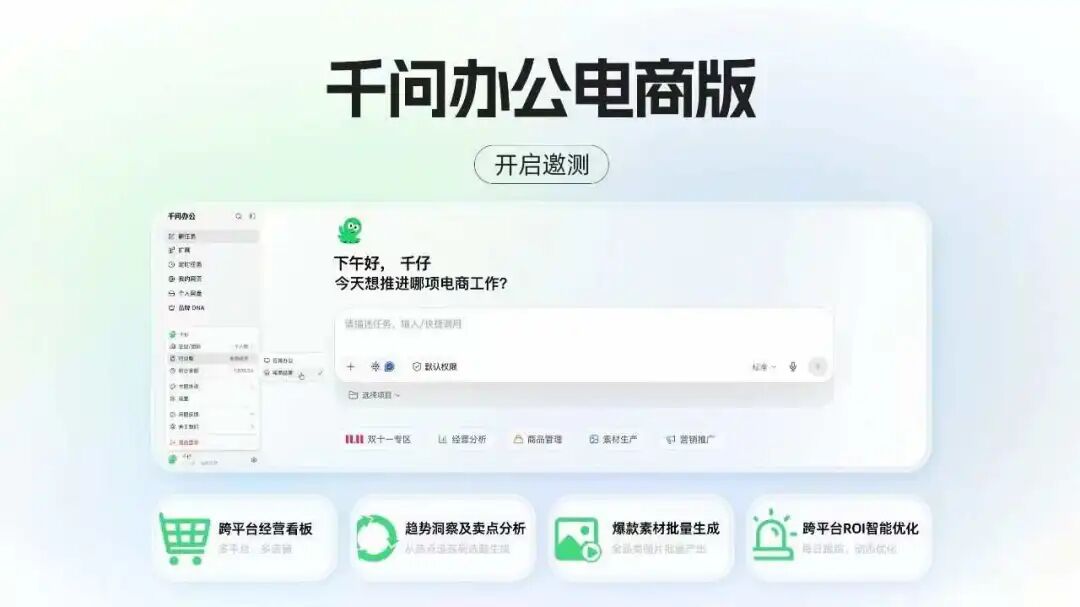
Figure: E-commerce version of Qwen Office Source: Alibaba
Platforms also need new growth narratives.
Especially at present, "de-GMV" has become the industry consensus. Platforms no longer announce total transaction volume, but instead emphasize the growth of member numbers. That is to say, the scale growth story has hit a ceiling, and the efficiency improvement story needs to take the stage. AI is exactly the best protagonist of the efficiency story.
However, no one wants to give the initiative to others.
In fact, when consumers first open Doubao or Qwen instead of the search box of Taobao or JD.com when they have shopping demands, the "traffic moat" carefully built by e-commerce platforms will face the risk of being bypassed. Therefore, whether it is Alibaba or ByteDance, even if the ecology is open, the core resources must be controlled by their own teams.
Of course, although the penetration of large language models into e-commerce is getting stronger, large language models still have points to improve when stepping into the e-commerce sector.
"Especially the trust mechanism: if unmarked commercial promotions are mixed in AI recommendations, consumers can hardly identify them. In fact, traditional advertisements have clear marking specifications, but soft recommendations embedded in AI conversations are still in a gray area of supervision." Dalin said.
However, the competition for traffic entrances is an established fact.
"Whether it is Qwen or Doubao, it is just the beginning. Whoever can become the first AI that consumers are willing to open is more likely to master the traffic distribution right in the next stage." Dalin said.
The relationship between platforms and models will also evolve from "cooperation" to "co-opetition". After all, the game between entrance and shelf is essentially a problem of benefit distribution.
Large language models have penetrated into the core of the e-commerce industry, and this year's Double 11 is just the opening, with more exciting stories yet to come.
This article is from WeChat official account "Tingtong Tech", author: Yang Lin, editor: Rao Xiafei, published with authorization from 36Kr.