Half of China's cities can no longer accommodate new shopping malls.
The incremental expansion of shopping malls in China is approaching the boundary of urban carrying capacity.
By sorting out the new supply of shopping malls in China in the next three years, we find that not all cities can accommodate an additional new shopping mall. According to statistics from Winshang Big Data, nearly half of the cities across the country (accounting for 47.5%) have entered the "peaking" stage of shopping mall development.
What is a peaking city? Based on multi-dimensional considerations, Winshang Big Data defines it as "a city with no new incremental shopping mall supply for the time being".
According to the differences in market supply, these cities can be further divided into two types: structural peaking and phased peaking.
By definition, among the 341 cities across the country that have deployed shopping malls with a floor area of more than 30,000 square meters, 162 cities have entered the peaking stage. Almost all of these cities are third-tier and lower-tier cities with relatively low economic levels and small single-market capacity, with Harbin being the only high-tier city among them.
The ensuing questions are: Which cities are taking the lead in touching the incremental ceiling? Why do these cities reach their peak first? What kind of expansion path have they experienced? By overlapping time and space, a clear "peaking map" of China's shopping malls is unfolding.
01.
Where are the peaking cities?
By sorting out the locations and customer group portraits of 162 peaking cities, three structural characteristics can be summarized.
Regional structure: Northeast China takes the lead in peaking, and Northwest China sees concentrated peaking around 2020
Looking at the longer timeline, Northeast China is the first region in the country to enter the structural peaking stage in a concentrated manner. Some cities in Northeast China ended their shopping mall expansion as early as around 2015. For example, cities like Jiamusi, Baicheng, Huludao and Heihe have not had any newly opened shopping malls with an area of more than 30,000 ㎡ since 2015. After that, cities including Jixi, Yingkou and Qiqihar also successively entered the long-term no-increment stage.
The early economy of Northeast China relied on heavy industry and resource-based industries, with a relatively single industrial structure and relatively insufficient development of the private economy. With the transformation of the economic development model and growth drivers, the industrial transformation is under pressure, and economic growth has gradually slowed down. Industrial contraction, population reduction, outflow of young people... The vitality of the city continues to decline, which naturally cannot support the sustained growth of the commercial market.
The data from the 7th National Population Census shows that the total population of the three provinces in Northeast China decreased by 11.01 million from 2010 to 2020, which is equivalent to losing the population size of a medium-sized city every year. The lack of consumer population and insufficient consumer demand are the fundamental reasons for no new supply of shopping malls.
The same is true for the Northwest China, where the time to enter structural peaking is concentrated around 2020. Different from the population loss situation in Northeast China, the Northwest China is characterized by low population density, scattered urban distribution and limited consumption hinterland, so the number of shopping malls that a single city can support is not high to begin with. When existing projects have basically covered the core consumer demand, the space for new supply will narrow rapidly.
An interesting perspective is that the lower the proportion of peaking cities in a region, the more cities still have incremental space for shopping malls, which indirectly indicates that the overall economic strength of the region is stronger and the development gradient between cities is more balanced. For example, the number of peaking cities in East China is far lower than that in other regions, and commercial demand is not highly concentrated in a few core cities, but is active in a wider range of urban tiers.
Spatial structure: The farther away from the core city, the easier it is to reach the peak
From the perspective of spatial relationship, the growth potential of urban commerce is closely related to its position in the metropolitan area. At present, there are 21 national-level metropolitan areas in China that have been officially approved by the National Development and Reform Commission or the State Council.
Since the expression and division standards of spatial structure in official plans across regions are not unified, for the convenience of horizontal comparison, this paper takes the urban positioning in official plans as the main basis, and combines the spatial location, industrial cooperation and functional connection between cities to uniformly divide the urban hierarchy within the metropolitan area.
According to the level of regional economic development and radiation driving capacity, the cities covered by these metropolitan areas can be divided into "core city - node city - peripheral city", presenting a hierarchical structure that weakens step by step from strong to weak.
There is an obvious rule in these metropolitan areas: the farther away from the core city, the higher the probability of the city reaching its peak. According to statistics from Winshang Big Data, up to now, only Zhangzhou among the 21 core cities of the metropolitan areas has shown phased peaking; the peaking rate of node cities is 23%, and that of peripheral cities further rises to 47%. For cities that do not belong to any metropolitan area, the peaking rate has reached as high as 57%.
Behind this is the gradual decline of the spillover growth dividends from core cities. In regional economics, the development of core cities will produce spatial spillover effects on surrounding areas, including industrial spillover, population flow, infrastructure sharing, employment opportunities and so on.
Therefore, node cities that are close to core cities and have close transportation links can often take the lead in undertaking industrial transfer, population spillover and consumption upgrading. Even if their own urban level is not high, the consumer market still has space for continuous expansion; while peripheral and remote cities are more prone to insufficient development and consumption spillover.
The Wuhan Metropolitan Area is a typical example. Node cities such as Huangshi, Huanggang, Ezhou and Xiaogan are more closely connected with Wuhan, which can realize industrial coordination, transportation commuting and functional complementarity. Except for Ezhou, none of them have reached the peak or are in the phased peaking stage; while peripheral cities such as Xianning, Xiantao, Qianjiang and Tianmen, which have relatively weaker spatial distance and economic ties with Wuhan, have entered the peaking stage.
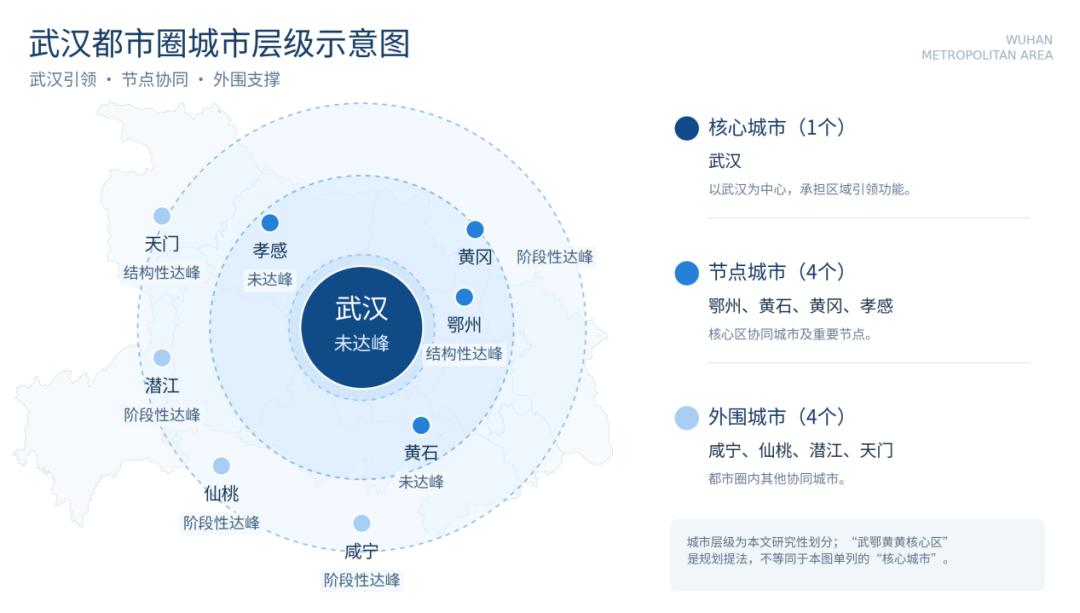
Note: The circle layer and urban location are conceptual illustrations and do not represent the real geographical distance.
Customer group structure: The mismatch between "popularity" and "consumption" in tourist cities
Among the peaking cities, there is also a special type of sample: tourist cities. In popular tourist destinations such as Lijiang, Guilin and Beihai, the shopping mall market has stagnated for many years with no new increments.
Different from the resource-based cities in Northeast China, tourist cities do not lack "popularity". The real problem is that tourists stay for a short time, the consumption frequency is low, and consumption is often concentrated in tourism scenarios such as scenic spots, characteristic blocks, catering, accommodation, and cultural and creative retail. For shopping malls, this part of passenger flow is more of an incremental supplement. What really determines whether a project can operate stably for a long time is still the high-frequency consumption formed by local residents.
Take Lijiang as an example. In 2025, it received about 87.06 million tourists throughout the year, while the city's permanent resident population was only about 1.25 million, and the annual number of tourist receptions was nearly 70 times the size of the permanent resident population. However, on the commercial development side, Lijiang has not added any new shopping malls since 2016.
This shows that tourists can amplify the total consumption of a city, but it is difficult to completely replace the long-term stable daily support of local customers for shopping malls.
When the existing businesses have basically covered local demand, adding a new shopping mall will only re-divide the limited local customer base instead of creating new consumer demand, and developers' willingness to enter will naturally decline accordingly.
However, not all tourist cities will reach their peak in advance. Cities such as Sanya and Xiamen still maintain continuous growth of shopping malls, which is often supported by stronger population and economic foundation as well as high-end consumption. Cities that are really prone to structural peaking are those that take tourism as their pillar industry but have a relatively limited local consumption base.
02.
How does peaking happen exactly?
Looking at the long timeline, the emergence of peaking cities does not happen instantly, but is the result of rounds of commercial expansion gradually touching the upper limit of urban capacity.
From the perspective of stock growth rate, compared with non-peaking cities, the shopping mall supply in peaking cities is more concentrated, with greater growth rate elasticity and more obvious periodicity of supply.
From 2006 to 2016, the stock growth rate of shopping malls in peaking cities maintained a high-speed growth of more than 30%-40% all year round, and then fell back rapidly. Excluding the impact of the epidemic, peaking cities formed the last small peak of concentrated supply around 2019, and then accelerated into a downward channel.
This difference in growth patterns is related to the supply characteristics of peaking cities. Combined with the changes in market capacity and development entities, the emergence track of peaking cities in the shopping mall market can be roughly divided into three stages:
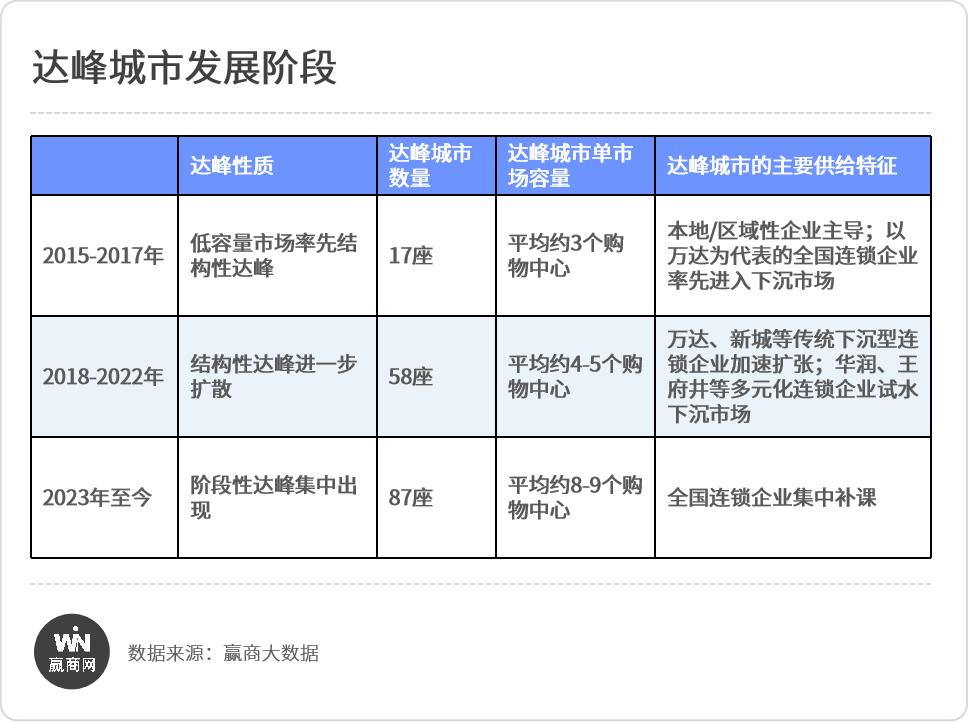
2015-2017: Low-capacity markets take the lead in peaking
The first cities to enter the structural peaking stage are a group of sinking cities with small market capacity and weak commercial foundation.
In this stage, a total of 17 cities took the lead in peaking, mainly concentrated in Northeast and Northwest China. For example, the last shopping mall project with an area of more than 30,000 ㎡ in Heihe is the Haihua Mall opened in 2015, and the last new project in Qiqihar is Huaxia City Plaza opened in 2017.
The shopping mall markets in these cities were initially built by local developers, local department store groups and regional operators, and it was not until 2009 that national chain enterprises represented by Wanda began to enter the market.
Most of these cities have a population of about 1 to 2 million, with limited commercial carrying capacity and small urban built-up area. Basically, two or three shopping malls can cover the needs of all age groups in the whole city. High-quality brands, passenger flow and consumption power will quickly concentrate on leading projects, which to a certain extent inhibits the entry of competitors.
Therefore, the peaking at this stage is essentially reaching the top before full expansion.
2018—2022: Chain enterprises sinking to lower-tier markets, accelerating peaking
Since 2018, the peaking of shopping malls has gradually spread to cities with relatively mature commercial foundations, and a second round of relatively concentrated structural peaking has been formed within five years. This stage covers 58 cities in total, with an average of 4-5 shopping malls, and their commercial foundation is significantly better than that of the cities in the first stage.
In 2018, among the 8 peaking cities, the last shopping mall project in 5 cities including Shizuishan, Fuxin, Wuwei, Benxi and Suihua was Wanda Plaza. At this stage, chain enterprises such as Wanda and Xincheng, which take the sinking market as their strategic focus, have shifted from city-level penetration to leading and improving the urban commercial pattern.
After that, this layout strategy continued to extend to new districts, counties and emerging business districts. In 2019, Yancheng Wuyue Plaza was settled in Yan'an New District, supplementing the supply of large-scale comprehensive commerce in the new district; from 2021 to 2022, Wanda and Wuyue entered county-level markets such as Tianmen and Shihezi. At the same time, large shopping malls were also added in counties and counties such as Menyuan, Xiangzhou, Kuqa and Hepu to fill the gaps in the market.
At the same time, chain operators such as Century Golden Resources, Aegean, China Resources, Intime and Tianhong also began to lay out the sinking market, becoming an important driving force for a new round of commercial supply.
However, this round of sinking is more about filling the original commercial gap in the market, rather than opening up unlimited commercial growth space.
Therefore, the second round of market peaking is the result of Wanda and Xincheng completing large-scale expansion in the sinking market, followed by other chain enterprises one after another. When the main business districts and consumption sectors of the city are gradually supplemented, structural peaking will come accordingly.
2023 to present: The final round of complementation in mature markets
Compared with the early peaking cities, the peaking cities at this stage already have a more mature shopping mall market. The 87 peaking cities have an average of about 8-9 shopping malls, including cities with good economic and commercial foundations such as Harbin, Haikou, Bengbu and Quzhou.
To a certain extent, the third round of peaking corresponds to the batch of cities with the most mature commercial foundations in the sinking market, as well as a very small number of high-tier cities with weak economic growth momentum. After the final round of complementation by chain enterprises, they gradually enter the supply peaking stage.
2023 is the starting point for the final round of sinking of these chain enterprises. Compared with the second stage, the development entities in the third stage are more diversified, and the expansion strategy has shifted from filling gaps to business district upgrading, product iteration and operation quality improvement.
For example, the latest opened shopping mall in Haikou, Longfor Hainan Haikou Paradise Walk, opened in September 2024, with a commercial volume of 220,000 square meters, located in the mature Yeyhai business district.
Before the opening of Longfor Hainan Haikou Paradise Walk, the duty-free commerce in Haikou was in full swing, but the commercial supply for local consumers mostly stayed at the traditional commercial positioning of "complete categories to meet daily needs".
As a latecomer, the advantage of Haikou Paradise Walk lies in that it has formed a generational gap with the existing commercial complexes in terms of products, experience and brands, and its business format structure and public area renovation are continuously optimized around the consumption habits of local consumers. For example, according to local dressing styles and consumption preferences, it builds a matrix of high-quality clothing brands; combined with the strong local consumption demand, it introduces many popular catering brands with better environment and service.
After the opening of Haikou Paradise Walk, it drove the Yeyhai business district to jump to the top of Haikou's business districts in terms of passenger flow. At present, Haikou Paradise Walk ranks first in the province with an average daily passenger flow of more than 100,000 person-times.
But from a long-term perspective, the commercial markets in these cities cannot be judged as long-term stagnation for the time being. Future changes in the city's population, industrial introduction, new district development and other aspects may still bring new business opportunities. Therefore, we should define the third round as phased peaking rather than structural peaking.
We expect that starting from the third stage, peaking will gradually evolve from a partial phenomenon in the sinking market to a universal phenomenon in the stock era of the shopping mall industry.
In the past two decades, China's shopping mall industry has been used to answering one question: Where to open the next mall? But when 162 cities cannot wait for the "next mall" for the time being, the question is reversed: How many shopping malls