China's AI Short Drama Going Global Report: Surging Production Capacity and Traffic Encirclement, What Exactly Are AI Short Dramas Competing Fiercely For?
Overseas expansion of AI-generated short dramas is plagued by overcapacity, and the industry urgently needs to shift its focus to quality improvement, user retention and core competitiveness building
While domestic micro short dramas are still locked in cutthroat competition for actors, Chinese manufacturers have already marched into the global market with AI technologies.
However, behind the frantic overseas expansion, a harsh truth has emerged: AI-generated short dramas already account for 95% of the total output, but only capture 4% of total view counts.
As AI pushes the marginal cost of content production close to zero, traditional content barriers have collapsed accordingly. In contrast, the traffic cost on the distribution side remains high, and compliance thresholds are still climbing.
This is not just an upgrade of production tools, but also a fierce competition for the distribution right of industrial value.
01
From "Production Capacity Myth" to "Quality Gap"
The transformation of AI on the short drama production end is extremely disruptive. Compared with live-action short dramas, AI-generated short dramas have cut the production cost of a single work from 500,000-1,500,000 RMB to 50,000-240,000 RMB, boosting production efficiency by 60 to 100 times.
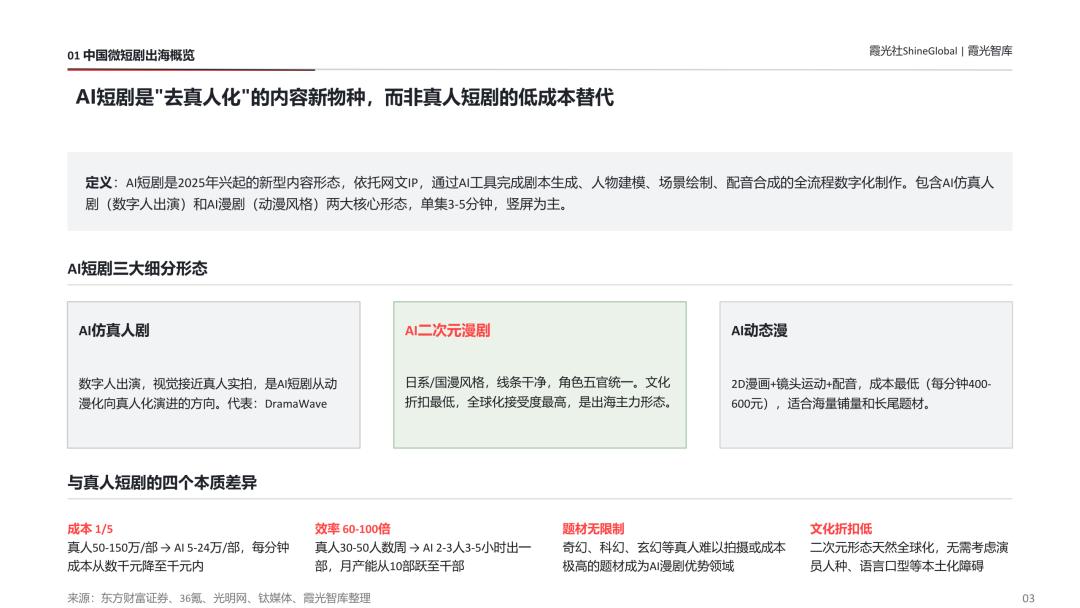
This dimensionality reduction attack directly leads to a surge in production capacity: the market size of AI-generated short dramas is expected to soar to 650 million US dollars in 2026, with a year-on-year growth rate as high as 550%.
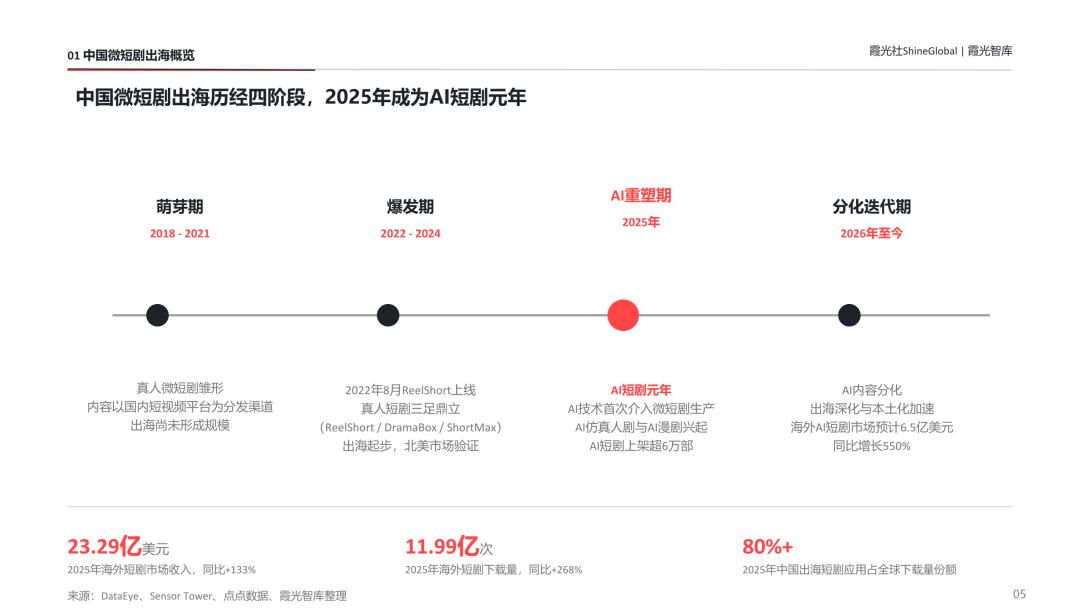
However, a harsh reality is hidden behind this production capacity feast.
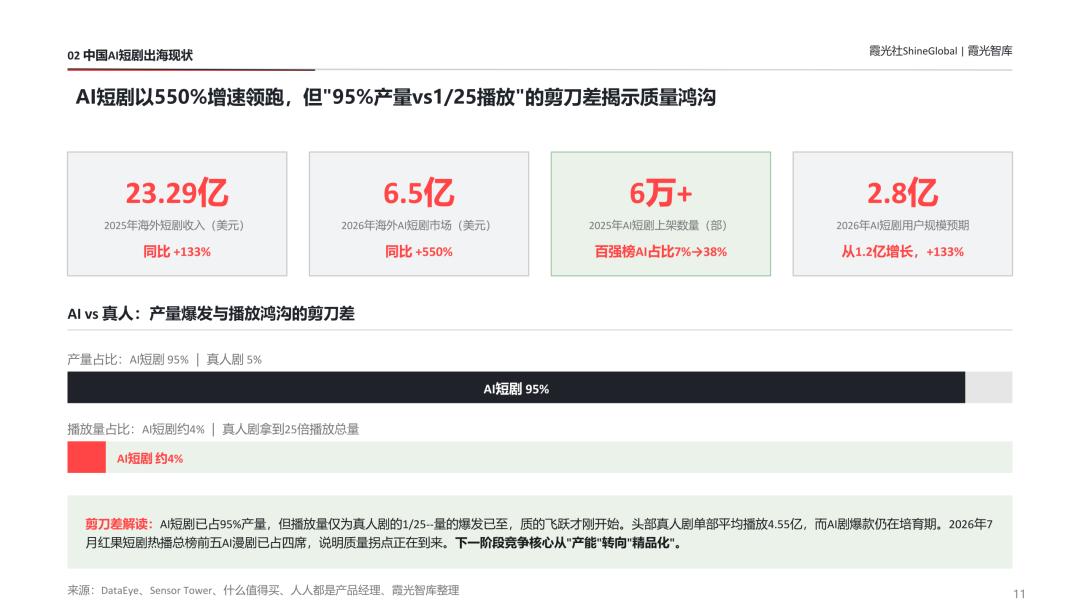
AI-generated short dramas account for 95% of total output, but only get 4% of total view counts, and live-action dramas still capture 25 times more view counts than AI-generated ones.
The "quantitative surge" brought by AI has been completely saturated, while the "qualitative leap" has just begun.
In July 2026, four of the top 5 most popular works on the hit ranking of Hongguo Short Drama are AI-generated animated dramas.
The core of competition in the AI short drama sector is shifting from "who can produce more dramas" to "who can produce dramas that users will not swipe away".
02
Efficiency Dividend Eroded by "Traffic Tax"
Many people mistakenly believe that the production cost saved by AI is pure profit.
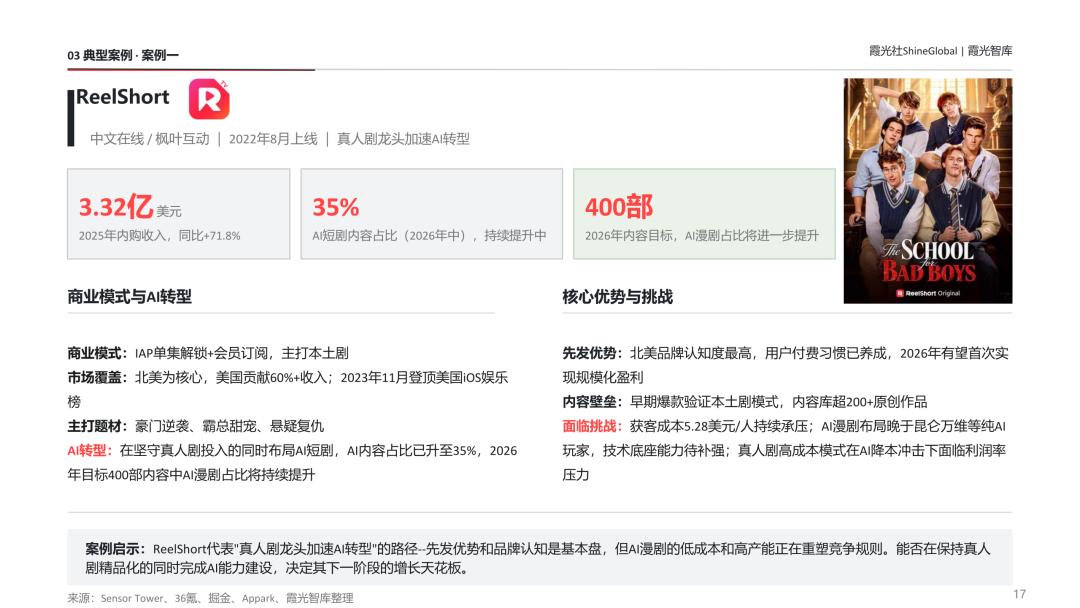
The report points out that the traffic delivery cost of overseas short dramas accounts for about 50% of the total overseas expansion cost, and the customer acquisition cost per user in the North American market is as high as 5.28 US dollars.
In 2025, although the in-app purchase revenue of ReelShort reached 332 million US dollars, its profit margin continued to face pressure due to the high customer acquisition cost.
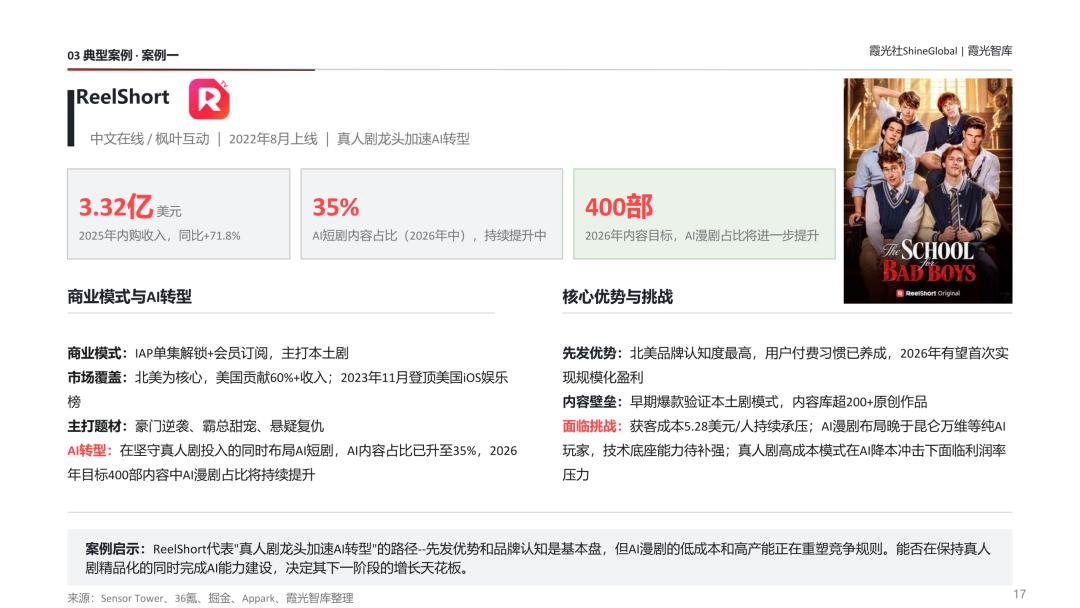
When AI pushes the marginal cost of content supply close to zero, the competition focus will inevitably shift from "content production" to "traffic acquisition". The production cost saved by AI is essentially reallocated to distribution platform operators including Meta (65%), Google (20%) and TikTok (10%) through the "traffic tax" of bidding for ad delivery.
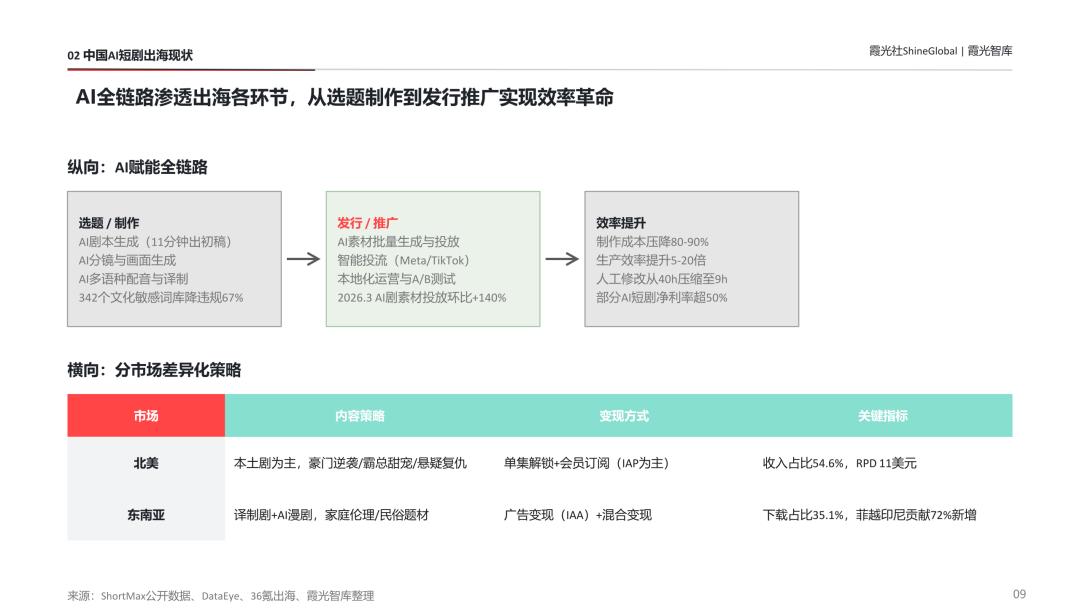
Every time a platform launches a new drama, it needs to repurchase traffic. The increased production capacity brought by AI has further aggravated the cyclic consumption of "production - ad delivery - user churn - re-production". The larger the production capacity, the more materials need to be delivered, and the more intense the traffic bidding will be — This is not an efficiency dividend, but a self-reinforcing cost trap.
03
Who is Building the Real Moat?
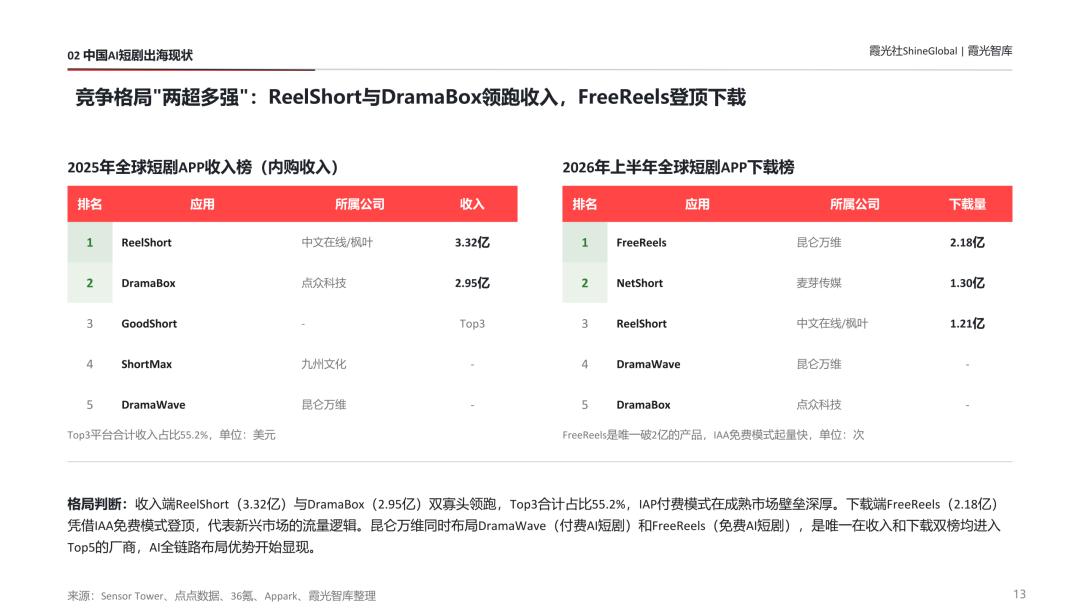
Squeezed by both rising traffic cost and higher compliance thresholds, the competition landscape of AI short drama overseas expansion has evolved from the early "two superpowers with multiple strong players" (ReelShort and DramaBox lead the revenue ranking, FreeReels tops the download ranking) to a deeper pattern of differentiation.
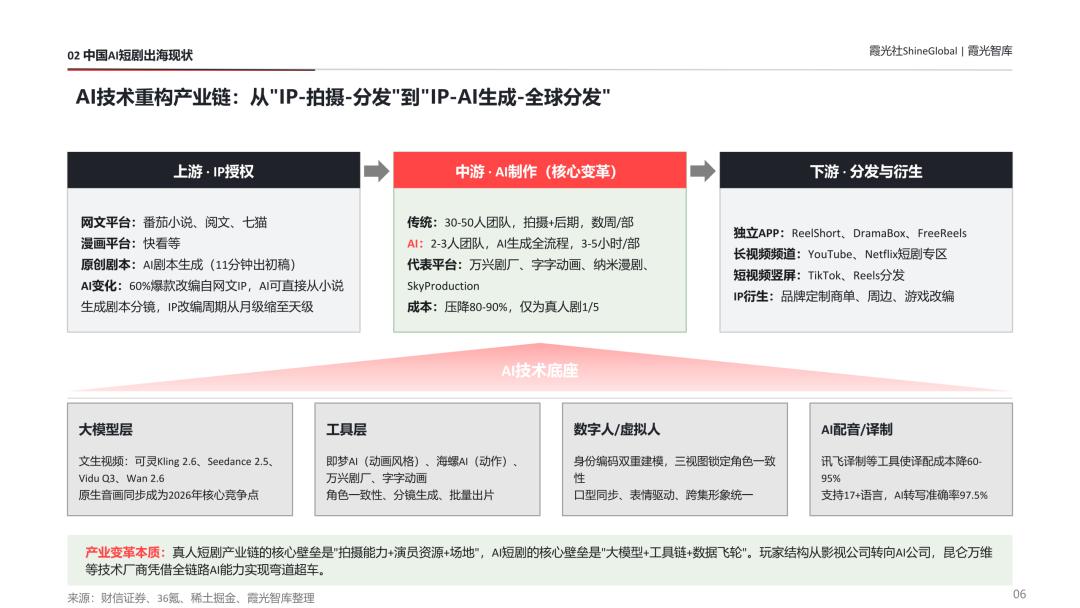
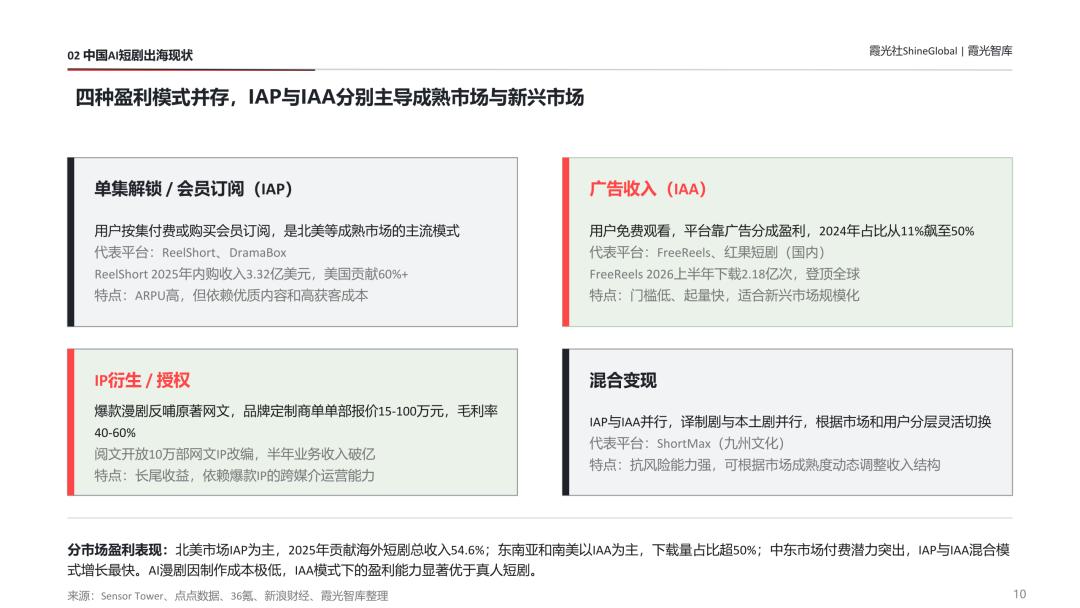
The IAP payment model has built a duopoly barrier in mature markets such as North America (ReelShort and DramaBox lead the revenue ranking), while the IAA free model has leveraged traffic scale in emerging markets (FreeReels tops the download ranking). Kunlun Wanwei, with its dual product matrix of "payment + free", has become the only manufacturer that ranks Top 5 on both lists, which proves the competitive advantage of full-link layout.
Dimensionality reduction attack from technology infrastructure players: Kunlun Wanwei
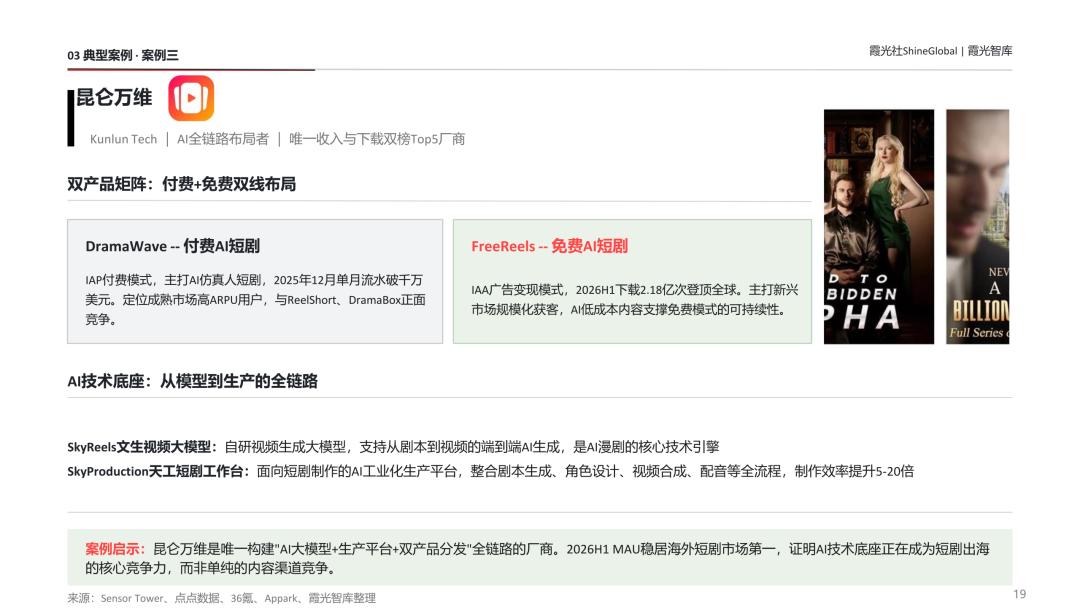
With self-developed large model (SkyReels), industrialized production platform (SkyProduction) and dual product matrix of "paid DramaWave + free FreeReels", Kunlun Wanwei is trying to build a technology moat with full-link capabilities of "model + tool + distribution". In the first half of 2026, its MAU ranks first overseas, proving that technology infrastructure is becoming the core competitiveness. However, the construction of technical barriers takes time, and the growth rate of promotion expenses is faster than that of revenue, so the company still faces loss pressure in the short term.
Scenario deep cultivation of content platform players: ReelShort, DramaBox
ReelShort's strategy is to stabilize brand premium with live-action content and cover long-tail distribution with AI-generated content, and the proportion of AI-generated content has risen to 35%.
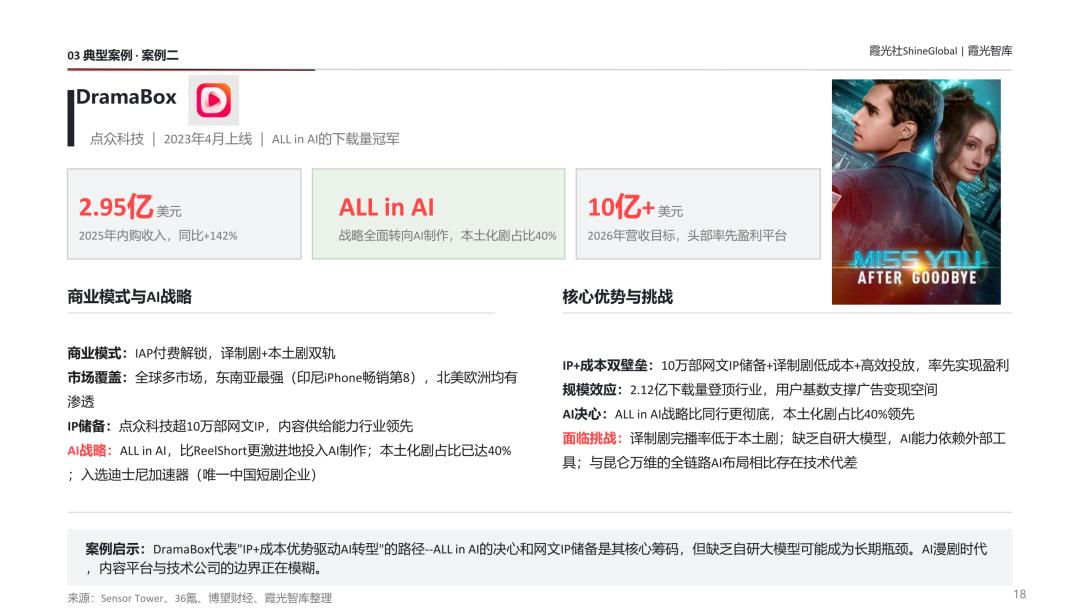
DramaBox has gone all in on AI with a reserve of 100,000 online novel IPs, and the proportion of localized dramas reaches 40%. The common point of the two platforms is that: AI is a leverage, not an anchor. The content library and user mindshare are the foundation for them to resist technology fluctuations.
Rule reconstruction of ecosystem players: ByteDance PineDrama
Platform-level players subsidize the market with the "free + ad" (IAA) model, do not pursue profit from a single drama, but pursue the scale effect of user duration and ad inventory. This gameplay has directly changed the rules of the game, and caused huge erosion to the pricing power of traditional IAP payment platforms.
04
From "Ex-post Patch" to "Admission Qualification"
AI brings not only production capacity, but also huge compliance risks.
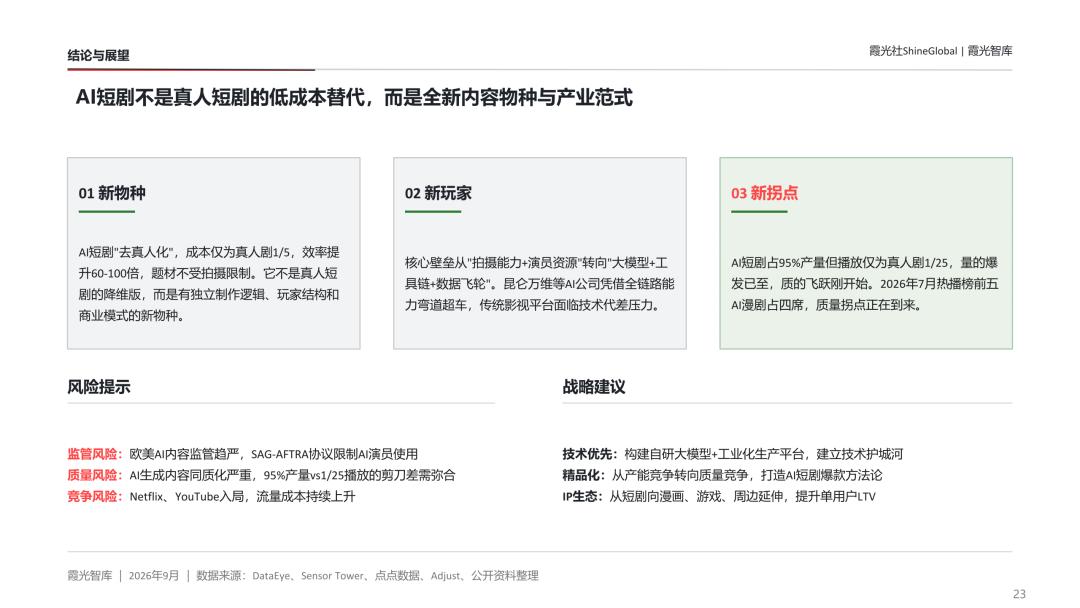
From the filing system of the National Radio and Television Administration of China, to the restrictions of the SAG-AFTRA vertical screen agreement in North America, and to the religious and minor protection reviews in Southeast Asia, compliance is evolving from a marginal cost item to an access threshold. The evaluation dimension of technical capabilities is being reconstructed: whether an AI content production system has native compliance capabilities (copyright traceability, AI label embedding, sensitive word detection) will directly affect whether its content can be distributed.
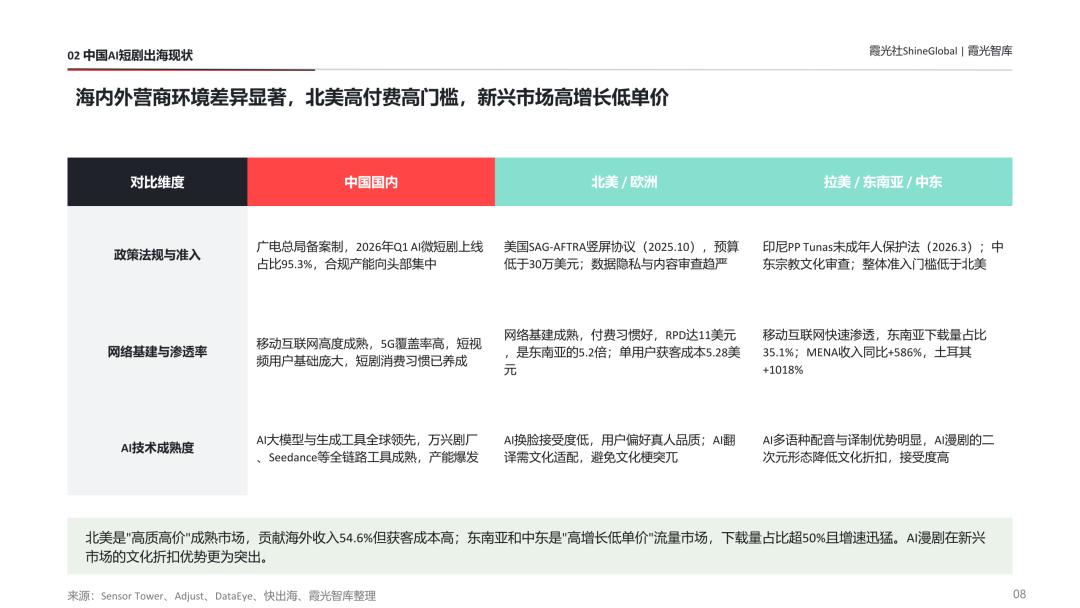
At the same time, although the SaaS trend of service ecosystem has lowered the threshold for overseas expansion, it also makes small and medium teams form external dependence on compliance capabilities. When platforms tighten standards, teams without compliance infrastructure will be eliminated first.
05
The Next Stop of Efficiency Narrative
Looking back at the node of 2026, the overseas expansion of AI short dramas is transforming from "supply-side scale expansion" to "total factor efficiency competition".
When production cost is no longer a scarce resource, value will inevitably concentrate at two ends: the upstream engineering controllability (whether high-quality content can be stably produced), and the downstream distribution right (whether user attention can be obtained at low cost).
According to the forecast of the report, from 2026 to 2028, we will witness the maturity of AI photorealistic short dramas, the rise of interactive short dramas, and the complete elimination of cultural discount by native multilingual generation technology.
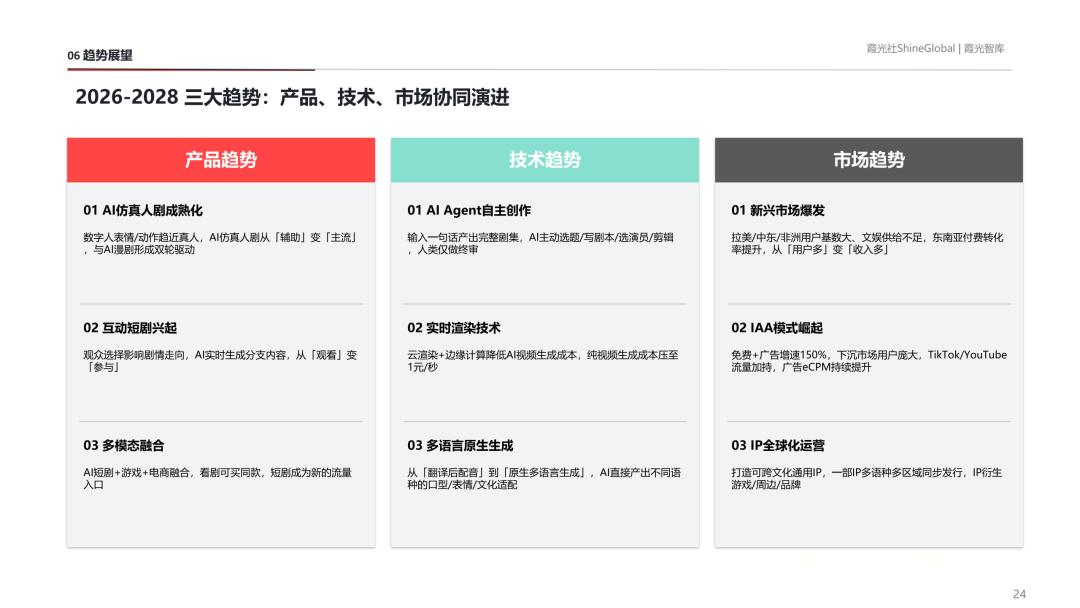
But before that, the industry must first cross the current gap — shift from "competing for output" to "competing for quality", shift from "buying traffic" to "improving retention", and shift from "single monetization" to "hybrid monetization".
For all overseas market players, the question they need to answer now is no longer "how much money can AI help me save", but: when everyone is using AI to reduce costs, where is my irreplaceability?
This article is from WeChat official account "Xiaguang Think Tank", author: Xiaguang Think Tank, published with authorization from 36Kr.