Tencent takes the lead, Baidu ranks second, and the AI office landscape is far from being finalized.
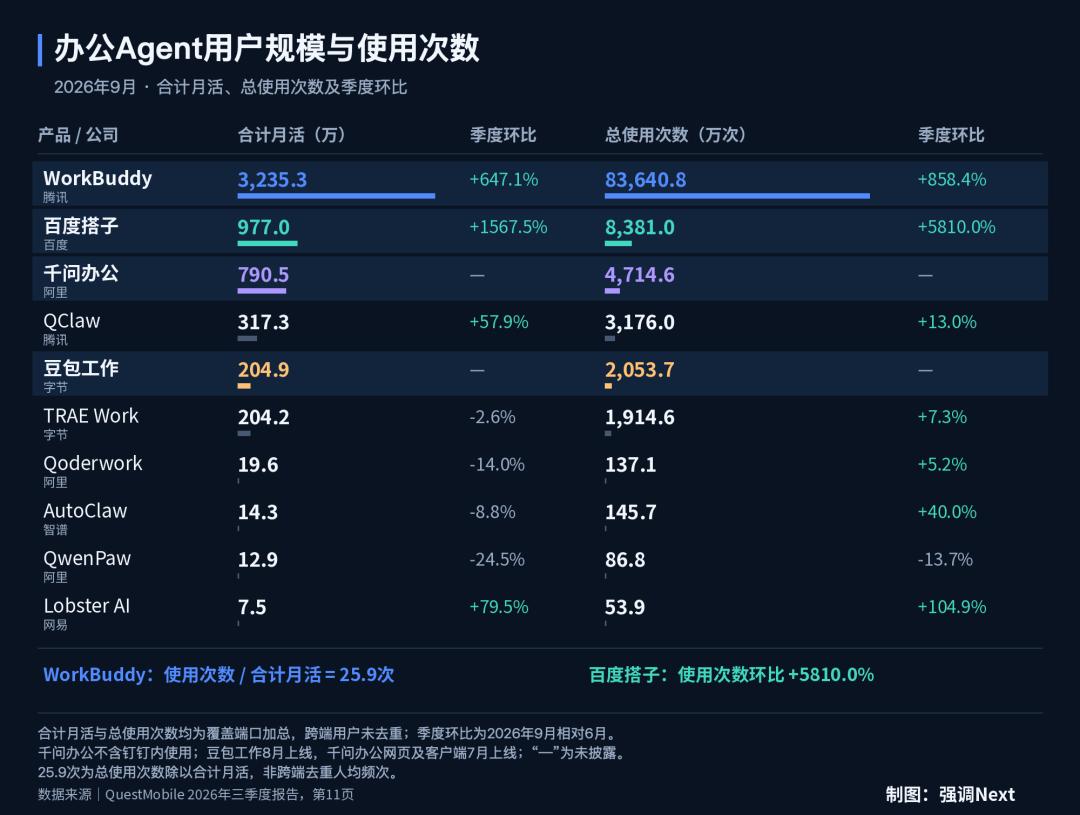
On October 20, QuestMobile released the Q3 AI application market report. In September, the total number of active users in the AI office track reached 142 million, a year-on-year increase of 50.6%. The top three in the typical office Agent list are Tencent WorkBuddy, Baidu Dazi and Alibaba Qianwen Office, with active user sizes of 32.353 million, 9.77 million and 7.905 million respectively.
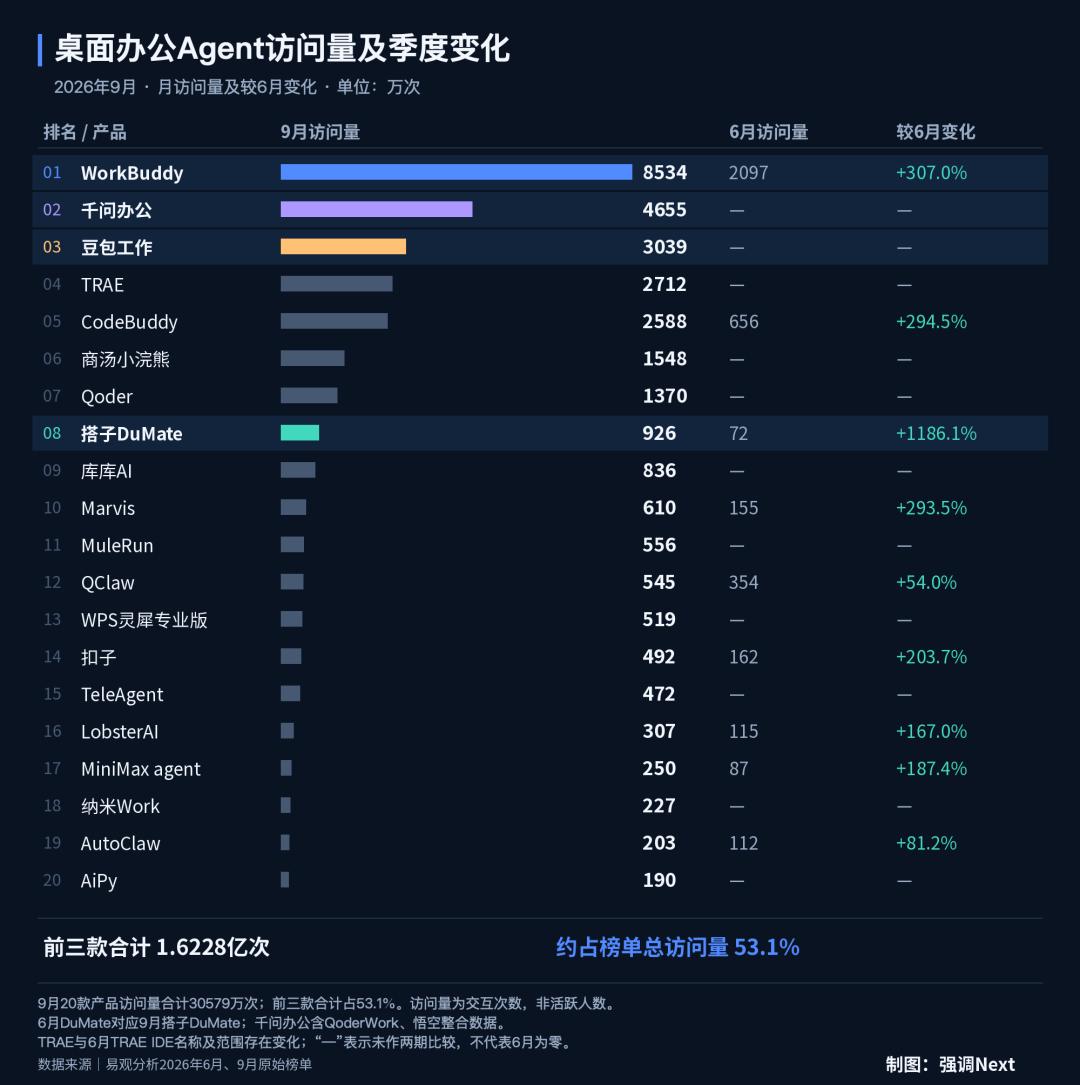
Another list presents a different perspective. According to Analysys' statistics of office agents on the desktop in September, the monthly visits of WorkBuddy, Qianwen Office and Doubao Work reached 85.34 million, 46.55 million and 30.39 million respectively, and the three products together accounted for 53.1% of the total visits of the 20 listed products.
The two lists measure different things. QM adds up the monthly active users of all ports covered by the products, without de-duplicating cross-port users, while Analysys counts the interaction times of desktop applications. Neither of them can be directly regarded as an enterprise order list, but they both target the same business goal: who can turn individual trials into fixed team expenses.
Major tech companies have already started poaching each other's customers for this purpose. Qianwen Office supports migrating local historical data from WorkBuddy; Doubao Work allows users to transfer conversations, skills and memories from other AI products; Tencent has integrated WorkBuddy into WeCom, and also provides robot access methods for DingTalk and Feishu.
Enterprises can continue to use their original software for meetings, chats and approvals, and hand over part of the work to AI from another vendor. The existing customers of collaborative software are becoming the target group that all office Agents are competing for.
Tencent's address book cannot retain all AI budgets
Tencent continues to maintain its leading position. According to QM's caliber, the total monthly active users of WorkBuddy in September are about 3.3 times that of Baidu Dazi and 4.1 times that of Qianwen Office, and the total number of multi-terminal usages reaches 836 million times. According to Analysys' desktop caliber, the monthly visits of WorkBuddy increased from 20.97 million in June to 85.34 million in September, 4.07 times the original figure in three months.
However, to maintain this lead, Tencent cannot just stick to its existing basic market.
On October 9, WorkBuddy added an independent file browser, which allows local files to be previewed directly and handed over to AI for editing. On October 14, WeCom and WorkBuddy jointly released a new version: after an enterprise activates and allocates seats, employees can call WorkBuddy from the address book or sidebar, or log in to the client with their WeCom accounts to process information such as messages, documents, meetings and to-dos within the authorized scope.
This saves Tencent one customer acquisition step. Employees are already communicating in WeCom, and work materials are already stored there. WorkBuddy can receive tasks along existing records, without requiring people to re-upload files and explain the context every time.
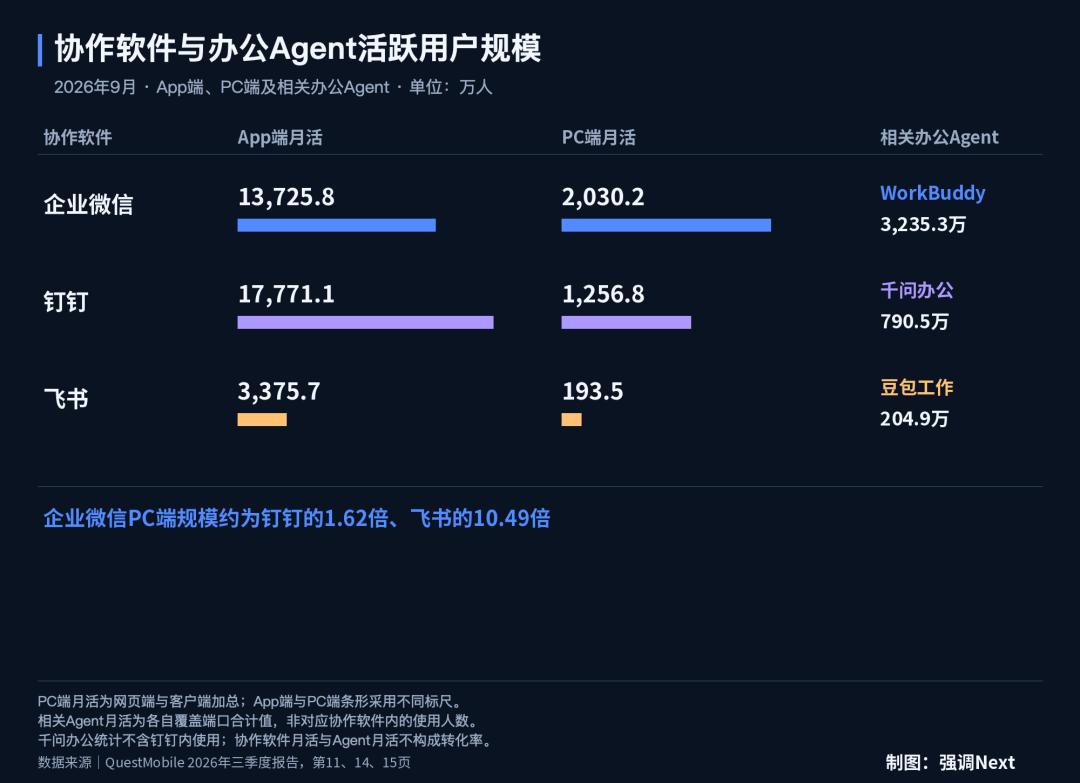
QM's data shows the scale of this advantage: in September, the total monthly active users of WeCom PC terminal reached 20.302 million, DingTalk 12.568 million, and Feishu 1.935 million. WeCom has a larger desktop entry, and Tencent is closer to the ongoing work scenarios.
But Tencent does not lock WorkBuddy within WeCom. The official guide also provides access methods for DingTalk and Feishu. After configuration, users can assign tasks to WorkBuddy on their computers through the robot.
This opens up Tencent to the customer base of its competitors, and also breaks the rule that "enterprises will buy AI from the vendor whose collaborative software they use". The address book can reduce the cost of approaching customers, but it can no longer solely determine who gets the new budget.
On October 16, the WorkBuddy update log recorded a fix: after the WeCom robot generated a file, the reply stayed in the thinking state and the file was not sent back to the conversation. For Tencent, the model completing the generation is only half the journey. Employees need to get the results in their original work windows to mark the task as completed.
Baidu competes for a specific task first
Baidu Dazi does not have a collaborative entry of the same scale, but it ranks second on the QM office Agent list.
In September, its total monthly active users reached 9.77 million, and the total number of multi-terminal usages reached 83.81 million. Compared with June, the former increased by 1567.5% and the latter by 5810.0%. The early small base amplified the growth rate, but the number of usages grew faster than the user scale, indicating that this round of expansion is not just about more people opening the product.
There is another line of Baidu's business on the list. On Analysys' desktop list, Kuku AI ranks 9th with 8.36 million visits, right next to the 8th-ranked Dazi (9.26 million visits). This means Baidu's desktop office users are split into two products. Baidu states that Kuku AI's global monthly active users for AI office have exceeded 40 million, including more than 10 million users of its overseas version Kooko. However, this caliber covers ports such as Baidu Library and Baidu Cloud Drive, which is different from the list's statistical standard.
The two lines have different divisions of labor. Dazi, developed by Baidu Intelligent Cloud, is embedded into enterprise processes, docking internal systems and connecting to professional agents such as Miaoda, Famou and Suansuan. Kuku AI, developed by Baidu Library and Baidu Cloud Drive, extends from users' existing files. After authorization, it can call private data from Cloud Drive and public content from Library, and directly deliver Word, Excel and PPT files.
At the sales end, the two products deliver the same value proposition: turn the results created by individuals into assets that the whole team can reuse repeatedly. In terms of quotation, Baidu's official website currently shows that the limited-time price for Dazi enterprise seats is 132 yuan per seat per month, with a minimum purchase of 1 seat; the enterprise incremental package is 10 yuan for 1000 resource points, which can be used for Dazi, Miaoda, Famou and Suansuan. The enterprise version of Kuku AI has no public pricing and is customized on demand.
The fact that users can start with only one seat lowers the threshold for department-level trials. Shared resources give Baidu the opportunity to put different tasks into the same procurement. The entry Baidu is fighting for is the ongoing work in the hands of employees: Dazi enters from enterprise processes, and Kuku AI enters from the files that employees have already saved. Neither requires the enterprise to replace its existing collaborative software first.
The threshold remains in the original place: a good result delivered by one individual only constitutes a reason for trial. The key is that another employee can complete the task according to the same requirements. For Baidu, there is another problem stacked on this threshold: Dazi and Kuku AI are selling two enterprise versions with similar capabilities to enterprises at the same time, and the sales team has to answer for customers which one to buy first.
Therefore, Baidu's second place shows that there is still space to enter enterprises outside collaborative software. With Kuku AI, its office user pool is larger than what the list shows. But this does not yet prove that it has the second largest number of enterprise customers. Turning individual tasks into fixed processes in the organization is the commercial value of this group of users. And Baidu must first prove that the two solutions it provides will not cannibalize each other.
Alibaba starts competing for merchants' operation budgets
Alibaba's route is pointed out in advance by a set of payment data.
On October 14, Qianwen Office released the e-commerce version and opened invitation testing. The press conference revealed that e-commerce users already account for 20% of Qianwen Office's paying users. This means that while Alibaba continues to catch up in the scale of general office scenarios, it has found a group of customers with more concentrated demands and willingness to pay.
The e-commerce version integrates business tools such as Business Advisor, Youzan and Qianniu, and provides functions such as cross-platform business dashboard, batch material generation and delivery return optimization. The next day, the client update added the e-commerce operation mode, which separately manages related sessions, projects and scheduled tasks.
When merchants purchase such products, their reference standards will change accordingly. It is easier to estimate how much time it takes to make a batch of product materials, how much manpower is needed to sort out data from multiple stores, and whether it is still necessary for employees to check orders and inventory item by item, than to measure "how much office efficiency has been improved".
The scenarios Qianwen Office can compete for begin to include budgets for material production, business analysis and daily operation. These repeated work scenarios can support continuous payment. 20% does not yet prove that Alibaba has demonstrated the profitability of this business, but it is enough to explain why it is deeply cultivating the e-commerce sector.
The problem also lies here. Chen Yusen, CEO of Qianwen Office, positions the e-commerce version as a third-party Agent for all e-commerce platforms and merchants. For Alibaba, this means that the product must properly handle the interests of different channels: Merchants need to compare the investment, conversion and profit of the whole store, and cannot only get a set of suggestions centered on Taobao's business.
At the time of release, the function of actively identifying and assisting in handling inventory, delivery and after-sales anomalies is still in the follow-up plan. How much operation work the e-commerce version can finally take over needs to be proved by actual delivery performance.
At the same time, Alibaba has not stopped competing for general office users. The update on September 18 has added support for migrating local historical data from WorkBuddy. The merchant scenario helps it find reasons for payment, and the migration tool directly reduces the cost for Tencent's users to switch over.
Doubao wants to move users' completed work over
ByteDance's most overestimated advantage is the user scale of the Doubao App.
QM data shows that the monthly active users of the Doubao App reached 419 million in September. In the same report, the total monthly active users of Doubao Work reached 2.049 million; on Analysys' desktop list, its 30.39 million visits also lag behind WorkBuddy and Qianwen Office. Doubao Work was only launched in August, and the current gap includes the time difference of entering the market, but the huge user base on the mobile end has obviously not automatically turned into office customers.
ByteDance has started to directly target people who are already using AI for work.
On October 14, Doubao Work launched data import and synchronization, supporting the migration of task preferences, skills, connectors, working memory and historical conversations from products such as ChatGPT, Claude Code and Trae Work.
The value of these contents lies in the time users have already invested before: they have adjusted the report format, explained common requirements, and introduced project backgrounds. If all these preparations become invalid after switching to a new AI, the new product needs to have greater advantages to offset the trouble of reconfiguration.
The migration tool gives ByteDance the opportunity to take over the ongoing work as well. For competitors, the usage stickiness accumulated by historical sessions now has an extra channel to be moved away.
However, importing personal data only solves the problem of getting started. The QM report lists Feishu as the connection carrier of Doubao Work. Organizational knowledge, business records and collaborative relationships are the next step for it to expand from personal tools to team work. In September, the monthly active users of Feishu App reached 33.757 million, and the total number of PC terminal users reached 1.935 million. Its entry scale still lags far behind WeCom and DingTalk.
ByteDance needs to complete two things at the same time: let existing AI users avoid paying the migration cost again, and make the company willing to keep subsequent work on the platform. The former depends on the import tool, and the latter depends on the results that can be continuously used among colleagues.
At the time of renewal, call volume will turn into cost
The growth of office Agents has obviously leaned towards independent applications that can directly process files and tasks.
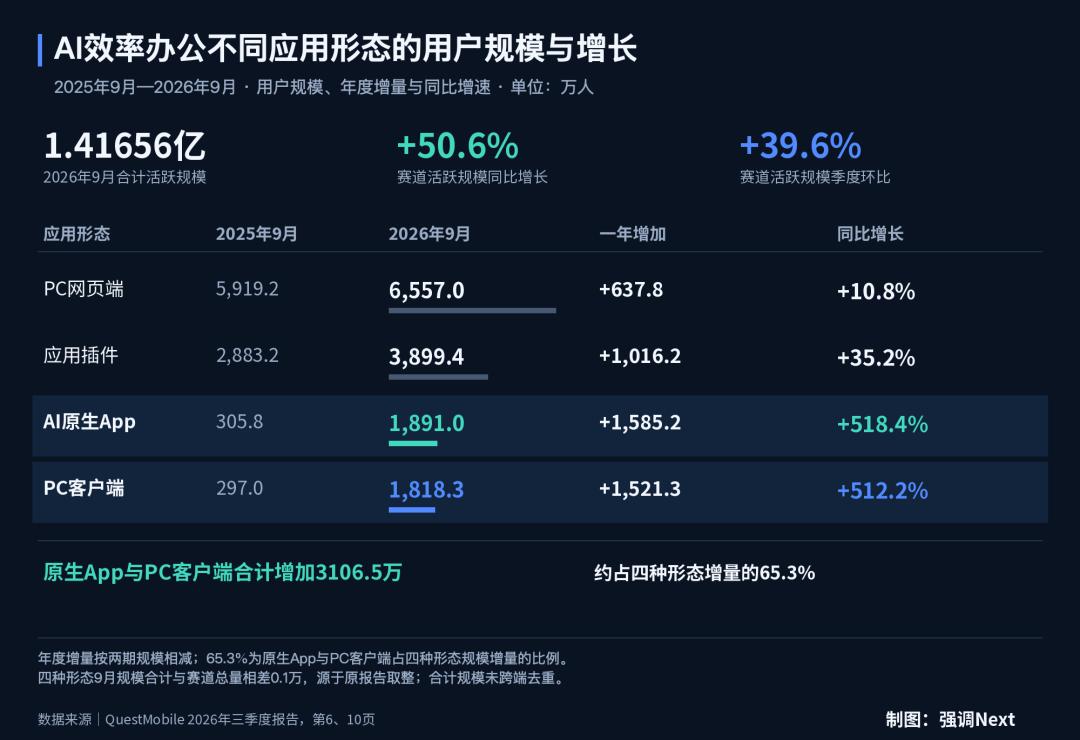
Calculated based on the marked values in the QM report, over the past year, the total active scale of AI office native Apps and PC clients has increased by 31.065 million, accounting for about 65.3% of the total increment of the four forms: web pages, plug-ins, native Apps and PC clients. This is not the de-duplicated number of new users, but it shows that users are increasingly handing over their work to independent tools.
Independent tools also bring independent bills. The domestic personal version of WorkBuddy has three consecutive monthly subscription tiers of 70 yuan, 140 yuan and 700 yuan, with different points allocated, and users can also buy additional packages after the points are used up. Baidu sells enterprise seats and incremental resources separately. The procurement side needs to calculate more than just "how many accounts have been purchased".
Repeated task running will consume quotas, and manual checking, modification and takeover will take up working hours. For manufacturers, the increase in visits means usage growth; for enterprises, it may also mean higher costs to complete the same work. The popularity on the list cannot replace this accounting.
This also explains why the four companies continue to improve their products beyond models. Files need to be findable, permissions need to be inheritable, results need to be sent back to the original work window, and errors need to be handled properly. Missing any of these steps may push the work that was originally handed over to AI back to employees.
Existing collaborative systems will still retain data, permissions and work habits, so enterprises cannot switch suppliers without any cost. But AI manufacturers have obtained a smaller entry point: take over a certain repeated work first, and then fight for the corresponding budget.
An enterprise can continue to use Feishu for meetings and DingTalk for approvals, while paying WorkBuddy to process files. The vendor who sold the previous set of office software no longer naturally owns the next AI bill.
When the renewal day really comes, the person in charge of procurement will calculate the subscription fee, extra usage and the time employees spend reworking together. On that bill, how much work can be completed with less cost is more important than how many times AI is called.