SpaceX has achieved its first profit, earning 4.4 billion US dollars from its AI business in a single quarter.
After market close on October 20 local time in the United States, SpaceX released its first profitable quarterly financial report since its listing.
In the third quarter, SpaceX recorded revenue of 145.75 billion US dollars, a year-on-year increase of 161%, exceeding the average analyst expectation of 127.2 billion US dollars; net profit reached 4.4 billion US dollars, compared with a loss of 1.105 billion US dollars in the same period last year; diluted earnings per share stood at 0.35 US dollars, compared with a loss of 0.09 US dollars per share in the previous quarter. Adjusted EBITDA reached 8.809 billion US dollars, up 306% year on year, with the profit margin rising to about 60%, a significant increase from 45% in the previous quarter.
The Superintelligence (SI) business integrated from xAI generated single-quarter revenue of 75.6 billion US dollars, a year-on-year increase of 830%, accounting for 52% of the company's total revenue. The connectivity business contributed 52.48 billion US dollars, up 69%; aerospace launch business brought in 17.67 billion US dollars, up 6%.
In other words, AI is no longer just a new growth point for SpaceX, but has also become a key force driving the company to turn losses into profits.
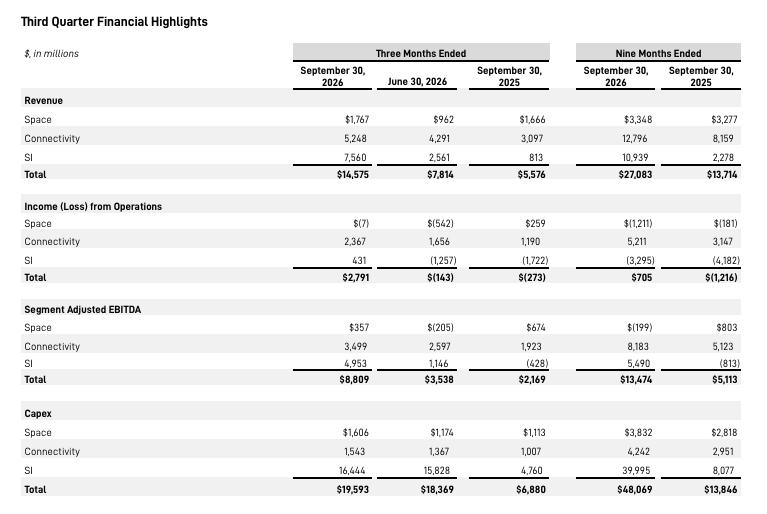
At the same time, SpaceX's capital expenditure in the third quarter also soared to 195.93 billion US dollars, nearly three times higher than the 68.8 billion US dollars in the same period last year. The cumulative capital expenditure in the first nine months reached 480.69 billion US dollars, 3.5 times that of the same period last year. SpaceX is investing a large amount of capital in AI computing power infrastructure, Starship and other projects, with both profit growth and capital consumption accelerating simultaneously.
The management previously predicted that by the end of 2026, SpaceX's annualized revenue run rate is expected to reach 100 billion US dollars.
Based on the revenue scale of 145.75 billion US dollars in the third quarter, this target still requires the business to continue to accelerate significantly in the following period. Whether AI computing power contracts can be continuously converted into revenue, whether Starlink can maintain growth, and whether Starship can further increase launch frequency will all affect this growth curve.
The market reacted positively to this performance report. After the financial report was released, SpaceX's stock price once rose by 3.2% in after-hours trading, corresponding to a market value of about 2 trillion US dollars, exceeding that of Elon Musk's Tesla.
01 AI business takes up "half of the total revenue"
In the third quarter, the revenue of SpaceX's three major businesses all exceeded market expectations, among which the AI business was the main source of growth.
Analysts previously expected that the revenue of the Superintelligence (SI) business would be between 6.3 billion and 7.6 billion US dollars, and the actual figure reached 75.6 billion US dollars, close to the upper limit of expectations. The revenue of the connectivity business was 52.48 billion US dollars, higher than the 4.84 billion US dollar expectation aggregated by StreetAccount; the revenue of the aerospace launch business was 17.67 billion US dollars, also exceeding Morgan Stanley's expectation of 1.57 billion US dollars.
Among them, the SI business originates from xAI under Elon Musk. In February this year, xAI was merged into SpaceX. In the third quarter, the revenue of this business increased by 830% year on year. The revenue of solutions and infrastructure reached 70.22 billion US dollars, higher than 21.94 billion US dollars in the previous quarter; the advertising business revenue was 538 million US dollars, mainly from the X platform.
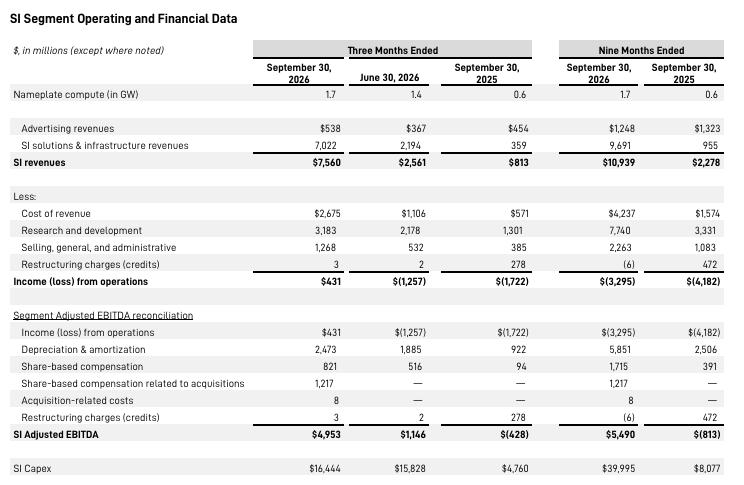
The main support for revenue growth comes from AI computing power leasing.
SpaceX provides the computing power of the Colossus II data center to customers such as Google and Anthropic. According to The Information, the computing power agreement signed between Anthropic and SpaceX is worth up to 845 billion US dollars, higher than the previously disclosed figure of about 450 billion US dollars.
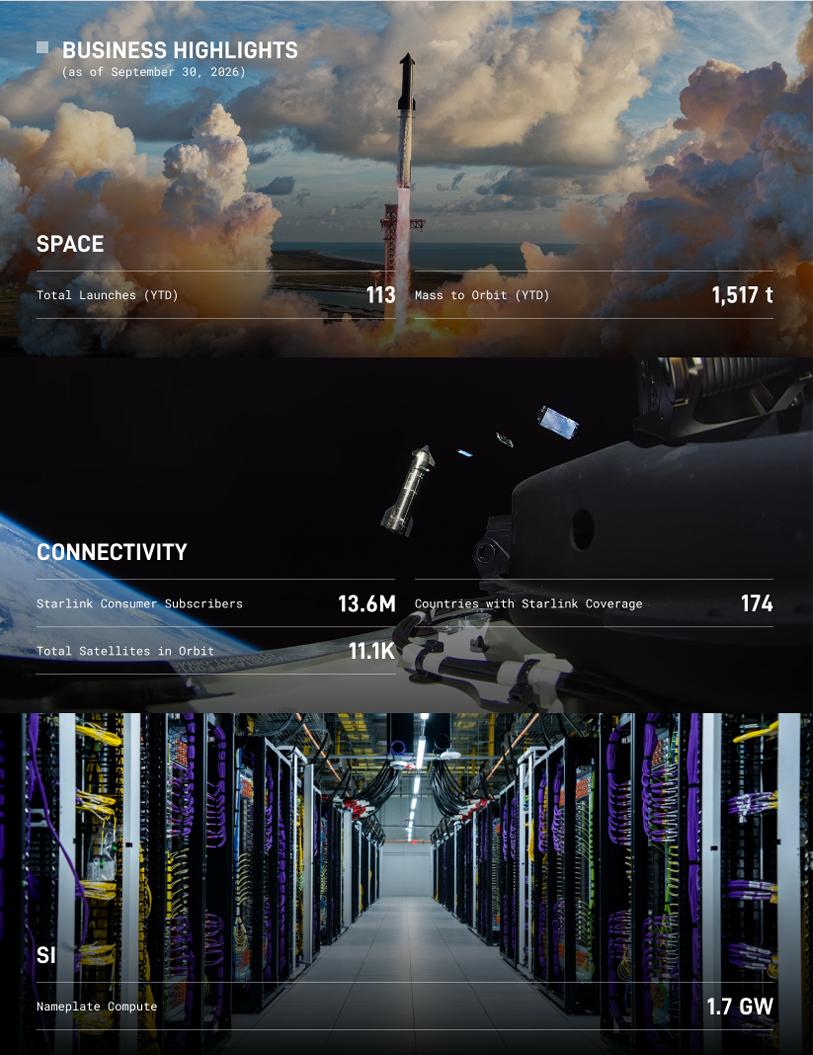
Morgan Stanley estimates that the pricing of newly signed cloud computing power contracts recently is about 30 to 50 US dollars per watt, and industry prices are still rising. As of September 30, SpaceX's computing power scale reached 1.7GW.
In terms of business adjusted EBITDA, the SI business contributed 49.53 billion US dollars, the connectivity business contributed 34.99 billion US dollars, and the aerospace launch business contributed 357 million US dollars. In the same period last year, the corresponding figures for the three major businesses were a loss of 428 million US dollars, a loss of 1.923 billion US dollars, and a profit of 674 million US dollars respectively. The source of profits has clearly shifted to the AI and connectivity businesses.
However, the operating profit of the SI business is still affected by acquisition-related expenses. In the third quarter, the operating profit of this business was 431 million US dollars (compared with a loss of 1.257 billion US dollars in the previous quarter). This is because in this quarter, Cursor contributed 608 million US dollars in revenue, and the SI business recognized 1.217 billion US dollars in equity incentive expenses. If only this incentive expense is added back, the operating profit of this business is about 1.648 billion US dollars.
At present, the revenue of the SI business mainly comes from a small number of customers such as Google and Anthropic. According to Reuters, relevant computing power contracts can be terminated with about 90 days' notice in advance. Whether the continuous expansion of computing power scale can be transformed into stable and long-term revenue still depends on customer demand and contract renewal.
02 Starlink ARPU rebounds
By the end of the third quarter, Starlink's consumer subscribers increased to 13.6 million, an increase of 1.6 million from the end of the second quarter, with growth mainly coming from developed markets. Average revenue per user (ARPU) rebounded from 66 US dollars to 69 US dollars, a quarter-on-quarter increase of 5%, but still lower than 83 US dollars in the same period last year.
Among them, the revenue of the enterprise and government business reached 2.127 billion US dollars, a year-on-year increase of 91%, higher than the 57% growth rate of the consumer business. The aviation market is one of the important sources of growth. As of September 30, more than 3,800 aircraft have been installed with Starlink.
Shawn Campbell, advisor at Camelthorn Investments, said before the financial report was released that when evaluating the Starlink business, the key indicator should be revenue growth rather than the number of launches.
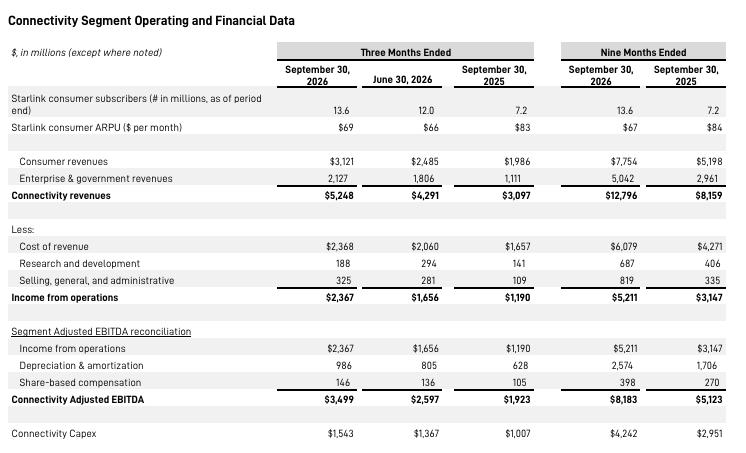
In the third quarter, the operating profit of SpaceX's connectivity business reached 2.367 billion US dollars, a year-on-year increase of 99%, with an operating profit margin of about 45%, higher than 38.6% in the previous quarter. During the same period, costs and expenses increased by 974 million US dollars year on year, mainly for satellite constellation expansion, terminal delivery and market investment. Revenue grew faster than costs, driving up profit margins.
The improvement of satellite capacity also provides space for subsequent business expansion.
At the end of September, the 14th flight of Starship deployed 26 Starlink V3 satellites. SpaceX claims that the downlink capacity provided by these satellites is roughly equivalent to the sum of 10 Falcon 9 Starlink launches, and the downlink capacity of a single V3 satellite is about 10 times that of previous models.
Spectrum resources are another path for Starlink to expand its connectivity business. On October 8, SpaceX signed an agreement with Grain Management to acquire a nationwide 800MHz low-frequency spectrum portfolio consisting of up to 14 MHz of paired spectrum. The transaction is expected to close in the first half of 2027, but still needs to be approved by the Federal Communications Commission (FCC). In the same month, the FCC approved SpaceX's plan to build a 15,000-satellite constellation.
Colin Canfield, an analyst at Cantor Fitzgerald, said in a research note to clients that the market will next focus on how SpaceX expands its global connectivity business through cooperation or competition, and whether low-bandwidth spectrum distribution can gradually become a new competitive advantage.
03 9 fewer launches, but revenue rose 6% instead
In the third quarter, SpaceX completed a total of 35 launches, lower than the 44 launches in the same period last year; the number of customer launches decreased from 15 to 12, and the mass delivered to orbit decreased from 525 tons to 476 tons. Although both the number of launches and the mass delivered to orbit declined, SpaceX's aerospace launch business revenue reached 1.13 billion US dollars, up 6% year on year and 84% quarter on quarter.
The revenue from the launch part covers launch missions such as NASA's Nancy Grace Roman Space Telescope.
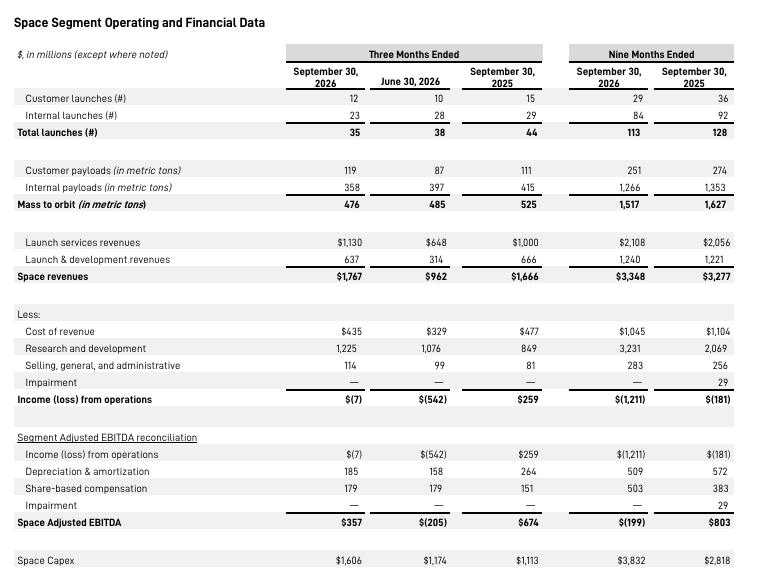
The financial report also disclosed newly signed orders, including 3 NASA ISS crew missions, 18 national security space launch missions, 3 commercial Starfall missions, and a contract to deliver cargo to the lunar surface using Starship. Among them, Starfall is SpaceX's space manufacturing project, which plans to use the Starship rocket to deploy unmanned space capsules to the orbital environment for industrial production.
However, the aerospace launch business has not yet achieved stable profitability. In the third quarter, the operating loss was 7 million US dollars, compared with a profit of 259 million US dollars in the same period last year. R&D investment increased from 849 million US dollars to 1.225 billion US dollars, and the new expenditure was mainly invested in Starship.
At the end of September, the 14th flight of Starship completed its first orbital insertion and deployed 26 Starlink V3 satellites, marking the first revenue-generating mission for Starship. SpaceX also revealed that the new Starbase launch site in Louisiana aims to make its first flight in 2029, with a design goal of supporting thousands of Starship launches per year.
Morgan Stanley predicted in a pre-earnings report that the 15th flight of Starship will take place in early November. If the upper-stage capture attempt of the spacecraft is successful, it will verify the key links of the reusable process and support the increase of launch frequency in 2027. The bank believes that this will be an important event affecting SpaceX's subsequent market performance.
04 Computing power expansion brings greater financing pressure
SpaceX's capital investment is mainly concentrated in the SI business. In the third quarter, the capital expenditure of this business reached 164.44 billion US dollars, accounting for about 84% of the company's total capital expenditure for the quarter. In the first nine months, the cumulative capital expenditure of the SI business was 399.95 billion US dollars, compared with 80.77 billion US dollars in the same period last year.
SpaceX has not yet issued official guidance for future capital expenditure. Melissa Otto, head of research at S&P Global, expects SpaceX's capital expenditure this year to be about 700 billion US dollars, and may approach 1.95 trillion US dollars by 2028. Evercore ISI estimates that capital expenditure will reach about 1.51 trillion US dollars in 2027.
Adam Jonas, an analyst at Morgan Stanley, pointed out in a research note that additional financing needs remain a key factor causing market concerns, especially after recent debt issues in the cloud computing power industry attracted attention. He expects SpaceX to issue another 80 billion US dollars in bonds next year.
Financing capacity and return on investment will directly affect the expansion pace. At the end of the second quarter, SpaceX held about 100 billion US dollars in cash and cash equivalents, but the company has not disclosed its cash balance at the end of the third quarter, nor has it provided guidance on future capital expenditure.
SpaceX's Chief Financial Officer Bret Johnsen previously stated in August that the payback period for new computing power investment is less than one year, and the capital expenditure levels in the third and fourth quarters are expected to be roughly equivalent to those in the second quarter. As investment continues to expand, the revenue realization speed of computing power contracts and return on investment will become the key.
Johnsen also predicted that SpaceX's annualized revenue run rate by the end of 2026 is expected to reach 100 billion US dollars. Evercore ISI's forecast is 104 billion US dollars, of which the AI business will take on most of the increment.
To support growth, SpaceX plans to increase its computing power scale to more than 2GW by the end of the year. Morgan Stanley expects the company to reaffirm its target of reaching 5GW to 10GW by the end of 2027, and the bank's own model predicts 4.9GW. Future revenue depends not only on the scale of computing power, but also on the pricing per watt and contract term, the latter two are also variables that are difficult to determine in profit forecasts.
At the capital market level, rumors of a merger between SpaceX and Tesla are still fermenting. Barclays released a report last week stating that the two companies may announce a merger before Tesla's annual general meeting on December 3, and SpaceX is more likely to be the acquirer. The reference valuations in the report are 2.1 trillion US dollars and 1.5 trillion US dollars respectively. If an all-stock transaction is adopted, Musk will hold about 37% of the equity and 56% of the voting rights in the merged company. Neither of the two companies nor Musk has made an official statement.
Musk said on X last week that SpaceX's value could be many orders of magnitude higher than the current global economy. The company estimated in its IPO filing that the total addressable market size of its business is 28.5 trillion US dollars, of which AI accounts for about 26.5 trillion US dollars.
For SpaceX, the next test is whether AI computing power contracts can continue to be fulfilled, whether huge infrastructure investments can generate corresponding returns, and whether Starship can gradually undertake higher-frequency launch missions. Quarterly profitability has been achieved, but the gap between long-term investment and actual returns still needs to be verified by subsequent performance.
Special translator Jin Lu also contributed to this article
This article is from "Tencent Tech"