In-depth Retrospective of the Codex Dream Team: How Was the Top Programming Superstar Born?
At the table of AI programming tools, OpenAI's Codex once did not even qualify for entry for a long time: it had very few users, mediocre public praise, and its team was on the verge of disbanding. However, today it has transformed into the underlying system of the ChatGPT desktop version, supporting 40 million weekly active users, and has successfully surpassed Claude Code in the download volume of its CLI version.
Codex completed this turnaround in less than a year.
Reported by Zhidx on October 20, Dan Shipper, founder of Every, an AI company with close ties to OpenAI, recently published a long article titled "How Codex Happened", which fully reviews this period of history through interviews with core members including OpenAI co-founder Greg Brockman, Codex team leader Thibault Sottiaux (Tibo), Codex product lead Alexander Embiricos, and designer Andrew Ambrosino.
This article shares a lot of product development experience and lessons with the public. For example, the cloud version of Codex received positive internal feedback but cold response from external users, the root cause of which was that it required users to migrate their entire development environment to the cloud, resulting in excessively high costs. The Codex team later admitted that their highly standardized development environment masked the harsh requirements for external users, products need to "go where the users are" instead of only working well in the familiar environment of the development team.
When the form of Codex was still undecided, OpenAI chose to place multiple bets. Employees complained that this choice was chaotic and wasteful, but Altman responded: "OpenAI is like investing in a series of startups — except that they are all inside the company." This kind of internal competition and multiple bets ensures that the next product will not be killed by the success of existing products, effectively avoiding the emergence of the "Innovator's Dilemma".
After the number of users of CLI and plugins increased significantly, the Codex team dared to bet on the next form. Even when no consensus was reached internally, Tibo still decided to put the largest investment into the native desktop application, which eventually led to Codex's greater success.
Now, let's turn back the clock to the end of 2024 and see how this turnaround was achieved step by step.
The following is the essence content sorted out based on the original text:
01.
It all started with the line "Thinking..." on the screen
Today's AI products have a familiar interface: after a complex request is sent, the words "Thinking" will appear at the position where the answer is displayed. Behind it is a paradigm shift in computing.
The first generation of large language models were more like improvisers: they had to make up content word by word on the spot, unable to plan ahead or look back. But early users found that as long as they asked the model to "reason step by step before answering", the quality of the answers would be significantly improved — this is the Chain-of-Thought prompting method.
OpenAI then directly trained this behavior into the model: before responding to user queries, the model will first deduce on a "scratch pad" (reasoning trajectory), roll back when encountering a dead end, select the final feasible path, and then start to generate answers.
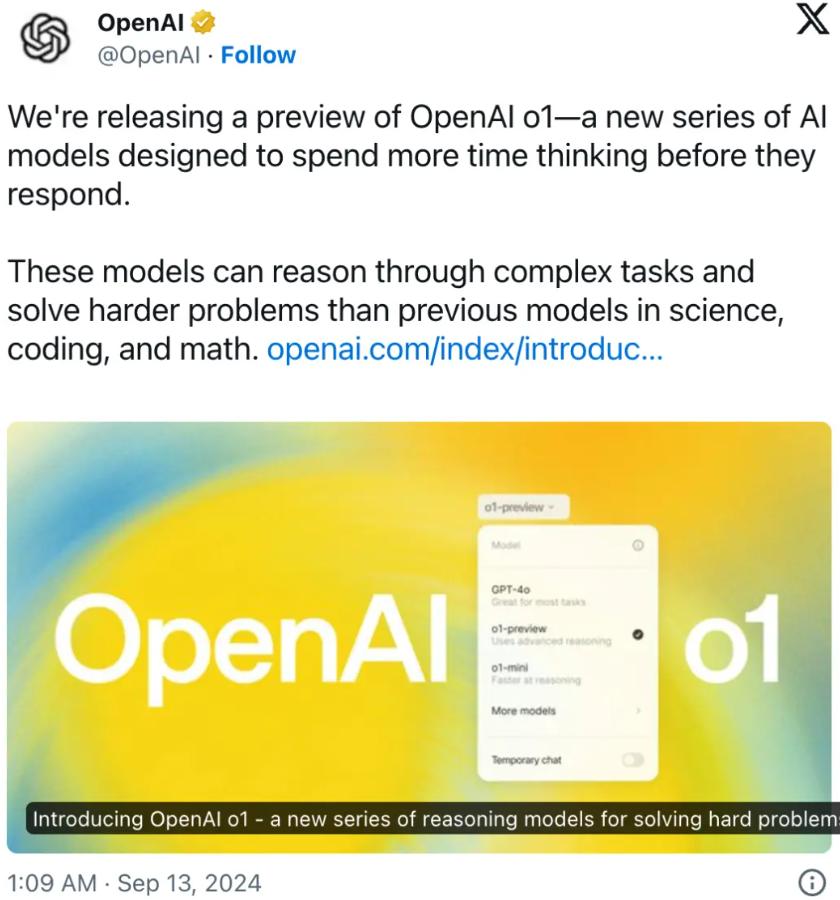
In September 2024, the preview version of OpenAI's o1 model was released, which was the first model with Chain-of-Thought characteristics. As long as it spends more time on difficult problems, it can generate better answers.
Programming is one of the most suitable scenarios for reasoning models: modifying code, running programs, and checking results, completing a self-verification within a few seconds to form a closed and self-consistent loop. Theoretically, as long as enough time is given, the reasoning model can independently complete any programming task.
02.
Multiple paths advancing in parallel, the multiple origins of Codex
Building an AI programmer has been OpenAI's obsession for many years. The name Codex is not new: the first version of Codex in 2021 was a model based on GPT-3, fine-tuned on public code, and used to power the original GitHub Copilot.
At the end of 2024, "programming" was elevated to a company-level goal at OpenAI, and several teams tried to solve the same problem from different perspectives.
One of the teams was led by Alexander Embiricos, Codex product lead. After OpenAI acquired the startup Multi, Embiricos joined OpenAI. When he first saw a reasoning model connected to the terminal, he was shocked at a career-changing level:
"The first moment I really 'touched AGI' was when I saw a reasoning model connected to the terminal. I know it sounds trivial to say that now, but watching it read files, run commands, and troubleshoot errors all by itself was really cool."
At that time, all AI programming tools on the market were built on VS Code: Copilot did auto-completion, Cursor and Windsurf did second-level Q&A, all relying on a tight feedback loop, because the models at that time could not support long-term autonomous work.
OpenAI's reasoning model was just the opposite: if its thinking time was cut off, it would become slow and weak. What Embiricos wanted to do was to turn "slowness" into an advantage: since it had to think for a long time, let it think and complete a full task.
However, letting the model think for a long time posed a product challenge: users could not wait in front of a black box. Embiricos thus set a rule: No matter how long the task is, users must be able to see what the model is doing every 30 seconds, at most 1 minute. The visible progress when the agent is working is itself part of the product.
Another path was entirely an unplanned happy accident. Thibault Sottiaux (known as Tibo by his team) was a research infrastructure engineer. In December 2024, he began to explore using reasoning models to accelerate research itself: training an internal programming agent on OpenAI's monorepo to help researchers write Python code for running and evaluating experiments. Since researchers used it every day, the feedback speed was fast, and the team's pace of training models became faster and faster.

▲ Thibault Sottiaux
The key point is: the technology they used to train these programming models was different from the method OpenAI used to train the main ChatGPT line, and it was difficult to reconcile the two sides for a time. Inside OpenAI, a second model line actually grew: one was the general model line serving the public, and the other was the dedicated programming model line serving R&D.
Later, this branch line was regarded as the source of Codex's "magic". However, Tibo revealed that OpenAI never made a decision to split the model lines. At the beginning, it was just research exploration, an optimization of OpenAI's iteration speed.
However, Tibo's internal programming agent only solved the problem of how the model becomes stronger, and it was not suitable for everyone to use. To make Codex take shape, the participation of other teams was still needed.
In early 2025, several teams inside OpenAI that explored AI programming from different perspectives began to converge. Tibo and Embiricos's teams merged first, and then OpenAI's Scientist Assistant research project was also incorporated.
With the full team in place, the next question was what the product should look like. Co-founder Greg Brockman summarized that the undecided issue at that time was the form factor: should this agent run in the terminal, the editor, or its own cloud computer? No one knew which paths were dead ends, and OpenAI actually chose the multi-bet solution.
This multi-bet approach actually troubled OpenAI employees. Some employees privately complained that it was chaotic and wasteful — who would want to stay in an agent team that could only rank third in the company? Facing this doubt, OpenAI's founder and CEO Sam Altman responded:
"In a sense, OpenAI is like investing in a series of startups — except that they are all inside the company."
03.
The cloud version of Codex, well-received but not well-received by users
Before OpenAI's Codex was officially released, Anthropic released Claude Code on February 24, 2025. This product does not have its own editor, but runs directly in the terminal to operate files on the computer: it can be interrupted halfway through the work, and the experience of the last run can be carried over to the next run, which was a capability that cloud solutions at that time could not achieve.
Tibo revealed that Codex had also explored the terminal route and made a version, but it was abandoned after a month, and the team turned to develop a full cloud version, with the ultimate goal of realizing a cloud asynchronous agent that can assign tasks from computers or mobile phones. Behind this is OpenAI's long-term belief. Brockman said: "Looking to the future, the correct form factor is a cloud AI with its own laptop. We actually built it."
After about 7 weeks of rush development, the cloud version of Codex was released on May 16, 2025. This product received enthusiastic response inside OpenAI, but was well-received by critics while unpopular with external users: to give full play to its full capabilities, users had to migrate all the software, permissions and configurations on their laptops to cloud virtual machines, which often took several hours; the running tasks could not be interrupted to correct deviations, and even if users just asked a follow-up question, a new cloud virtual machine would be started, and the environment needed to be reconfigured.
In the post-project review, the Codex team admitted two problems: first, their own development environment was highly standardized and the task definition was clear, which masked the harsh requirements for external users, and the product did not "go where the users are"; second, the more fundamental problem was the model, Tibo said: "It was too early to do this at that time, because the model was not smart enough."
During the same period, OpenAI also released a small open-source Codex CLI, but it was only a side project developed by two employees. Due to security concerns, this CLI could only use OpenAI's general model instead of the dedicated Codex model, which to some extent limited the product's performance.
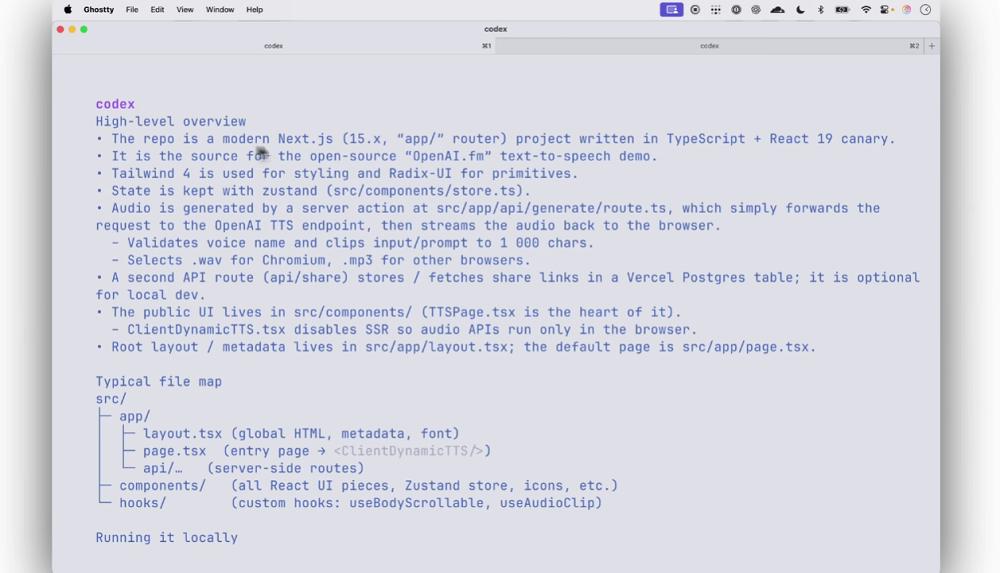
▲ Codex CLI
After the product failed to gain traction, Codex's engineering manager left the team and joined Cursor, which was valued at 9 billion US dollars at that time, and OpenAI's 3 billion US dollar acquisition deal of Windsurf also fell through in July.
04.
Rewriting the agent with Rust
Giving the model a practical social lesson
In the late summer of 2025, Tibo took full control of this team, which was still a "side project" of OpenAI at that time, he said: "I took over the team, and then changed the direction quite a lot. We shifted to local deployment."
He did not rush to add new features to Codex CLI, but rewrote Codex with Rust, completely decoupling the core engine that reads files, runs commands and troubleshoots errors from the terminal interface, so that it can later run in terminals, editors, the cloud, and even ChatGPT.
During the same period, OpenAI's models were also being optimized. Michelle Pokrass, who was responsible for the post-training of GPT-5, found that models with excellent benchmark scores do not necessarily have outstanding capabilities in real scenarios, because the models had never seen a messy code base, and had never been interrupted by humans halfway through the work. Brockman called it "a student who got full marks in the SAT, but never went to work for a single day".
Therefore, OpenAI let programmers supervise GPT-5 to work, record where the model failed, and then turn the failures into repeatable training tasks, which ultimately improved the model's capabilities in real scenarios.
One week after GPT-5 was released, Codex's VS Code and Cursor plugins went online, and developers flocked to them. By October of that year, its usage had increased more than tenfold.
Logically, OpenAI should continue to increase investment in CLI and editor plugins. But Tibo made the decision at that time: "We decided to continue maintaining the CLI, but the next largest immediate investment should be to build a native desktop application."
His judgment was that the tasks the model can complete are getting longer and longer, and people will soon manage multiple agents at the same time and immerse themselves in the work all day, and it is absurd to keep an eye on multiple streams of messages in a pure text terminal window.
After designer Andrew Ambrosino joined, the goal he set was to make Codex the primary tool. In terms of positioning, Codex is lighter than IDE, and its interface refers to chat applications instead of VS Code.
They also decided not to build a built-in editor, and users can only modify code by telling the agent. They judged that once users could type to modify code, they would expect a full set of editor functions, but with the size of the 4-person design team at that time, they could not make a perfect editor. Therefore, they needed to make the experience of "commanding the agent to write code" so good that users would not miss the editor.
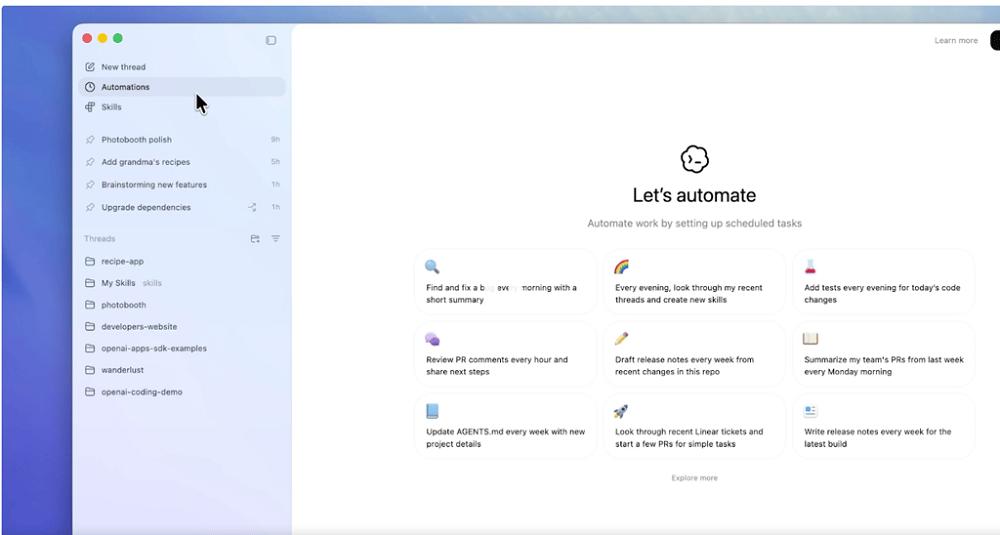
However, even inside OpenAI, such a product could hardly become a primary tool. The experience of typing a long prompt just to modify one sentence of code could not convince users.
In November 2025, Google released Antigravity, an agent tool forked from VS Code with a full built-in editor. This external factor made the Codex team waver:
"Did we make a big mistake by not forking VS Code? We were very conflicted inside, and I don't think the team reached a consensus at all." —— Ambrosino
The turning point came from the model. Since Codex's model was independent of ChatGPT, they could iterate quickly without worrying about the experience of 800 million ChatGPT users at that time. On November 19, 2025, GPT-5.1 Codex Max was released, which could write code continuously for several hours; on December 18 of the same year, GPT-5.2 Codex was also launched, which was good at making unified modifications across large code bases.
With the rapid improvement of model capabilities, OpenAI employees began to find that the number of modifications humans needed to make was getting smaller and smaller.
In February 2026, OpenAI's engineering and research teams across the company began to widely adopt Codex, even Brockman, who had used terminals and Emacs all his life, began to use Codex. Altman said that Codex has become "the most internally loved product in OpenAI's history".