Starlink, which rakes in tens of billions of US dollars in annual revenue, has become a "cash cow", and Elon Musk has wagered a whopping 16.4 billion US dollars in a single quarter on superintelligence.
In the early hours of October 21 Beijing time, SpaceX (ticker: SPCX), which has been listed on NASDAQ, released its Q3 2026 financial report covering the period ending September 30.
From the overall market perspective, the third quarter marks a historic inflection point for SpaceX as it crosses the break-even line.
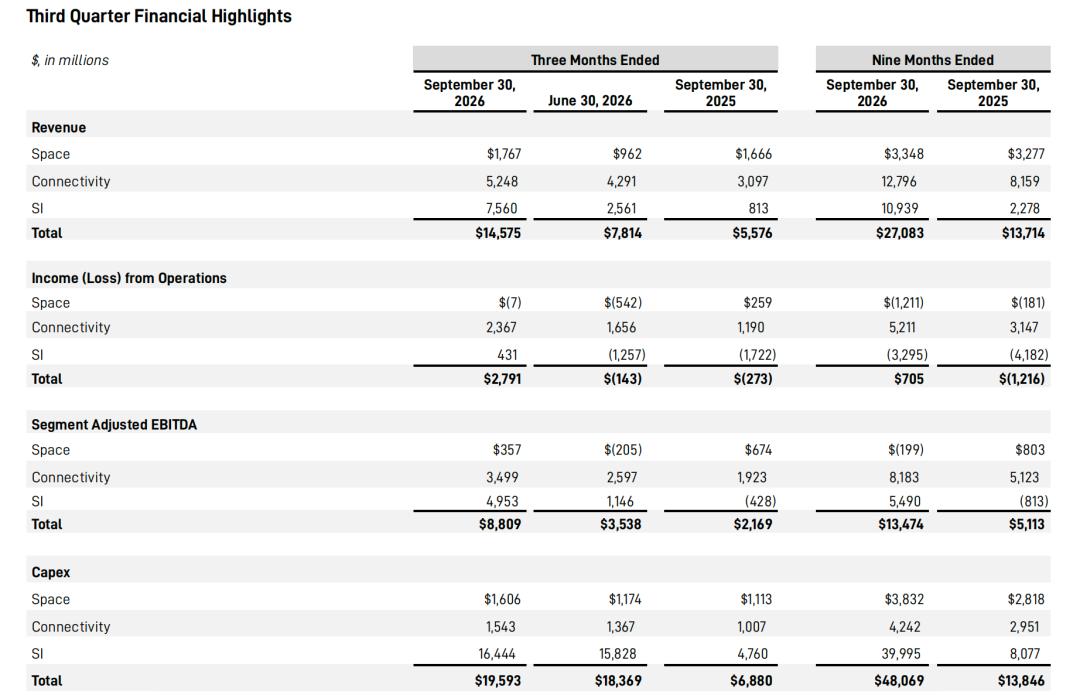
Total quarterly revenue reached 145.75 billion US dollars, a 161% surge from 55.76 billion US dollars in the same period last year, and also an 86.5% quarter-on-quarter jump from 78.14 billion US dollars in the second quarter of this year.
Looking at the first nine months of this year, the company's cumulative revenue hit 270.83 billion US dollars, almost doubling from 137.14 billion US dollars in the same period last year.
Along with the expansion of revenue scale, the company's operating performance has fully turned positive in the third quarter.
In this quarter, SpaceX recorded an operating profit of 27.91 billion US dollars, completely reversing the situation of 1.43 billion US dollars in operating loss in the second quarter and 2.73 billion US dollars in operating loss in the same period last year.
In addition to the 27.91 billion US dollars in operating profit generated from its main business, the huge amount of cash on SpaceX's books also brought in 8.73 billion US dollars in interest income in the third quarter, plus 10.25 billion US dollars in other net gains from investments and 3.9 billion US dollars in tax credits. These inflows directly pushed the final net profit for the third quarter to 44.04 billion US dollars.
The profit generated in this single quarter almost offsets the nearly 48 billion US dollars of loss accumulated in the first two quarters of this year, drastically reducing the company's cumulative net loss for the first nine months of this year to 4.13 billion US dollars.
If we calculate a more practical "cash account" — adding back non-cash expenditures such as 36.44 billion US dollars in equipment depreciation and amortization, and a total of 23.63 billion US dollars in stock incentives issued to employees and acquired teams — SpaceX's core operating profit in the third quarter reached as high as 88.09 billion US dollars, surging more than 3 times compared with the same period last year.
01
1.7 GW Computing Power Infrastructure and $60 Billion Acquisition of Cursor
Behind the high growth is still fierce R&D and infrastructure investment.
In the third quarter, the company's total operating costs and expenses reached 117.84 billion US dollars, of which R&D expenses amounted to 45.96 billion US dollars, doubling from 22.91 billion US dollars in the same period last year.
In terms of capital expenditure (Capex), the expenditure in the third quarter alone reached 195.93 billion US dollars, and the cumulative capital expenditure in the first nine months soared to 480.69 billion US dollars, more than 3.4 times that of the same period last year (138.46 billion US dollars).
What supports this high-intensity consumption is extremely abundant cash reserves and self-sustaining profitability.
In the first nine months of this year, the net cash flow generated from SpaceX's operating activities reached 130.97 billion US dollars;
Coupled with the net proceeds of 856.75 billion US dollars from the IPO, by the end of the third quarter, the company's cash and cash equivalents on the books reached as high as 512.94 billion US dollars, plus 385.61 billion US dollars in marketable securities, making the short-term available funds close to 900 billion US dollars.
This has also caused SpaceX's total asset size to expand sharply from 920.79 billion US dollars at the end of last year to 2540.45 billion US dollars.
After clarifying this dominant overall book situation, if we further break down the revenue composition and capital flow of the three core segments, we will find a more core signal: the business focus of this company has undergone a fundamental shift.
According to the financial report, SpaceX's original "Artificial Intelligence (AI)" business segment has been officially renamed "Super Intelligence (abbreviated as SI)" starting from this quarter.
In the third quarter, the revenue of the SI segment for a single quarter exceeded 75 billion US dollars for the first time, surpassing the sum of the connection business where Starlink is located and the traditional aerospace business, accounting for 51.8% of the company's total revenue.
Today's SpaceX has long passed the stage of making money simply by launching rockets and selling satellite broadband.
Musk is using his near-monopoly aerospace transportation capacity and the continuous cash flow from Starlink to feed a ground computing power and large model empire with an astonishing capital consumption rate.
The SI segment is the fastest-growing engine in this financial report. The segment's quarterly revenue surged 830% year-on-year to 75.6 billion US dollars from 8.13 billion US dollars in the same period last year, nearly tripling from 25.61 billion US dollars in the second quarter.
Of this revenue, the traditional advertising business only accounts for 5.38 billion US dollars, and the real main contributor is the "SI solutions and infrastructure revenue" as high as 70.22 billion US dollars.
This explosion stems from Musk's two heavy bets on physical computing power and software entry points.
On the computing power side, with the continuous construction of the COLOSSUS II supercomputing cluster, as of September 30, SpaceX's Nameplate Compute scale has been raised to 1.7 GW.
For comparison, this figure was 1.4 GW three months ago, and only 0.6 GW a year ago.
The huge computing power pool is used on the one hand to train its own Grok model and the all-weather agent system Grok Bot newly launched this quarter, and on the other hand, it directly cuts into the enterprise-level computing power leasing market by signing cloud service agreements with third-party customers.
On the software application side, SpaceX completed a huge merger and acquisition in this quarter.
On August 14, the company officially completed the acquisition of AI programming tool Cursor with an implied equity valuation of 60 billion US dollars (GAAP acquisition consideration of 425 billion US dollars).
In just one and a half months from the consolidation in mid-August to September 30, Cursor contributed 608 million US dollars in revenue to SpaceX.
In order to retain Cursor's core R&D team, SpaceX replaced all its original common shares and unvested options with SpaceX equity with time-locked conditions. The total value of equity incentives attributable to the post-acquisition service period is as high as 234 billion US dollars.
Only in the third quarter, 12.17 billion US dollars of equity incentive expenses brought by this acquisition were accrued.
Even with this 12 billion US dollars "retention fee" and the segment's R&D expenditure of 31.83 billion US dollars in the single quarter, the SI segment still recorded an operating profit of 4.31 billion US dollars in the third quarter, achieving a turnaround from operating loss for the first time at the operating level (the operating loss was 12.57 billion US dollars in the second quarter), and the segment's adjusted EBITDA reached 49.53 billion US dollars.
With 1.7 GW supercomputing at the bottom, Grok large model in the middle, and Cursor that directly occupies the developer entry point at the top, Musk's AI closed loop has been financially validated.
02
Starlink Enters Profit Harvest Period
Computing power infrastructure is a cruel capital consumption war.
Of the nearly 481 billion US dollars in capital expenditure of the whole company in the first three quarters, the SI segment alone burned 399.95 billion US dollars (of which 164.44 billion US dollars was spent in the third quarter alone), accounting for more than 83%.
In addition to the confidence brought by secondary market fundraising, at the daily operation level, the connection business segment where Starlink is located is the real "cash cow" for this computing power gamble.
In the third quarter, the connection business achieved 52.48 billion US dollars in revenue, up 69% year-on-year and 22% quarter-on-quarter;
It contributed 23.67 billion US dollars in operating profit in a single quarter (up 99% year-on-year), and the segment's adjusted EBITDA reached 34.99 billion US dollars.
At the same time, the capital expenditure of this segment in a single quarter was only 15.43 billion US dollars, and the R&D investment was also controlled at 1.88 billion US dollars.
This means Starlink has completely passed the early heavy asset investment stage and entered a steady cash flow harvest period.
Looking at Starlink's business in detail, two changes are worth noting: First, developed markets have driven the recovery of average revenue per user on the consumer side.
By the end of the third quarter, the number of Starlink consumer subscription users reached 13.6 million, with a net increase of 1.6 million in the single quarter, almost doubling from 7.2 million in the same period last year.
The average monthly revenue per user (ARPU) rose from 66 US dollars in the second quarter to 69 US dollars, driving the consumer side's quarterly revenue to 31.21 billion US dollars.
Second, the growth rate of the government, enterprise and aviation markets is significantly faster than that of the consumer side. In this quarter, the revenue of government and enterprise business reached 21.27 billion US dollars, a 91% year-on-year surge.
At present, more than 3,800 aircraft around the world have activated the Starlink in-flight Wi-Fi service.
In addition, SpaceX signed a new agreement on October 8 to acquire the FCC license for the 800 MHz frequency band (up to 14 MHz paired spectrum) covering the whole of the United States, which is expected to be completed in the first half of 2027, directly completing the ground low-frequency band puzzle for the satellite-direct-to-mobile service.
There is another detail in the financial report worth noting: SpaceX revised the statistical caliber of in-orbit satellites, and for the first time included about 400 "de-orbit approved" satellites into the total in-orbit number of 11,100 (if only the actual operating satellites are counted according to the old caliber, the in-orbit number is about 10,700).
This slight adjustment of the caliber does not affect financial performance, but it also reflects that as the constellation scale exceeds 10,000, the active controlled de-orbit and replacement of large batches of satellites have become the norm.
03
Starship Generated First Commercial Revenue, New Louisiana Base Emerges
Compared with the rapid growth of SI and Starlink in financial volume, the traditional aerospace business (Space) appears relatively restrained on the books, but this quarter has crossed the most critical engineering and commercial thresholds.
In the third quarter, the aerospace segment achieved 17.67 billion US dollars in revenue, up 6% year-on-year, and a significant 84% increase from 9.62 billion US dollars in the second quarter.
Among them, launch service revenue was 11.3 billion US dollars, and launch and R&D contract revenue was 6.37 billion US dollars.
The company completed 35 launches throughout the quarter (12 external customer missions, 23 internal Starlink launches), with a total of 113 launches in the first nine months of this year, sending 1517 tons of payload into orbit.
The biggest breakthrough in this quarter came from Starship Flight 14.
This is Starship's first orbital flight, and also the first Starship mission that generates actual revenue. It sent 26 third-generation Starlink satellites (Starlink V3) into orbit at one time, and the downlink bandwidth capacity added to the constellation by a single launch is about 10 times that of the Falcon 9 Starlink launch mission.
Due to the full sprint of Starship R&D, the R&D expenses of the aerospace segment in this quarter were pushed up to 12.25 billion US dollars (8.49 billion US dollars in the same period last year), resulting in a slight operating loss of 7 million US dollars for this segment under GAAP standards, and the single-quarter capital expenditure also reached 16.06 billion US dollars.
However, external customers are already paying for Starship's transportation capacity.
In the third quarter, SpaceX not only completed the launch of NASA's Nancy Grace Roman Space Telescope, but also added 3 NASA ISS crew missions, 18 National Security Space Launch (NSSL) missions, 3 commercial "Starfall" missions, and a commercial contract to deliver payloads to the lunar surface using Starship to its backlog of orders.
In order to undertake the huge launch plans in the future, SpaceX officially disclosed in the financial report that it will build the next-generation super spaceport "Starbase, Louisiana" in Louisiana, with a designed capacity directly targeting "thousands of Starship launches per year", and it is planned to welcome its first flight in 2029.
04
Underlying Synergy of the Three Segments
Putting the general ledger of this financial report together with the three business segments, we can clearly see what kind of commercial moat Musk is building.
Starship is responsible for breaking through the cost of entering orbit, using V3 satellites with 10 times the capacity per launch to rapidly expand the space communication network, and providing the extreme transportation capacity of thousands of launches per year in the future;
Tens of thousands of in-orbit Starlink satellites are responsible for harvesting millions of users and government and enterprise orders around the world, stably generating billions of US dollars in operating profits every quarter;
And these continuous funds and engineering capabilities in turn support the 1.7 GW supercomputing cluster, Grok model, and developer ecosystem like Cursor on the ground.
While cloud manufacturers in Silicon Valley are still anxious about power shortage in data centers, and AI startups are still worrying about computing power costs and commercial monetization, SpaceX has put space orbits, global communication networks, ground computing power, and top-level software into the same balance sheet.
This is the most core signal in this Q3 financial report.
This article is from the WeChat official account "Xingdong Wuji", Author: Julian, published with authorization from 36Kr.