Private art museums are barely hanging on.
"After all these years, how could it disappear all of a sudden?"
In mid-September, the Meet Museum at Beijing's 798 Art Zone vanished abruptly. Once one of the most popular venues in the park, it quietly withdrew from 798, with nothing but pitch-black darkness visible through the exterior glass walls.
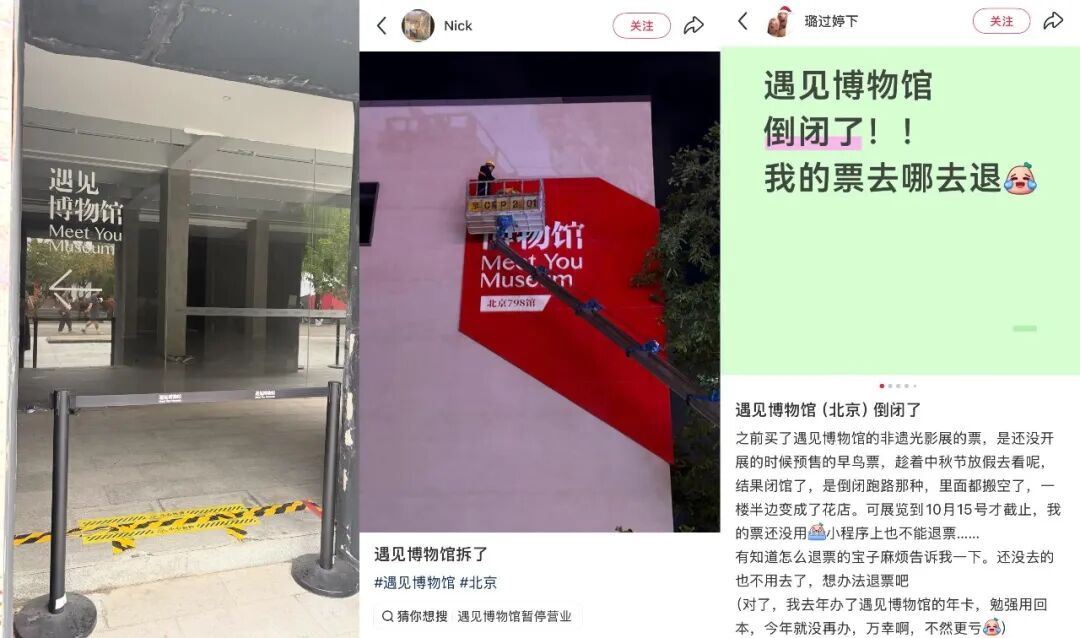
No official announcement has been released for this closure so far. The last exhibition was originally scheduled to end on October 15, but it was shut down nearly a month in advance. Netizens who had bought exhibition tickets and annual passes that they had no chance to use began to post online and safeguard their rights, but the customer service hotline was never answered.
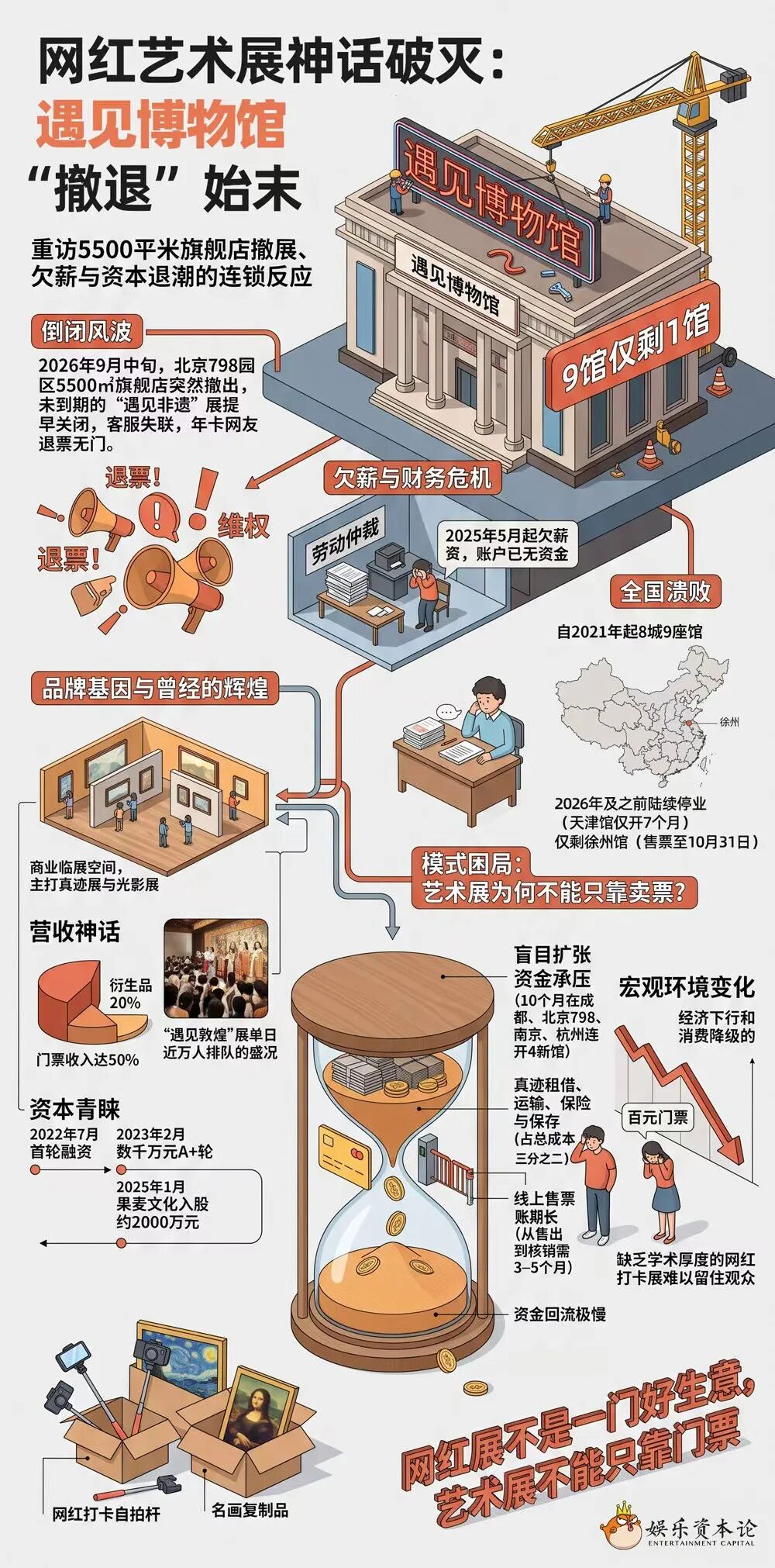
A former employee told Yule, a media outlet, that Meet Museum had defaulted on his salary since May 2025, and even after he won the labor arbitration case, the ruling could not be enforced. "The enforcement judge told me that there was no money left in the company's account." Another resigned employee said that as far as she knew, the company had already started the bankruptcy liquidation process.
Who could have imagined that Meet Museum, which was frantically opening new venues across the country and was chased by capital just a few years ago, would end up in such a situation?
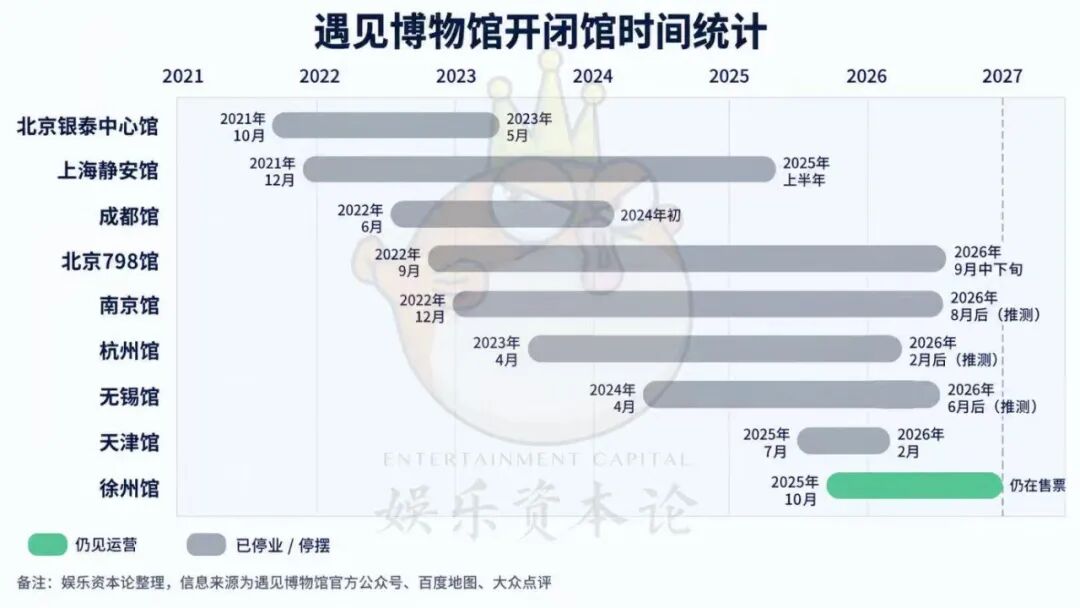
According to the statistics sorted out by Entertainment Capital, starting from 2021, Meet Museum successively opened 9 offline venues in 8 cities across China including Beijing, Shanghai, Chengdu, Nanjing and Hangzhou. At its peak, a single exhibition received nearly 10,000 visitors per day, and it also obtained tens of millions of yuan in financing. It was one of the most well-known top-tier brands in the commercial temporary exhibition track in China.
Only five years later, except for the jointly operated Xuzhou venue that is still holding the "Meet Dunhuang" exhibition, all other venues are suspected of having closed down successively in 2026 or earlier. It was not until the closure of this 5,500-square-meter landmark flagship store in 798 that widespread public attention was drawn.
As of press time, Entertainment Capital tried to contact Meet Museum for the real reason of the closure, but none of the public phone lines were answered.
The collapse of Meet Museum is not an isolated case.
In the middle of last year, Shanghai Himalayas Museum, Shanghai Dongyi Art Museum, Shenzhen Jupiter Museum of Art, and Qingdao West Coast Art Museum which was built at a cost of nearly 2 billion yuan, closed down one after another. In fact, most private art museums in China can hardly make profits through their own operations, and they often rely on funding from real estate developers, enterprises and collectors, or support from local governments. When the real estate industry declines and enterprises face uncertain operating conditions, these institutions will quickly fall into survival crises.
Meet Museum was once regarded as a "positive case" that relied on serving C-end consumers to turn art exhibitions into a replicable, expandable chain business, which even attracted capital investment. At least from the outside world, it seemed to be doing well, and the public was willing to buy tickets to visit the exhibitions, which made it the envy of many peers.
But now this path is no longer viable. The high costs of exhibition organization, operation and marketing, the long capital recovery cycle, and the financial pressure brought by rapid expansion have made this seemingly thriving business increasingly difficult to sustain.
It is no longer feasible to support art museums with real estate, and the vision of self-reliance through ticket sales has also gone bankrupt. What else can private art institutions rely on to survive?
# This article has interviewed six relevant people, who are also the 318th to 323rd interviewees of "Entertainment Capital" in 2026
1
Only one of the 9 venues remains open. What happened to Meet Museum?
When Xiaolu saw the news that the 798 venue of Meet Museum was closed, she was very surprised. She had an annual pass, never missed any new exhibition, and visited the museum about once a month. Not long ago, she just went to see the "Meet Angkor Wat" exhibition that ran from May to August, which now seems to be its "last glory".
The last exhibition before the closure was the "Chinese Crafts · Meet Intangible Cultural Heritage: Immersive Light and Shadow Experience Exhibition" co-organized with Poly, which was originally scheduled to close on October 15. More than half a month before the scheduled closing date, Meet Museum shut down.
A consumer who bought an early-bird ticket told Yule that she once found a pre-closure announcement released on the mini-program for ticket purchasing, but there was no refund option in her order. On September 12, she got through the customer service hotline, registered her order and contact information, and did not receive the refund until September 30.
Others were not so lucky. A consumer said that she planned to visit the exhibition during the Mid-Autumn Festival holiday only to find the museum had closed down. She tried to apply for a refund, but the customer service number was never answered, and she still has not got her money back.
Now it seems that the 798 venue was the last decent facade of Meet Museum.
According to the statistics of Entertainment Capital, among the 9 offline venues opened by Meet Museum in 8 cities across the country, the Beijing Yintai Center venue has not held any new exhibitions since May 2023 and has been closed. The Chengdu venue and Shanghai venue issued announcements of temporary closure and relocation for new openings in 2024 and early 2025 respectively, but no new addresses were announced afterwards.
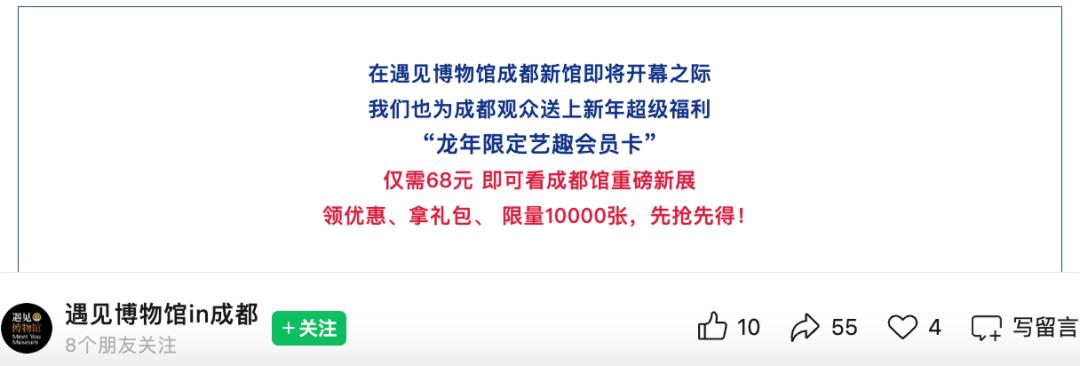
The Chengdu venue once announced that the new venue would open soon, but no follow-up news came out afterwards
The closures of these venues might only be related to lease issues or development plans. Between 2023 and 2025, Meet Museum successively opened four new venues in Hangzhou, Wuxi, Tianjin and Xuzhou, the last three of which were joint ventures with local state-owned assets.
The real problem probably emerged in the second half of 2025.
A former employee of Meet Museum told Yule that the company started to delay salary payment last May. After he resigned earlier this year, he applied for labor arbitration and won the case, but still did not get the owed payment. The enforcement judge informed him that there was no money left in the company's account.
In February this year, the Tianjin venue of Meet Museum issued a temporary closure announcement and never reopened, only about 7 months after its opening. All other venues stopped announcing new exhibitions in the first half of 2026. At present, except for the Xuzhou venue which is still selling tickets online for the "Meet Dunhuang" exhibition (lasting until October 31), most of the other venues are marked as temporarily closed on Amap, with no online sales channels available.
From high-profile opening to quiet withdrawal, Meet Museum only lasted for five years.
Essentially, Meet Museum is not a "museum" defined by the cultural and museum system. It is a cultural and creative brand IP launched by Beijing Zhongchuang Cultural Tourism Industry Group in March 2021, focusing on global original art exhibitions and light and shadow themed exhibitions, which is closer to commercial temporary exhibitions. Different from many short-term temporary exhibitions, Meet Museum rents long-term pavilions or cooperates with local state-owned assets to hold exhibitions in fixed locations.
Wang Xiao, who used to work at Meet Museum, introduced to Yule that the two unique features of Meet Museum are: first, its main revenue comes from consumer-facing businesses such as ticket sales and derivatives, "unlike other galleries or art museums, which get most of their revenue from art auction and sales, or rely on individual or corporate sponsorship." Second, it turned this kind of exhibition into a chain brand, "At that time, Meet Museum ranked top 1 in China."
Capital was also optimistic about this business. According to public information, Beijing Zhongchuang Cultural Tourism Group, the backer of Meet Museum, obtained three rounds of financing in 2022, 2023 and 2025 respectively.
The first round of financing took place in July 2022, with investors being Rising Capital, Star Nax Capital and Hongzhang Capital. In February 2023, Meet Museum voluntarily disclosed that it had obtained tens of millions of yuan in Series A+ financing, led by Jiangsu Cultural Investment and followed by the three old shareholders mentioned above. Shortly before that, in December 2022, the Nanjing venue of Meet Museum was officially opened.

Data source: Fengchao Wang
Qichacha, a corporate information query platform, shows that in January 2025, Gomay Culture invested in Zhongchuang Cultural Tourism with a 7.1% stake. Later, the financial report of Gomay Culture showed that its investment in Zhongchuang Cultural Tourism was about 20 million yuan, classified as an associated enterprise. By the first half of 2026, the book value of this investment dropped to 19.0548 million yuan, with a loss of 1.0865 million yuan in the reporting period.
Ordinary visitors and professionals have different impressions of Meet Museum.
Wang Xiao believes that this is an innovative attempt, which brings overseas art exhibitions to China, allowing ordinary audiences to access real artworks without going abroad, and expands its coverage through chain operation.
But Chen Yun, the curator of a private art museum in operation, thinks that Meet Museum is actually an IP exhibition operation enterprise, which cannot be called an art museum or museum. "It has no collections of its own, does not do academic research, and there is no consistent curatorial logic running through all its exhibitions."
He once visited the "Meet Gaudí" exhibition. In his opinion, "the exhibition was very perfunctory, there were not many real items directly related to Gaudí. I can't remember if there were any manuscripts, even if there were, they were very few. The exhibition was mainly constructed with materials, graphic boards and models, which was very different from the curatorial logic in the industry."
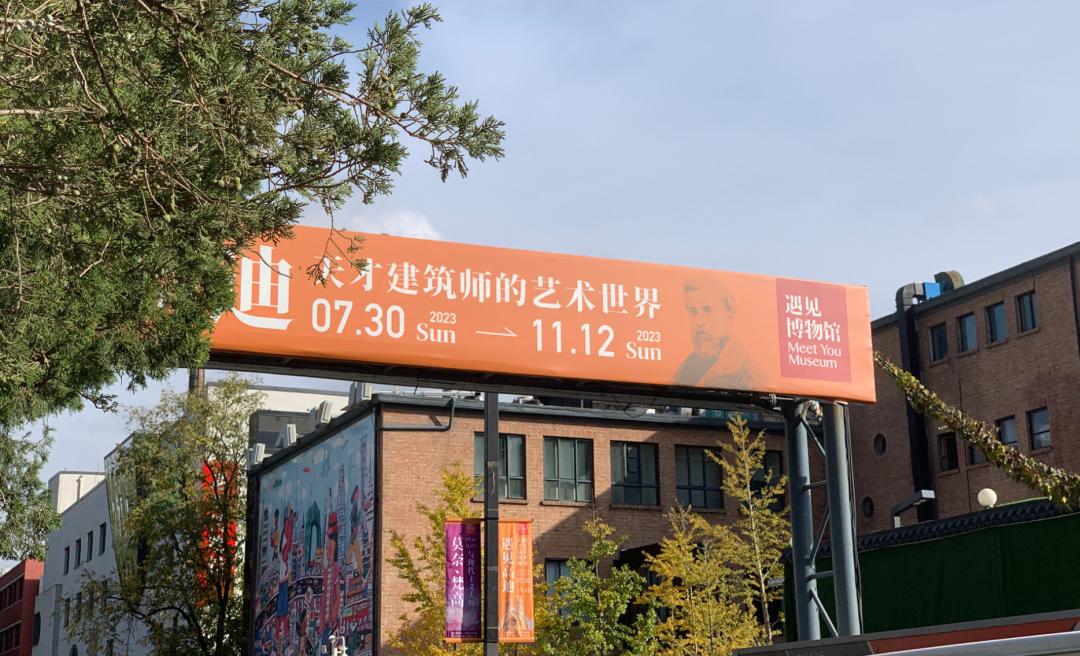
Source: photo provided by netizens
Sun Yongzeng, founder of White Box Art Center also located in 798 Art Zone, believes that these ticket-dependent exhibitions and contemporary art institutions that rely on sponsors or government support should be discussed separately. Meet Museum has been open in 798 for four years, but he has never visited it. "It is more like an internet-famous check-in exhibition, a trend that rose in recent years driven by people's growing demand for social interaction and checking in at popular spots."
Apart from the evaluations from professionals, ordinary audiences also have mixed feelings about it.
A netizen who graduated with an art major told Yule that she had visited the Meet Impressionism and Meet Gaudí exhibitions, with ticket prices of 67 yuan and 98 yuan respectively. She was very satisfied with the Gaudí exhibition, but her impression of the Impressionism exhibition was mediocre. "Maybe because I had high expectations at the beginning, I rushed to the Impressionism exhibition as soon as I heard the news, thinking I could see many famous Impressionist paintings."
In her memory, the exhibition arrangement itself was not bad, but the proportion of real works by Monet and Renoir in the exhibition was very small. There were only about two works by Monet, which were not very famous, and other works were created by little-known Impressionist artists, the "Normandy masters" mentioned in the subtitle of the exhibition. "But," the netizen emphasized, "after all, it only cost 67 yuan, the price is there, so we can't ask for too much."
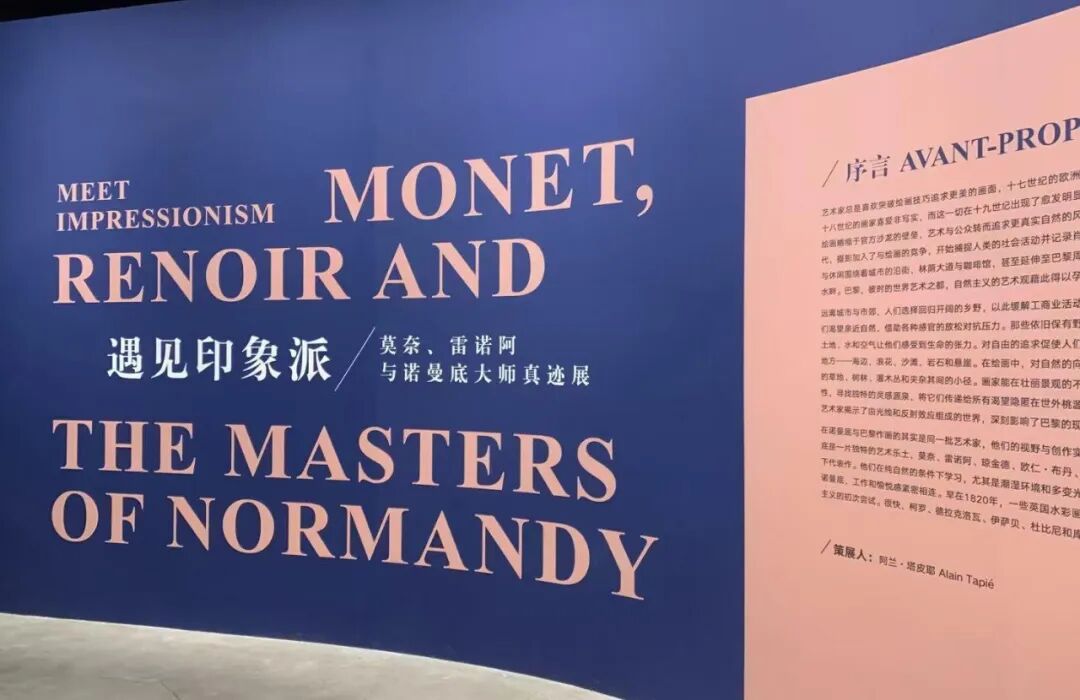
Source: photo provided by netizens
For her, Meet Museum is not much different from other art exhibitions and art museums. "In fact, it left a similar impression on me as the UCCA nearby. Maybe UCCA has better peripheral products. But as long as there is an exhibition I am interested in and I have enough time, I will go to visit it."
Just like this netizen, Meet Museum did make some people willing to walk into the exhibition hall, and made buying tickets to visit art exhibitions a daily leisure choice. Now its quiet exit makes Yule want to focus on the question: why could an exhibition brand with well-known IP, passenger flow and capital support still not be able to sustain its operation?
2
Ticket sales alone cannot support art exhibitions
In Wang Xiao's view, Meet Museum once enjoyed a period of good times.
Around 2020, he clearly felt that mass-oriented art exhibitions were on the rise. Especially during the epidemic, outbound travel was restricted, and being able to see overseas artworks without going abroad became a very attractive selling point for this kind of exhibitions.
Sun Yongzeng also remembers that from 2021 to 2022, the 798 Art Zone was very lively, and people often queued up to visit exhibitions. The sales of cultural and creative products and derivatives of White Box were also very good, with sales volume more than doubling the current level. It was also during that period that White Box gradually broke even after a long period of losses.
