In the AI era, the most essential task for enterprises is to streamline their management hierarchy.
When it comes to the relationship between management hierarchy and corporate development, Jack Welch's autobiography Winning is an unavoidable classic, and Welch put it this way:
"Excessive management levels are essentially a crime against speed. Every additional layer of management adds one more round of filtering, modification and distortion when information is passed upward, and one more round of delay, deviation and loss when decisions are implemented downward. The thicker the organization is, the farther it is from the market."
Generally speaking, apart from the business owner (core shareholders) and front-line grassroots employees, all middle levels within the organization belong to the "management personnel":
"Many middle management positions do nothing but 'gatekeeping' — they do not generate new ideas, nor do they solve real problems. They only package the results of their subordinates upward, and forward the instructions from their superiors downward. The more such positions there are, the more cumbersome the company becomes."
The radical reforms Jack Welch carried out at GE have always been a much-talked-about case in business schools. Welch's main move to save the century-old enterprise General Electric was to cut off middle management levels. He compressed the original GE management hierarchy, which had about 24-26 levels from the chairman to front-line employees, to 5-6 levels through the "boundaryless organization" initiative, making GE the industrial company with the highest profit reporting in the United States.

Jack Welch's way of tackling the "big company disease" 30 years ago was quite forward-looking, and now more and more companies around the world are following in his footsteps:
Alibaba explicitly proposed to govern "big company disease" after Joseph Tsai took the position of chairman.
JD Retail abolished the C4 and C5 management levels, and daily approval is directly connected to the C3 person in charge, shortening the management chain by two nodes.
Tencent's multiple business groups piloted the cancellation of fixed team leader and director titles, implemented the project responsibility system, and the management identity changes dynamically with business progress.
ByteDance updated ten leadership principles, requiring managers to deliver substantive business outputs, and phased out transactional middle managers who do no practical work.
KE Holdings launched organizational restructuring, requiring all 3000 managers to sink to the front line and directly participate in business and customer interactions.
Meta drastically cut middle management positions, introduced AI-native design principles, and shifted to a leaner small-team operation model.
Amazon has cut a total of 30,000 white-collar positions, most of which are middle management roles, and all the saved human resource budget has been invested in AI computing power.
·······
This wave of global organizational adjustment is far more than a layoff operation for "cost reduction and efficiency increase"; its underlying structural evolution is more like a sense of crisis in the face of the huge upcoming changes in the business landscape brought by AI, as well as the emergency response that must be made.
Just like after the informatized warfare, the command system shifted from the multi-level structure of trench warfare to a flat global direct control model — essentially, after the jump in information transmission efficiency, the middle levels are structurally dissolved.
This trend was not obvious in the Internet era, but after AI began to emerge from large models that are nearly "omniscient" to Agents that are nearly "omnipotent", enterprise decision-makers gradually began to get rid of their dependence on the management layer, and are more willing to communicate directly with front-line grassroots staff and drive organizational business.
In other words, after the advent of the AI era, the impact on management personnel will be the greatest! This is a fundamental change for each of us to think about our own career paths and the management methods of companies.
I. Multi-level Management: A Legacy of the Industrial Age That Has Become a Double Shackle of Efficiency and Cost
Welch explicitly pointed out in Winning that the multi-level pyramid structure is essentially a product of the slow environment in the industrial age, and has become a "negative asset" for organizations in the fast-changing market.
In the past, when the speed of information media transmission was slow and the efficiency was low, people were heavily relied on as the carrier of information dissemination, which formed the phenomenon of multi-level transmission. In addition, in the era of large-scale industrial production, division of labor and collaboration were required, and each person only needed to handle a small section of the process, which required a large number of managers to coordinate. The common departments in general factories such as workshop, section, team, labor union, human resources, finance, planning, technology, materials, supply, and sales carry out management by function, so the number of levels naturally increases.
Therefore, although the corporate organizational bureaucracy was born in the industrial age, it is essentially a compensation for the insufficient information processing capacity of human beings. When the information bandwidth, collaboration scope, and control radius of a single manager are limited, the only way to operate is to disassemble the large system into nested subsystems through hierarchical decomposition, and maintain operation through step-by-step summarization, step-by-step approval, and step-by-step control.
However, with the emergence of endless information media and the continuous opening of AI computing power to ordinary people, the drawbacks brought by excessive management levels have become increasingly obvious.
Management levels are amplifiers of information loss. Every additional layer of management adds one more round of filtering, modification and distortion when real front-line information is passed upward, and one more round of disassembly, delay and deviation when top-level instructions are passed downward. No matter the voices of front-line workers and the actual business status are transmitted to the business owner, or the instructions of the business owner are transmitted to the front line, they have been processed layer by layer beyond recognition.
In the old management system, if the decision-making layer wants to understand the actual situation of the front line of business or supervise the work of the front line, they can only rely on the information from a large number of middle managers directly under their management. As a result, the main work of the management layer has become "summarizing subordinates' reports, conveying superiors' instructions, and signing and checking on processes", which neither directly contacts customers nor directly creates business value, and is only an internal "relay station" of the organization.
This set of problems could be covered up as long as the business was still growing before the emergence of AI. However, once economic development slows down and technological shocks accelerate the transformation of traditional industry models, it will be out of place to continue the past multi-level work and information flow modes:
From the perspective of efficiency, some departments are no longer needed after the emergence of AI, such as copywriting, design, legal affairs and so on, which everyone can actually handle. In addition, business transformation requires more urgent orientation to the market, updated production tools, and accelerated progress of department communication and coordination. At this time, if we maintain the past functional division mode, we will eventually fall into the big company diseases such as "department walls", "process over common sense", and "procedure is justice".
From the perspective of cost, management personnel are one of the heaviest fixed expenditures of enterprises. Salaries, benefits, office costs, communication costs, plus the consumption of redundant links for the sake of management, a large number of resources are consumed in internal circulation rather than business output. More critically, what this expenditure buys is often not value, but information interception, credit shifting and idle procedure — the core work of many middle managers is only to package the results of their subordinates upward, and put pressure on their subordinates downward with the instructions of their superiors, without generating incremental value themselves.
In the AI era where market changes are calculated in days or even hours, this slow-paced, high-loss multi-level system has changed from "the guarantee of order" to "the source of internal friction". Many companies have not really grown bigger, but they have learned from large companies to build frameworks, set levels, and design processes, exhausting the flexibility and vigor in the start-up period. The main reason why many outstanding talents in large manufacturers choose to start businesses is that they can't stand the situation where things end up with a whimper due to layers of management, with much said but little done. Most of them want to get things done and pursue self-value realization.
II. AI Reconstructs the Management Paradigm: Business Owner + AI, Directly Drives Front-line Execution
What Jack Welch did to cut redundant management levels mainly focused on the redundant nodes of "managing for the sake of management", compressing the levels to the minimum number that supports business operation.
The fact that AI replaces more jobs actually means that a large number of work nodes and management levels have become irrelevant embellishments to support business operation. In other words, even if more management levels are removed with "Occam's Razor", it will not hurt the fundamentals.
This is not as simple as "no idle staff", but a thorough reconstruction of the underlying logic of management.
In fact, for the vast majority of enterprises, doing online market business is more direct and simpler than doing offline market business in the past. There is no need for a large number of managers to drive front-line business personnel, and the platform has helped us do a lot of things. But competition is definitely more fierce, and the core competitiveness within the organization, as well as the founder's understanding of the industry and development trends, are more needed, and the rest is the execution ability of front-line personnel.
In fact, after the emergence of various "enterprise brain", "intelligent agent" and other process automation systems, they systematically undertake the core functions of traditional middle managers, making the minimalist structure of "Decision Maker — AI — Execution Layer" have a practical implementation path.
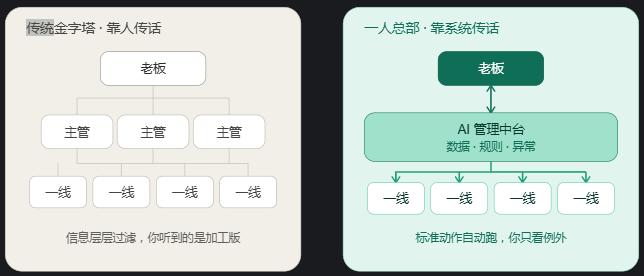
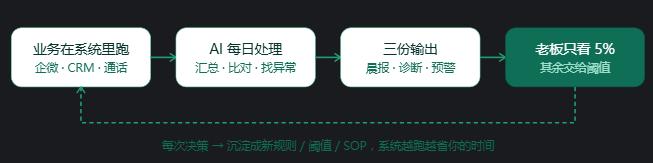
That is to say, we can put forward a rather bold idea for AI to realize, which is to cut off the information middlemen in internal corporate communication, prevent them from taking undeserved benefits, and send instructions directly from the source of information (the business owner) to the front line. There is no technical difficulty in this operation.
The only concern is that from the perspective of labor-capital conflicts, the middle management layer is often needed as a "firewall". Of course, the middle managers themselves also bear stronger pressure from the instructions issued by the business owner. In other words, part of their salary is the "fee for swallowing grievances" or "fee for being scolded".
However, if a company has relatively standardized personnel management, the salary and remuneration for employees are reasonably designed, and the business owner has a stable mood and only wants to improve business efficiency, and the managers also learn from the business owner to attend to everything personally and directly engage in front-line business, then the entire business drive under AI integration will become very smooth:
For example, discuss three things at the daily morning meeting: the main tasks to be done today, who will do them, and who will provide support. Use voice recording tools to sort out the content and synchronize the work progress of relevant personnel directly.
For example, hand over document processing directly to AI assistants to complete.
At the information processing level, platforms such as the Data Compass in Douyin's Ocean Engine can view business data at any time, and the performance growth dimensions can also be found in Douyin Shop, where the data decline in any aspect can be seen at a glance, which is equivalent to dashboard management.
In the past, the management chain of "collection — summarization — analysis — reporting" can be completed in one step with the platform's data compass, with lower noise, less distortion and faster speed. Business owners no longer need to listen to reports through multiple layers, and can penetrate all levels through the data dashboard to see the most real front-line status.
In terms of specific business process control, a lot of work can actually be handed over to AI for one-click hosting, and manual intervention will be automatically triggered only in abnormal scenarios beyond the boundary. It is similar to the direct transition from assembly line to automated production line.
In fact, current enterprise brain systems such as WPS AI, Feishu, WeCom, and DingTalk can all realize the business owner directly docking with an AI system; instructions are directly delivered to the front line through business data flow. There is no longer a need for a huge management echelon for transmission, buffering and translation, and the organization only retains execution personnel who can directly generate value.
This set of business logic is very similar to that of a small start-up team. There are not too many hierarchical divisions between the business owner and employees, and everyone works on the business together, which is the so-called boundaryless organization. Many small and medium-sized enterprises are most likely to fall into a misunderstanding when they initially scale up: they rush to imitate large companies to build frameworks, set levels, and hire managers, thinking that the more people they manage, the more formal they are. As a result, the flexibility and vigor of the start-up period are quickly lost, the scale does not increase much, but the efficiency drops by half first.
AI actually helps small and medium-sized enterprises find another way: there is no need to gradually build a management echelon, no need to set up middle positions layer by layer, and directly use the "business owner + AI system" to support business operation, maintaining the primary management mode of "business owner — all employees".
III. Value Redistribution: All Staff Return to the Front Line of Business to Keep the Foundation of Flexible Response
The process of breaking through levels is also the process of redistributing value and power within the organization. It not only brings growth dividends, but also puts forward transformation requirements, and hides traps that need to be vigilant.
For small and medium-sized enterprises, the core of this reform is not "cutting middle managers", but "de-management and strengthening business" — management personnel are business-oriented, business personnel are empowered by AI tools, and all staff return to the front line of value creation.
For front-line business personnel, this is the dual dividend of information equality and tool empowerment.
In the past, the work results of front-line staff had to go through multiple layers of packaging to reach the decision-making layer, and the credit was often recorded on the managers, and personal abilities were submerged in the team. In the AI era, the full-link data is automatically recorded, who did it, how much was done, and what the effect was, the original records are directly visible, and cannot be intercepted or shifted. At the same time, the independent decision-making power of routine matters is delegated to the front line, coupled with the full arming of AI tools — sales personnel use AI to filter clues, write plans, and follow up with customers, operation personnel use AI to make reports, supervise progress, and control risks. Business personnel are liberated from transactional work, and concentrate their time and energy on real customer communication, solution solving, and business expansion. The front line is no longer a simple execution end, but a value creation unit with AI tools, and the individual combat capability is multiplied, and the growth path changes from "waiting for years and waiting for levels" to "exercising abilities and delivering results".
For the original managers, this is a transition period of getting rid of level premium and being forced to return to business.
The value of "megaphone-style" managers who only do information transmission, process approval, and credit packaging will directly go to zero — after information is directly connected up and down, the position itself loses the basis for existence. The only way out is to sink completely to the front line of business, master specific operational knowledge, solve real business problems, and take the lead in developing the market and delivering services. Shift from "sitting in the office looking at reports" to "solving problems on the front line", and replace hierarchical power with professional ability. Managers who can complete the transformation will become more scarce business operators; those who cannot transform and only rely on seniority and job level to eat will be systematically eliminated.
