Q3 Smartphone Market Sees Major Reshuffle: Price Hike Wave Unleashes Hell-Level Challenges, Huawei and Apple Emerge as Top Winners
Recently, market research firm Counterpoint released partial mobile phone shipment data for the third quarter of this year. In short, whether in the global or domestic market, the performance of the mobile phone industry in this quarter is relatively weak, and the overall shipment volume has declined under the pressure of storage costs.
At the same time, further differentiation has taken place within the mobile phone market. In the past, several leading brands took up most of the market share, showing a relatively balanced trend.
Nowadays, the super leading players represented by Apple and Huawei have eroded the market share of other brands, and the phenomenon of ebb and flow has intensified. In other words, the five or six leading brands in our previous impression have also been divided into different tiers, and the gap between the first and second place and the third, fourth and fifth place is widening rapidly.
Mobile phone shipment hits a new low, but Huawei and Apple remain the winners
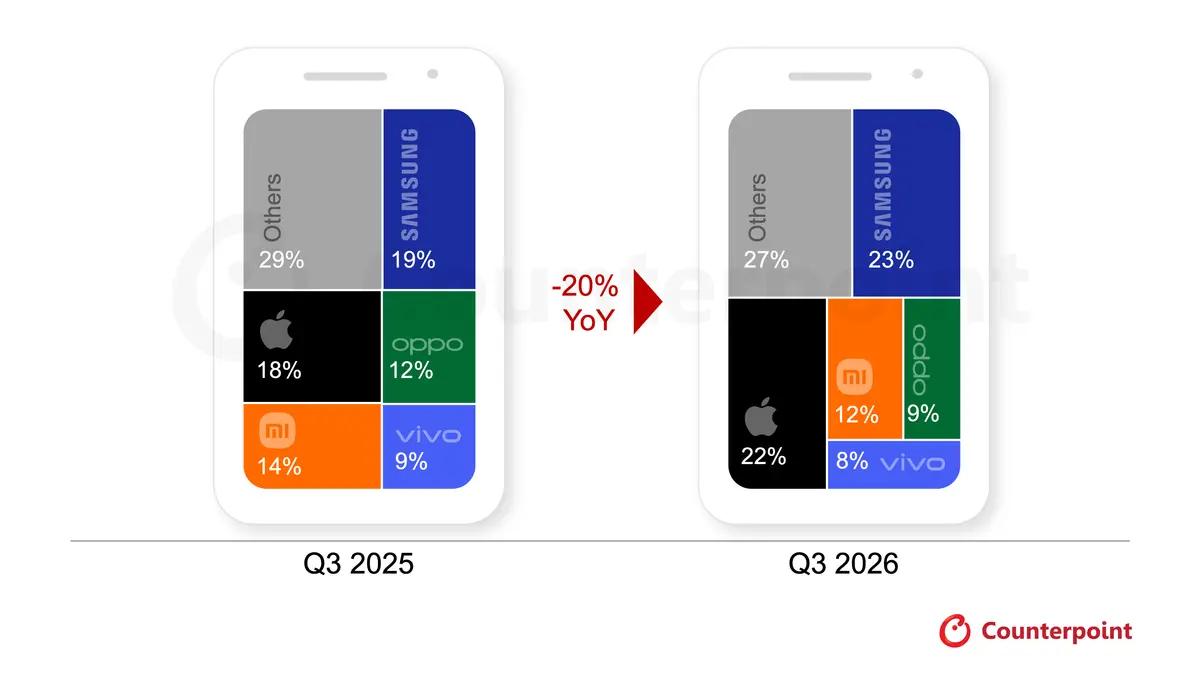
Looking at the global data first, the release published by Counterpoint on its official website shows that in the third quarter of this year, global mobile phone shipments fell by 20% year-on-year, marking the worst third quarter in terms of data since 2012. Counterpoint believes that the sharp decline in mobile phone shipments is mainly due to the skyrocketing prices of memory and flash memory, which has brought huge cost pressure to terminal manufacturers. Once this pressure is transmitted to consumers, their willingness to buy new phones will naturally drop sharply.
The top 5 mobile phone brands by shipment in Q3 are still Samsung, Apple, Xiaomi, OPPO and vivo, with market shares of 23%, 22%, 12%, 9% and 8% respectively. The combined market share of the above five brands reached 74%, an increase of 2 percentage points compared with Q3 last year. With the rise in storage prices, the five leading brands are undoubtedly under great pressure, and the living space of small brands in the "Others" category has been further compressed.
Comparing the data of Q3 2025, we can find that the share changes of the five major brands are different: Samsung's market share increased from 19% to 23%, Apple's share increased from 18% to 22%, while the market shares of Xiaomi, OPPO and vivo all decreased.
(Source: Counterpoint)
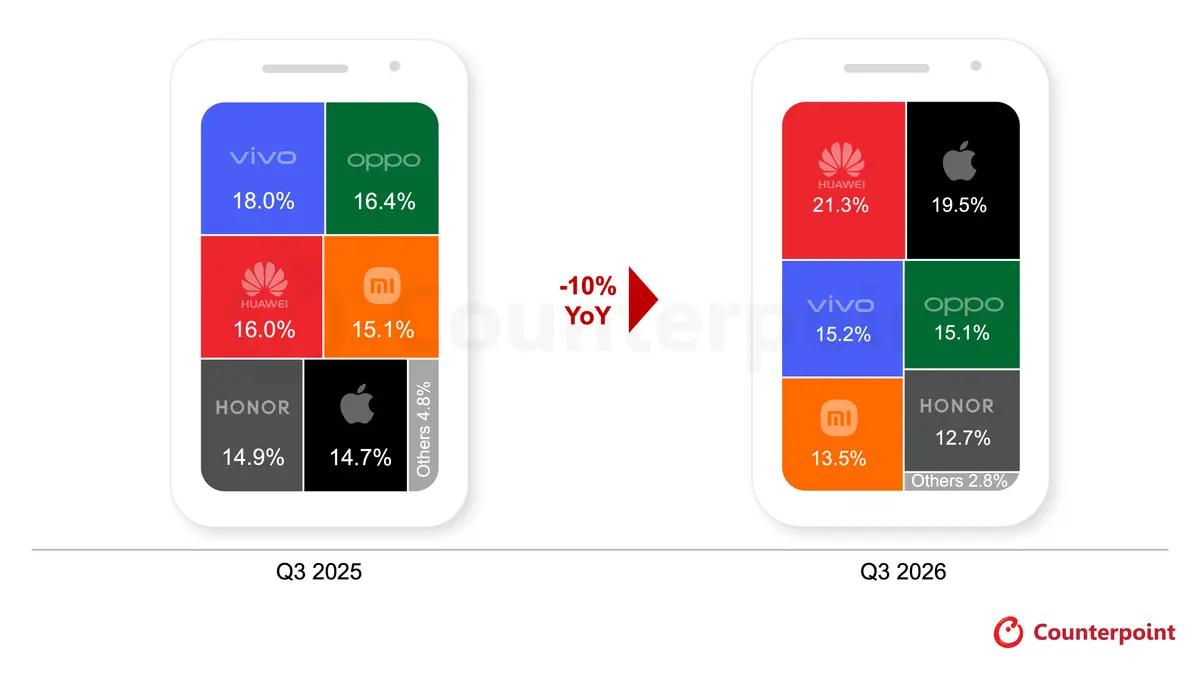
The overall situation of the domestic mobile phone market in Q3 is similar, but the specific data is slightly different. First of all, the overall shipment volume decreased by 10%. The situation is certainly not good, but it is more optimistic than the global market. The leading effect in the domestic market is also more obvious, with the combined share of six brands reaching an astonishing 97.3%.
Secondly, Counterpoint counted six major brands, namely Huawei, Apple, vivo, OPPO, Xiaomi and Honor, with market shares of 21.3%, 19.5%, 15.2%, 15.1%, 13.5% and 12.7% respectively. According to this data, the secondary differentiation of leading brands in the domestic market is very similar to that in the global market, except that the two "super leading" brands are Huawei and Apple, whose combined market share exceeds 40%.
Compared with Q3 last year, both Huawei and Apple's domestic market shares have increased significantly, while the shares of the other four brands have declined. Moreover, in Q3 last year, the gap between the shares of the six major brands was small, which can be regarded as "equally dividing" the domestic market. But in Q3 this year, the pattern of the mobile phone industry has become that Huawei and Apple take the lion's share, while the other four can only get the leftover scraps.
(Source: Counterpoint)
Overall, the impact of rising storage prices on the mobile phone industry is enormous. Most brands have seen their market share decline, but super brands such as Huawei and Apple have still managed to absorb this pressure relatively successfully, and even achieved counter-growth in shipment volume and market share.
Leading brands gather in the high-end market, and competition among flagship products becomes more brutal
As we mentioned in previous articles, the rise in storage prices has the greatest impact on mid-to-low-end mobile phones, which have lower profits and target users who are more sensitive to prices. Therefore, mobile phone manufacturers have unanimously shifted their focus to high-end products with larger profit margins.
However, the rise in storage prices has intensified, to the point where quotations change several times a month. In addition, the new generation of flagship chips is also increasing in price. As a result, the cost of flagship phones has risen sharply, and the proportion of storage in material costs has reached an unprecedented high.
This has a disastrous impact on new flagship phones, forcing manufacturers to adjust their product strategies.
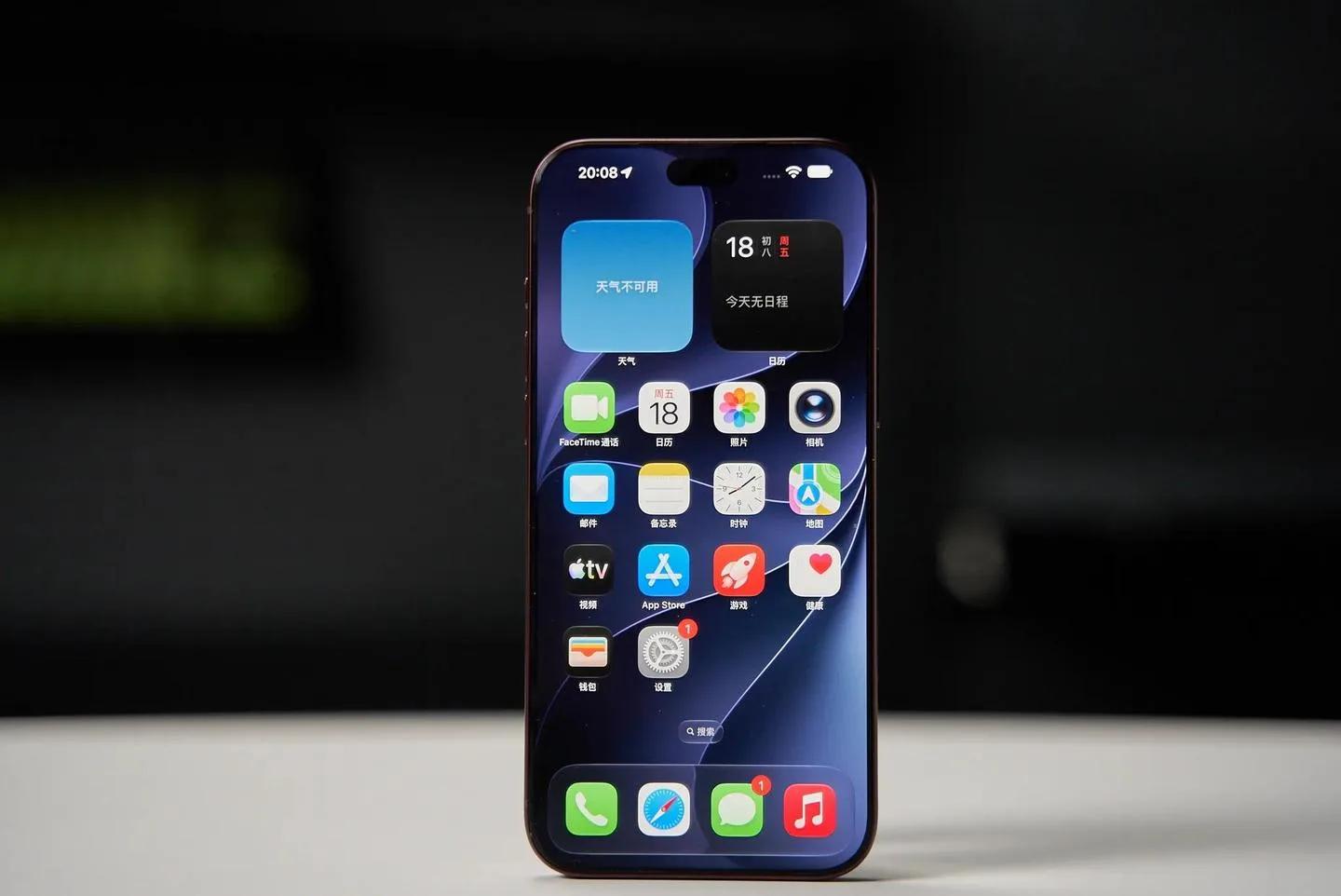
First of all, the simplest and most brutal measure is to raise prices. Almost all new flagship phones have raised prices this year. The starting price of iPhone 18 Pro has increased by 1000 yuan, and the price increase of large-capacity versions such as 1TB has even reached 2500 yuan. For Android brands, the starting price of the standard OPPO Find X10 is 1100 yuan higher than the launch price of the standard Find X9, the starting price of vivo X500 is 1100 yuan more expensive than X300, and the starting price of Xiaomi 17 Pro is 1000 yuan higher than the previous generation.
Of course, in order to minimize the "pain" brought by price increases to users, the price increase of the starting price of flagship phones is controlled at about 1,000 yuan. In fact, the price increase of large-capacity versions such as 512GB and 1TB is much more exaggerated, which largely affects the willingness of users of large-capacity versions to replace their phones.
(Source: Leikeji)
Secondly, adjust the release rhythm and product portfolio of the mid-size, large-size and extra-large-size versions of the new flagship phones. It can be found that the new flagship phones released this autumn have basically changed in this aspect. Apple and Xiaomi directly delayed the release of the digital standard version, and only launched the Pro version for the time being. The main purpose of this is to prioritize limited storage and other resources to models with higher profits. Recently, Apple even plans to cut orders for iPhone 18 Pro to prioritize production of iPhone Duo, nothing more than because foldable screens have higher profits.
Some manufacturers have adopted the practice of adding new models such as the "small cup" to the new flagship series. Taking the OPPO Find X10 series as an example, there is an additional X10E model, which uses the lower-tier Dimensity 9500s chip. The operation of adding a small cup is, on the one hand, to reduce the starting price of the entire flagship series and weaken the impact of the price increase; on the other hand, these small cups use old-generation chips, making the cost more controllable.
Before the storage price surge, most brands, except Apple, relied mainly on mid-to-low-end models for high sales volume. But now, the pressure of rising storage prices has forced everyone to fight hand-to-hand in the high-end flagship market, where the stock of users is smaller and the competition is more brutal.
Apple and Huawei are still able to stand out and expand their market advantages, which is largely related to their own strengths. They are among the few brands in the mobile phone industry that can independently control self-developed chips and system ecosystems, and have a stronger ability to absorb the pressure of rising storage prices. At the same time, they have been deeply engaged in the high-end market for a long time, and also have stronger user stickiness and product advantages.
According to data disclosed by @RD Observation, a digital blogger who has long focused on the sales of individual mobile phone models, as of October 11, the domestic shipment volume of the iPhone 18 Pro series has exceeded 4.08 million units, less than a month after its official release. Just one week after its launch, the sales volume of the iPhone 18 Pro series was close to 1.3 million units, 15% higher than that of the iPhone 17 Pro series in the same period last year.
In comparison, Huawei's flagship models are more numerous and scattered, but the performance of a single series is equally strong. As of October 11, the cumulative sales of the Huawei Pura 90 series exceeded 1.63 million units, the Mate 90 series exceeded 430,000 units, and the Huawei Pura X View released in September has now sold more than 550,000 units.
Continuously and successfully creating popular flagship hits is the key for the super leading players to capture the market.
Can the Double Eleven promotion save the market?
Normally, the annual Double Eleven is a key node for mobile phone promotions, and many consumers will buy new mobile phones at this time. But to be frank, this year's Double Eleven, the discount intensity of activities from various manufacturers is not that great. On the one hand, the new autumn phones have just been released, and there is basically no room for price reduction. On the other hand, the rise in storage prices has not eased, and some models have already raised prices once before, so it is difficult to have large-scale discount activities under cost pressure.
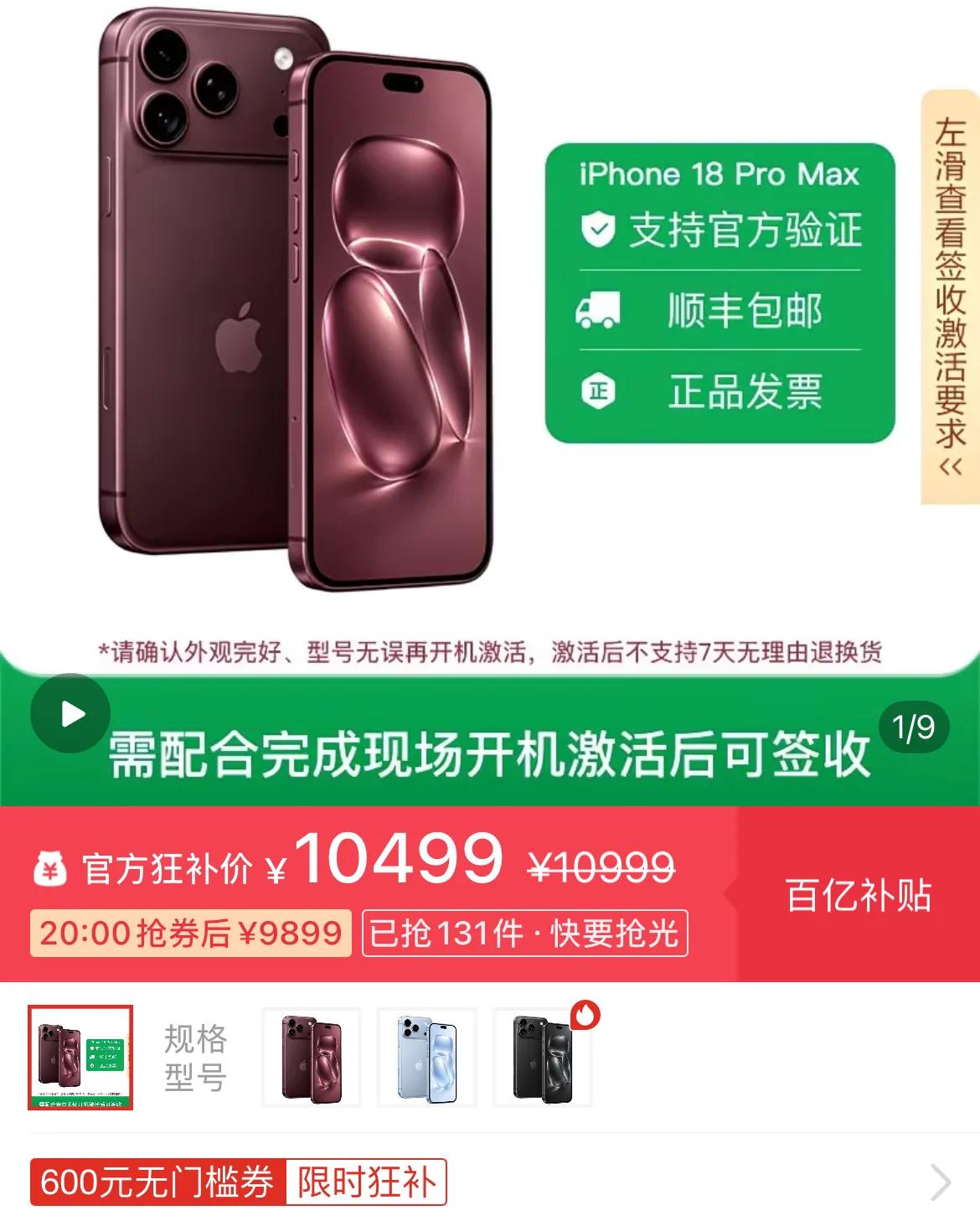
At present, there are mainly several types of mobile phone-related promotion activities for Double Eleven. The first is subsidies from platform parties, similar to the 10-billion-yuan subsidy. E-commerce platforms will still issue some coupons that can be used for mobile phone products during this year's Double Eleven. For example, on the Pinduoduo platform, the price of the iPhone 18 Pro Max 256GB version after coupon is 9899 yuan, which is 1100 yuan cheaper than the official price. If you plan to buy a new flagship phone, you can pay attention to such offers.
(Source: E-commerce platform)
Then some old models are being sold at reduced prices to clear inventory, such as the standard Xiaomi 15, which costs just over 2000 yuan. Although its performance is not as good as the latest flagship phones on the market, it is no less than mid-range new phones that cost three or four thousand yuan. OPPO, vivo, Honor and others also have similar models. However, for this kind of mobile phone, you should pay attention to the sales channel and after-sales service, and try to buy from self-operated or official stores.
For mobile phone manufacturers, the overall mobile phone market is in a slump, and it is difficult to save shipment volume through a phased large-scale promotion. In the past, Double Eleven was a key node for manufacturers to boost sales volume and clear inventory to recover cash flow, but now the cost of core components such as chips and storage remains high, making it difficult for manufacturers to exchange market share through large promotions as in previous years.
For the entire mobile phone industry, the chain reaction triggered by the rise in storage prices is also accelerating the reshuffling of the industry. In the past few years, several leading brands could maintain a relatively balanced trend in their respective comfort zones.
Now that the overall market continues to shrink, competition among brands has become more intense, and differentiation has emerged. The mobile phone industry has shifted from a pattern of multiple strong players coexisting to a situation where a small number of super leading players take all the benefits. As for when this situation will change, it depends on when this wave of storage price hikes will stop.
This article is from "Leikeji", authorized for release by 36Kr.